
Quick summary: Learn how packaging manufacturers in the Netherlands can comply with the EU Packaging and Packaging Waste Regulation (PPWR), including design, recyclability, recycled content, and documentation requirements.
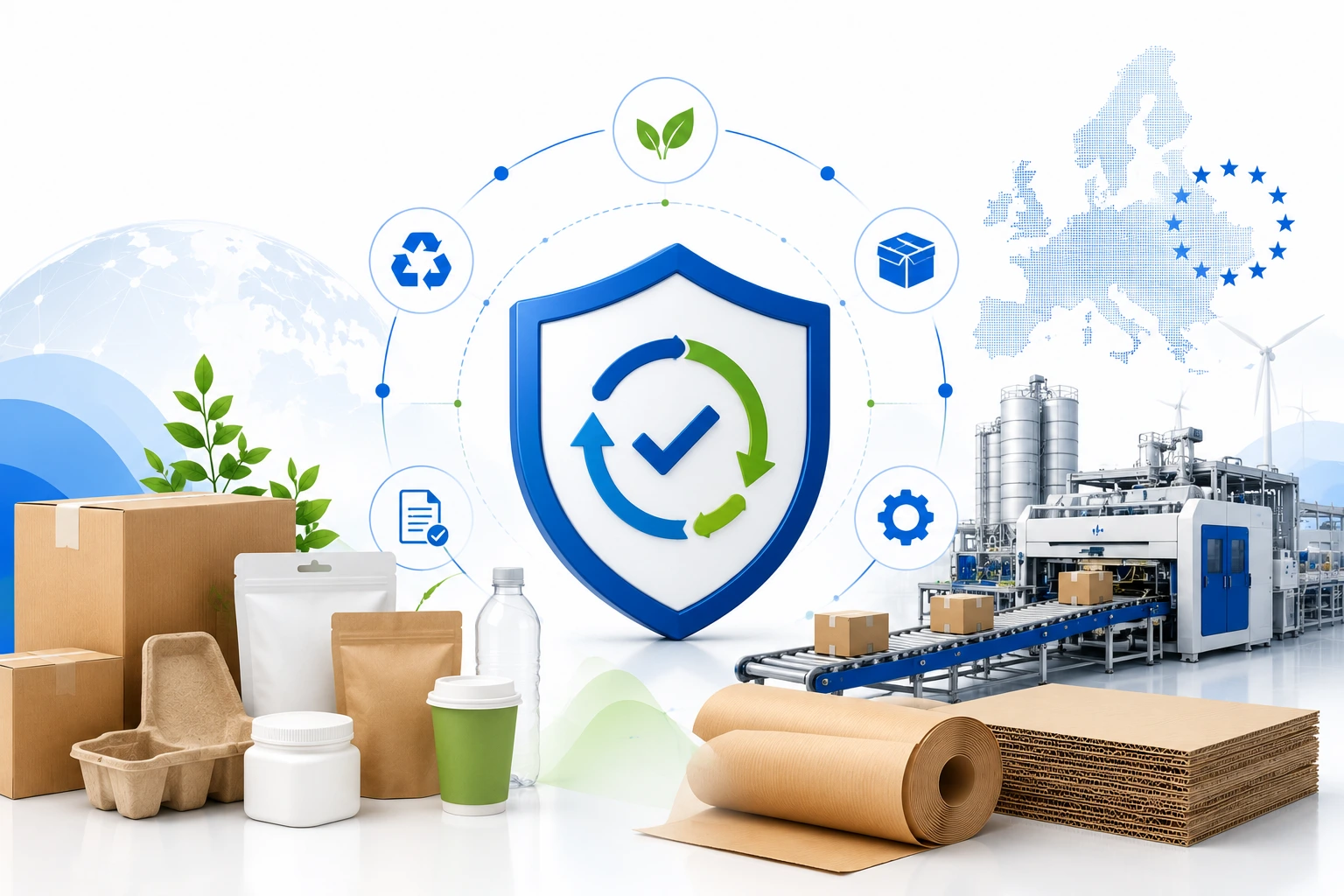
If you manufacture packaging for the Dutch or wider EU market, the Packaging and Packaging Waste Regulation (PPWR) introduces new requirements covering packaging design, recyclability, recycled content, reuse, labelling, and documentation. The regulation aims to reduce packaging waste while supporting a circular economy across the European Union. Manufacturers should begin assessing their product portfolios, supply chains, and technical documentation to prepare for phased implementation.
Don’t Wait Until PPWR Deadlines Create Compliance Challenges
The Packaging and Packaging Waste Regulation (PPWR) establishes a harmonised framework for packaging placed on the EU market. Unlike the previous Packaging and Packaging Waste Directive, the PPWR is a regulation, meaning its requirements apply consistently across all EU Member States without requiring national transposition.
The regulation supports the European Green Deal and the Circular Economy Action Plan by establishing common rules for:
For Dutch packaging manufacturers, the PPWR represents a significant shift from focusing solely on waste management towards designing packaging that is circular throughout its lifecycle.
The Netherlands has long maintained one of Europe’s most advanced packaging compliance systems. However, the PPWR introduces EU-wide obligations that extend beyond existing national legislation.
Packaging manufacturers supplying:
must ensure that packaging products meet applicable PPWR requirements before they are placed on the EU market.
Failure to comply may affect market access, customer procurement requirements, and regulatory obligations.
Do you know your responsibilities under PPWR?
Read our complete guide to PPWR Roles & Responsibilities.
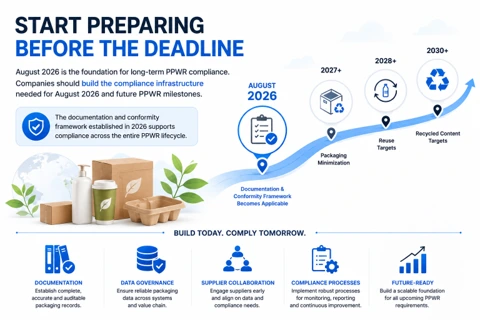
What Should Companies Prioritize Before the August 2026 PPWR Deadline?
While several PPWR requirements have phased implementation dates extending to 2030 and beyond, 12 August 2026 marks the first major compliance milestone. From this date, businesses placing packaging on the EU market must be able to demonstrate that their packaging complies with the applicable PPWR requirements.
Here’s where organizations should focus their efforts.
1. Conduct Packaging Conformity Assessments
Before packaging is placed on the EU market, manufacturers must carry out a conformity assessment to verify that each packaging type meets the applicable PPWR requirements. This isn’t simply a paperwork exercise it requires evaluating whether the packaging satisfies the relevant sustainability and regulatory criteria and documenting the evidence used to reach that conclusion.
A conformity assessment typically includes:
This assessment forms the basis for demonstrating compliance during regulatory inspections.
2. Prepare Technical Documentation
Every Declaration of Conformity must be supported by comprehensive technical documentation.
Companies should establish a centralized repository containing documentation such as:
Maintaining complete, accurate, and accessible documentation will become essential for responding to market surveillance authorities.
3. Issue an EU Declaration of Conformity (DoC)
One of the most significant changes introduced by PPWR is the requirement for a Declaration of Conformity (DoC) for each packaging type placed on the EU market.
The DoC is a legally binding declaration in which the manufacturer confirms that the packaging complies with the applicable provisions of the regulation. It must be supported by the conformity assessment and technical documentation and made available to authorities upon request.
Organizations managing hundreds or thousands of packaging SKUs should begin preparing now, as generating and maintaining DoCs at scale requires structured packaging data and robust document management processes.
4. Verify Compliance with Substance Restrictions
PPWR also strengthens requirements relating to substances in packaging.
From 12 August 2026, companies placing packaging on the EU market must ensure compliance with applicable substance restrictions, including:
Businesses should work closely with packaging suppliers to obtain declarations, laboratory reports, and material information needed to demonstrate conformity.
5. Understand Your Responsibilities as an Economic Operator
PPWR assigns different legal obligations depending on your role in the supply chain.
For example:
Many organizations perform multiple roles simultaneously, making it important to identify all applicable responsibilities.
6. Build a Robust Packaging Data Management Process
Meeting PPWR requirements depends on having accurate, consistent, and readily available packaging information.
Companies should establish processes to collect and maintain:
A centralized packaging data management system reduces compliance risks and simplifies future reporting and audits.
The PPWR applies broadly to packaging placed on the EU market, including:
Manufacturers should evaluate every packaging format they produce to determine which PPWR obligations apply.
Know what’s in scope before you start your PPWR compliance journey.
Packaging should be designed using only the material necessary to ensure product protection, safety, logistics, and functionality.
Manufacturers should review:
Optimising packaging can reduce environmental impact while improving material efficiency.
The PPWR places strong emphasis on packaging that can be effectively collected, sorted, and recycled.
Manufacturers should consider:
Packaging that is difficult to recycle may face future restrictions or reduced market acceptance.
Certain plastic packaging categories will be subject to minimum recycled content requirements over time.
Manufacturers should work closely with suppliers to:
Supply chain transparency becomes increasingly important as recycled content obligations expand.
The PPWR introduces reuse objectives for selected packaging applications.
Although requirements vary depending on packaging type and industry sector, manufacturers may need to develop packaging solutions that:
Reusable packaging design is expected to become a growing market requirement.
Manufacturers should assess packaging materials for substances that could affect recycling, human health, or environmental performance.
This includes reviewing:
Effective material management supports both regulatory compliance and customer confidence.
The PPWR introduces harmonised labelling requirements intended to improve consumer understanding of packaging disposal and recycling.
Manufacturers should prepare for evolving requirements covering:
Consistent labelling will help improve collection and recycling outcomes across the EU.
Understand the PPWR Requirements Before They Impact Your Business
Read our complete guide to PPWR Requirements.
Packaging manufacturers play a central role in PPWR compliance.
Typical responsibilities include:
Manufacturers should establish internal governance processes to ensure compliance is incorporated into product development.
Maintaining accurate technical documentation is essential.
Documentation may include:
Maintaining organised documentation simplifies customer requests and regulatory inspections.
Can you demonstrate your packaging complies with PPWR?
Read our complete guide to PPWR Technical Documentation.
Packaging manufacturers often face several implementation challenges.
Raw materials may originate from multiple suppliers across different countries, making documentation management more difficult.
Packaging designs frequently evolve in response to customer requirements, requiring continual compliance reviews.
Evaluating recyclability across multiple packaging formats requires technical expertise and collaboration throughout the supply chain.
Obtaining accurate material and recycled content information from suppliers can be time-consuming.
Brand owners increasingly request detailed sustainability and compliance information as part of procurement processes.
Successful manufacturers typically adopt a proactive compliance strategy.
Recommended practices include:
Preparing early can reduce future compliance costs and improve customer confidence.
As regulatory requirements expand, digital systems can help manufacturers manage increasing volumes of compliance data.
Digital traceability solutions may support:
Centralising compliance information improves visibility across the product lifecycle and reduces manual administration.
Simplify PPWR Compliance with TraceX
Managing PPWR compliance requires more than spreadsheets and disconnected systems. As packaging data grows more complex, businesses need a centralized platform to collect, validate, and maintain the information required to demonstrate compliance throughout the product lifecycle.
TraceX PPWR Solution helps manufacturers, brand owners, importers, and packaging suppliers streamline compliance by digitizing packaging data and enabling end-to-end traceability across the value chain. From supplier collaboration and material declarations to technical documentation, conformity assessments, and Declaration of Conformity (DoC) management, TraceX provides a single source of truth for your packaging compliance data.
With TraceX, you can:
Whether you’re preparing for the initial PPWR obligations or building long-term compliance capabilities, TraceX helps transform packaging compliance from a manual, document-intensive process into a connected, data-driven workflow.
The PPWR marks a significant evolution in packaging regulation across the European Union. For packaging manufacturers in the Netherlands, compliance extends beyond waste management to encompass product design, material selection, recyclability, recycled content, and comprehensive technical documentation.
By embedding compliance into product development, strengthening supplier collaboration, and maintaining robust records, manufacturers can better position themselves for the transition to a more circular packaging economy. As implementation progresses, businesses that invest early in compliance processes and digital information management will be better equipped to meet regulatory requirements while supporting customer sustainability objectives.
Yes. Packaging manufacturers placing packaging on the EU market should assess how the PPWR applies to their products and business activities. The regulation establishes harmonised requirements across EU Member States.
The PPWR introduces directly applicable EU-wide requirements. Some national legislation, including existing Dutch packaging rules, will continue to operate alongside the regulation where applicable. Businesses should understand how both frameworks interact.
The regulation covers a broad range of packaging materials, including plastic, paper, cardboard, glass, metal, composite, transport, industrial, consumer, and e-commerce packaging.
Manufacturers should retain technical documentation supporting compliance, including material information, product specifications, design assessments, recyclability evidence, supplier declarations, and other records required under the regulation.
Preparation typically includes reviewing packaging portfolios, engaging suppliers, improving technical documentation, incorporating circular design principles, and implementing robust data management processes. Early planning can help manufacturers meet future regulatory milestones more efficiently.