EUDR Traceability Requirements: How to Achieve End-to-End Visibility
Published
, 11 minute read
Share this article
Quick summary: Discover how digital traceability simplifies EUDR compliance by automating supplier onboarding, GPS-based mapping, and Due Diligence Statement (DDS) generation. Learn how to achieve deforestation-free, legally sourced supply chains with ease.
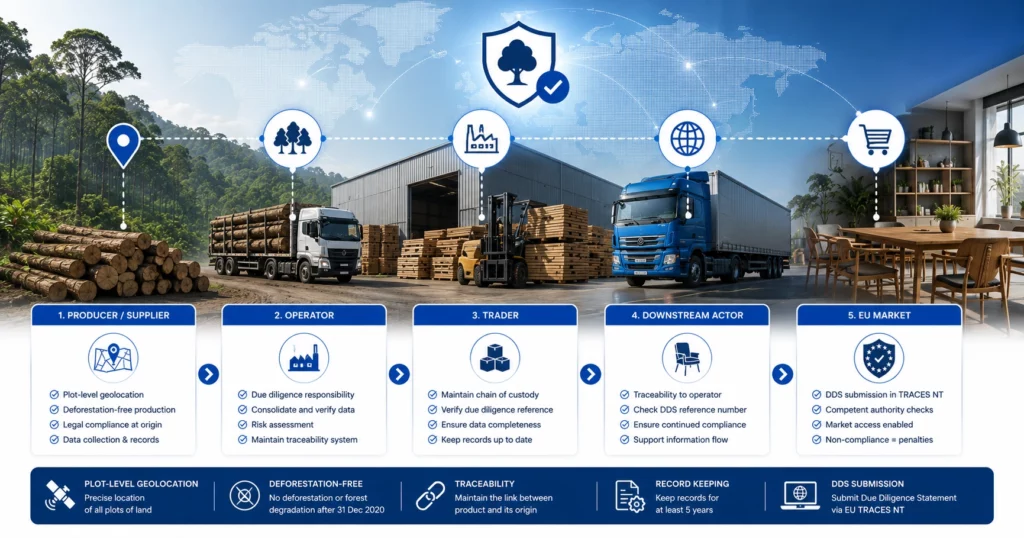
EUDR traceability requirements mandate that operators and traders placing regulated commodities (coffee, cocoa, palm oil, soy, cattle, rubber, timber) on the EU market must:
Collect GPS polygon-level geolocation for every production plot
Verify land is deforestation-free post-31 December 2020 using satellite data
Confirm products are legally produced per country-of-origin laws
Submit a Due Diligence Statement (DDS) via EU TRACES before placing products on the market
Retain all compliance documentation for a minimum of 5 years
Apply risk assessment and mitigation at the supply chain level, not just the product level
Deadlines: Large/medium operators — December 30, 2026 | SMEs — June 30, 2027. Non-compliance: fines up to 4% of EU annual turnover + product seizure + market bans.
EUDR traceability requirements are non-negotiable, plot-level data mandates under EU Regulation 2023/1115 that every operator and trader placing regulated commodities on the EU market must meet — or face fines, shipment seizure, and market bans.
Plot-level GPS polygon data is mandatory single-point GPS alone is insufficient for high-risk plots
Mass balance accounting (Rainforest Alliance, RSPO) does NOT satisfy EUDR’s physical traceability mandate
Penalties reach 4% of EU turnover a board-level financial risk, not just a compliance checkbox
Digital traceability platforms (from TraceX) automate DDS generation, geolocation capture, and risk scoring
4%Maximum fine as percentage of EU annual turnover for non-compliance
EU Regulation 2023/1115 | Confirmed enforcement
EUDR Traceability Requirements: What the Regulation Actually Demands
EUDR traceability requirements go far beyond sustainability reporting. Under Regulation (EU) 2023/1115, businesses must prove with verifiable, digital evidence that every commodity batch is deforestation-free, legally sourced, and traceable to the precise plot of land where it was grown or harvested.
EUDR traceability requirements under Article 9 mandate GPS polygon coordinates for every plot of land cited in a Due Diligence Statement. A single GPS point is insufficient for meaningful deforestation checks polygon boundaries must map actual farm perimeters with sub-hectare precision.
Polygon geometry must pass EU validation no self-intersecting boundaries
Plots cross-referenced against post-2020 satellite deforestation datasets (JRC, Hansen GFC)
Offline-capable GPS capture is essential for smallholder sourcing regions with poor connectivity
EUDR traceability requirements specify December 31, 2020 as the legal cut-off date. Operators must demonstrate, using satellite and geospatial data, that sourcing plots were not subject to deforestation after this date.
Satellite datasets: Hansen Global Forest Cover, Sentinel-2, Global Forest Watch alerts
Time-stamped, immutable audit trails editable spreadsheets do not qualify
Risk classification by country benchmark logic high-risk regions require stricter evidence
EUDR traceability requirements also demand proof of legal land use aligned with the laws of the country of production. This means title deeds, permits, and legal declarations each tied to the specific plot, not just the supplier entity.
Land tenure documents linked per farm plot, not per supplier
Jurisdiction-specific compliance layer — requirements differ by country
Labor rights, Indigenous rights, and tax compliance included in legality scope
EUDR Traceability Requirement 4: Due Diligence Statement (DDS)
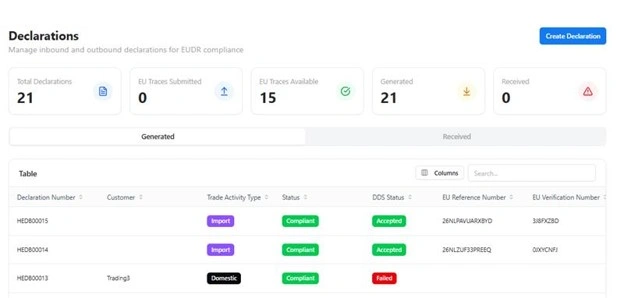
EUDR traceability requirements culminate in a DDS submitted via EU TRACES before each product batch enters the market. The DDS must include GeoJSON files, supplier data, volume, product type, harvest date, risk assessment evidence, and legal sourcing declarations.
DDS submitted digitally through the EU Information System (TRACES portal)
One DDS required per product batch not per supplier or per year
Missing a single data point can trigger DDS rejection and shipment blockage
EUDR traceability requirements mandate that all due diligence records, DDS documents, geolocation data, and risk assessments be retained for a minimum of five years and be accessible for inspection by competent authorities on demand.
Secure, tamper-proof digital storage not shared drives or email archives
Records must be retrievable in hours, not days
Third-party audit access must be configurable without compromising data privacy
73%+of agri-food exporters source from smallholders who pool commodities creating EUDR traceability aggregation gaps
EUDR Traceability Requirements by Actor: Operators, Traders, and Downstream
EUDR traceability requirements apply differently depending on your supply chain role. Understanding your obligations is the first step to building a compliant system.
EUDR Traceability Requirements for Operators
Operators the first entity to place a regulated product on the EU market carry the heaviest EUDR traceability requirements. They must conduct and document full due diligence, collect all geolocation data, perform risk assessment, and submit the DDS.
Full DDS submission required before each product placement
Primary responsibility for plot-level data collection from Tier-1 through Tier-3 suppliers
Risk mitigation documentation required where supply chain risk is identified
Traders those reselling regulated products within the EU have simplified DDS obligations but must act as data custodians. Any gap in trader documentation can invalidate the buyer’s compliance and trigger penalties across the chain.
Retain and transfer supplier DDS references to downstream buyers
Simplified DDS allowed when based on an existing compliant DDS from the operator
Chain of custody must remain unbroken traders cannot strip traceability data from transactions
EUDR Traceability Requirements for Downstream Operators
Downstream operators (retailers, manufacturers using processed commodities) are exempt from full DDS submission under the amended EUDR proposal but must register in the EU system, maintain traceability records, and pass on DDS reference numbers to buyers.
Register in the EU Information System — mandatory regardless of DDS exemption
Pass on supplier reference numbers and declaration identifiers with each sale
Maintain traceability data for audit-driven verification — digital platforms enable this at scale
EUDR Traceability Requirements: Which Commodities Are Covered
EUDR traceability requirements apply to seven high-risk commodities and all derived products. If your supply chain touches any of these, you are in scope.
EUDR traceability requirements were designed to be digital-first. Spreadsheets, PDFs, and shared drives cannot meet the regulation’s technical standards at scale.
EUDR Traceability Requirements vs. Manual Systems: A Direct Comparison
Dynamic benchmark scoring, auto-updated as EU list changes
Supplier Onboarding
Email questionnaires slow, incomplete
Structured digital onboarding with KYC + document parsing
Audit Readiness
Manual document retrieval hours per audit
On-demand reports; 5-year tamper-proof storage
Aggregation Handling
Chain of custody lost at pooling stage
Batch-level traceability maintained through aggregation
A real-world example: a mid-sized European coffee importer found its Tier-3 suppliers in Ethiopia were using hand-drawn farm boundaries from 2011 land surveys. Converting those to GeoJSON polygons referenced against post-2020 satellite data took four months of field work without digital tooling.
EUDR Traceability Requirements: How Digital Platforms Automate Compliance
EUDR traceability requirements become manageable and scalable when you deploy a purpose-built digital traceability platform. Here is how a TraceX EUDR Solutions maps to each requirement:
EUDR Traceability Requirements: GPS Plot Mapping
Mobile-first GPS polygon capture works offline in low-connectivity sourcing regions. Field agents capture farm boundaries on smartphones; data syncs to the cloud when connectivity is restored. AI geometry validation rejects self-intersecting polygons before DDS submission.
Discover how GeoJSON mapping can accelerate EUDR compliance in the tyre industry. Read our case study to see how a leading tire manufacturer digitized plantation boundaries, validated geolocation data, and strengthened plot-level traceability across its rubber supply chain.
EUDR traceability requirements for DDS submission become a one-click action when procurement and export events trigger auto-population of TRACES-compliant JSON/XML. No manual data assembly, no last-minute scrambles before shipment.
Country risk benchmarking updates automatically as the EU reclassifies regions. High-risk sourcing areas trigger stricter due diligence workflows — no manual monitoring required.
The single biggest aggregation challenge under EUDR traceability requirements is the loss of plot-level traceability when smallholders pool commodities. Digital platforms maintain batch-level chain of custody through the aggregation step linking each shipment back to verified, deforestation-free farm plots even after mixing.
EUDR Traceability Requirements: Penalties for Non-Compliance
EUDR traceability requirements are backed by some of the strictest trade penalties in EU regulatory history. Non-compliance is not an option it is a direct threat to market access and brand credibility.
4% of EU Turnover
Minimum fine for large-scale non-compliance — for multinationals, this can reach hundreds of millions of euros
EU Regulation 2023/1115 | Enforcement Articles
Additional penalties for failing EUDR traceability requirements include:
Confiscation and seizure of all non-compliant products and revenue generated from them
Temporary or permanent exclusion from public procurement processes
EU market bans you cannot place new products until compliance is established
Reputational damage from public enforcement actions, visible to buyers and investors
Avoid Fines, Shipment Delays, and Market Bans
Get audit-ready with TraceX — automated geolocation, DDS, and risk scoring built for EUDR.
EUDR Traceability Requirements Checklist: 7 Steps to Compliance
Use this EUDR traceability requirements checklist to assess your current readiness and prioritize gaps.
Identify your EUDR scope — map all product lines containing regulated commodities across your full supply chain
Digitize supplier onboarding — replace email questionnaires with structured digital onboarding that captures legal entity data, KYC documents, and GPS plot data
Capture GPS polygon data — deploy mobile-capable tools for offline polygon capture, especially for Tier-2/Tier-3 smallholder suppliers
Validate geolocation against deforestation datasets — cross-reference all plots against Hansen GFC, Sentinel-2, and Global Forest Watch post-2020 alerts
Conduct and document risk assessments — apply country-level and commodity-level risk logic aligned with EU benchmark classifications
Generate and submit DDS via EU TRACES — automate DDS population from existing traceability data; submit before each product placement
Set up 5-year tamper-proof record storage — implement secure digital storage with role-based access, audit log, and on-demand retrieval
Frequently Asked Questions (FAQ’s)
What are the EUDR traceability requirements for geolocation?
EUDR traceability requirements under Article 9 mandate GPS polygon coordinates for every production plot in a DDS. A single GPS point may be accepted for very small plots, but polygon boundaries are required for meaningful deforestation verification. Geolocation must be validated against post-2020 satellite deforestation data and submitted in GeoJSON format via EU TRACES.
Do EUDR traceability requirements apply to SMEs?
Yes. EUDR traceability requirements apply to all operators and traders regardless of company size. SMEs benefit from an extended deadline — June 30, 2027 — but the core obligations (geolocation, DDS, risk assessment, legal sourcing proof) are identical to large operators. Some simplified documentation rules apply for SME traders.
Does Rainforest Alliance or RSPO certification satisfy EUDR traceability requirements?
No. EUDR traceability requirements mandate physical traceability — each shipment must be traceable to specific geo-located plots. Mass balance accounting methods used under Rainforest Alliance or RSPO certifications do not satisfy EUDR’s plot-level geolocation mandate. These certifications may support due diligence but cannot replace EUDR compliance.
What happens if a DDS is rejected under EUDR traceability requirements?
A rejected DDS means the product batch cannot be placed on the EU market until the data gaps are resolved and a compliant DDS is resubmitted. Repeated rejections or deliberate non-compliance can trigger formal investigations, fines of up to 4% of EU annual turnover, product seizure, and market exclusion.
How long must EUDR traceability documentation be retained?
EUDR traceability requirements mandate a minimum five-year retention period for all due diligence records, DDS documents, geolocation data, and risk assessments. Records must be accessible to competent authorities on demand at any time during this period. Digital platforms with tamper-proof storage and role-based access are the only scalable solution.
Can TraceX automate EUDR traceability requirements?
Yes. TraceX is built specifically for EUDR-regulated agri-food and forestry supply chains. The platform automates GPS polygon capture (offline-capable), supplier onboarding with KYC validation, deforestation cross-referencing, dynamic risk scoring, and one-click DDS generation in TRACES-compliant format. It also manages 5-year tamper-proof record storage and generates on-demand audit reports.
Start using TraceX
Transparency, Trust, & Success for your Climate Journey.
We use cookies on our website to give you the most relevant experience by remembering your preferences and repeat visits. By clicking “Accept All”, you consent to the use of ALL the cookies. However, you may visit "Cookie Settings" to provide a controlled consent.
This website uses cookies to improve your experience while you navigate through the website. Out of these, the cookies that are categorized as necessary are stored on your browser as they are essential for the working of basic functionalities of the website. We also use third-party cookies that help us analyze and understand how you use this website. These cookies will be stored in your browser only with your consent. You also have the option to opt-out of these cookies. But opting out of some of these cookies may affect your browsing experience.
Necessary cookies are absolutely essential for the website to function properly. These cookies ensure basic functionalities and security features of the website, anonymously.
Cookie
Duration
Description
cookielawinfo-checkbox-analytics
11 months
This cookie is set by GDPR Cookie Consent plugin. The cookie is used to store the user consent for the cookies in the category "Analytics".
cookielawinfo-checkbox-functional
11 months
The cookie is set by GDPR cookie consent to record the user consent for the cookies in the category "Functional".
cookielawinfo-checkbox-necessary
11 months
This cookie is set by GDPR Cookie Consent plugin. The cookies is used to store the user consent for the cookies in the category "Necessary".
cookielawinfo-checkbox-others
11 months
This cookie is set by GDPR Cookie Consent plugin. The cookie is used to store the user consent for the cookies in the category "Other.
cookielawinfo-checkbox-performance
11 months
This cookie is set by GDPR Cookie Consent plugin. The cookie is used to store the user consent for the cookies in the category "Performance".
viewed_cookie_policy
11 months
The cookie is set by the GDPR Cookie Consent plugin and is used to store whether or not user has consented to the use of cookies. It does not store any personal data.
Functional cookies help to perform certain functionalities like sharing the content of the website on social media platforms, collect feedbacks, and other third-party features.
Performance cookies are used to understand and analyze the key performance indexes of the website which helps in delivering a better user experience for the visitors.
Analytical cookies are used to understand how visitors interact with the website. These cookies help provide information on metrics the number of visitors, bounce rate, traffic source, etc.
Advertisement cookies are used to provide visitors with relevant ads and marketing campaigns. These cookies track visitors across websites and collect information to provide customized ads.
Download the 2026 Traceability Scorecard and Benchmark Your Supply Chain Across 10 Critical Capabilities.
Download our eBook
Don’t Wait for an Audit to Find Your EUDR Gaps
The 2026 Simplification Package changes how HS codes, DDS pass-through and geolocation rules apply to you. Get the free guide and 20-point readiness checklist before enforcement catches you unprepared.