Substantiated Concerns in EUDR: What They Are and How to Keep Products Sale-Ready
Published
, 13 minute read
Share this article
Quick summary: A substantiated concern under the EUDR can suspend your sales overnight. See how the mechanism works, real examples, and how to stay audit-ready.
A substantiated concern under the EUDR is a duly reasoned, evidence-backed claim that a company’s products may breach the EU Deforestation Regulation. Once it is filed, a competent authority or the company itself can be required to suspend the affected products from the EU market while due diligence is verified. In practice, a single complaint can freeze revenue you have already booked, before any fine or court ruling exists.
Picture a container of coffee already sold to an EU roaster, sitting at the port of Antwerp. An advocacy group publishes satellite imagery suggesting one farm in that supply chain cleared forest after 2020. Within days, the buyer’s competent authority opens a file and the shipment cannot move. No fine has been issued. No court has ruled. The product is simply frozen while someone proves a negative.
That is the quiet power of a substantiated concern in the EUDR. It is not an audit you can schedule around. It is a trigger that any outsider can pull, and it lands on the part of the business that hurts most your ability to sell. This guide explains exactly how the mechanism works, who can use it against you, what a real concern looks like, and how to build a supply chain that answers one in hours instead of weeks.
Key Takeaways A substantiated concern is a formal, evidence-based claim of EUDR non-compliance that any NGO, community group, whistleblower or competitor can submit to a competent authority or directly to an operator. The first consequence is operational, not financial: affected products must be held back from the EU market while a verification check runs. Penalties for confirmed breaches can reach 4% of EU-wide annual turnover. The only reliable defence is a continuously audit-ready supply chain plot-level geolocation, satellite-verified risk data, and Due Diligence Statement records that hold up the moment a concern lands.
Download the Latest EUDR Compliance Guide
Get practical insights on geolocation, DDS filing, supplier traceability, risk assessment, HS code scope, and how to prepare your supply chain for EUDR compliance.
Under Article 31 of the EU Deforestation Regulation, a substantiated concern is defined as a duly reasoned claim, based on objective and verifiable information, that one or more operators or traders are not complying with the regulation. It is the legal channel through which an outside party can formally allege that a company’s products are linked to deforestation, illegal production, or inadequate due diligence.
Two words carry the weight: duly reasoned and verifiable. A vague accusation is not enough. The European Commission’s EUDR FAQ confirms a concern must rest on objective, checkable evidence satellite data, land records, audit findings or documented testimony before an authority is obliged to act on it. That bar is lower than many operators assume. Public deforestation datasets and plot-level mapping tools have made it straightforward for a motivated party to assemble exactly that kind of evidence.
Crucially, a concern can be submitted in two directions: to a national competent authority, or directly to the operator, downstream operator or trader involved. Either route obliges the recipient to respond. This is also why an operator’s ‘EUDR Due Diligence Statement workflow’ matters so much it is the record that will be examined first.
Understand what EUDR due diligence really requires.Explore DDS obligations, supplier verification, geolocation requirements, risk assessment workflows, and the steps businesses must take to ensure deforestation-free sourcing compliance.
Who Can Raise a Substantiated Concern Against Your Business?
The EUDR deliberately opens the door wide. The regulation allows any natural or legal person to submit a substantiated concern when they believe an operator or trader is breaching the rules. In effect, enforcement is no longer the sole job of regulators. The public has been handed a lever.
In practice, the parties most likely to file fall into four groups:
Environmental and human-rights NGOs — many have already signalled their intent to monitor commodity supply chains and submit concerns systematically.
Local communities and Indigenous groups — typically raising land-rights and free, prior and informed consent issues at the production site.
Whistleblowers — current or former employees, contractors or auditors with direct knowledge of a gap.
Competitors — commercial rivals who can use a well-documented concern to delay a competitor’s shipments.
The competitor angle is the part most compliance teams underestimate. A substantiated concern is structurally asymmetric: the cost to file one is close to zero, while the cost of receiving one held inventory, stalled contracts, weeks of legal and data work falls entirely on the operator. That asymmetry turns the mechanism into a low-effort competitive tactic, not just an environmental safeguard. Treating it purely as an NGO issue underprepares the business for who may actually file.
The takeaway is not paranoia it is scope. Your exposure is not limited to the regulators who might inspect you. It extends to anyone, anywhere, who can point objective evidence at your supply chain.
What Happens When a Substantiated Concern is Filed?
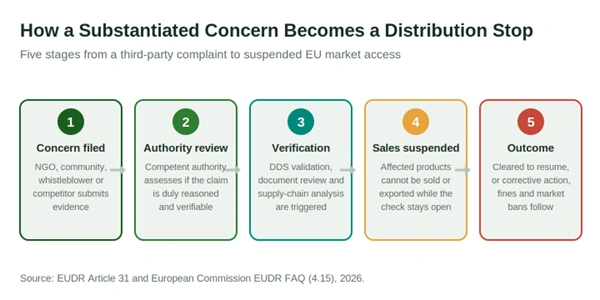
When a substantiated concern lands, the EUDR’s first instinct is containment. The European Commission’s guidance is explicit: on receipt of a concern, the affected products’ placement on the market must be suspended while a verification is carried out. The check itself covers Due Diligence Statement validation, documentation review and additional supply-chain analysis.
The Notification and Verification Obligations
A concern does not only obligate regulators. Non-SME downstream operators and traders who become aware of information indicating non-compliance must immediately notify the competent authorities. Where a substantiated concern exists, they must verify that due diligence was exercised and that only a negligible risk remains and if they cannot, they may not place or make available the products on the market.
There is a second, easily missed duty. All downstream operators and traders must inform their own downstream customers and the competent authorities if they learn of new information including substantiated concerns about products that are already on the market. A concern can therefore reach back through a chain you thought was closed.
When Products are Suspended From the Market
This is where a substantiated concern becomes a distribution stop. While verification is open, the goods are commercially stranded. If the check confirms non-compliance, competent authorities can order corrective action, confiscate goods, exclude the company from public contracts and funding, and impose temporary bans on placing the products on the market. Financial penalties can reach up to 4% of a company’s total EU-wide annual turnover.
STAT BLOCK — THE COST OF A CONFIRMED BREACH Up to 4% of EU-wide annual turnover in fines for confirmed EUDR non-compliance. 30 days — the window within which a competent authority must inform the person who filed a concern of the follow-up taken (Article 31). Indefinite hold on affected products: placement on the market is suspended for the duration of verification, with no fixed end date. Confiscation, exclusion from public contracts and temporary market bans are available to authorities alongside fines.
Real Examples of Substantiated Concerns in Agri-Food Supply Chains
A substantiated concern is easier to understand through concrete cases than legal definitions. Industry guidance and the regulation’s own logic point to recurring patterns. Each example below is the kind of objective, verifiable evidence an authority is obliged to act on:
Satellite imagery of land clearing. A watchdog group submits time-stamped imagery showing forest loss on a supplier farm after the 31 December 2020 cut-off date.
Land-rights violations. A community organisation presents evidence that a timber or cocoa supplier produced on contested land without free, prior and informed consent.
Missing chain-of-custody visibility. Evidence that an operator placed goods on the market without being able to trace them to specific, verified plots of land.
Broken batch traceability. Where products from different sources are mixed or recombined, the original due diligence may no longer cover the new product unit a documented gap a concern can target.
Notice the common thread: every example is a data gap, not necessarily a sustainability failure. A farm may be genuinely deforestation-free, but if the operator cannot produce verifiable plot-level evidence on demand, the concern still stands and the goods still wait.
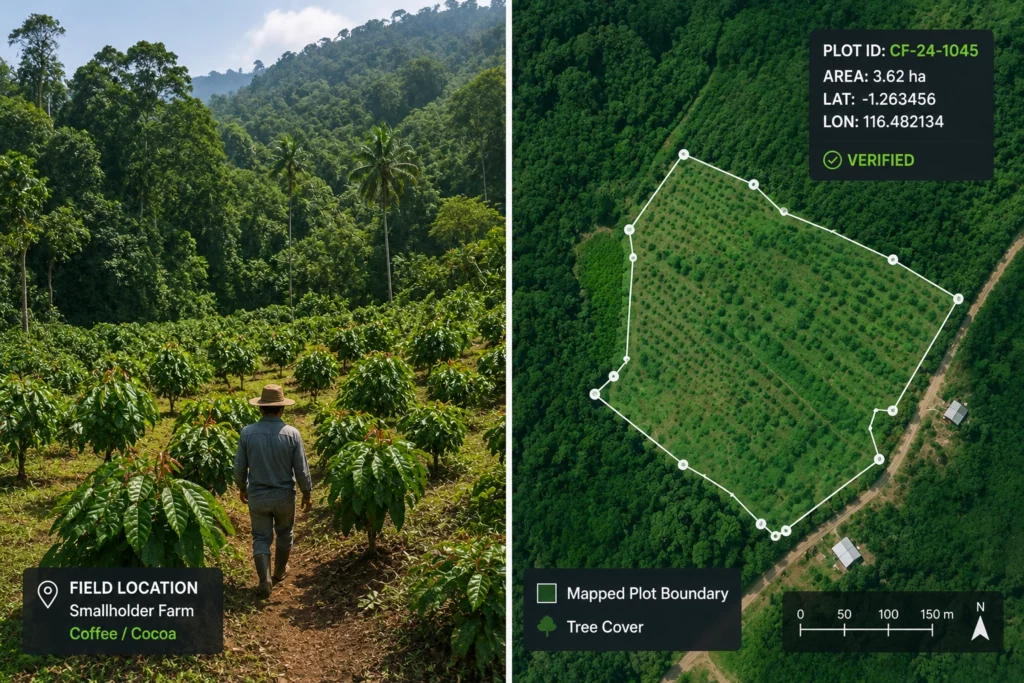
SEE IT BEFORE A REGULATOR DOES TraceX maps every supplier plot as a GPS polygon and cross-checks it against satellite deforestation datasets so a risk surfaces on your dashboard, not in someone else’s complaint. Book a platform walkthrough and see your own supply chain through a regulator’s lens.
How Substantiated Concerns Feed Your Routine EUDR Risk Assessment
Substantiated concerns are not only a reactive enforcement tool they are a required input to your routine due diligence. Under Article 10, operators must take substantiated concerns into account when assessing the risk that products are non-compliant. An existing concern about a sourcing region or supplier raises your assessed risk, which in turn shapes the mitigation you must perform.
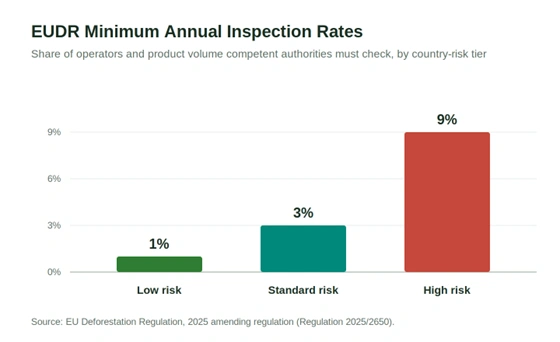
That risk level also drives how often authorities check you. The 2025 amendment sets minimum annual inspection rates by the country-risk tier of your sourcing origin the higher the tier, the more frequently your operations and volumes are examined.
Read the two mechanisms together. Routine inspections are a sampling regime most operators are not checked in any given year. A substantiated concern bypasses the sample entirely: it can pull you into scrutiny even from a low-risk origin. Build your ‘EUDR risk assessment framework’ so that documented concerns are monitored and ingested continuously, not discovered after a shipment is already held.
Learn how to conduct EUDR risk assessments with confidence.Explore deforestation-risk evaluation, country benchmarking, supplier risk analysis, mitigation workflows, and the data businesses need to demonstrate negligible risk under EUDR.
Here is the exposure most teams miss: a concern is contagious across a batch. If one farm out of two hundred in a consolidated lot is credibly flagged, the concern can suspend the entire shipment, because traceability for the lot is now in doubt. The unit of risk is not the questionable farm it is every product that shares a Due Diligence Statement with it. That is why plot-level, not supplier-level, traceability is the real protection.
How to Make Your Supply Chain Substantiated-Concern-Proof
You cannot stop someone from filing a concern. You can make sure that when one arrives, your answer is already written. The goal is a supply chain where verification is a query against existing records not a scramble. Five capabilities make the difference:
Plot-level geolocation for every supplier. Capture each production plot as GPS coordinates or a boundary polygon. Address-level or estimated data invites exactly the gap a concern exploits.
Independent satellite verification. Cross-check every plot against deforestation datasets so a flag is something you raise internally before an outsider does.
Centralised, structured supplier evidence. KYC documents, land tenure proof and certifications should live in one system, not scattered across inboxes.
Audit-ready Due Diligence Statements. Every DDS should be reproducible and exportable on demand, with a complete trail back to source data.
Continuous monitoring. Treat new deforestation alerts and public concerns as live inputs to risk scoring, reviewed continuously rather than annually.
This is the design principle behind the TraceXEUDR Solutions. TraceX maps supplier plots as GPS polygons and validates them against the JRC and Hansen satellite datasets, so deforestation risk is scored against independent evidence. Its agentic AI parses supplier emails and documents to auto-extract KYC, land tenure and certification data removing the fragmented, manual collection that creates gaps. From that verified base, TraceX generates audit-ready Due Diligence Statements with one-click export to PDF, XML or CSV, and issues real-time deforestation alerts using JRC and Hansen data.
The outcome is practical: when a concern names one of your plots, the geolocation, the satellite history and the DDS are already on file. Verification becomes a report you run, not a project you launch.
Reactive vs. Proactive: Responding to a Substantiated Concern
The difference between a contained concern and a costly one is almost never the underlying sustainability of the farm. It is whether the evidence already exists. The contrast below shows what each path looks like in practice:
Dimension
Reactive (no system in place)
Proactive (continuous compliance)
Time to respond
Weeks supplier data is chased by email and spreadsheet
Hour geolocation, KYC and DDS records are already centralised
Product status
Shipments frozen at port while evidence is assembled
Verification served from existing records; goods keep moving
Evidence quality
Fragmented PDFs, gaps in plot coverage, unverified claims
Plot-level polygons cross-checked against satellite datasets
Financial exposure
Held inventory, missed contracts, fines up to 4% of turnover
Exposure contained; concern resolved before it escalates
Buyer confidence
EU buyer questions the whole relationship
Buyer sees a supplier who can prove compliance on demand
The Bottom Line
A substantiated concern is the EUDR’s sharpest tool because it skips the queue. It does not wait for an inspection cycle, it can be filed by almost anyone, and its first effect is to stop you selling. The companies that handle one calmly are not the ones with the cleanest farms they are the ones whose plot data, satellite history and Due Diligence Statements are already verified and on file.
With the EUDR applying from 30 December 2026 for large and medium operators, the time to build that readiness is now, not after the first concern arrives.
DON’T WAIT FOR A CONCERN TO TEST YOUR COMPLIANCE
Could your team prove a single plot is deforestation-free today within hours, with verifiable evidence? If that question makes you pause, a substantiated concern would too.
It is a duly reasoned claim, based on objective and verifiable information, that an operator or trader is not complying with the EU Deforestation Regulation. Defined in Article 31, it can be submitted to a competent authority or directly to the company, and obliges the recipient to respond.
Who can file a substantiated concern?
Any natural or legal person. In practice this includes environmental and human-rights NGOs, local and Indigenous communities, whistleblowers, and commercial competitors. The EUDR deliberately extends enforcement beyond regulators to the wider public.
Can a substantiated concern stop my products from being sold?
Yes. On receipt of a concern, placement of the affected products on the EU market is suspended while a verification check is carried out. The goods remain commercially stranded until the operator can prove due diligence was exercised and risk is negligible.
What is the difference between a substantiated concern and a routine EUDR inspection?
Routine inspections are a risk-based sample only a set percentage of operators is checked each year (9% high-risk, 3% standard, 1% low-risk). A substantiated concern is not sampled: any credible complaint can trigger scrutiny, even for a low-risk sourcing origin.
How can companies prevent substantiated concerns?
You cannot prevent one being filed, but you can make it harmless. Maintain plot-level geolocation for every supplier, cross-check plots against satellite deforestation data, centralise supplier evidence, and keep Due Diligence Statements audit-ready so verification can be answered from existing records.
Start using TraceX
Transparency, Trust, & Success for your Climate Journey.
We use cookies on our website to give you the most relevant experience by remembering your preferences and repeat visits. By clicking “Accept All”, you consent to the use of ALL the cookies. However, you may visit "Cookie Settings" to provide a controlled consent.
This website uses cookies to improve your experience while you navigate through the website. Out of these, the cookies that are categorized as necessary are stored on your browser as they are essential for the working of basic functionalities of the website. We also use third-party cookies that help us analyze and understand how you use this website. These cookies will be stored in your browser only with your consent. You also have the option to opt-out of these cookies. But opting out of some of these cookies may affect your browsing experience.
Necessary cookies are absolutely essential for the website to function properly. These cookies ensure basic functionalities and security features of the website, anonymously.
Cookie
Duration
Description
cookielawinfo-checkbox-analytics
11 months
This cookie is set by GDPR Cookie Consent plugin. The cookie is used to store the user consent for the cookies in the category "Analytics".
cookielawinfo-checkbox-functional
11 months
The cookie is set by GDPR cookie consent to record the user consent for the cookies in the category "Functional".
cookielawinfo-checkbox-necessary
11 months
This cookie is set by GDPR Cookie Consent plugin. The cookies is used to store the user consent for the cookies in the category "Necessary".
cookielawinfo-checkbox-others
11 months
This cookie is set by GDPR Cookie Consent plugin. The cookie is used to store the user consent for the cookies in the category "Other.
cookielawinfo-checkbox-performance
11 months
This cookie is set by GDPR Cookie Consent plugin. The cookie is used to store the user consent for the cookies in the category "Performance".
viewed_cookie_policy
11 months
The cookie is set by the GDPR Cookie Consent plugin and is used to store whether or not user has consented to the use of cookies. It does not store any personal data.
Functional cookies help to perform certain functionalities like sharing the content of the website on social media platforms, collect feedbacks, and other third-party features.
Performance cookies are used to understand and analyze the key performance indexes of the website which helps in delivering a better user experience for the visitors.
Analytical cookies are used to understand how visitors interact with the website. These cookies help provide information on metrics the number of visitors, bounce rate, traffic source, etc.
Advertisement cookies are used to provide visitors with relevant ads and marketing campaigns. These cookies track visitors across websites and collect information to provide customized ads.
Download the 2026 Traceability Scorecard and Benchmark Your Supply Chain Across 10 Critical Capabilities.
Download our eBook
Don’t Wait for an Audit to Find Your EUDR Gaps
The 2026 Simplification Package changes how HS codes, DDS pass-through and geolocation rules apply to you. Get the free guide and 20-point readiness checklist before enforcement catches you unprepared.