EUDR Traceability Examples: The Farm Is Mapped. The Purchase Order Isn’t
Published
, 13 minute read
Share this article
Quick summary: Explore practical EUDR traceability examples showing how farms, suppliers, purchase orders, batches and shipments need to connect for defensible traceability.
Practical scenarios that show why EUDR traceability is more than farm mapping.
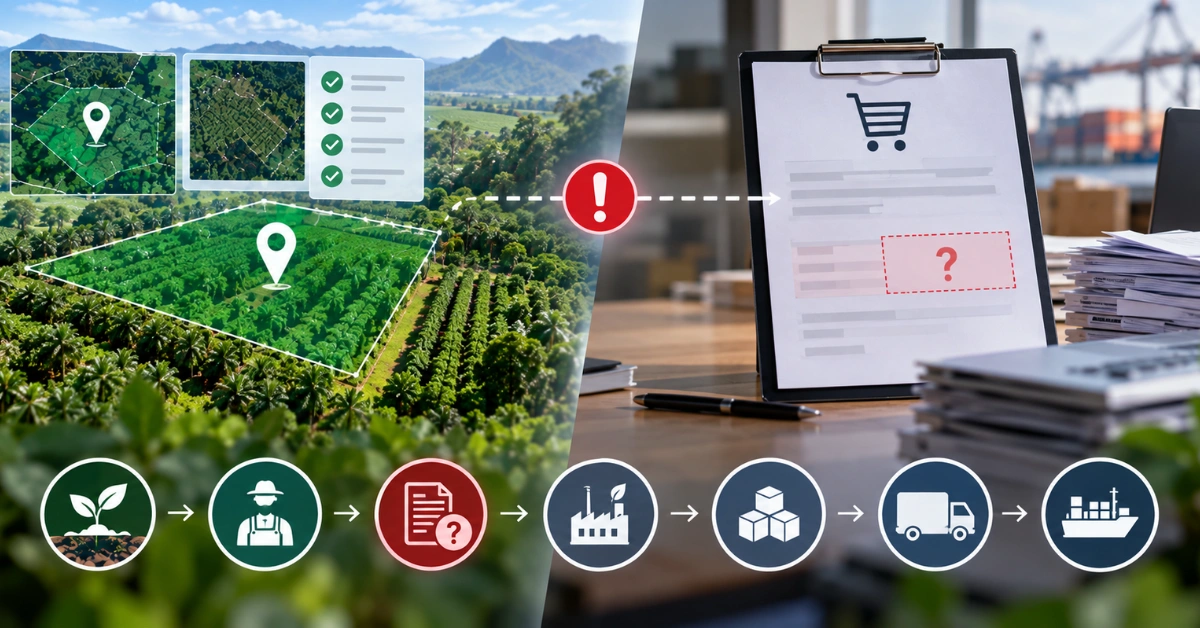
EUDR traceability examples show why having farm geolocation data is only one part of building a traceable supply chain. A farm may be accurately mapped, yet the real challenge begins when you need to connect that farm to the supplier, purchase order, raw-material lot, production batch, finished product, and ultimately an EU-bound shipment. In practice, traceability is about maintaining these relationships as material moves through the supply chain. A mapped farm answers “where was it produced? “but a shipment-level traceability process must also answer “which material from that farm actually contributed to this shipment?” That distinction becomes especially important when suppliers aggregate material from hundreds of farms, multiple source lots are combined, or procurement and geolocation data sit in separate systems.
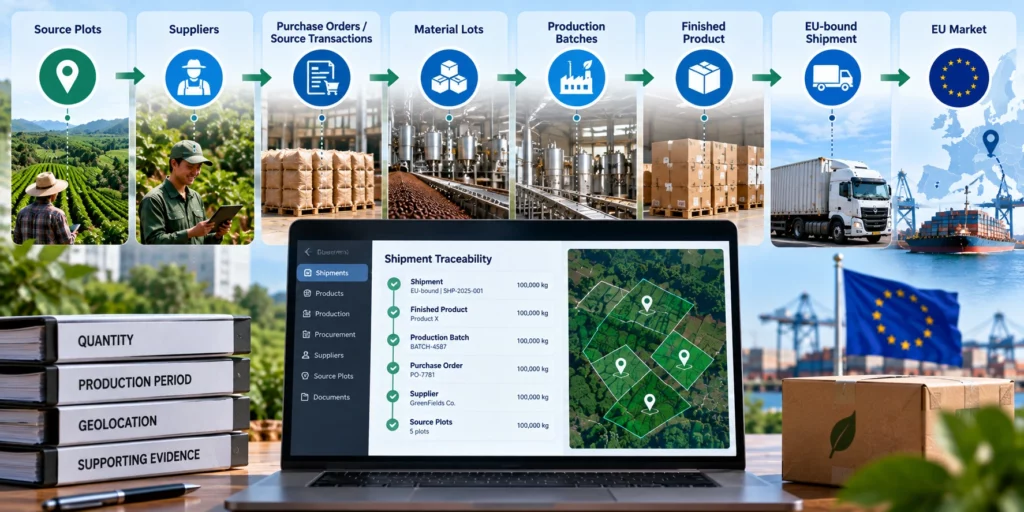
EUDR traceability is not simply the ability to show a farm on a map. A farm polygon can be perfectly captured and still leave a critical question unanswered: did material from that farm actually contribute to the product or shipment being placed on the EU market? Practical EUDR traceability examples make the gap easier to see. The strongest process connects source plots with suppliers, procurement transactions, material lots, production batches, finished products and EU-bound shipments, while preserving the relevant quantities and evidence.
December 2026 is approaching. Is your supply chain actually ready?
Move from spreadsheets and fragmented supplier data to a traceable, audit-ready EUDR workflow with TraceX.
Farm mapping is only the starting point of EUDR traceability not the complete solution.
Geolocation must be connected to actual material flows to establish meaningful traceability.
A mapped farm should be linked to the supplier, purchase order, quantity, lot, production batch, and shipment where applicable.
100% mapped farms does not necessarily mean 100% traceable shipments.
Purchase orders and procurement records can provide an important bridge between source-level data and downstream material flows.
Traceability becomes challenging when multiple farms, suppliers, or lots are combined into one production batch or shipment.
Disconnected data across ERP systems, spreadsheets, supplier records, and geolocation platforms can create traceability gaps.
The real test is not “How many farms have we mapped?” but “Can we trace an EU-bound shipment back to its relevant source plots?”
Effective EUDR traceability requires connected data, quantity relationships, validation, and a clear audit trail.
EUDR Traceability Is a Chain, Not a Map
Imagine a coffee exporter with 1,000 mapped farms. The geolocation database looks impressive. Every farmer has a record. Polygons are available. The sourcing team can open a map and see where coffee was produced.
Then an EU customer asks a deceptively simple question: “For this shipment, which farms contributed the coffee?”
Suddenly, the map is no longer enough.
Someone needs to connect the shipment to the purchase order, the purchase order to supplier or farmer records, those records to sourced quantities or lots, and those lots to the farms that produced the relevant commodity.
That is the difference between having geolocation data and having EUDR traceability.
EUDR Article 9 requires operators to collect information relating to each relevant product, including its description and quantity, country of production, the geolocation of all relevant plots and the date or time range of production, as well as information about businesses or persons from whom the product was supplied and to whom it is supplied. Where a product is made from relevant commodities produced on different plots, the geolocation of all those plots must be included.
The regulation does not list a purchase order as a standalone mandatory Article 9 field. But in a real supply chain, purchase orders and related procurement records can be useful operational bridges between source data and commercial transactions. They help answer: which material was actually procured, from whom, in what quantity, and into which downstream flow did it move?
Mapping farms is only the beginning. EUDR traceability requires you to connect source plots, suppliers, purchase orders, batches, quantities, and EU-bound shipments into one reliable chain of evidence.
EUDR Traceability Examples: Where the Difference Becomes Real
Example 1: Coffee exporter — farms are mapped, but the shipment isn’t linked
A coffee exporter has 1,000 farm polygons. Supplier A is linked to 200 of them. The company then buys 15 tonnes from Supplier A under PO-1045. Three months later, 8 tonnes are processed and allocated to EU Shipment EU-778.
The question is not whether the 200 farms are mapped. The question is whether the company can establish which relevant source plots contributed to the 8 tonnes shipped to the EU.
If the answer is “all 200,” that may be an assumption rather than traceability. If the system can connect sourcing quantities and lots to the relevant farms, the relationship is much stronger.
EUDR compliance doesn’t stop at knowing where your raw material came from. You need to maintain traceability and control as material moves through suppliers, processing stages, batches, and shipments.
Example 2: Cocoa cooperative — one purchase order, hundreds of farms
A cooperative aggregates cocoa from 500 smallholders. All 500 farmers have source records, but the purchase order is recorded only against the cooperative.
When an EU-bound batch is selected, the business needs to understand whether the aggregation model preserves the relationship between the relevant sourced quantity and the contributing farms.
This is where a farm database alone can fall short. The operational model needs a way to connect aggregated procurement and batch movements back to the applicable source population and quantities.
When material comes from multiple farms, suppliers, or sourcing locations, aggregated traceability can quickly become difficult to manage manually. Learn how to connect source-level data, quantities, batches, and shipments while maintaining a clear and defensible EUDR traceability chain.
Example 3: Rubber processor — multiple suppliers feed one production batch
A rubber processor receives material from four suppliers. Each supplier has its own source records and geolocation files. The four inputs are combined into one production batch.
Now imagine that only part of that production batch is allocated to an EU shipment.
Can the company identify which supplier inputs contributed to that shipment and, further upstream, which relevant source locations are connected to those inputs?
Without material and batch relationships, four good supplier datasets can become one difficult traceability problem.
See How Large-Scale EUDR Traceability Works in Practice
How do you map, validate, and trace thousands of rubber plots across multiple suppliers?
Discover how a leading global tire manufacturer digitized its upstream rubber supply chain across six major suppliers and built a structured foundation for EUDR geolocation and traceability.
→ Read the Case Study: How a Leading Tire Company Achieved EUDR Compliance Through Large-Scale Polygon Mapping
Example 4: Timber manufacturer — the purchase order exists, but source data is disconnected
A timber manufacturer has purchase orders, goods-receipt records and production batches in its ERP. Separately, the sustainability team has a spreadsheet containing supplier-provided geolocation.
Both datasets are complete in isolation.
But if the supplier ID or material-lot identifier does not connect the two, the company may not be able to move from a finished shipment back to the relevant source plots without manual reconciliation.
The lesson: data completeness at two different systems does not automatically create traceability.
Your ERP manages orders, inventory, production, and shipments. But can it connect those records to farm-level geolocation, supplier data, and EUDR evidence?
Example 5: Plywood manufacturer — one finished batch uses several timber lots
A plywood manufacturer produces one batch using timber from several incoming lots. Each lot has its own supplier and source information.
The finished batch is then divided between several customers, including one EU customer.
A useful traceability system needs to preserve the relationships between input lots, production batch, allocation and shipment. Otherwise, the company may know every source location involved in production without being able to determine which source information belongs to a particular EU-bound quantity.
Example 6: Supplier changed — the farm record stayed, but the commercial relationship changed
A sourcing organisation has a farm record from an earlier season. The supplier later changes, the cooperative structure changes, or sourcing moves through a different intermediary.
The polygon may still be technically valid. But the commercial relationship attached to it may no longer describe the current transaction.
This is why traceability is not a one-time mapping exercise. Source data and supply-chain relationships need to remain connected to the transactions they actually support.
EUDR compliance starts with knowing where your products come from and how they move through the supply chain. Learn how supply chain mapping can connect suppliers, source locations, materials, processing stages, and shipments to build greater visibility and traceability.
Example 7: Mixed-origin material — the map says yes, the batch logic says maybe
A processor receives material from several origins and combines it into a production flow. The sourcing team has geolocation for all origins.
The difficult question becomes: what quantity from which source entered the relevant production or shipment flow?
If the system simply attaches every available source polygon to every shipment, the dataset may look comprehensive while obscuring the actual material relationship. Allocation and traceability logic matter.
Example 8: Customer asks for one shipment — and the spreadsheet marathon begins
An EU customer asks for supporting EUDR information for a specific shipment.
The compliance team starts with the shipment number, searches the ERP for production batches, checks purchase orders, emails procurement for supplier details, opens a separate geolocation spreadsheet, asks the cooperative for missing information and finally tries to reconcile quantities manually.
The data exists. The process is still fragile.
This is the classic difference between having information and having an operational traceability system.
What These EUDR Traceability Examples Have in Common
Different commodities create different workflows, but the underlying problem repeats:
Source data exists, but its relationship to the transaction is unclear.
Supplier records exist, but quantities are not connected to the relevant material flow.
Purchase orders exist, but source geolocation sits in another system.
Production batches exist, but upstream inputs are difficult to reconstruct.
Shipments exist, but the organisation cannot quickly navigate back to source.
Data was collected once, but the supply chain changed afterwards.
Everything looks complete individually, but the links between records are missing.
Why “We Have All the Farm Data” Can Be Misleading
Completeness at one layer does not guarantee traceability across the chain. You can have 100% farm mapping and still have weak shipment traceability.
Think of it like parcel delivery. Knowing every warehouse address in a country does not tell you which warehouse handled your package. You need the transaction and movement records that connect the package to its origin.
EUDR works in much the same way. A polygon is an origin record. Traceability requires the relationships around that record.
The Data Model Matters
A practical EUDR traceability model should be able to connect:
Source: farm / plot / production location
Supplier: farmer, cooperative, trader or other upstream party
Procurement: purchase order, receipt or sourcing transaction
Material: raw-material lot, quantity and relevant production period
Processing: production batch or transformation event
Product: finished product or SKU
Shipment: EU-bound shipment and shipped quantity
Compliance: geolocation, evidence, risk assessment, due diligence statement and relevant reference information
The exact records and identifiers differ by commodity and operating model. The important principle is that the relationships must be preserved.
Why This Matters for EUDR Due Diligence
EUDR due diligence is not simply a document-upload exercise. Article 10 requires operators to verify and analyse the information collected under Article 9 and other relevant documentation, then assess whether the relevant products present a risk of non-compliance.
If source plots cannot be reliably connected to the product or shipment being assessed, an organisation may have information somewhere in its systems without having a clear, defensible chain showing how that information relates to the specific product being placed on the EU market or exported.
Where relevant products are made with commodities from several sources or geolocations, the relevant sources and geolocations need to be considered in the due-diligence process.
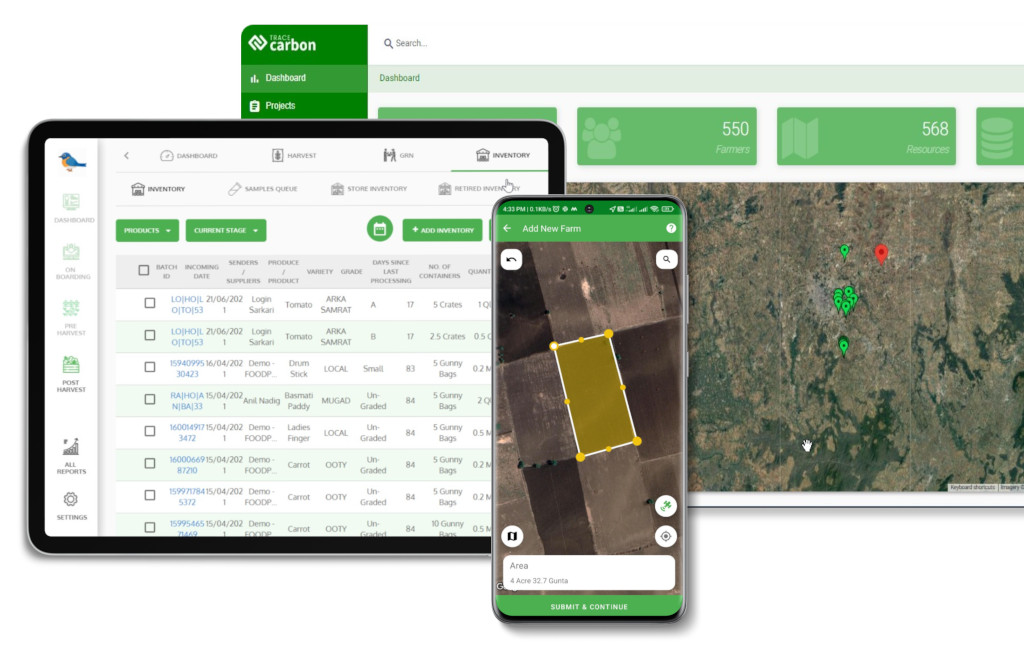
TraceX’s EUDR solution helps bridge the gap between farm-level mapping and shipment-level traceabilityby connecting source geolocation with suppliers, purchase orders, material quantities, batches, products, and EU-bound shipments in a single traceability workflow. Instead of keeping farm polygons, supplier information, and procurement records in disconnected spreadsheets or systems, TraceX helps establish the relationships between them, making it easier to trace a shipment backwards to the relevant source plots and verify whether the required information is available. It also helps identify missing or inconsistent data, maintain supporting evidence and create an auditable trail across the supply chain. So, when an EU customer asks, “Which farms contributed to this shipment?”, the answer doesn’t have to depend on manual reconciliation it can be supported by a connected digital traceability record.
Can You Trace One EU Shipment Back to Source?
→ Trace One EU Shipment with TraceX
Conclusion
Mapping the farm is an important milestone. It is not the finish line.
The practical EUDR traceability examples above show the same pattern across coffee, cocoa, rubber, timber and wood-based manufacturing: the difficult part is often not collecting another record. It is preserving the relationships between records as material moves through the supply chain.
So before asking how many farms you’ve mapped, ask a harder question:
“Can we trace one EU-bound shipment all the way back to the source?”
If you can, you are testing traceability where it matters most.
Frequently Asked Questions (FAQ’s)
What is an example of EUDR traceability?
A practical example is tracing an EU-bound shipment back through finished product, production batch, raw-material lot, procurement transaction, supplier and ultimately the relevant production plots, while preserving the relevant quantity and supporting information.
Is farm mapping the same as EUDR traceability?
No. Farm mapping establishes source geolocation. EUDR traceability also requires the relevant source information to be connected to products, quantities and supply-chain relationships.
Can purchase orders help with EUDR traceability?
Yes. A purchase order is not itself a standalone Article 9 requirement, but it can provide an important operational link between supplier, material and quantity and help connect upstream source information to downstream flows.
How do you trace a shipment back to farms?
Start with the shipment, identify the relevant product and quantity, trace it to production or material lots, connect those lots to procurement transactions and suppliers, and then connect those suppliers or sourcing records to the relevant source plots.
What is the best way to test EUDR traceability?
Run a one-shipment trace-back exercise. It exposes missing relationships much faster than measuring only the percentage of farms that have been mapped.
Why can 100% farm mapping still fail to provide traceability?
Because the source polygons may not be linked to the specific quantities, procurement transactions, material lots, production batches and shipments in which the commodity was actually used.
Start using TraceX
Transparency, Trust, & Success for your Climate Journey.
We use cookies on our website to give you the most relevant experience by remembering your preferences and repeat visits. By clicking “Accept All”, you consent to the use of ALL the cookies. However, you may visit "Cookie Settings" to provide a controlled consent.
This website uses cookies to improve your experience while you navigate through the website. Out of these, the cookies that are categorized as necessary are stored on your browser as they are essential for the working of basic functionalities of the website. We also use third-party cookies that help us analyze and understand how you use this website. These cookies will be stored in your browser only with your consent. You also have the option to opt-out of these cookies. But opting out of some of these cookies may affect your browsing experience.
Necessary cookies are absolutely essential for the website to function properly. These cookies ensure basic functionalities and security features of the website, anonymously.
Cookie
Duration
Description
cookielawinfo-checkbox-analytics
11 months
This cookie is set by GDPR Cookie Consent plugin. The cookie is used to store the user consent for the cookies in the category "Analytics".
cookielawinfo-checkbox-functional
11 months
The cookie is set by GDPR cookie consent to record the user consent for the cookies in the category "Functional".
cookielawinfo-checkbox-necessary
11 months
This cookie is set by GDPR Cookie Consent plugin. The cookies is used to store the user consent for the cookies in the category "Necessary".
cookielawinfo-checkbox-others
11 months
This cookie is set by GDPR Cookie Consent plugin. The cookie is used to store the user consent for the cookies in the category "Other.
cookielawinfo-checkbox-performance
11 months
This cookie is set by GDPR Cookie Consent plugin. The cookie is used to store the user consent for the cookies in the category "Performance".
viewed_cookie_policy
11 months
The cookie is set by the GDPR Cookie Consent plugin and is used to store whether or not user has consented to the use of cookies. It does not store any personal data.
Functional cookies help to perform certain functionalities like sharing the content of the website on social media platforms, collect feedbacks, and other third-party features.
Performance cookies are used to understand and analyze the key performance indexes of the website which helps in delivering a better user experience for the visitors.
Analytical cookies are used to understand how visitors interact with the website. These cookies help provide information on metrics the number of visitors, bounce rate, traffic source, etc.
Advertisement cookies are used to provide visitors with relevant ads and marketing campaigns. These cookies track visitors across websites and collect information to provide customized ads.
Download the 2026 Traceability Scorecard and Benchmark Your Supply Chain Across 10 Critical Capabilities.
Download our eBook
Don’t Wait for an Audit to Find Your EUDR Gaps
The 2026 Simplification Package changes how HS codes, DDS pass-through and geolocation rules apply to you. Get the free guide and 20-point readiness checklist before enforcement catches you unprepared.