Aggregated Traceability Under EUDR: The Legal Path to Compliant Mixing
Published
, 8 minute read
Share this article
Quick summary: Aggregated traceability under EUDR is allowed via “declaration in excess”—when every plot is known and compliant. Learn how to mix commodities and still file a clean DDS.
Aggregated traceability under EUDR is explicitly permitted through a mechanism the European Commission calls “declaration in excess.” When commodities from several farms are pooled, an operator may report all potential source plots for the mixed batch provided every plot is known, geolocated and verified deforestation-free, and no material of unknown or non-compliant origin has entered the mix. Aggregation becomes a violation only when the pooled commodity can no longer be traced back to compliant plots. It is not the same as mass balance or book-and-claim, which the EUDR does not accept.
Key Takeaways
Aggregation is legal, not forbidden. The EUDR permits aggregated traceability under EUDR through “declaration in excess” you can mix batches from multiple farms and still file a compliant Due Diligence Statement (DDS).
There is one hard condition. Every plot in the pool must be known, GPS-mapped and deforestation-free. The moment unknown or non-compliant material enters, the whole batch is non-compliant.
The risk isn’t mixing — it’s lost identity. Aggregation fails when farm-level identity is destroyed at the collection point, before the commodity ever enters your records.
Software decides whether you can declare in excess. Capturing plot identity before pooling, cross-checking against satellite data, and assembling the DDS at scale is what separates a defensible declaration from a rejected one.
Don’t guess whether your mixed batches are defensible.
See how TraceX preserves plot-level identity through every aggregation point and files a clean DDS in hours.
What Aggregated Traceability Under EUDR Actually Means
Aggregated traceability under EUDR is the practice of pooling a commodity coffee, cocoa, rubber, palm or soy from many separate farms and still being able to prove, at the point of import, that the whole mixed batch traces back to plots of land that are known, legal and deforestation-free. In plain terms: you don’t have to keep every farmer’s harvest in its own sealed bag to comply. You have to keep every farmer’s identity and geolocation in your records before the harvests are combined.
The EU Deforestation Regulation is built on a principle of strict traceability: under Article 9, operators must collect the GPS geolocation coordinates of every plot where a commodity was produced and submit them in a Due Diligence Statement through the EUDR Information System. That sounds incompatible with real-world sourcing, where smallholders deliver in small volumes and warehouses blend batches daily. It isn’t because the Commission has confirmed that the law explicitly allows this, so long as the trace back to compliant plots survives the mixing.
Why EUDR Aggregation Is Allowed, Not Banned
Most compliance content treats aggregation as the enemy. That’s only half the picture. The regulator’s own guidance takes the opposite starting point: aggregated traceability under EUDR is a recognised, cost-effective pathway called “declaration in excess.”
Declaration in excess lets you list more plots of land than physically contributed to a given shipment because once beans are in a silo or latex is in a tank, you can’t match each kilogram to one farm. The Commission’s FAQ permits this only when three conditions hold:
Full traceability to plots. The bulk commodity is fully traced to known plots of land.
No unknown material. Mixing involves only commodities of known origin never material of unknown or non-compliant origin.
Negligible non-compliance risk. All declared plots are verified deforestation-free, so the risk across the pool is negligible.
This is where aggregated traceability under EUDR stops being a loophole and becomes a design requirement. A worked example makes it concrete.
Worked example cocoa silo
A processor bulks cocoa from 100 mapped farms into one silo and exports a batch that, by volume, could only have come from 40 of them. Because the beans are physically indistinguishable, the operator declares all 100 compliant plots in the DDS a declaration in excess. This is accepted, because all 100 are known, geolocated and deforestation-free. Swap in one unmapped or high-risk farm, and the entire batch is now non-compliant.
Two things this is not: it is not mass balance, and it is not book-and-claim. Both decouple the physical product from its origin claim, and the EUDR accepts neither. Certifications such as RSPO or FSC can support your risk assessment, but they do not replace geolocation, the DDS, or plot-level evidence a distinction buyers transitioning from certification schemes get wrong most often.
Where Aggregated Traceability Under EUDR Breaks Down
If the law permits it, why does aggregation sink so many compliance programmes? Because the conditions above are fragile, and ordinary supply chains break them by default. These are the failure points that turn a legal pathway into a rejected DDS.
Identity is destroyed at the collection point
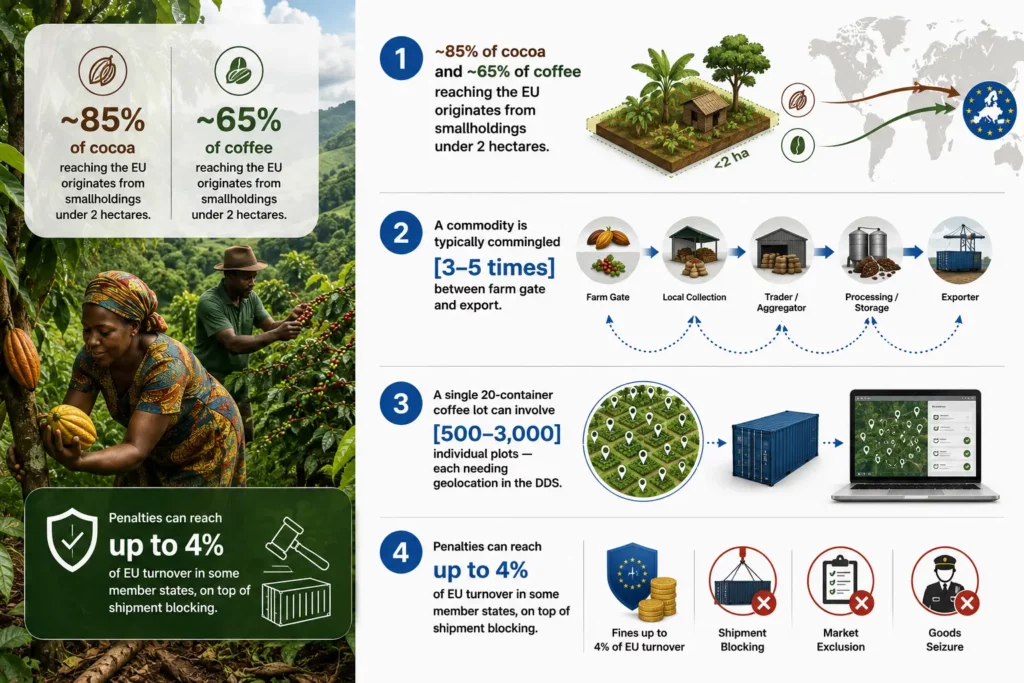
When a collector buys from 200 farmers in a market day and records one weight and one price, the farm-of-origin data is never captured. Aggregated traceability under EUDR is impossible to reconstruct after this point the geolocation gap is structural, not clerical.
Commingling with unknown or non-compliant material
A batch that is 98% deforestation-free but 2% unverified is 100% non-compliant. Each time a commodity is pooled farm gate, collection centre, mill, export warehouse the chance of one unknown plot entering the mix compounds, and declaration in excess is no longer available to you.
Informal intermediaries leave no trail
Village collectors and commission agents who handle the first mile often operate on paper or verbal deals. Without turning them into documented nodes, you can’t show the negligible-risk condition that this compliant pathway depends on.
How to Make Aggregated Traceability Under EUDR Audit-Ready
The fix isn’t to abandon aggregation it’s to protect the three conditions that make aggregated traceability under EUDR legal. That means capturing identity before the pool forms, and keeping it attached through every downstream mix. A defensible system does five things.
Captures plot identity before pooling. Field agents record GPS-polygon boundaries and farmer identity at onboarding offline where there’s no connectivity so every future batch inherits a verified origin.
Keeps a farmgate ledger. Each first-mile purchase logs who sold, how much, from which plot, on what date, creating a digital aggregation ledger that survives physical commingling.
Cross-checks plots against satellite data. GPS coordinates are screened against JRC and Hansen forest datasets per plot, so a high-risk farm is flagged before it enters an aggregated batch not after the DDS is rejected.
Assembles the declaration in excess automatically. The platform compiles all compliant plots behind a batch and generates a DDS ready for the EUDR Information System, turning a week of manual assembly into hours.
Onboards informal intermediaries as nodes. Multilingual, pictographic tools register collectors so the first mile stops being a chain-of-custody void.
EUDR Aggregation vs. the Alternatives
Buyers evaluating compliance approaches usually weigh three models. Only one lets you mix at scale and stay compliant.
Traceability model
EUDR-accepted?
Bottom line for buyers
Full physical segregation
Yes
Cleanest trace, but operationally costly and impractical for smallholder or bulk-liquid supply chains.
Aggregated traceability (declaration in excess)
Yes — conditional
Mix at scale and stay compliant, provided every declared plot is known, mapped and deforestation-free. The realistic path for most exporters.
Mass balance / book-and-claim
No
Decouples the physical product from its origin claim. Used under some certification schemes, but does not satisfy EUDR’s plot-level rule.
TraceX EUDR Solutions simplifies aggregated traceability for EUDR by connecting every forest-based input within a finished product into a single, audit-ready compliance record. Whether it’s kraft paper, décor paper, plywood, MDF, or other wood-derived components sourced from multiple suppliers and countries, TraceX captures supplier data, verifies geolocations, assesses deforestation risk, and maintains complete chain-of-custody for each material. The platform then aggregates these independent supply chains into a unified Due Diligence workflow, enabling manufacturers to generate accurate, audit-ready Due Diligence Statements (DDS) for complex composite products with confidence.
Make aggregated traceability under EUDR your advantage, not your risk.
TraceX preserves plot-level identity through every aggregation point, cross-checks each plot against satellite data, and assembles declaration-in-excess DDS files ready for the EUDR Information System.
Before you trust a platform to defend your mixed batches, confirm it can tick every box below.
✓Captures GPS-polygon plot boundaries and farmer identity at onboarding, offline included.
✓Logs farmgate transactions before commodities are pooled (a real aggregation ledger).
✓Screens each plot against JRC / Hansen deforestation data automatically.
✓Assembles declaration-in-excess DDS files and submits to the EUDR Information System via API.
✓Onboards informal intermediaries as documented supply-chain nodes.
✓Produces an audit trail linking every exported batch back to its full set of compliant plots.
Frequently Asked Questions
Does the EUDR allow mixing commodities from multiple farms?
Yes. Aggregated traceability under EUDR is permitted through declaration in excess — but only if every contributing plot is known, geolocated and deforestation-free, and no unknown or non-compliant material is mixed in.
What is a “declaration in excess”?
It’s declaring more plots of land than physically contributed to a shipment, because bulk mixing makes exact matching impossible. It’s valid only when all declared plots are compliant and the risk across the pool is negligible.
Is mass balance accounting acceptable under the EUDR?
No. The EUDR requires physical traceability to specific geo-located plots under Article 9. Mass balance and book-and-claim models used under schemes like RSPO or Rainforest Alliance do not satisfy that requirement.
When does the EUDR apply?
From 30 December 2026 for large and medium operators and traders (and micro/small operators in the timber sector), and from 30 June 2027 for micro and small operators outside timber, under Regulation (EU) 2025/2650. Re-verify at EUR-Lex before relying on these dates.
Do RSPO or FSC certificates cover EUDR aggregation?
They help your risk assessment but don’t replace geolocation, the DDS, or plot-level evidence. Aggregated traceability under EUDR still requires plot-level data behind every batch.
We use cookies on our website to give you the most relevant experience by remembering your preferences and repeat visits. By clicking “Accept All”, you consent to the use of ALL the cookies. However, you may visit "Cookie Settings" to provide a controlled consent.
This website uses cookies to improve your experience while you navigate through the website. Out of these, the cookies that are categorized as necessary are stored on your browser as they are essential for the working of basic functionalities of the website. We also use third-party cookies that help us analyze and understand how you use this website. These cookies will be stored in your browser only with your consent. You also have the option to opt-out of these cookies. But opting out of some of these cookies may affect your browsing experience.
Necessary cookies are absolutely essential for the website to function properly. These cookies ensure basic functionalities and security features of the website, anonymously.
Cookie
Duration
Description
cookielawinfo-checkbox-analytics
11 months
This cookie is set by GDPR Cookie Consent plugin. The cookie is used to store the user consent for the cookies in the category "Analytics".
cookielawinfo-checkbox-functional
11 months
The cookie is set by GDPR cookie consent to record the user consent for the cookies in the category "Functional".
cookielawinfo-checkbox-necessary
11 months
This cookie is set by GDPR Cookie Consent plugin. The cookies is used to store the user consent for the cookies in the category "Necessary".
cookielawinfo-checkbox-others
11 months
This cookie is set by GDPR Cookie Consent plugin. The cookie is used to store the user consent for the cookies in the category "Other.
cookielawinfo-checkbox-performance
11 months
This cookie is set by GDPR Cookie Consent plugin. The cookie is used to store the user consent for the cookies in the category "Performance".
viewed_cookie_policy
11 months
The cookie is set by the GDPR Cookie Consent plugin and is used to store whether or not user has consented to the use of cookies. It does not store any personal data.
Functional cookies help to perform certain functionalities like sharing the content of the website on social media platforms, collect feedbacks, and other third-party features.
Performance cookies are used to understand and analyze the key performance indexes of the website which helps in delivering a better user experience for the visitors.
Analytical cookies are used to understand how visitors interact with the website. These cookies help provide information on metrics the number of visitors, bounce rate, traffic source, etc.
Advertisement cookies are used to provide visitors with relevant ads and marketing campaigns. These cookies track visitors across websites and collect information to provide customized ads.
Download the 2026 Traceability Scorecard and Benchmark Your Supply Chain Across 10 Critical Capabilities.
Download our eBook
Don’t Wait for an Audit to Find Your EUDR Gaps
The 2026 Simplification Package changes how HS codes, DDS pass-through and geolocation rules apply to you. Get the free guide and 20-point readiness checklist before enforcement catches you unprepared.