EUDR Due Diligence: Requirements, Steps and DDS Filing
Published
, 10 minute read
Share this article
Quick summary: EUDR due diligence made simple: follow the 5 core steps, meet geolocation and risk rules, and file a compliant DDS before the 2026-2027 deadlines.
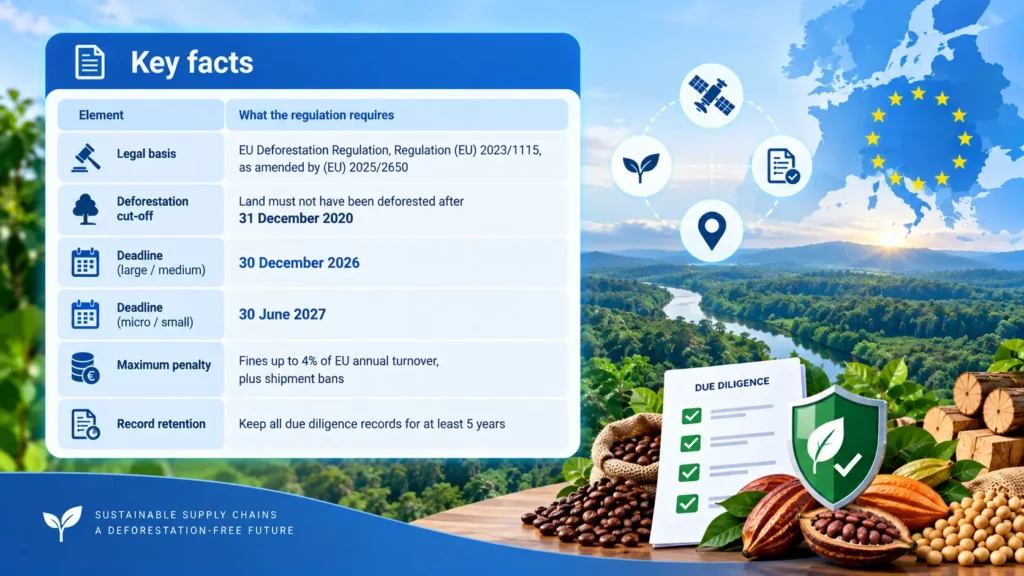
EUDR due diligence is the legally required process an operator must complete before placing regulated commodities such as coffee, cocoa, soy, palm oil, timber, rubber and cattle on the EU market. It means collecting plot-level geolocation data, proving no deforestation occurred after 31 December 2020, gathering legal production documents, assessing risk, and filing a Due Diligence Statement (DDS) in the EU Information System. Without a valid DDS reference number, goods cannot legally enter the EU.
Key Takeaways
EUDR due diligence is more than submitting a DDS.
Start with product and scope assessment.
Collect complete Article 9 information
Geolocation is a core EUDR requirement.
Conduct a documented risk assessment under Article 10.
Mitigate non-negligible risks under Article 11.
Maintain an evidence trail.
Connect source data to the physical product.
DDS filing is the regulatory submission step.
The DDS is the output of the due-diligence process, not the complete compliance record.
Reference and verification numbers should be connected to the shipment/product records.
Transitional products need separate treatment.
Digital systems can reduce manual compliance work.
December 2026 is approaching. Is your supply chain actually ready?
Move from spreadsheets and fragmented supplier data to a traceable, audit-ready EUDR workflow with TraceX.
EUDR due diligence is the structured legal process by which an operator proves that a commodity placed on the EU market is deforestation-free, legally produced and traceable to the exact plot of land where it was grown. Under the EU Deforestation Regulation it is not a voluntary best practice, it is the condition for market access.
This is a shift from traditional sustainability reporting. Voluntary certificates and self-declarations are no longer enough on their own. EUDR due diligence is data-driven and tied directly to customs clearance: an operator must provide verified GPS coordinates, satellite deforestation evidence, legal land documentation and a filed DDS. A single missing data point can hold a shipment at the border.
EUDR due diligence in 5 steps
Every compliant DDS is built from the same five steps. Complete them in order for each shipment.
Collect geolocation data as GPS points or polygons for every production plot, in GeoJSON format.
Prove no deforestation after 31 December 2020 using time-stamped satellite evidence.
Gather legal production documents covering land tenure, permits and supplier identity.
Assess and mitigate risk under Articles 10 and 11 until residual risk is negligible.
Submit the Due Diligence Statement in the EU Information System and obtain the DDS reference number.
The 5 core components in detail
Most shipment rejections trace back to a gap in one of these five areas. Build your workflow around each.
1. What geolocation data does EUDR require?
Geolocation is the technical foundation of every DDS. You must record either a GPS point or a mapped polygon boundary for each production plot in your supply chain.
Polygon boundaries, not just single points, are required for most production systems.
Each plot is mapped individually, including in smallholder aggregation models.
GeoJSON is the required format for submission to the EU Information System.
Incomplete or inaccurate coordinates are the leading cause of DDS rejections.
You must confirm the land used to grow the commodity was not deforested after the 31 December 2020 cut-off.
Reference satellite data from JRC, Global Forest Watch or Hansen datasets.
Use time-stamped analysis showing no forest-cover change after the cut-off.
Expect EU buyers to ask for third-party verification before accepting a DDS.
High-risk countries face stricter verification and more frequent audits.
3. What legal documentation is needed?
EUDR requires proof that the commodity was legally produced, not only deforestation-free. That means documenting land rights, permits and supplier identity.
Land tenure certificates or customary land-rights documentation per supplier.
Harvest permits and agricultural licences where applicable.
Business or cooperative registration records, and supplier KYC indexed by supplier ID.
Note: certifications such as Rainforest Alliance or FSC are supporting evidence only, not a substitute for due diligence.
Operators sourcing from standard or high-risk countries must conduct a documented risk assessment under Article 10 and record mitigation under Article 11.
Assess deforestation risk, legality risk and supply-chain transparency risk.
Document mitigation: supplier audits, monitoring, field checks and certifications.
The final residual risk must be classified as negligible before you file.
Low-risk country classification enables simplified due diligence procedures.
Understand how EUDR country risk classification works, what the three risk categories mean, and how businesses should incorporate country risk into their due diligence and supplier risk assessment process.
Once data is collected and verified, you submit a formal Due Diligence Statement in the EU Information System before goods enter the market.
The DDS is tied to a specific shipment and references all underlying compliance data.
A DDS reference number is issued and is required before goods clear customs.
Records must be retained and audit-ready for at least 5 years.
Understand how to build an effective EUDR due diligence workflow that connects supplier onboarding, source-level traceability, risk assessment, evidence management, and DDS preparation.
Here is what the core of a completed Due Diligence Statement looks like for a single coffee shipment. Use it as a reference for the fields you will need to populate.
DDS field
Example entry
Operator
EU importer, EORI number DE123456789012
Commodity / product
Coffee, green Arabica beans
HS code
0901 11
Country of production
Colombia
Geolocation
Polygon, GeoJSON, plot centroid 5.0689 N, 75.5174 W (12 plots attached)
Production / harvest period
October 2025 to January 2026
Deforestation check
No forest-cover change after 31 Dec 2020 (satellite reference, JRC dataset)
Legal documents
Land title, municipal harvest permit, cooperative registration
Risk conclusion
Negligible after supplier audit and satellite verification
DDS reference number
Issued by the EU Information System on submission
Who must complete EUDR due diligence? Operators vs traders
Operators, the companies that first place a regulated commodity on the EU market or export it from the EU, carry the full legal obligation to perform due diligence and submit the DDS. Under the simplification package, only the first operator placing a product on the market submits the DDS; downstream operators and traders pass on the reference number and keep their own traceability records. Non-EU exporters are affected too, because EU importers cannot comply without plot-level data from upstream partners.
Learn how upstream operators fit into the EUDR framework, what information they need to provide, and how businesses can build a connected due diligence process across suppliers and source locations.
An EU importer bringing in coffee, cocoa, soy or rubber.
A manufacturer producing chocolate, furniture or leather goods for EU sale.
An exporter shipping timber or rubber from the EU to another country.
Traders and downstream operators: reference tracking
A wholesaler distributing pre-packaged coffee or cocoa within the EU.
A retailer sourcing certified cocoa ingredients for repackaging.
They register in the system and maintain traceability through DDS reference identifiers, rather than filing a separate DDS.
What happens if you fail EUDR due diligence?
Non-compliance carries direct operational consequences, not just reputational risk.
Shipment rejection at the EU border
A container arriving with an incomplete or missing DDS is held at customs. Even one missing polygon or invalid coordinate can trigger a hold, and demurrage, spoilage and rebooking costs compound quickly.
Financial penalties and investigations
Authorities can impose fines of up to 4% of an operator’s annual EU turnover for negligent due diligence. Persistent non-compliance can lead to temporary bans and full supply-chain audits.
Loss of market access and reputation
EU buyers now embed EUDR requirements in purchase orders. Operators that cannot produce a valid DDS on demand risk losing contracts to compliant competitors, and failed traceability audits are increasingly read as a greenwashing signal.
EUDR due diligence deadlines in 2026 and 2027
The December 2025 amendment and the May 2026 simplification package confirmed the timeline rather than resetting it. The simplification package is estimated to cut annual compliance costs by around 75% versus the original 2023 estimates, but the core obligations and dates below are unchanged.
Operator category
DDS obligation
Deadline
Large operators and non-SME traders
Full DDS per shipment
30 December 2026
Micro and small enterprises
Full DDS per shipment
30 June 2027
Micro / small primary operators (low-risk)
Simplified one-time declaration available
30 June 2027
Downstream operators and traders
Register and pass DDS reference numbers
30 December 2026
All operators
Retain records, audit-ready
Ongoing, minimum 5 years
A July 2026 delegated act also refined the product scope (for example soluble coffee and certain palm oil derivatives were added, while leather and retreaded tyres were removed). Check whether your specific derived products are in scope before you file.
How technology simplifies EUDR due diligence
Prepared manually, a single DDS can take days to weeks: collecting supplier data, validating geolocation, running satellite checks, compiling legal documents and formatting for submission. EUDR Solutions from TraceX reduces this to minutes.
Process step
Manual workflow
TraceX platform
Geolocation collection
Spreadsheets and supplier emails
Mobile, offline GPS polygon mapping
Deforestation check
Manual satellite checks over weeks
Automated satellite cross-reference in minutes
Legal documents
Scattered PDFs and email threads
Centralised and indexed by supplier ID
Risk assessment
Inconsistent analyst judgement
Documented scoring per Article 10
DDS submission
Manual login and format conversion
Direct API submission
Audit readiness
Manual retrieval, high gap risk
5-year digital record, searchable on demand
See where you stand.
Identify your data gaps before they become shipment rejections.
Do I need EUDR due diligence if I source from a low-risk country?
Yes. Any operator placing covered commodities on the EU market must complete due diligence regardless of sourcing country. Low-risk classification enables simplified procedures, but the requirement to submit a DDS remains.
Can I use my supplier’s DDS instead of filing my own?
Downstream operators and traders may reference an upstream DDS by its reference number, but they must verify the upstream due diligence is trustworthy, register in the system, and keep their own traceability records.
What is a DDS reference number and where do I get it?
It is the identifier the EU Information System issues when you submit a valid DDS. Goods cannot clear customs without it, and downstream partners use it to maintain the traceability chain.
Does FSC or Rainforest Alliance certification satisfy EUDR due diligence?
No. Certifications are supporting evidence only. They can strengthen your risk assessment, but they do not replace geolocation data, deforestation proof, legality checks or the DDS itself.
What HS codes are covered under EUDR?
EUDR covers coffee, cocoa, soy, palm oil, cattle, rubber and timber, plus derived products such as chocolate, leather, furniture and paper. HS-code misclassification is a leading rejection cause, so cross-verify with your customs broker before filing.
What if my supplier cannot provide GPS coordinates?
This is common in smallholder supply chains. Mobile, offline field-data tools let agents collect GPS polygon data in low-connectivity areas and sync it centrally. Without plot-level geolocation, a compliant DDS cannot be filed.
How far back does deforestation verification go?
You must confirm no deforestation occurred after 31 December 2020. Satellite analysis should cover land-use change from that date through the time of filing.
What does EUDR due diligence cost, and can it be outsourced?
Cost depends on supply-chain complexity and data readiness. The 2026 simplification package is estimated to cut annual compliance costs by around 75%. Much of the work can be handled by a compliance platform or a specialist provider, though the operator keeps legal liability.
What happens if my DDS is rejected?
The shipment cannot legally enter the EU. Common triggers are missing or invalid geolocation, HS-code misclassification, missing supplier information and incomplete risk documentation. Built-in validation catches these before submission.
How long must I retain records?
All DDS documentation and supporting evidence must be retained for at least 5 years and made available to authorities on request.
Start using TraceX
Transparency, Trust, & Success for your Climate Journey.
We use cookies on our website to give you the most relevant experience by remembering your preferences and repeat visits. By clicking “Accept All”, you consent to the use of ALL the cookies. However, you may visit "Cookie Settings" to provide a controlled consent.
This website uses cookies to improve your experience while you navigate through the website. Out of these, the cookies that are categorized as necessary are stored on your browser as they are essential for the working of basic functionalities of the website. We also use third-party cookies that help us analyze and understand how you use this website. These cookies will be stored in your browser only with your consent. You also have the option to opt-out of these cookies. But opting out of some of these cookies may affect your browsing experience.
Necessary cookies are absolutely essential for the website to function properly. These cookies ensure basic functionalities and security features of the website, anonymously.
Cookie
Duration
Description
cookielawinfo-checkbox-analytics
11 months
This cookie is set by GDPR Cookie Consent plugin. The cookie is used to store the user consent for the cookies in the category "Analytics".
cookielawinfo-checkbox-functional
11 months
The cookie is set by GDPR cookie consent to record the user consent for the cookies in the category "Functional".
cookielawinfo-checkbox-necessary
11 months
This cookie is set by GDPR Cookie Consent plugin. The cookies is used to store the user consent for the cookies in the category "Necessary".
cookielawinfo-checkbox-others
11 months
This cookie is set by GDPR Cookie Consent plugin. The cookie is used to store the user consent for the cookies in the category "Other.
cookielawinfo-checkbox-performance
11 months
This cookie is set by GDPR Cookie Consent plugin. The cookie is used to store the user consent for the cookies in the category "Performance".
viewed_cookie_policy
11 months
The cookie is set by the GDPR Cookie Consent plugin and is used to store whether or not user has consented to the use of cookies. It does not store any personal data.
Functional cookies help to perform certain functionalities like sharing the content of the website on social media platforms, collect feedbacks, and other third-party features.
Performance cookies are used to understand and analyze the key performance indexes of the website which helps in delivering a better user experience for the visitors.
Analytical cookies are used to understand how visitors interact with the website. These cookies help provide information on metrics the number of visitors, bounce rate, traffic source, etc.
Advertisement cookies are used to provide visitors with relevant ads and marketing campaigns. These cookies track visitors across websites and collect information to provide customized ads.
Download the 2026 Traceability Scorecard and Benchmark Your Supply Chain Across 10 Critical Capabilities.
Download our eBook
Don’t Wait for an Audit to Find Your EUDR Gaps
The 2026 Simplification Package changes how HS codes, DDS pass-through and geolocation rules apply to you. Get the free guide and 20-point readiness checklist before enforcement catches you unprepared.