Quick summary: EUDR Customs Declarations require DDS reference numbers or declaration identifiers for compliant imports and exports. Learn how to manage EUDR customs compliance.
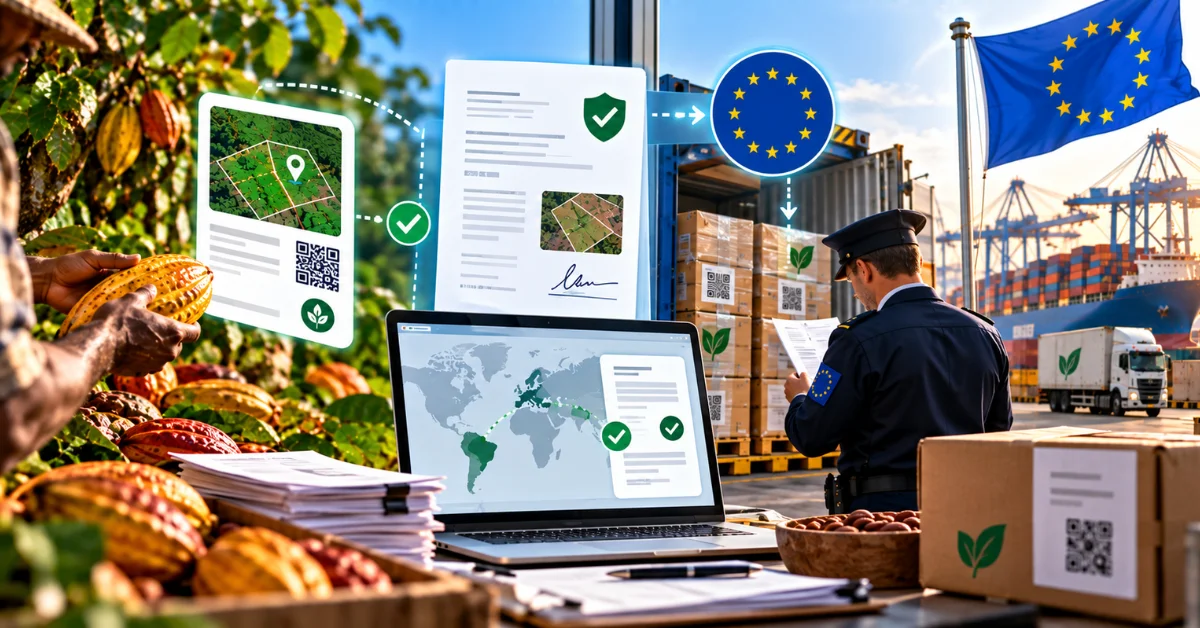
EUDR customs declarations are an important part of the compliance process for businesses importing or exporting products covered by the EU Deforestation Regulation (EUDR). For relevant products entering or leaving the EU market, customs procedures do not operate separately from EUDR compliance. The relevant EUDR reference must be made available to customs before the product is released for free circulation or exported.
For upstream operators, this creates a practical link between the EUDR Information System, the Due Diligence Statement (DDS), and the customs declaration. For downstream operators, the process can be different where products are already covered by an upstream DDS or simplified declaration. Understanding who must submit a DDS, which reference is required, and when it must be provided can prevent avoidable delays in import and export workflows.
Key Takeaways
DDS reference numbers are essential for linking an EUDR-covered shipment to its Due Diligence Statement.
Customs declarations must include the applicable DDS reference number or declaration identifier for relevant imports and exports.
A DDS can cover multiple shipments or batches when the applicable requirements are met.
Downstream operators may not need to submit a new DDS when the relevant product is already covered by an upstream DDS or simplified declaration.
Accurate reference management is critical to connect customs declarations, shipments, products and the underlying EUDR due-diligence evidence.
EUDR compliance goes beyond submitting a DDS—companies need reliable processes to manage references and trace them back to the relevant supply-chain information.
December 2026 is approaching. Is your supply chain actually ready?
Move from spreadsheets and fragmented supplier data to a traceable, audit-ready EUDR workflow with TraceX.
An EUDR customs declaration is the customs declaration associated with relevant products entering or leaving the EU market under the customs procedures ‘release for free circulation’ or ‘export’. Under Article 26 of Regulation (EU) 2023/1115, relevant products placed under these procedures are subject to EUDR controls. Customs authorities perform controls on the relevant customs declarations, while competent authorities are responsible for the broader enforcement of the EUDR.
The EUDR therefore adds a compliance data requirement to the customs process: the reference number of the applicable DDS, or where applicable the declaration identifier for a simplified declaration by a micro or small primary operator, must be available to customs before release for free circulation or export.
When Is the EUDR DDS Reference Number Required?
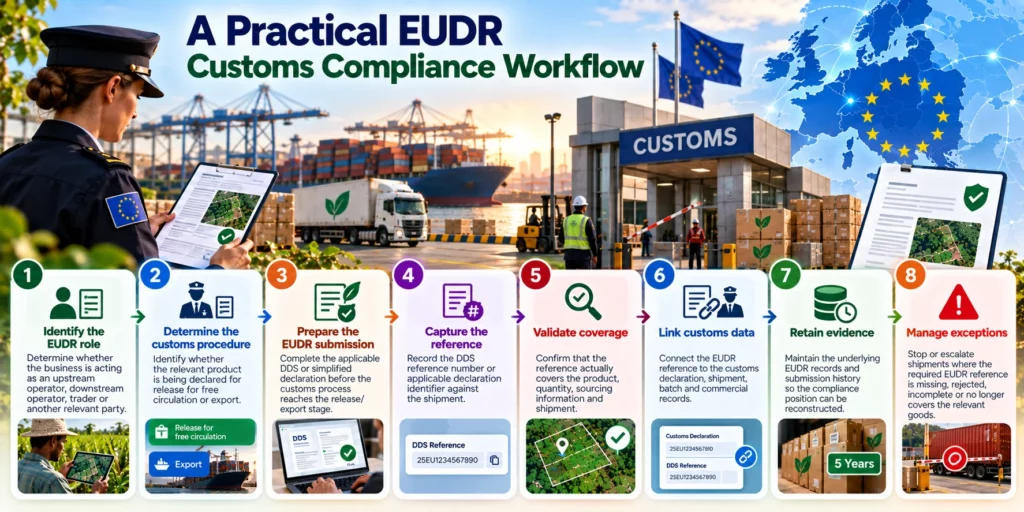
For an upstream operator placing imported relevant products on the EU market or exporting relevant products, the DDS reference number must be made available to customs before the relevant product is released for free circulation or exported. The current Regulation provides an exception where the DDS is made available to customs through the electronic interface established under the Regulation.
A DDS reference number is assigned by the EUDR Information System after the DDS has been processed through the system’s applicable workflow. The system also assigns a verification number. Businesses should therefore treat the DDS reference as a transaction-critical compliance identifier rather than as a document number that can be added later.
Example: Coffee Import Into the EU
A coffee importer brings green coffee from India into the EU. The importer is the operator responsible for the relevant imported product. Before the coffee can be released for free circulation, the applicable DDS reference must be available to customs, unless the DDS is made available through the relevant electronic interface.
Operationally, the importer should connect the customs declaration, shipment or batch, product information, DDS reference and supporting EUDR evidence in its compliance workflow.
Learn how to track, link, and manage DDS reference numbers and declaration identifiersacross suppliers, products, shipments, and customs declarations.
The EUDR Information System also provides for simplified declarations for micro or small primary operators. A declaration identifier is the identifier assigned to such a simplified declaration. The current implementing rules define a declaration identifier separately from the DDS reference number.
This distinction matters because businesses should not treat every EUDR customs reference as a DDS number. The correct identifier depends on the type of EUDR submission associated with the relevant product.
Understand how Micro and Small Primary Operators (MSPOs) are treated under EUDR, including simplified declarations, geolocation requirements, and the specific compliance obligations that apply to qualifying smallholders and primary producers.
The customs link applies to the two procedures specifically identified in Article 26: release for free circulation and export. For imports, the customs declaration is connected to the product entering the EU market. For exports, the relevant declaration concerns a relevant product leaving the Union.
Example: An Indian exporter shipping a relevant rubber product to an EU customer should understand that the EU-side import process and EUDR obligations need to be coordinated with the operator responsible for placing the product on the EU market. Separately, an EU-based operator exporting a relevant product must account for the EUDR requirements applicable to exports.
Can One DDS Reference Number Be Used for Multiple Shipments?
A DDS may cover multiple shipments or batches when the scope and conditions of the DDS support those shipments. In that situation, the same DDS reference number may be used in several customs declarations, provided the products and transactions remain within the coverage of the DDS and all applicable EUDR requirements are met.
This is particularly important for companies managing recurring shipments from the same supply chain. The operational control should not simply be ‘reuse the DDS number’; it should be ‘verify that each shipment is actually covered by the DDS before reusing its reference’.
Example: Multiple Coffee Shipments
An importer has a DDS covering a defined set of compliant coffee products sourced from identified production plots. The importer receives three shipments covered by that DDS. The same DDS reference may be associated with multiple customs declarations where the DDS legitimately covers each shipment. If a later shipment falls outside the scope or facts supporting the DDS, the reference should not be reused without the appropriate compliance action.
Understand how EUDR DDS consolidation can simplify compliance by combining multiple Due Diligence Statements, reducing administrative effort while maintaining the required traceability and reference links.
A key distinction in EUDR customs compliance is between upstream operators and downstream operators. Where a downstream operator places on the market or exports relevant products that are already covered by an upstream DDS or applicable simplified declaration, it does not necessarily submit a new DDS for those products.
Instead, the downstream operator’s obligations depend on its role, the product, the transaction and the information already available through the upstream supply chain. The EUDR framework requires relevant reference information to be communicated through the supply chain in the circumstances specified by the Regulation.
This means a downstream business should not automatically create a new DDS for every transaction. It should first determine whether the product is already covered by an upstream DDS or simplified declaration and identify the applicable downstream obligations.
Example: Downstream Wood Product Manufacturer
A European furniture manufacturer purchases wood panels that are already covered by an upstream operator’s EUDR DDS. The manufacturer later exports a relevant finished product. The compliance team should first establish whether the product and transaction fall within the downstream rules and whether the existing upstream DDS or simplified declaration provides the required coverage. The company should then maintain the applicable reference information and supporting records rather than assuming that a completely new DDS is always required.
Understand how EUDR obligations change once a product moves downstream, including DDS reference management, traceability, record-keeping, SME vs non-SME requirements, and responsibilities when non-compliance concerns arise.
How the EUDR Information System Connects to Customs
The EUDR Information System assigns reference numbers to DDS submissions and declaration identifiers to simplified declarations. The implementing rules also provide for grouping DDSs and simplified declarations. A grouped DDS or simplified declaration can represent the individual submissions it references for the purposes of EUDR compliance, with the grouped reference or identifier communicated where the Regulation requires it.
For businesses, this means the EUDR compliance platform should be capable of maintaining a clear relationship between original submissions, grouped submissions, products, shipments and customs declarations.
How Can TraceX Support EUDR Customs Compliance?
TraceX EUDR Solutions helps businesses operationalize EUDR customs compliance by connecting DDS reference numbers and declaration identifiers with the underlying supplier, product, batch, shipment, and due-diligence data. Instead of managing references separately in spreadsheets or across multiple systems, companies can maintain a connected compliance trail from source-level information through procurement and shipment. This makes it easier to retrieve the correct EUDR reference for customs declarations, maintain traceability across shipments, and demonstrate the supporting evidence behind each declaration when required.
Ready to Simplify Your EUDR Customs Compliance?
See how TraceX connects DDS references, shipments, products, suppliers, and compliance evidence in one platform.
Treating the EUDR DDS as a document that can be submitted after customs release.
Confusing a DDS reference number with a customs MRN or other customs identifier.
Using a DDS reference for a shipment without checking whether the DDS actually covers that shipment.
Creating a new DDS for every downstream transaction without first checking the applicable downstream rules.
Failing to link the DDS reference to the shipment and customs declaration in internal systems.
Relying on spreadsheets or emails without a controlled audit trail for reference numbers and coverage.
EUDR Customs Declaration Checklist
Is the product within EUDR scope?
Who is the operator responsible for the relevant placing on the market or export?
Is the customs procedure release for free circulation or export?
Has the applicable DDS or simplified declaration been submitted?
Has the Information System assigned the applicable reference number or declaration identifier?
Is the reference available to customs before release or export, where required?
Does the reference cover the specific product and shipment?
If the product is downstream, is it already covered by an upstream DDS or simplified declaration?
Are the customs, shipment and EUDR records linked and retrievable?
Conclusion
EUDR customs declarations connect regulatory due diligence with the practical movement of goods across the EU border. For upstream operators, the key operational requirement is to ensure that the applicable DDS reference number or, where relevant, the declaration identifier is available to customs before release for free circulation or export.
For downstream operators, the analysis is different. Products may already be covered by an upstream DDS or simplified declaration, so businesses should first establish the applicable downstream obligations rather than assuming that every transaction requires a new DDS.
The most reliable approach is to connect EUDR submissions with shipment, batch and customs data in a single traceability workflow. This gives compliance teams a clear audit trail and helps ensure that the correct EUDR reference is available when customs and competent authorities need it.
Frequently Asked Questions (FAQ’s)
What is an EUDR DDS reference number?
It is the reference number assigned by the EUDR Information System to a Due Diligence Statement. It is used to identify the applicable DDS and, where required, is made available to customs for relevant imports or exports.
When must the EUDR DDS reference be available to customs?
For relevant products subject to release for free circulation or export, the applicable reference must be made available to customs before release or export, subject to the electronic-interface provision in Article 26(4).
Can one DDS reference number be used for multiple shipments?
Yes, where the DDS legitimately covers the multiple shipments or batches and all applicable EUDR requirements continue to be met.
Do downstream operators always need to submit a new DDS?
No. Where relevant products are already covered by an upstream DDS or applicable simplified declaration, the downstream rules do not automatically require a new DDS. The operator should determine its specific obligations based on its role and transaction.
What is the difference between a DDS reference number and a declaration identifier?
A DDS reference number identifies a Due Diligence Statement. A declaration identifier identifies a simplified declaration submitted by a micro or small primary operator.
Start using TraceX
Transparency, Trust, & Success for your Climate Journey.
We use cookies on our website to give you the most relevant experience by remembering your preferences and repeat visits. By clicking “Accept All”, you consent to the use of ALL the cookies. However, you may visit "Cookie Settings" to provide a controlled consent.
This website uses cookies to improve your experience while you navigate through the website. Out of these, the cookies that are categorized as necessary are stored on your browser as they are essential for the working of basic functionalities of the website. We also use third-party cookies that help us analyze and understand how you use this website. These cookies will be stored in your browser only with your consent. You also have the option to opt-out of these cookies. But opting out of some of these cookies may affect your browsing experience.
Necessary cookies are absolutely essential for the website to function properly. These cookies ensure basic functionalities and security features of the website, anonymously.
Cookie
Duration
Description
cookielawinfo-checkbox-analytics
11 months
This cookie is set by GDPR Cookie Consent plugin. The cookie is used to store the user consent for the cookies in the category "Analytics".
cookielawinfo-checkbox-functional
11 months
The cookie is set by GDPR cookie consent to record the user consent for the cookies in the category "Functional".
cookielawinfo-checkbox-necessary
11 months
This cookie is set by GDPR Cookie Consent plugin. The cookies is used to store the user consent for the cookies in the category "Necessary".
cookielawinfo-checkbox-others
11 months
This cookie is set by GDPR Cookie Consent plugin. The cookie is used to store the user consent for the cookies in the category "Other.
cookielawinfo-checkbox-performance
11 months
This cookie is set by GDPR Cookie Consent plugin. The cookie is used to store the user consent for the cookies in the category "Performance".
viewed_cookie_policy
11 months
The cookie is set by the GDPR Cookie Consent plugin and is used to store whether or not user has consented to the use of cookies. It does not store any personal data.
Functional cookies help to perform certain functionalities like sharing the content of the website on social media platforms, collect feedbacks, and other third-party features.
Performance cookies are used to understand and analyze the key performance indexes of the website which helps in delivering a better user experience for the visitors.
Analytical cookies are used to understand how visitors interact with the website. These cookies help provide information on metrics the number of visitors, bounce rate, traffic source, etc.
Advertisement cookies are used to provide visitors with relevant ads and marketing campaigns. These cookies track visitors across websites and collect information to provide customized ads.
Download the 2026 Traceability Scorecard and Benchmark Your Supply Chain Across 10 Critical Capabilities.
Download our eBook
Don’t Wait for an Audit to Find Your EUDR Gaps
The 2026 Simplification Package changes how HS codes, DDS pass-through and geolocation rules apply to you. Get the free guide and 20-point readiness checklist before enforcement catches you unprepared.