EUDR Article 5: Obligations of Traders – A Practical Guide to EUDR Compliance
Published
, 10 minute read
Share this article
Quick summary: EUDR Article 5 explains trader obligations for traceability, DDS references, five-year record keeping, risk alerts, and competent authority checks.
EUDR Article 5 sets out the obligations of traders that make relevant commodities and relevant products available on the EU market. The rules differ significantly depending on whether the trader is an SME or a non-SME. For SME traders, Article 5 focuses primarily on traceability: they must hold specific information about who supplied the relevant product and who received it. Non-SME traders are treated as non-SME operators and therefore face the broader obligations that apply to operators under the Regulation.
Understanding EUDR Article 5 is important because a trader may sit between an upstream supplier and another business without being the party that originally produced the commodity. The trader still has defined responsibilities for information, records, communication and cooperation with competent authorities.
Key Takeaways
Non-SME traders are treated as non-SME operators and are subject to the broader EUDR obligations applicable to operators.
SME traders have specific traceability obligations and must possess the information required under Article 5 before making relevant products available.
SME traders must maintain supplier and customer information, including names, addresses, contact details and applicable DDS reference numbers.
Required information must be retained for at least five years from the date the product is made available on the market.
If new information or a substantiated concern indicates a risk of non-compliance, SME traders must act immediately and inform the relevant authorities and affected traders.
All traders must cooperate with competent authorities, including providing access to relevant records and documentation.
Effective EUDR compliance requires traceability across suppliers, products, DDS references and customers, rather than treating the DDS as a standalone document.
December 2026 is approaching. Is your supply chain actually ready?
Move from spreadsheets and fragmented supplier data to a traceable, audit-ready EUDR workflow with TraceX.
Article 5 of Regulation (EU) 2023/1115 addresses the obligations of traders. Under the current consolidated Regulation, non-SME traders are considered non-SME operators for the relevant products they make available on the market and are subject to the corresponding operator obligations. SME traders have a more limited information and traceability obligation: they may make relevant products available only when they possess the information specified in Article 5(3). The European Commission’s 2025 guidance similarly explains that SME traders do not need to conduct the full operator due diligence process; their core obligation is to maintain traceability information and make it available to competent authorities when requested.
What are the obligations for SME/Non SME Traders?
1. Non-SME Traders: Why Their Obligations Are Broader
Article 5(1) states that non-SME traders are considered non-SME operators. This means their compliance responsibilities extend beyond simply recording supplier and customer information. They are subject to the relevant provisions covering compliance with Article 3, operator obligations, due diligence, risk assessment and mitigation, record keeping and other applicable requirements.
Example: A large European company purchases cocoa from a supplier and resells it to a chocolate manufacturer. Because the company is a non-SME trader, it is not treated like an SME trader that merely keeps supplier and customer records. Its activities fall within the broader non-SME operator framework.
2. SME Traders: The Core EUDR Information Requirement
For SME traders, Article 5(2) establishes a clear condition: they may make relevant products available on the market only if they possess the information required under Article 5(3). This creates a practical traceability checkpoint before a transaction proceeds.
The required information covers two sides of the transaction: the business that supplied the relevant product to the SME trader and the business to which the SME trader subsequently supplies it.
Understand the EUDR obligations for SME and non-SME traders, including traceability, supplier and customer information, DDS references, record keeping, and cooperation with competent authorities.
Under Article 5(3)(a), an SME trader must collect the supplier’s name, registered trade name or registered trademark, postal address, email address and, if available, web address. The trader must also retain the reference numbers of the due diligence statements associated with the relevant products.
Under Article 5(3)(b), the SME trader must collect equivalent identifying information for the business to which it supplies the relevant products: name, registered trade name or trademark, postal address, email address and, if available, web address.
In practice, this means an SME trader should be able to answer a simple chain-of-custody question: Who supplied this product to us, which EUDR due diligence statement is associated with it, and who did we supply it to?
Example: SME Coffee Trader
Consider an SME coffee trader in Belgium purchasing green coffee from an exporter. Before making the coffee available to another company, the trader should have the exporter’s legal and contact details and the reference number of the relevant due diligence statement. The trader should also record the identity and contact details of its customer.
If the DDS reference number is missing, the trader has not yet collected all information required under Article 5(3). The practical workflow should therefore flag the transaction for supplier action rather than treating the record as complete.
Five-Year Record-Keeping Requirement
Article 5(4) requires SME traders to keep the information referred to in Article 5(3) for at least five years from the date the relevant product was made available on the market. They must provide the information to competent authorities upon request.
This makes record retention an operational requirement, not simply a documentation preference. Businesses should be able to retrieve historical supplier, customer and DDS-reference information in a structured way.
Learn how to organise, track, and manage EUDR Due Diligence Statement (DDS) reference numbers across suppliers, products, shipments, and downstream transactions.
An SME trader sells a batch of rubber products to a European manufacturer in February 2027. In a later competent-authority check, the trader may be asked to provide the supplier identity, associated DDS reference and customer identity. A system that stores these fields against the transaction or batch makes retrieval significantly easier than searching through disconnected emails, PDFs and spreadsheets.
What Happens When New Information Raises a Concern?
Article 5(5) requires SME traders to act when they obtain or become aware of relevant new information, including substantiated concerns, indicating that a relevant product they made available on the market may be at risk of not complying with the Regulation. They must immediately inform the competent authorities of the Member States where they made the product available and inform traders to whom they supplied the relevant product.
Example: An SME trader learns after a sale that a supplier’s product may be associated with a substantiated deforestation concern. The trader should not treat the original transaction as permanently closed. The new information triggers an escalation and notification process under Article 5(5).
Cooperation With Competent Authorities
Article 5(6) applies to traders whether or not they are SMEs. Traders must offer all necessary assistance to competent authorities carrying out checks under the Regulation, including access to premises and making documentation and records available.
For compliance teams, this means records should be organized for retrieval and verification. A defensible EUDR process should connect products or batches to their relevant suppliers, customers, DDS references and supporting records where applicable.
SME Trader vs Non-SME Trader: A Practical Comparison
Requirement
SME Trader
Non-SME Trader
Full operator due diligence
Not required solely by Article 5; maintain required traceability information
Subject to applicable non-SME operator obligations
Supplier information
Required
Required as part of applicable obligations
DDS reference numbers
Required
Relevant DDS obligations apply under the operator framework
Customer information
Required
Relevant operator/trader obligations apply
Record retention
At least 5 years
Applicable record-keeping obligations apply
Authority cooperation
Required
Required
Action on substantiated new concerns
Immediate notification obligations under Article 5(5)
Applicable obligations under the operator framework
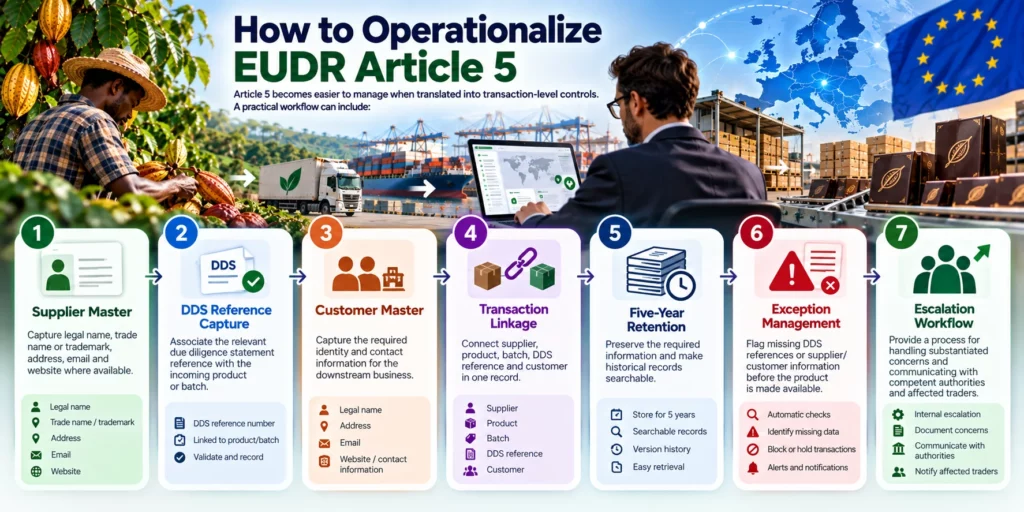
How to Operationalize EUDR Article 5
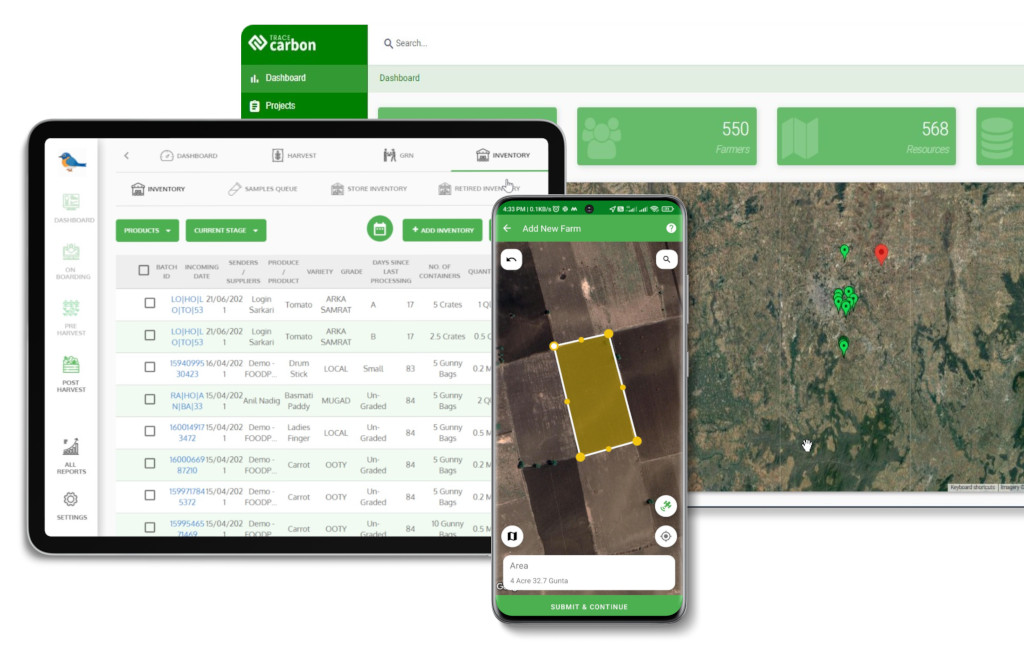
TraceX EUDR Solutions can operationalize EUDR Article 5 by turning the trader’s traceability and record-keeping obligations into a structured digital workflow. For SME traders, TraceX can maintain supplier and customer records, product information, and the relevant DDS reference numbers or declaration identifiers, with a searchable five-year audit trail. It can link incoming products to their suppliers, batches and EUDR references, making it easier to retrieve the required information when requested by competent authorities. TraceX can also flag new information or compliance concerns so the trader can initiate the required notification and follow-up process. For non-SME downstream operators and traders, the platform can additionally support Information System registration workflows and, where a substantiated concern arises, help verify upstream due diligence and the associated reference information.
See how TraceX connects supplier data, geolocation, traceability, risk assessment, evidence, and DDS workflows in one platform.
EUDR compliance is not limited to submitting a Due Diligence Statement. The Regulation creates information and traceability responsibilities that extend through commercial transactions. For SME traders, the focus under Article 5 is particularly clear: know who supplied the product, retain the associated DDS reference, know who received the product, preserve the information and respond when new compliance concerns arise.
This is why disconnected spreadsheets, email attachments and PDFs can create operational gaps. A structured EUDR traceability workflow can give compliance teams a transaction-level view of suppliers, products, DDS references, customers and exceptions.
EUDR Article 5 Compliance Checklist
Have we identified whether the trader is an SME or non-SME?
For SME traders, do we have the required supplier identity and contact information?
Do we have the relevant DDS reference numbers?
Do we have the required customer identity and contact information?
Can we retrieve the information for at least five years?
Is there a process for responding to substantiated new concerns?
Can we provide documentation and records to competent authorities when requested?
Are supplier, product, DDS and customer records linked rather than stored in isolated systems?
Conclusion
EUDR Article 5 creates a clear distinction between SME and non-SME traders. Non-SME traders are treated as non-SME operators and are subject to the broader operator framework. SME traders have a more focused traceability obligation, requiring them to hold specified supplier and customer information and associated DDS references, retain that information for at least five years, respond to substantiated new concerns and cooperate with competent authorities.
For businesses preparing for EUDR application, the practical priority is to turn these legal requirements into repeatable workflows. Supplier onboarding, DDS reference capture, customer records, transaction linkage, retention and exception handling should work together so that the required evidence can be retrieved when needed.
Frequently Asked Questions (FAQ’s)
What is EUDR Article 5?
EUDR Article 5 sets out the obligations of traders. It distinguishes between SME traders, who have defined traceability and information obligations, and non-SME traders, who are treated as non-SME operators.
Do SME traders need to conduct full EUDR due diligence?
Under the Commission’s 2025 guidance, SME traders do not need to conduct the full operator due diligence process solely because they are SME traders under Article 5. Their core obligation is to maintain the required traceability information.
How long must SME traders keep Article 5 information?
At least five years from the date the relevant product was made available on the market.
What information must an SME trader collect?
The required information includes supplier and customer identity and contact details, plus the reference numbers of the due diligence statements associated with the relevant products.
What if an SME trader discovers a substantiated concern after a sale?
Article 5(5) requires immediate notification to the relevant competent authorities and to traders to whom the product was supplied, when the trader obtains or becomes aware of relevant new information indicating a risk of non-compliance.
Start using TraceX
Transparency, Trust, & Success for your Climate Journey.
We use cookies on our website to give you the most relevant experience by remembering your preferences and repeat visits. By clicking “Accept All”, you consent to the use of ALL the cookies. However, you may visit "Cookie Settings" to provide a controlled consent.
This website uses cookies to improve your experience while you navigate through the website. Out of these, the cookies that are categorized as necessary are stored on your browser as they are essential for the working of basic functionalities of the website. We also use third-party cookies that help us analyze and understand how you use this website. These cookies will be stored in your browser only with your consent. You also have the option to opt-out of these cookies. But opting out of some of these cookies may affect your browsing experience.
Necessary cookies are absolutely essential for the website to function properly. These cookies ensure basic functionalities and security features of the website, anonymously.
Cookie
Duration
Description
cookielawinfo-checkbox-analytics
11 months
This cookie is set by GDPR Cookie Consent plugin. The cookie is used to store the user consent for the cookies in the category "Analytics".
cookielawinfo-checkbox-functional
11 months
The cookie is set by GDPR cookie consent to record the user consent for the cookies in the category "Functional".
cookielawinfo-checkbox-necessary
11 months
This cookie is set by GDPR Cookie Consent plugin. The cookies is used to store the user consent for the cookies in the category "Necessary".
cookielawinfo-checkbox-others
11 months
This cookie is set by GDPR Cookie Consent plugin. The cookie is used to store the user consent for the cookies in the category "Other.
cookielawinfo-checkbox-performance
11 months
This cookie is set by GDPR Cookie Consent plugin. The cookie is used to store the user consent for the cookies in the category "Performance".
viewed_cookie_policy
11 months
The cookie is set by the GDPR Cookie Consent plugin and is used to store whether or not user has consented to the use of cookies. It does not store any personal data.
Functional cookies help to perform certain functionalities like sharing the content of the website on social media platforms, collect feedbacks, and other third-party features.
Performance cookies are used to understand and analyze the key performance indexes of the website which helps in delivering a better user experience for the visitors.
Analytical cookies are used to understand how visitors interact with the website. These cookies help provide information on metrics the number of visitors, bounce rate, traffic source, etc.
Advertisement cookies are used to provide visitors with relevant ads and marketing campaigns. These cookies track visitors across websites and collect information to provide customized ads.
Download the 2026 Traceability Scorecard and Benchmark Your Supply Chain Across 10 Critical Capabilities.
Download our eBook
Don’t Wait for an Audit to Find Your EUDR Gaps
The 2026 Simplification Package changes how HS codes, DDS pass-through and geolocation rules apply to you. Get the free guide and 20-point readiness checklist before enforcement catches you unprepared.