Economic Operators in EUDR: Roles, Responsibilities and Practical Examples
Published
, 12 minute read
Share this article
Quick summary: Economic Operators in EUDR must understand roles, DDS obligations and compliance rules for upstream, downstream and small primary operators.
Economic Operators in EUDR play a central role in determining who is responsible for due diligence, traceability and compliance when relevant products are placed on the EU market or exported. But not every company in an EUDR supply chain has the same obligations.
An importer, manufacturer, downstream operator, trader and micro or small primary operator can have different responsibilities depending on what they do with the product and where they sit in the supply chain. Under the revised EUDR framework, downstream operators and traders generally follow different requirements from the operator responsible for the upstream due-diligence process, while qualifying micro and small primary operators can use a simplified declaration regime.
The revised EUDR has simplified parts of the downstream supply chain. In particular, downstream operators and traders are generally no longer required to submit their own Due Diligence Statements (DDS), while the first operator placing a relevant product on the EU market or exporting it carries the main due-diligence responsibility. New rules also introduced micro or small primary operators and simplified declarations. The European Commission has published updated guidance and Information System rules to reflect these changes.
Key Takeaways
Economic Operators in EUDR are not defined simply by company type or industry. Their obligations depend on what they do with relevant products and where they sit in the supply chain.
The revised EUDR places the main full due-diligence responsibility on the relevant upstream operator, while downstream operators and traders have more limited obligations under the revised framework.
Qualifying micro or small primary operators have a simplified declaration route.
The practical challenge is therefore not only understanding the regulation. It is correctly identifying the role for each supply-chain scenario and building a workflow that applies the right obligation at the right point.
December 2026 is approaching. Is your supply chain actually ready?
Move from spreadsheets and fragmented supplier data to a traceable, audit-ready EUDR workflow with TraceX.
Under EUDR, an operator is a natural or legal person who, in the course of a commercial activity, places relevant commodities and products on the EU market or exports them from the EU.
This definition is important because the word “operator” is about what the company does not simply what industry it belongs to.
For example, imagine a Dutch company importing coffee beans from Brazil for the first time and placing those beans on the EU market. If the product is within EUDR scope and no relevant upstream DDS already covers it, the Dutch company can be the operator responsible for carrying out due diligence and submitting the DDS.
Now imagine a German chocolate manufacturer buying cocoa that has already been covered by an upstream DDS. The German manufacturer may have a downstream role rather than repeating the full due-diligence process.
Why Your EUDR Role Matters
Two companies can handle the same commodity but have very different EUDR responsibilities.
Consider coffee. A Brazilian producer grows coffee, an exporter ships it, a Dutch importer brings it into the EU, a German roaster processes it, and a supermarket sells the packaged coffee.
The important question is not simply, “Who sells coffee?”
Instead ask:
Who first places the relevant product on the EU market?
Has the product already been covered by a DDS or simplified declaration?
Is the company an upstream operator, downstream operator or trader?
Is the company an SME or non-SME?
Is it a micro or small primary operator that qualifies for the simplified declaration regime?
Getting this classification right is the starting point for determining what the company must actually do.
Your EUDR obligations can change significantly depending on where you sit in the supply chain and whether the product is already covered by a DDS or simplified declaration.
The current EUDR framework distinguishes several important roles:
1. Operator
The company placing relevant products on the EU market or exporting them where it has the upstream operator responsibility. Operators subject to the full due-diligence regime must collect the required information, assess and mitigate risk where necessary, and submit a DDS before the relevant activity.
If your business is responsible for placing or exporting EUDR-relevant products, understanding your operator obligations is critical from due diligence and geolocation to risk assessment, mitigation and DDS submission.
A specific category covers qualifying natural persons or micro/small enterprises that themselves produce relevant products in low-risk countries. Instead of submitting a DDS for each relevant placement/export, they submit a one-time simplified declaration under the applicable rules.
Understand how Micro and Small Primary Operators (MSPOs) are treated under EUDR, including simplified declarations, production locations, geolocation requirements, and the specific obligations that apply to qualifying primary producers.
A company that receives or uses a relevant product already covered by the EUDR upstream. Downstream operators generally do not submit a new DDS. Their obligations focus on collecting and keeping the information required under the revised Article 5 framework.
4. Trader
A trader makes relevant products available on the EU market but does not necessarily carry the upstream operator responsibility. Trader obligations depend on whether the trader is an SME or non-SME and on its position in the supply chain.
5. Authorised Representative
An operator or qualifying primary operator can use an authorised representative to submit a DDS or simplified declaration on its behalf, while the underlying legal responsibilities remain with the relevant operator.
Get EUDR-ready with confidence!
Download our EUDR Compliance Toolkit 2026: 10 Practical Checklists for EUDR Readiness to assess your compliance gaps, strengthen due diligence, and prepare your supply chain for EUDR requirements.
Imagine a Dutch company importing coffee beans from Brazil. The company is bringing the coffee into the EU for the first time, and the product is not already covered by a relevant DDS.
The company needs to look at its role as the operator. That means its process needs to cover the EUDR due-diligence requirements: supplier information, production location, geolocation, production details, legality information, deforestation assessment, risk assessment and, where required, risk mitigation.
Once the due diligence is completed, the company submits the DDS through the EUDR Information System.
The lesson is simple: an importer cannot treat EUDR as just a document requested from the Brazilian supplier. The importer needs a process that connects the source information to its own due-diligence responsibility.
Example 2: Chocolate Manufacturer Buying Covered Cocoa
Now consider a Belgian chocolate manufacturer buying cocoa from a supplier where the relevant cocoa is already covered by an upstream DDS.
The manufacturer may be a downstream operator rather than a new upstream operator. Under the revised EUDR framework, it generally does not need to submit another DDS merely because it processes or uses the product.
However, the manufacturer still has traceability and information obligations. If it is the first downstream operator after the upstream operator, the required information includes the relevant DDS reference number or declaration identifier.
This is where supply-chain position becomes important. The company needs to know what it received, from whom, and what EUDR reference is associated with the relevant product.
Example 3: Small Supermarket Selling Packaged Chocolate
Consider a small independent supermarket purchasing packaged chocolate that has already been covered upstream.
The supermarket is not automatically required to repeat the upstream operator’s full due diligence. Its obligations depend on its role and size under the EUDR.
For an SME trader or downstream actor, the practical focus can be on maintaining required information about business partners and acting when it becomes aware of information indicating possible non-compliance.
The takeaway is that EUDR does not mean every company in the chain has to repeat the same compliance exercise. The obligation follows the company’s role and position in the supply chain.
Example 4: Micro or Small Primary Coffee Producer
Consider a qualifying small coffee producer in a low-risk country that grows and harvests its own coffee.
The revised EUDR introduced the micro or small primary operator category to reduce repetitive reporting for qualifying producers.
Instead of submitting a full DDS for every relevant placement or export, the qualifying operator submits a simplified declaration according to the applicable rules. The Information System assigns a declaration identifier.
That identifier then supports traceability as the product moves downstream.
For technology providers, this means a supplier onboarding workflow should not assume that every producer follows exactly the same DDS process. The system needs to distinguish between full DDS workflows and simplified-declaration workflows.
Example 5: One Company Can Have Different Roles
Role classification can become more complicated when one company performs several activities.
For example, a company may import raw cocoa into the EU, process it into chocolate, and then export some finished products. Depending on the transaction and supply-chain position, different EUDR provisions can apply.
This is why businesses should avoid creating a single “EUDR company role” and assuming it applies to every transaction.
A better approach is to determine the role at the relevant product and supply-chain event level.
What Do Economic Operators Need to Manage?
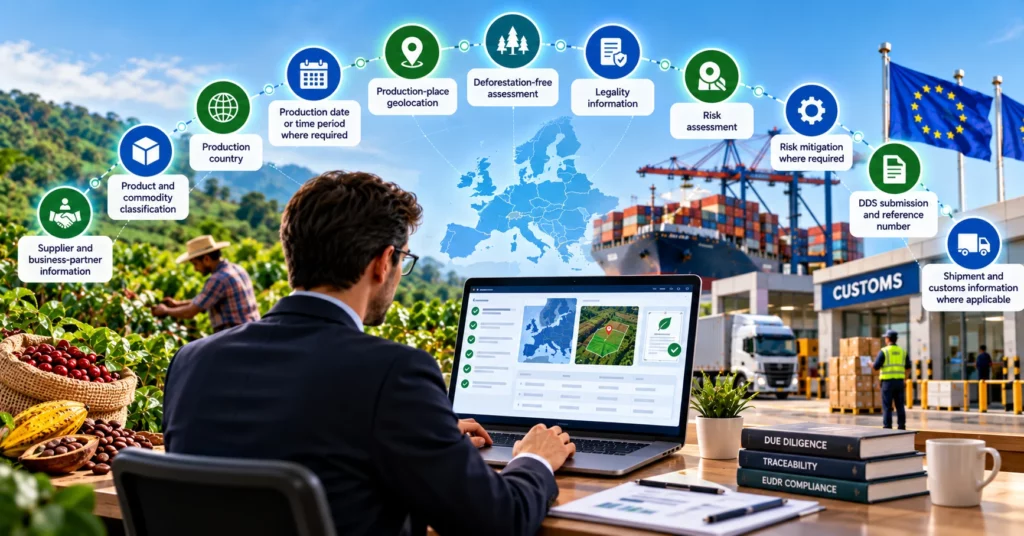
For an operator with full due-diligence responsibility, the compliance workflow needs to connect several types of information:
Supplier and business-partner information
Product and commodity classification
Production country
Production date or time period where required
Production-place geolocation
Deforestation-free assessment
Legality information
Risk assessment
Risk mitigation where required
DDS submission and reference number
Shipment and customs information where applicable
The important point is connectivity. A polygon sitting in one system, a supplier document in another, and a DDS reference in an Excel sheet may create administrative work and reconciliation risk.
Economic Operators and the EUDR Information System
The EUDR Information System is central to the revised workflow. The current system supports registration of operators and traders and their authorised representatives, submission of DDSs, simplified declarations for qualifying micro or small primary operators, and other functions.
For relevant operators placing products under release for free circulation or export, the EORI number must be included in the registration profile.
The system also assigns a reference number to submitted DDSs and a declaration identifier to simplified declarations. These identifiers support traceability across the supply chain and customs processes.
The Commission’s 2026 implementing rules specifically updated the Information System to reflect the new downstream operator and micro/small primary operator categories.
The EUDR Information System is where businesses manage key compliance activities, including Due Diligence Statements, Simplified Declarations, geolocation data, reference numbers and downstream verification.
The revised framework changed downstream responsibilities. Not every downstream operator or trader needs to submit its own DDS.
2. Treating EUDR as a supplier-document exercise
Supplier information is important, but the responsible operator needs an end-to-end due-diligence process.
3. Confusing EORI with DDS references
EORI identifies the economic operator for customs. The DDS reference identifies the submitted due-diligence statement.
4. Ignoring supply-chain position
The first downstream operator can have different information requirements from actors further downstream.
5. Using one workflow for every supplier
Qualifying micro or small primary operators can follow the simplified declaration route.
6. Separating compliance from procurement and customs
The relevant EUDR data needs to connect with products, purchases, batches, shipments and customs activities.
Economic Operators in EUDR: Practical Checklist
Before implementation, ask:
Have we identified every EUDR-relevant product?
Have we mapped our role for each relevant supply-chain scenario?
Are we an upstream operator, downstream operator, trader or qualifying micro/small primary operator?
Do we know whether an upstream DDS or simplified declaration already exists?
Can we collect the required supplier and product information?
Can we connect products to production locations and geolocation?
Can we perform and document risk assessment and mitigation where required?
Can we manage DDS references and declaration identifiers?
Is our EORI correctly captured where required?
Can we connect EUDR records with procurement and customs workflows?
How TraceX Can Help Economic Operators
TraceX EUDR Solutions helps businesses operationalise EUDR by connecting the data and workflows behind compliance.
Instead of treating supplier information, geolocation, legality documents, risk assessment, traceability, DDS references and shipment data as separate activities, TraceX can bring them into a connected workflow.
For an upstream operator, this can support supplier onboarding, production-place mapping, geolocation validation, deforestation checks, legality evidence, risk assessment, risk mitigation and DDS preparation.
For downstream businesses, the workflow can focus on supplier information, EUDR reference management, traceability and the obligations applicable to their role.
For larger supply chains, role-based workflows are particularly important because the same organisation may encounter different EUDR obligations across different transactions.
TraceX helps connect supplier data, production locations, geolocation, traceability, risk assessment, evidence, DDS workflows and customs-related information in one connected compliance process.
See how TraceX can help you operationalise EUDR compliance across your supply chain.
An operator is a natural or legal person who, in the course of a commercial activity, places relevant products on the EU market or exports them from the EU.
Does every company in an EUDR supply chain need to submit a DDS?
No. Under the revised framework, downstream operators and traders are generally not required to submit their own DDS. The obligation depends on the company’s role and position.
What is the difference between an operator and a downstream operator?
The upstream operator carries the relevant due-diligence responsibility when it is the party placing the product on the EU market or exporting it under the applicable rules. A downstream operator receives or uses relevant products already covered upstream and follows the obligations applicable to downstream actors.
What is a micro or small primary operator?
It is a specific EUDR category for qualifying natural persons or micro/small enterprises that produce relevant products themselves in a low-risk country and meet the regulatory conditions for the simplified regime.
Does a downstream operator need the DDS reference number?
The first downstream operator or trader needs to collect the relevant DDS reference numbers or declaration identifiers under the revised framework. Further downstream obligations differ.
Is EORI the same as the EUDR reference number?
No. EORI identifies the economic operator for customs purposes. A DDS reference identifies a submitted Due Diligence Statement.
Start using TraceX
Transparency, Trust, & Success for your Climate Journey.
We use cookies on our website to give you the most relevant experience by remembering your preferences and repeat visits. By clicking “Accept All”, you consent to the use of ALL the cookies. However, you may visit "Cookie Settings" to provide a controlled consent.
This website uses cookies to improve your experience while you navigate through the website. Out of these, the cookies that are categorized as necessary are stored on your browser as they are essential for the working of basic functionalities of the website. We also use third-party cookies that help us analyze and understand how you use this website. These cookies will be stored in your browser only with your consent. You also have the option to opt-out of these cookies. But opting out of some of these cookies may affect your browsing experience.
Necessary cookies are absolutely essential for the website to function properly. These cookies ensure basic functionalities and security features of the website, anonymously.
Cookie
Duration
Description
cookielawinfo-checkbox-analytics
11 months
This cookie is set by GDPR Cookie Consent plugin. The cookie is used to store the user consent for the cookies in the category "Analytics".
cookielawinfo-checkbox-functional
11 months
The cookie is set by GDPR cookie consent to record the user consent for the cookies in the category "Functional".
cookielawinfo-checkbox-necessary
11 months
This cookie is set by GDPR Cookie Consent plugin. The cookies is used to store the user consent for the cookies in the category "Necessary".
cookielawinfo-checkbox-others
11 months
This cookie is set by GDPR Cookie Consent plugin. The cookie is used to store the user consent for the cookies in the category "Other.
cookielawinfo-checkbox-performance
11 months
This cookie is set by GDPR Cookie Consent plugin. The cookie is used to store the user consent for the cookies in the category "Performance".
viewed_cookie_policy
11 months
The cookie is set by the GDPR Cookie Consent plugin and is used to store whether or not user has consented to the use of cookies. It does not store any personal data.
Functional cookies help to perform certain functionalities like sharing the content of the website on social media platforms, collect feedbacks, and other third-party features.
Performance cookies are used to understand and analyze the key performance indexes of the website which helps in delivering a better user experience for the visitors.
Analytical cookies are used to understand how visitors interact with the website. These cookies help provide information on metrics the number of visitors, bounce rate, traffic source, etc.
Advertisement cookies are used to provide visitors with relevant ads and marketing campaigns. These cookies track visitors across websites and collect information to provide customized ads.
Download the 2026 Traceability Scorecard and Benchmark Your Supply Chain Across 10 Critical Capabilities.
Download our eBook
Don’t Wait for an Audit to Find Your EUDR Gaps
The 2026 Simplification Package changes how HS codes, DDS pass-through and geolocation rules apply to you. Get the free guide and 20-point readiness checklist before enforcement catches you unprepared.