Quick summary: EUDR Article 4 explained: operator due diligence, DDS submission, 5-year record keeping, downstream communication and when products must not proceed.
What operators need to do before placing EUDR-relevant products on the EU market or exporting them
EUDR Article 4 sets out the core obligations of operators under the EU Deforestation Regulation. At its heart, Article 4 requires operators to complete due diligence before placing relevant products on the EU market or exporting them, submit a Due Diligence Statement (DDS), and take responsibility for the compliance conclusion they make.
Article 4 is therefore more than a DDS submission requirement. The DDS is the formal output of a broader process involving information collection, verification and analysis, risk assessment, and where required risk mitigation. The European Commission’s guidance explains that operators must establish and keep up to date a due diligence system and that data collection, risk analysis and mitigation should reflect the characteristics of the operator’s business and supply chains.
Key Takeaways
Due diligence comes first: Operators must complete due diligence before placing relevant products on the EU market or exporting them.
DDS is mandatory: A Due Diligence Statement must be submitted before the relevant product is placed on the market or exported.
Operators remain responsible: Submitting a DDS means the operator assumes responsibility for the product’s EUDR compliance.
Non-negligible risk means stop: Products cannot proceed where they are non-compliant, present non-negligible risk, or the required due diligence cannot be completed.
Keep records: Operators must retain DDS records for five years.
Monitor new information: New information or substantiated concerns can trigger further action and notification obligations.
Be audit-ready: Operators must provide necessary documentation, records and assistance to competent authorities.
Share information downstream: Relevant due diligence information and DDS reference numbers must be communicated further down the supply chain.
Existing DDS does not remove responsibility: Depending on the operator’s status, businesses may be able to refer to an existing DDS, but specific conditions apply and responsibility remains.
Build the process behind the DDS: EUDR compliance requires connected supplier, source, evidence, risk, traceability and shipment data not just a declaration.
December 2026 is approaching. Is your supply chain actually ready?
Move from spreadsheets and fragmented supplier data to a traceable, audit-ready EUDR workflow with TraceX.
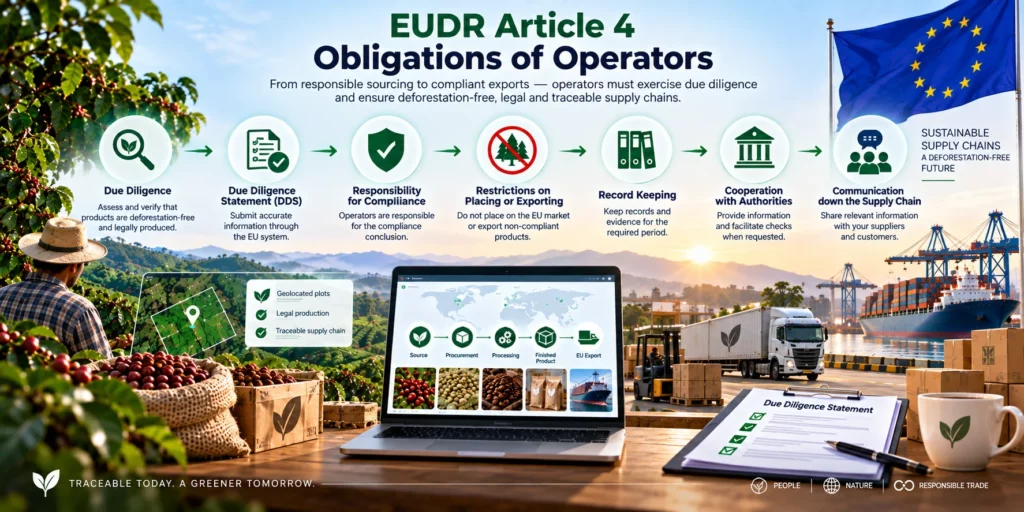
Article 4, “Obligations of operators,” establishes what an operator must do before a relevant product is placed on the market or exported. The requirements include exercising due diligence, submitting a DDS, retaining records, preventing non-compliant products from being placed on the market or exported, communicating relevant information downstream, and cooperating with competent authorities.
The framework has also evolved through amendments and implementing measures. Businesses should use the current consolidated Regulation and Commission guidance when designing compliance processes. The Commission states that the Regulation will apply from 30 December 2026 for large and medium-sized operators and for micro and small operators already covered by the EU Timber Regulation, and from 30 June 2027 for other micro and small operators.
Understanding the Operator’s Responsibility
Article 4(1) requires operators to exercise due diligence in accordance with Article 8 before placing relevant products on the market or exporting them. The purpose is to establish that the products comply with the substantive requirements of Article 3. In practice, this means having a repeatable process for collecting required information, assessing relevant risks, and documenting the basis for the conclusion. Article 4 therefore connects directly with the wider EUDR due diligence framework rather than operating as a standalone declaration step. For a timber business, for example, the workflow may connect suppliers, source plots, geolocation, production information, legality evidence, procurement quantities, risk assessment and the final product or shipment.
Submit the Due Diligence Statement Before the Transaction
Article 4(2) requires an operator that has concluded, after due diligence, that the relevant products comply with Article 3 to make a DDS available to competent authorities through the EUDR Information System before placing the products on the market or exporting them. The DDS contains the information specified in Annex II and includes the operator’s declaration that due diligence was exercised and that no or only a negligible risk was found. The practical distinction is important: submitting a DDS is the final declaration in the process; it does not replace the due diligence work supporting the conclusion.
Article 4(3) states that by making the DDS available to competent authorities, the operator assumes responsibility for the compliance of the relevant product with Article 3. Operators must also keep records of DDSs for five years from submission. This means compliance teams should maintain an audit trail showing what information was collected, what was verified, how risks were assessed, what evidence supported the conclusion, and which DDS was associated with the relevant products.
Learn what an EUDR Due Diligence Statement (DDS) is, what information it must contain, and how to prepare and submit it correctly.
When Can an Operator Place or Export an EUDR Product?
Article 4(4) identifies three situations in which an operator must not place relevant products on the market or export them:
1. The product is non-compliant
Example: A coffee exporter is sourcing coffee from a farm located in a protected area where production does not comply with applicable national laws. Even if the operator has complete farm and supplier data, the product cannot be placed on the EU market or exported as an EUDR-compliant product.
2. Due diligence identifies a non-negligible risk of non-compliance
Example: An importer has collected the supplier details and farm polygons for a batch of cocoa. Satellite assessment identifies potential deforestation after 31 December 2020 on some of the production plots. Until the operator can adequately verify and mitigate the risk, the batch should not be placed on the EU market or exported.
3. The operator cannot fulfil the applicable due diligence or DDS requirements
Example: A rubber buyer receives a shipment but the supplier cannot provide the required production geolocation. Without the required plot-level geolocation and supporting information, the operator cannot complete the due diligence process or submit a defensible DDS. The shipment therefore cannot proceed as an EUDR-compliant transaction.
A practical way to classify transactions
In an operational workflow, each transaction can be classified as:
Ready to proceed: Required data and evidence are complete, and the risk assessment supports compliance.
Supplier action required: Missing information, such as farm geolocation or legal documents, must be obtained from the supplier.
Further verification required: Risk indicators have been identified and require additional evidence or investigation.
Do not proceed: The product is non-compliant, a non-negligible risk remains, or the operator cannot fulfil the due diligence/DDS requirements.
This makes the Article 4 obligation easier to translate into an actual EUDR compliance workflow rather than treating the DDS as a standalone submission.
EUDR Compliance Doesn’t End With DDS Submission
Article 4(5) requires operators to act when they obtain or become aware of relevant new information, including substantiated concerns, indicating that a product already placed on the market may be at risk of non-compliance. The operator must immediately inform the relevant competent authorities and downstream parties, as applicable under the Regulation. This makes EUDR compliance an ongoing process rather than a one-time pre-shipment exercise.
Article 4(6) requires operators to offer the assistance necessary to facilitate checks by competent authorities, including access to premises and documentation and records. Audit readiness therefore means more than having a folder of documents. Businesses need to retrieve the information and records relevant to products under review and explain the relationship between source information, risk assessment, mitigation actions and the resulting DDS.
Learn how upstream operators can meet EUDR requirements through supplier data collection, plot-level geolocation, deforestation checks, risk assessment, and Due Diligence Statements.
Article 4(7) requires operators to communicate to operators and traders further down the supply chain the information necessary to demonstrate that due diligence was exercised and that no or only negligible risk was found, including the reference numbers of the DDSs associated with the products. This creates an operational requirement for businesses selling EUDR-relevant products to other supply-chain participants: compliance information needs to remain connected to the relevant material or product relationship.
Understand the specific EUDR obligations, due diligence requirements, and documentation that apply to downstream operators handling relevant products.
Article 4 contains specific rules for SME operators further down the supply chain. Under the supplied Article 4 text, SME operators may not be required to repeat due diligence for relevant products already subject to due diligence and covered by a submitted DDS, while they must provide the relevant DDS reference number upon request. Parts of products that have not already been subject to due diligence can trigger their own due diligence obligations. The exact application depends on the operator’s role, size and supply-chain scenario.
Article 4 provides a different rule for non-SME operators. They may refer to existing DDSs only after ascertaining that the relevant due diligence was exercised in accordance with the Regulation. They must include the reference numbers of existing DDSs in their own DDS. A reference number should therefore not be treated as a substitute for understanding the underlying due diligence.
Article 4(10) makes clear that an operator referring to an existing DDS retains responsibility for compliance with Article 3, including the conclusion that no or only negligible risk was found, before placing products on the market or exporting them. This reinforces a central EUDR principle: an upstream declaration can support a downstream workflow, but the relevant operator still needs a documented basis for relying on it.
How TraceX Can Help Operationalize Article 4
Article 4 creates a workflow challenge because its obligations span multiple teams, systems and supply-chain participants. TraceX EUDR Solutions can help operationalize this process by connecting:
The platform can support supplier engagement, source-level data collection, geolocation and GeoJSON validation, risk workflows, evidence management, material traceability and DDS-related workflows. This helps compliance teams maintain a connected record rather than managing Article 4 obligations across disconnected spreadsheets, PDFs, email threads and folders.
The objective is not simply to generate a DDS. It is to create a defensible process behind the DDS one where the operator can understand what information was collected, how it was assessed, what evidence supported the conclusion and which products or shipments the declaration relates to.
Article 4 places responsibility on operators to complete due diligence, support their conclusions with reliable information and maintain records behind their DDS. TraceX helps businesses connect supplier data, source geolocation, risk assessment, evidence, material traceability and DDS workflows in one platform.
See how to operationalize Article 4 across your supply chain.
Identify which products and transactions trigger operator obligations.
Maintain a documented due diligence process before placing products on the market or exporting.
Collect and connect required source and supply-chain information.
Verify and assess information supporting the risk conclusion.
Identify cases where risk is non-negligible or the due diligence process is incomplete.
Submit and retrieve relevant DDS information.
Retain DDS records for the required period.
Communicate relevant compliance information and DDS reference numbers downstream.
Retrieve documentation and records for competent authority checks.
Reassess information when new concerns or evidence arise.
Conclusion: Build the Process Behind the DDS
EUDR Article 4 turns due diligence into an operational responsibility. Operators need to do more than submit a declaration: they need to establish the required information, assess the risk, prevent non-compliant or non-negligible-risk products from proceeding, retain records, communicate relevant information and remain prepared to respond to new information or competent authority checks.
The practical takeaway is simple: the DDS should be the output of a connected compliance process, not the starting point. Businesses that connect suppliers, source plots, evidence, risk assessment, procurement, products and shipments can build a more structured and auditable approach to EUDR compliance.
Frequently Asked Questions (FAQ’s)
Is EUDR Article 4 only about submitting a DDS?
No. Article 4 covers the broader obligations of operators, including due diligence, the DDS, responsibility for the compliance conclusion, restrictions on placing products on the market or exporting, record keeping, cooperation with authorities and communication down the supply chain.
Does submitting a DDS mean the product is automatically compliant?
No. The DDS is based on the operator’s conclusion following due diligence. Article 4 requires the operator to establish compliance and a no-or-negligible-risk conclusion before making the DDS available.
How long must operators keep DDS records?
Article 4 requires operators to keep records of DDSs for five years from the date the statement is submitted through the Information System.
Can an operator rely on an upstream DDS?
The rules depend on the operator’s status and supply-chain position. SME operators have specific provisions for relevant products already covered by due diligence, while non-SME operators must ascertain that the relevant due diligence was exercised before referring to existing DDSs.
What should businesses prepare for an EUDR compliance check?
Businesses should be able to retrieve the records supporting their due diligence and explain the connection between source information, evidence, risk assessment, mitigation where required, products and the relevant DDS.
Start using TraceX
Transparency, Trust, & Success for your Climate Journey.
We use cookies on our website to give you the most relevant experience by remembering your preferences and repeat visits. By clicking “Accept All”, you consent to the use of ALL the cookies. However, you may visit "Cookie Settings" to provide a controlled consent.
This website uses cookies to improve your experience while you navigate through the website. Out of these, the cookies that are categorized as necessary are stored on your browser as they are essential for the working of basic functionalities of the website. We also use third-party cookies that help us analyze and understand how you use this website. These cookies will be stored in your browser only with your consent. You also have the option to opt-out of these cookies. But opting out of some of these cookies may affect your browsing experience.
Necessary cookies are absolutely essential for the website to function properly. These cookies ensure basic functionalities and security features of the website, anonymously.
Cookie
Duration
Description
cookielawinfo-checkbox-analytics
11 months
This cookie is set by GDPR Cookie Consent plugin. The cookie is used to store the user consent for the cookies in the category "Analytics".
cookielawinfo-checkbox-functional
11 months
The cookie is set by GDPR cookie consent to record the user consent for the cookies in the category "Functional".
cookielawinfo-checkbox-necessary
11 months
This cookie is set by GDPR Cookie Consent plugin. The cookies is used to store the user consent for the cookies in the category "Necessary".
cookielawinfo-checkbox-others
11 months
This cookie is set by GDPR Cookie Consent plugin. The cookie is used to store the user consent for the cookies in the category "Other.
cookielawinfo-checkbox-performance
11 months
This cookie is set by GDPR Cookie Consent plugin. The cookie is used to store the user consent for the cookies in the category "Performance".
viewed_cookie_policy
11 months
The cookie is set by the GDPR Cookie Consent plugin and is used to store whether or not user has consented to the use of cookies. It does not store any personal data.
Functional cookies help to perform certain functionalities like sharing the content of the website on social media platforms, collect feedbacks, and other third-party features.
Performance cookies are used to understand and analyze the key performance indexes of the website which helps in delivering a better user experience for the visitors.
Analytical cookies are used to understand how visitors interact with the website. These cookies help provide information on metrics the number of visitors, bounce rate, traffic source, etc.
Advertisement cookies are used to provide visitors with relevant ads and marketing campaigns. These cookies track visitors across websites and collect information to provide customized ads.
Download the 2026 Traceability Scorecard and Benchmark Your Supply Chain Across 10 Critical Capabilities.
Download our eBook
Don’t Wait for an Audit to Find Your EUDR Gaps
The 2026 Simplification Package changes how HS codes, DDS pass-through and geolocation rules apply to you. Get the free guide and 20-point readiness checklist before enforcement catches you unprepared.