EUDR Challenges in the Laminate Industry: From Raw Material Traceability to Finished Sheet Compliance
Published
, 12 minute read
Share this article
Quick summary: EUDR Challenges in Laminate Industry explained: map raw-material batches to finished sheets, keep plot-level traceability, and stay audit-ready for EU buyers.
EUDR Challenges in the Laminate Industry are becoming increasingly complex as manufacturers need to connect raw-material sourcing, plot-level traceability, supplier data, risk assessment, production batches, and finished products to demonstrate compliance across the supply chain. The European Union Deforestation Regulation (EUDR) creates a new level of traceability and due diligence pressure for businesses working with relevant wood-derived products. For laminate manufacturers supplying the EU, the challenge is not limited to collecting supplier documents or submitting a Due Diligence Statement (DDS). The deeper challenge is building a reliable chain of evidence that connects incoming raw materials to their sources and ultimately to the finished laminate product supplied to an EU customer.
Laminate manufacturing is typically a batch-based operation. A single production batch can consume multiple reels of kraft paper and décor paper and, depending on the product line, veneer, plywood or chipboard cores. When several raw-material batches are combined during production, tracing a finished HPL or Compact Laminate sheet back to a specific set of plots or plantations can become difficult without a systematic raw-material-to-finished-goods mapping process.
Under the EUDR, operators must exercise due diligence before placing relevant products on the EU market or exporting them. Due diligence includes collecting required information, assessing risk and, where necessary, mitigating risk. The Regulation also requires relevant geolocation information for the plots where covered commodities were produced.
Key Takeaways: EUDR Challenges in the Laminate Industry
Map Raw Materials to Finished Goods
Maintain Plot-Level Traceability
Manage EU and Non-EU Suppliers Differently
Strengthen Physical Segregation
Improve Supplier Data Quality
Integrate Procurement and Compliance
Link Risk Assessment to Materials
Create an Auditable Evidence Trail
Prepare for Customer and Regulatory Checks
Digitize EUDR Due Diligence
Is your supply chain actually ready?
Move from spreadsheets and fragmented supplier data to a traceable, audit-ready EUDR workflow with TraceX.
Determine Whether the Laminate Product Is in EUDR Scope
Not every laminate product is automatically subject to the EUDR simply because it contains paper or wood-derived inputs. The applicable CN/HS classification and the specific product configuration must be checked against the current Annex I of the Regulation. The European Commission’s 2026 product-scope update also changed and simplified the list of products covered by the Regulation.
Laminate manufacturers should therefore begin with a product-scope assessment covering the finished product, relevant raw materials and the company’s role in the supply chain. Once a product is confirmed to be in scope, the manufacturer needs a defensible system for connecting relevant raw materials and their origins to the finished product.
Understand What Falls Under the EUDR.Discover which commodities and products are covered by the EUDR, how HS/CN classifications determine scope, and what businesses need to assess before preparing for due diligence.Read the Full Blog →
What are EUDR Challenges in the Laminate Industry
1. Mapping Multiple Raw-Material Batches to One Finished Product
One of the biggest EUDR challenges in the laminate industry is the many-to-one relationship between raw materials and finished goods. A production batch may consume several reels of kraft paper and décor paper, while a downstream compact laminate product may also incorporate veneer, plywood or chipboard cores.
Example: a manufacturer produces 500 HPL sheets in one batch using six kraft-paper reels and two décor-paper reels. Each reel may have a different supplier, production batch and underlying sourcing information. If the manufacturer records only the finished-product batch number, it may be impossible to reconstruct which raw-material sources contributed to the sheets supplied to a particular EU customer.
The practical answer is a structured RM-to-FG mapping model that records which raw-material lots entered which production batch and which finished-goods batches were created from them.
Prepare Your Laminate Supply Chain for EUDR Compliance.Discover how the EUDR impacts laminate manufacturers, from raw-material sourcing and plot-level traceability to supplier due diligence, risk assessment, and finished-goods compliance.Read the Full Blog →
2. Maintaining Plot-Level Traceability Through Processing
EUDR due diligence requires information about the production origin of covered commodities, including the geolocation of the plots of land where they were produced. Where a relevant product contains commodities produced on different plots, the applicable geolocations need to be included.
This creates a traceability challenge because the plot is several stages upstream from the finished laminate sheet. The chain may look like: forest or plantation → paper or panel producer → laminate raw-material supplier → laminate manufacturer → finished HPL/Compact Laminate → EU customer.
A laminate manufacturer therefore needs to preserve the connection between supplier material, supplier batch, production batch and finished-goods batch rather than treating supplier documents as isolated attachments.
3. Different Workflows for EU and Non-EU Suppliers
Supplier location can materially change the information flow. For relevant products already covered by an existing due diligence statement, downstream actors may in certain circumstances rely on or communicate the relevant DDS reference information under the applicable EUDR rules. For other supply routes, the EU-side operator may need to obtain the underlying information required for its own due diligence, including relevant production geolocations.
For a laminate manufacturer, supplier onboarding cannot follow one universal checklist. The workflow should identify the supplier’s role, location, product classification and available DDS information, then determine whether the manufacturer needs a DDS reference, plot-level geolocation and supporting evidence, or both.
Example: an EU-based supplier may provide a relevant DDS reference for material already subject to due diligence, while a non-EU upstream supplier may need to provide underlying plot-level information required for the manufacturer’s due-diligence process. The exact legal treatment depends on the transaction structure and the current EUDR rules.
Discover how a structured due diligence workflow helps businesses collect supplier and geolocation data, assess risks, document mitigation measures, and maintain an auditable compliance trail.Read the Full Blog →
4. Physical Segregation and Chain-of-Custody Control
Digital traceability is only useful when it reflects the physical movement of material. If EUDR-relevant kraft paper is physically mixed with material of unknown or different origin, the manufacturer may struggle to demonstrate which input was actually used in a particular production batch.
EU EUDR guidance indicates that mixing known-origin and unknown-origin material is not an acceptable way to establish compliance. The due-diligence process must cover the relevant product in its entirety.
For laminate plants, this makes warehouse controls important. Reels, sheets, veneers, plywood and chipboard cores may need clear batch identification, controlled storage locations and transaction-level consumption records. The digital record should match the physical flow from receipt to production and dispatch.
Explore how a digital-first approach helped strengthen rubber sourcing visibility, establish a verifiable chain of custody, support EUDR compliance, and maintain operational efficiency.Read the Full Case Study →
5. Supplier Data Quality and Completeness
Another major EUDR challenge in the laminate industry is obtaining consistent data from suppliers. A supplier may provide a purchase document and a sustainability certificate but not the plot-level information needed for EUDR due diligence. Other suppliers may provide geolocation data in different formats, with missing coordinates, incorrect polygons or inconsistent batch references.
The manufacturer needs a supplier-data validation process that checks whether information is complete, logically consistent and connected to the relevant raw-material batch. A spreadsheet can store data, but maintaining these relationships at scale becomes difficult when hundreds of suppliers, reels and production batches are involved.
6. Risk Assessment and Risk Mitigation
EUDR due diligence is more than data collection. The Regulation requires collection of information, risk assessment and, where necessary, risk mitigation. Operators must not place relevant products on the market or export them where due diligence identifies a non-negligible risk of non-compliance.
For laminate manufacturers, a raw-material record should not end with ‘documents received’. The business needs to know whether the sourcing location has been assessed, what the assessment found, whether additional evidence was required and how the conclusion is connected to the material and finished-product batch.
Discover how businesses can assess deforestation, legality, and supply-chain risks, identify potential non-compliance, and take appropriate mitigation measures before placing relevant products on the EU market.Read the Full Blog →
7. Linking Procurement, Production, Inventory and Customer Shipments
A common operational gap occurs when procurement data sits in an ERP, supplier evidence sits in emails or shared folders, production data sits in a manufacturing system, and EUDR assessments sit in a separate tool.
Example: an SAP purchase order identifies a kraft-paper supplier, while the warehouse records the material under a reel or batch number. Production consumes several reels into a laminate production order, and sales subsequently ships finished sheets under another batch number. Unless these identifiers are connected, the company may struggle to answer a simple audit question: Which source plots contributed to this finished batch?
A connected workflow should maintain relationships between PO, supplier, raw-material batch, sourcing location, risk assessment, production batch, finished-goods batch, customer shipment and, where applicable, the relevant DDS reference.
8. Preparing Evidence for Audits and Customer Requests
EUDR compliance also creates an evidence-management challenge. Operators are required to retain relevant records for five years, and their due-diligence systems must be maintained and reviewed.
An EU customer may ask a laminate supplier to demonstrate the origin and compliance status of a particular shipment. The manufacturer should be able to move from the finished-goods batch to the production record, then to the raw-material lots, supplier records, plot-level evidence or DDS references, risk assessment results and supporting documents.
Strengthen EUDR Traceability for Your Laminate Supply Chain
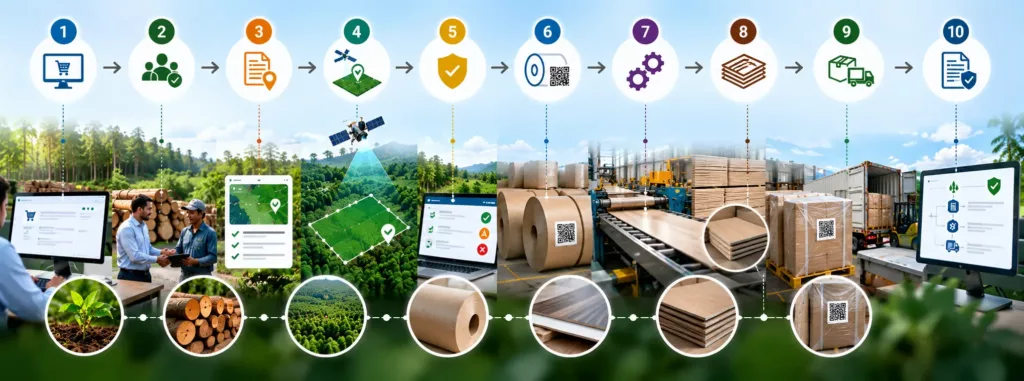
A practical workflow can include the following:
Create the purchase order in the ERP and send relevant procurement data to the EUDR platform.
Onboard the supplier and identify whether the supply route is EU or non-EU.
Collect applicable DDS reference information, geolocation and supporting evidence.
Validate plot-level data and perform deforestation-free and legality risk assessments.
Approve, hold or escalate incoming material according to the compliance workflow.
Record raw-material batch, reel or lot identifiers at goods receipt.
Map raw-material consumption to production batches and finished-goods batches.
Maintain physical segregation or controlled identification of relevant material where required by the company’s chain-of-custody model.
Link finished-goods batches to customer shipments and retain supporting evidence.
Maintain an auditable record connecting the finished product back to relevant source information.
How a Digital EUDR Workflow Can Help Laminate Manufacturers
A digital EUDR workflow can act as the compliance layer connecting procurement, suppliers, production and finished-goods traceability. TraceX EUDR solutions provide a connected digital workflow that links procurement, suppliers, raw-material batches, plot-level geolocation, risk assessment, production, and finished-goods traceability. Manufacturers can manage supplier data, validate sourcing locations, assess deforestation and compliance risks, and maintain the evidence trail needed to connect EUDR-relevant raw materials to finished laminate products. This helps teams improve visibility, streamline due diligence, and maintain an auditable EUDR compliance record across the supply chain.
Discover how TraceX can help laminate manufacturers build a digital EUDR workflow across procurement, supplier onboarding, geolocation validation, risk assessment and end-to-end traceability.
Consider a laminate manufacturer producing a batch of HPL sheets for an EU customer. The production order consumes four kraft-paper reels and two décor-paper reels. The four kraft reels come from two suppliers, while the décor paper comes from a third supplier.
A digital traceability workflow can record each incoming reel against its supplier and source evidence. During production, the system records which reels were consumed in the HPL production batch. The finished HPL batch is then linked to the customer’s shipment.
If the customer asks for evidence, the manufacturer can navigate from the finished batch to the production order, then to the raw-material lots and finally to the relevant supplier evidence, geolocations or DDS references. This is the difference between having EUDR documents and having an operational EUDR traceability system: the latter connects evidence to the physical product and transaction.
Conclusion: Turning EUDR Traceability into an Operational Process
The biggest EUDR challenges in the laminate industry are not limited to regulatory interpretation. They are operational: connecting multiple raw-material batches to finished products, obtaining reliable source information, managing different supplier routes, maintaining physical and digital chain-of-custody, assessing risk and producing evidence quickly.
For laminate manufacturers supplying EU customers, EUDR readiness therefore needs to extend beyond supplier documentation. The objective should be a connected traceability chain that links procurement, raw materials, source locations, risk assessments, production, inventory and customer shipments.
With a digital EUDR workflow, manufacturers can make this chain more structured, searchable and auditable helping procurement, sustainability, quality and supply-chain teams work from the same evidence base.
Frequently Asked Questions
What are the main EUDR challenges in the laminate industry?
Key challenges include mapping multiple raw-material batches to finished laminate, collecting reliable plot-level source information, handling different supplier routes, maintaining physical segregation or controlled chain-of-custody, performing risk assessment and retaining an auditable connection between raw materials and finished goods.
Does every laminate product automatically fall under the EUDR?
No. EUDR applicability depends on the product’s classification and whether it is listed in the applicable Annex I. Laminate manufacturers should verify the current CN/HS classification of each relevant product and input before determining the compliance workflow.
Why is batch traceability important for EUDR compliance in laminate manufacturing?
Laminate production can consume multiple reels or raw-material lots in one production batch. Batch-level mapping allows the manufacturer to connect finished goods with the relevant raw-material sources and supporting EUDR evidence.
How should laminate manufacturers handle EU and non-EU suppliers?
The workflow should distinguish the supplier’s legal and supply-chain role. Depending on the transaction, existing DDS reference information may be relevant for material already subject to due diligence, while other supply routes may require collection of underlying plot-level information and supporting evidence.
Can ERP systems alone solve EUDR traceability for laminate manufacturers?
An ERP can manage purchase orders, inventory, batches and production transactions, but EUDR workflows may require specialised geolocation, risk assessment and evidence-management capabilities. An integrated architecture can connect ERP transaction data with an EUDR compliance layer.
Start using TraceX
Transparency, Trust, & Success for your Climate Journey.
We use cookies on our website to give you the most relevant experience by remembering your preferences and repeat visits. By clicking “Accept All”, you consent to the use of ALL the cookies. However, you may visit "Cookie Settings" to provide a controlled consent.
This website uses cookies to improve your experience while you navigate through the website. Out of these, the cookies that are categorized as necessary are stored on your browser as they are essential for the working of basic functionalities of the website. We also use third-party cookies that help us analyze and understand how you use this website. These cookies will be stored in your browser only with your consent. You also have the option to opt-out of these cookies. But opting out of some of these cookies may affect your browsing experience.
Necessary cookies are absolutely essential for the website to function properly. These cookies ensure basic functionalities and security features of the website, anonymously.
Cookie
Duration
Description
cookielawinfo-checkbox-analytics
11 months
This cookie is set by GDPR Cookie Consent plugin. The cookie is used to store the user consent for the cookies in the category "Analytics".
cookielawinfo-checkbox-functional
11 months
The cookie is set by GDPR cookie consent to record the user consent for the cookies in the category "Functional".
cookielawinfo-checkbox-necessary
11 months
This cookie is set by GDPR Cookie Consent plugin. The cookies is used to store the user consent for the cookies in the category "Necessary".
cookielawinfo-checkbox-others
11 months
This cookie is set by GDPR Cookie Consent plugin. The cookie is used to store the user consent for the cookies in the category "Other.
cookielawinfo-checkbox-performance
11 months
This cookie is set by GDPR Cookie Consent plugin. The cookie is used to store the user consent for the cookies in the category "Performance".
viewed_cookie_policy
11 months
The cookie is set by the GDPR Cookie Consent plugin and is used to store whether or not user has consented to the use of cookies. It does not store any personal data.
Functional cookies help to perform certain functionalities like sharing the content of the website on social media platforms, collect feedbacks, and other third-party features.
Performance cookies are used to understand and analyze the key performance indexes of the website which helps in delivering a better user experience for the visitors.
Analytical cookies are used to understand how visitors interact with the website. These cookies help provide information on metrics the number of visitors, bounce rate, traffic source, etc.
Advertisement cookies are used to provide visitors with relevant ads and marketing campaigns. These cookies track visitors across websites and collect information to provide customized ads.
Download the 2026 Traceability Scorecard and Benchmark Your Supply Chain Across 10 Critical Capabilities.
Download our eBook
Don’t Wait for an Audit to Find Your EUDR Gaps
The 2026 Simplification Package changes how HS codes, DDS pass-through and geolocation rules apply to you. Get the free guide and 20-point readiness checklist before enforcement catches you unprepared.