EUDR for Laminate & HPL Manufacturers: Why Every Layer Is a Forest-Risk Input
Published
, 9 minute read
Share this article
Quick summary: EUDR for laminate & HPL manufacturers: why every layer - kraft core, décor paper, and substrate - is a forest-risk input, and how to prove all of it by 2026.
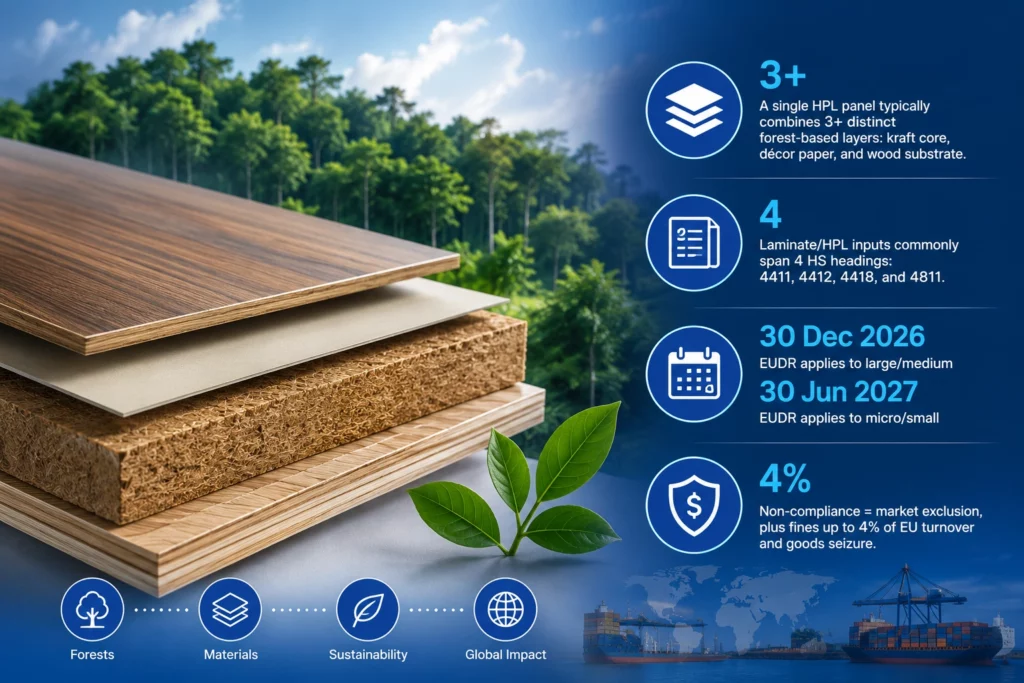
EUDR for laminate & HPL manufacturers applies because high-pressure laminate and decorative laminates are forest-based composites: the kraft-paper core and décor paper are wood pulp, and the MDF, particleboard, or plywood substrate is wood. All fall under EUDR’s wood scope (typically HS 4411, 4412, 4418, and 4811). From 30 December 2026 for large and medium operators (30 June 2027 for micro and small), any such product placed on the EU market must be proven deforestation-free with plot-level geolocation, verified legality, and a filed due diligence statement for every forest-based layer, not just the panel as a whole
For most surfacing and panel businesses, EUDR for Laminate & HPL Manufacturers arrives as a surprise and a misfiled one. The instinct is to treat the EU Deforestation Regulation as a raw-timber problem that belongs to sawmills and log traders, or at most to the supplier who ships the substrate. A laminate producer sees itself as a maker of decorative surfaces: paper, resin, colour, texture. Surely that is a chemistry story, not a forestry one? That assumption is exactly where the compliance risk hides.
In plain terms, EUDR for laminate and HPL manufacturers is the set of obligations that apply when high-pressure laminate, continuous-pressed laminate, decorative papers, and the panels they are bonded to are placed on the EU market. Because every one of those items originates in forest-based raw materials timber, pulp, cellulose they sit squarely inside the regulation’s wood scope. This guide explains why, layer by layer, and what proving it actually takes.
Key takeaways
EUDR for laminate & HPL manufacturers is in scope: kraft core, décor paper, and wood substrate are all forest-based inputs.
Liability compounds by layer each input is a separate origin needing its own geolocation and legality proof.
Resin and plastic content do not exempt a product; if it contains wood or pulp, EUDR applies.
FSC or PEFC help but do not satisfy EUDR; “FSC Controlled Wood” is weaker still and insufficient on its own.
From 30 December 2026, non-compliant laminate is barred from the EU market exclusion, not a fine.
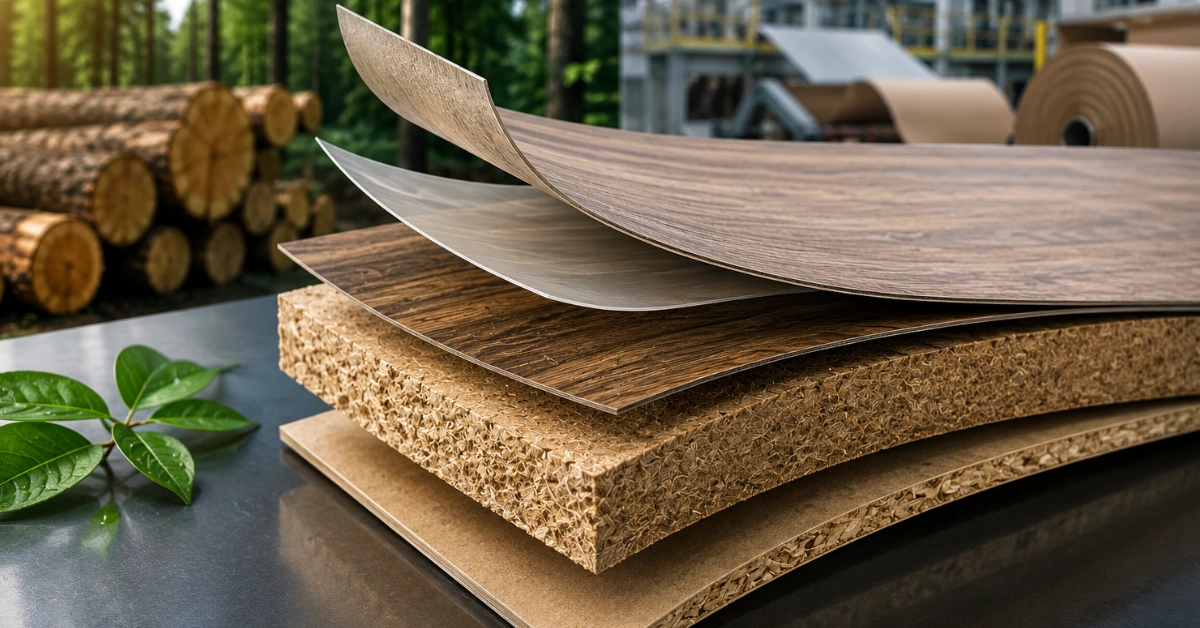
High Pressure Laminate isn’t just one product it’s a combination of kraft paper, décor paper, overlays, and wood-based substrates, each with its own sourcing and compliance requirements.
The EU Deforestation Regulation covers seven commodities and their derived products; wood is one of them, and “derived” is doing a lot of work. Under EUDR, in-scope wood products include medium-density fibreboard (MDF), high-density fibreboard (HDF), particle board, plywood, veneered panels, decorative papers, and composite laminates. They qualify not because they look like timber but because they come from it. A high-pressure laminate is produced by saturating multiple layers of kraft paper with phenolic resin, adding a printed décor paper, and fusing the stack under heat and pressure; that sheet is then bonded to a wood-composite substrate such as MDF or particleboard. Pulp, pulp, and wood three forest inputs in one product.
From timber sourcing and supplier onboarding to geolocation verification, deforestation risk assessment, and Due Diligence Statement (DDS) generation, TraceX helps plywood manufacturers and exporters build transparent, audit-ready supply chains.
So EUDR for laminate & HPL manufacturers is not a question of whether you are in scope, but of how many times over. Most guidance on the regulation treats a product as a single commodity with a single origin. Laminate breaks that model which is precisely why it needs its own playbook.
The Unique Problem: A Laminate Manufacturer Is a Forest-Risk Aggregator
Here is the reframe that changes how you scope the work. A finished HPL panel is not one wood product; it is a stack of independent forest-risk layers, each with its own species, supplier, and country of harvest. Peel a panel apart and you find at least three distinct EUDR exposures: the kraft-paper core (wood pulp), the décor paper (wood pulp, often from a different mill entirely), and the substrate MDF, particleboard, or plywood (wood, frequently sourced from yet another region). Add backers and balancing laminates and the count rises.
That makes a laminate producer something the regulation did not coin a word for but clearly intends to capture: a forest-risk aggregator. You sit at the point where several independent forest supply chains converge into a single traded item. EUDR does not let you average that risk or point downstream it requires you to account for each forest-based input individually and then roll them into one composite-product due diligence statement. Miss one layer say, a décor paper from an unverified mill and the whole panel is non-compliant, regardless of how clean the substrate is.
The resin is the trap. Because roughly a third of an HPL sheet is thermoset plastic, it is tempting to file the product mentally under “plastics” or “chemistry.” EUDR does not care about the resin. If the article contains wood or wood-derived pulp and laminate is mostly that it is in scope. Plastic content dilutes neither the obligation nor the liability.
The Layers of an HPL Panel and What EUDR Demands of Each
Mapping the product by layer is the fastest way to scope EUDR for laminate & HPL manufacturers honestly:
Layer
Forest origin
Typical HS
EUDR obligation
Décor paper
Wood pulp
4811
Geolocation + legality of pulp origin
Kraft-paper core
Wood pulp
4811
Geolocation + legality of pulp origin
MDF / HDF substrate
Wood fibre
4411
Geolocation + legality of timber origin
Plywood / veneer
Wood
4412
Geolocation + legality of timber origin
Finished panel / joinery
Composite
4418
Consolidated DDS covering all inputs
Read down the last column and the scale of the task is clear: EUDR for laminate & HPL manufacturers is a multi-origin traceability problem, not a single-line declaration. Each layer must trace back to the plot of land where the wood was grown, be shown deforestation-free after 31 December 2020, be verified as legally harvested, and then be consolidated without losing chain of custody into the filed statement for the finished article.
Operator or Trader? Where Laminate & HPL Manufacturers Sit Under EUDR
Your obligations depend on your role. If you are the first to place the laminate on the EU market importing panels or manufacturing them from imported inputs you are an operator and carry the full due diligence burden: information, risk assessment, and risk mitigation before a due diligence statement is filed. If you buy already-placed laminate and sell it on, you may be a trader, with lighter but still real record-keeping duties. Many laminate businesses are both at once operator for imported décor paper, trader for domestically bought substrate which is why supply-chain mapping has to come before any filing.
Why Certifications Won’t Carry Laminate & HPL Manufacturers Through EUDR
Many laminate brands lean on FSC or PEFC, and those schemes genuinely help with sustainable sourcing and risk mitigation. But the rule for EUDR for laminate and HPL manufacturers is the same as for every other commodity: certifications do not replace the regulation’s geolocation, plot-level evidence, or DDS obligations, which must be met independently. One nuance matters especially here several HPL products carry “FSC Controlled Wood,” which is a weaker risk-management category than full FSC certification and provides even less of what EUDR requires. Treat any certificate as supporting evidence, never as the compliance itself.
How TraceX Solves EUDR for Laminate & HPL Manufacturers
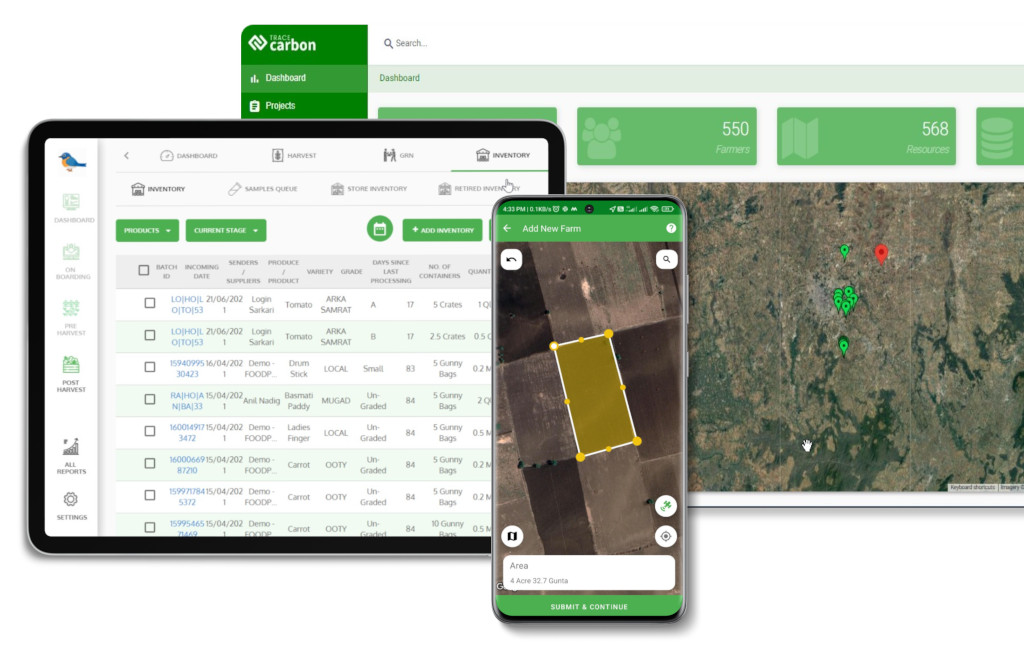
The pain is now well-defined: multiple forest-based layers, multiple origins, multiple HS codes, and a composite product that fails if any single input cannot be proven. Manual document assembly KYC files, land records, and certificates in different formats and languages cannot hold that together at shipment volume. The capability that answers it is an end-to-end EUDR Solutions that maps each forest-based input to plot-level geolocation, runs satellite deforestation checks against the 2020 cut-off, verifies legality per origin, maintains chain of custody for pulp and paper streams, and consolidates everything into a single, structured DDS for TRACES. The benefit for a laminate producer is decisive: every layer proven, one filing, EU market access protected.
The result is that EUDR for laminate & HPL manufacturers shifts from an unmanageable document-assembly scramble into a repeatable, audit-ready workflow the difference between a shipment that clears and one that is turned back at the EU border.
Prove every layer, file once
See how TraceX maps each forest-based layer of your laminates and consolidates them into one EUDR-ready DDS.
EUDR Readiness Checklist for Laminate & HPL Manufacturers
Before your next EU shipment, confirm you can:
List every forest-based layer in each product décor paper, kraft core, substrate, backers
Map each layer to its correct HS code (4411, 4412, 4418, 4811 and others as applicable)
Capture plot-level geolocation for the pulp and timber origin of every layer
Prove each layer deforestation-free after 31 December 2020 and legally harvested
Maintain chain of custody through crushing, pulping, pressing, and lamination
Consolidate all inputs into one composite-product due diligence statement for TRACES
Treat FSC / PEFC / Controlled Wood as support never as the compliance itself
Frequently Asked Questions (FAQ’s)
Does EUDR apply to HPL if it is mostly resin?
Yes. Resin and plastic content do not exempt a product. If it contains wood or wood-derived pulp and HPL’s kraft core, décor paper, and substrate all do it falls under EUDR’s wood scope.
Which HS codes matter for EUDR for laminate & HPL manufacturers?
Commonly HS 4411 (fibreboard incl. MDF/HDF), 4412 (plywood, veneered and laminated wood), 4418 (builders’ joinery), and 4811 (coated or impregnated paper). Confirm the exact codes for your products against EUDR Annex I.
Do we need separate proof for each layer of a laminate?
Effectively, yes. Each forest-based layer décor paper, kraft core, and substrate has its own origin and must be traced, verified deforestation-free and legal, then consolidated into one due diligence statement for the finished panel.
Does FSC certification make our laminate EUDR-compliant?
No. FSC and PEFC support risk mitigation but do not replace EUDR’s geolocation, plot-level evidence, or DDS. “FSC Controlled Wood” in particular is weaker than full certification and insufficient on its own.
When must laminate & HPL manufacturers comply with EUDR?
From 30 December 2026 for large and medium operators, and 30 June 2027 for micro and small ones. Product from land cleared after 31 December 2020 is non-compliant regardless of size.
We use cookies on our website to give you the most relevant experience by remembering your preferences and repeat visits. By clicking “Accept All”, you consent to the use of ALL the cookies. However, you may visit "Cookie Settings" to provide a controlled consent.
This website uses cookies to improve your experience while you navigate through the website. Out of these, the cookies that are categorized as necessary are stored on your browser as they are essential for the working of basic functionalities of the website. We also use third-party cookies that help us analyze and understand how you use this website. These cookies will be stored in your browser only with your consent. You also have the option to opt-out of these cookies. But opting out of some of these cookies may affect your browsing experience.
Necessary cookies are absolutely essential for the website to function properly. These cookies ensure basic functionalities and security features of the website, anonymously.
Cookie
Duration
Description
cookielawinfo-checkbox-analytics
11 months
This cookie is set by GDPR Cookie Consent plugin. The cookie is used to store the user consent for the cookies in the category "Analytics".
cookielawinfo-checkbox-functional
11 months
The cookie is set by GDPR cookie consent to record the user consent for the cookies in the category "Functional".
cookielawinfo-checkbox-necessary
11 months
This cookie is set by GDPR Cookie Consent plugin. The cookies is used to store the user consent for the cookies in the category "Necessary".
cookielawinfo-checkbox-others
11 months
This cookie is set by GDPR Cookie Consent plugin. The cookie is used to store the user consent for the cookies in the category "Other.
cookielawinfo-checkbox-performance
11 months
This cookie is set by GDPR Cookie Consent plugin. The cookie is used to store the user consent for the cookies in the category "Performance".
viewed_cookie_policy
11 months
The cookie is set by the GDPR Cookie Consent plugin and is used to store whether or not user has consented to the use of cookies. It does not store any personal data.
Functional cookies help to perform certain functionalities like sharing the content of the website on social media platforms, collect feedbacks, and other third-party features.
Performance cookies are used to understand and analyze the key performance indexes of the website which helps in delivering a better user experience for the visitors.
Analytical cookies are used to understand how visitors interact with the website. These cookies help provide information on metrics the number of visitors, bounce rate, traffic source, etc.
Advertisement cookies are used to provide visitors with relevant ads and marketing campaigns. These cookies track visitors across websites and collect information to provide customized ads.
Download the 2026 Traceability Scorecard and Benchmark Your Supply Chain Across 10 Critical Capabilities.
Download our eBook
Don’t Wait for an Audit to Find Your EUDR Gaps
The 2026 Simplification Package changes how HS codes, DDS pass-through and geolocation rules apply to you. Get the free guide and 20-point readiness checklist before enforcement catches you unprepared.