PPWR Compliance for FMCG Manufacturers in France

Published
, 16 minute read

Quick summary: : Learn how FMCG manufacturers in France can prepare for PPWR compliance with guidance on packaging requirements, conformity assessments, technical documentation, packaging data management, and August 2026 readiness.

The Packaging and Packaging Waste Regulation (PPWR) is set to transform how Fast-Moving Consumer Goods (FMCG) manufacturers design, manage, and demonstrate packaging compliance across the European Union. For manufacturers in France, the regulation introduces harmonized packaging requirements that extend beyond sustainability goals to become a fundamental part of regulatory compliance.

Whether you manufacture packaged foods, beverages, household cleaning products, personal care products, home care products, pet care products, or other consumer goods, PPWR introduces new obligations covering packaging design, recyclability, recycled content, technical documentation, conformity assessments, and supplier collaboration.

Unlike the previous Packaging and Packaging Waste Directive, PPWR is a regulation that applies directly across all EU Member States. This creates a consistent compliance framework while increasing accountability for manufacturers placing packaged products on the EU market.

For FMCG manufacturers managing extensive product portfolios, multiple manufacturing sites, private-label products, and thousands of packaging SKUs, achieving compliance requires much more than changing packaging materials. It demands structured packaging data, centralized documentation, supplier engagement, and digital compliance processes capable of scaling across the organization.

Organizations that begin preparing today will be better positioned to meet regulatory milestones, improve packaging governance, strengthen operational efficiency, and respond confidently to future sustainability requirements.

Key Takeaways

If your business manufactures packaged consumer goods in France, PPWR introduces new responsibilities throughout the packaging lifecycle.

Key compliance areas include:

  • Packaging conformity assessment
  • Technical documentation
  • Declaration of Conformity (DoC)
  • Packaging data management
  • Design for recyclability
  • Recycled content verification
  • Substance restrictions
  • Supplier documentation
  • Packaging optimization
  • Audit readiness

Rather than treating PPWR as a one-time compliance exercise, FMCG manufacturers should establish scalable compliance processes that support product innovation, packaging redesign, retailer requirements, and future regulatory developments.

Prepare for PPWR Before Compliance Deadlines Arrive

PPWR implementation requires more than understanding regulatory requirements—it requires a structured implementation roadmap.

Download the PPWR Handbook Now

What Is the Packaging and Packaging Waste Regulation (PPWR)?

The Packaging and Packaging Waste Regulation (PPWR) establishes a harmonized legal framework governing packaging placed on the European Union market.

Its objective is to reduce packaging waste, improve recyclability, promote recycled content, encourage reuse, and support the EU’s transition toward a circular economy.

Unlike the Packaging and Packaging Waste Directive, which required implementation through national legislation, PPWR applies directly across all EU Member States. This provides greater regulatory consistency while creating standardized obligations for businesses placing packaged products on the market.

The regulation addresses packaging throughout its lifecycle, including:

  • Packaging design
  • Packaging minimization
  • Design for recyclability
  • Recycled plastic content
  • Reuse systems
  • Packaging labelling
  • Technical documentation
  • Declaration of Conformity
  • Market surveillance
  • Extended Producer Responsibility (EPR)

For FMCG manufacturers, compliance is no longer limited to selecting sustainable packaging materials. Organizations must demonstrate compliance through documented evidence, supplier collaboration, conformity assessments, and structured packaging data management.

Why PPWR Matters for FMCG Manufacturers in France

France has one of Europe’s largest FMCG manufacturing sectors, producing packaged products for domestic consumption and export across the European Union.

Manufacturers operate across numerous categories including:

  • Packaged foods
  • Soft drinks and beverages
  • Dairy products
  • Frozen foods
  • Snacks and confectionery
  • Household cleaning products
  • Laundry detergents
  • Home care products
  • Personal care products
  • Pet food
  • Consumer packaged goods

These products rely on a wide range of packaging formats such as:

  • PET bottles
  • HDPE bottles
  • Glass containers
  • Aluminium cans
  • Flexible pouches
  • Plastic tubs
  • Trays
  • Folding cartons
  • Corrugated shipping cases
  • Shrink wrap
  • Pallets
  • Display-ready packaging

Under PPWR, manufacturers are responsible for ensuring that these packaging formats comply with applicable regulatory requirements before products are placed on the EU market.

Compliance therefore extends far beyond packaging procurement.

Manufacturers must collaborate with packaging suppliers, raw material suppliers, converters, laboratories, contract manufacturers, logistics providers, and retailers to collect, verify, and maintain compliance evidence throughout the packaging lifecycle.

Without structured compliance processes, organizations may experience:

  • Product launch delays
  • Supplier documentation gaps
  • Increased retailer compliance requests
  • Packaging redesign costs
  • Difficulties responding to regulatory inspections
  • Increased administrative burden

At the same time, retailers and consumers are demanding more sustainable packaging, making PPWR compliance an opportunity to improve both environmental performance and operational resilience.

Understand Your Responsibilities Under PPWR

Manufacturers, importers, distributors, and brand owners each have distinct responsibilities under PPWR.

Understanding your role is the first step toward building a successful compliance strategy.

Read our complete guide to PPWR Roles & Responsibilities.


What Should FMCG Manufacturers Prioritize Before the August 2026 PPWR Deadline?

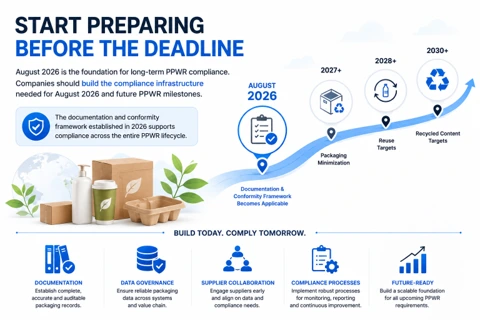
Although several PPWR obligations including packaging minimization, recycled content targets, and reuse requirements will be introduced progressively, 12 August 2026 marks the first major compliance milestone.

From this date, manufacturers placing packaged products on the EU market should be prepared to demonstrate compliance with the applicable provisions of the regulation.

Rather than waiting until deadlines approach, FMCG manufacturers should build the governance, documentation, and digital infrastructure needed to support long-term compliance.

The following six priorities should form the foundation of every PPWR compliance strategy.

1. Conduct Packaging Conformity Assessments

Packaging conformity assessments help manufacturers demonstrate that packaging complies with applicable PPWR requirements before products are placed on the market.

For FMCG manufacturers, this means evaluating packaging across extensive product portfolios.

Conformity assessments should become an integral part of packaging development, procurement, and product approval workflows rather than a final compliance check.

2. Maintain Comprehensive Technical Documentation

Technical documentation provides the evidence supporting packaging compliance.

Manufacturers should establish centralized repositories containing documentation for every packaging component used throughout the organization.

Centralized documentation improves governance while simplifying customer requests, retailer questionnaires, and regulatory inspections.

3. Establish Declaration of Conformity (DoC) Processes

PPWR introduces the requirement for an EU Declaration of Conformity (DoC) confirming that packaging complies with applicable regulatory provisions.

For FMCG manufacturers managing multiple brands, packaging formats, and thousands of SKUs, maintaining DoCs manually can become resource-intensive.

Digital workflows significantly improve efficiency while reducing compliance risks.

4. Verify Compliance with Substance Restrictions

Packaging materials frequently contain polymers, coatings, adhesives, inks, additives, and other substances that require careful review.

Early supplier engagement helps prevent documentation gaps and accelerates compliance verification.

5. Understand Your Responsibilities as an Economic Operator

PPWR assigns responsibilities according to an organization’s role within the supply chain.

Each role carries different obligations relating to packaging compliance, documentation, and market placement.

Cross-functional collaboration between procurement, packaging engineering, regulatory affairs, sustainability, quality, legal, and operations teams will be essential for maintaining compliance.

6. Build a Robust Packaging Data Management Strategy

Packaging compliance depends on accurate, complete, and accessible data.

However, many FMCG manufacturers continue managing packaging information across disconnected spreadsheets, ERP systems, PLM platforms, supplier portals, and shared drives.

As PPWR requirements expand, fragmented data creates unnecessary complexity and increases compliance risks.

A centralized packaging data management strategy improves visibility across brands and product portfolios while strengthening audit readiness and supporting future PPWR obligations.

Which FMCG Packaging Is Covered Under PPWR?

One of the most common questions FMCG manufacturers ask is whether PPWR applies only to specific packaging materials or product categories.

The answer is simple: PPWR applies to virtually all packaging placed on the EU market, irrespective of the material used or the type of consumer product it contains.

Whether you manufacture packaged foods, beverages, dairy products, frozen foods, household cleaners, detergents, home care products, pet food, or personal care products, the packaging accompanying these products is generally within the scope of the regulation.

For FMCG manufacturers, compliance extends beyond consumer-facing packaging to include secondary and transport packaging used throughout the supply chain.

Primary Packaging

Primary packaging comes into direct contact with the product and plays a vital role in preserving product quality, ensuring hygiene, extending shelf life, and enhancing consumer convenience.

Examples include:

  • PET beverage bottles
  • HDPE detergent bottles
  • Plastic tubs
  • Glass jars
  • Aluminium beverage cans
  • Flexible pouches
  • Stand-up pouches
  • Sachets
  • Food trays
  • Paper cartons
  • Aerosol cans
  • Plastic containers
  • Milk cartons
  • Beverage cartons

Primary packaging represents one of the largest compliance areas under PPWR because it directly influences recyclability, material composition, recycled content, and packaging design.

Secondary Packaging

Secondary packaging groups products together for retail presentation and distribution while providing additional protection.

Examples include:

  • Folding cartons
  • Multipacks
  • Promotional packaging
  • Shelf-ready packaging
  • Display boxes
  • Shrink wrap
  • Cardboard sleeves
  • Retail display units

Although secondary packaging may never come into direct contact with the product, it is still subject to PPWR requirements.

Manufacturers should therefore include secondary packaging within their compliance strategy and technical documentation.

Transport Packaging

Transport packaging protects goods throughout storage, warehousing, and distribution.

Examples include:

  • Corrugated shipping cartons
  • Stretch films
  • Pallets
  • Pallet wraps
  • Plastic crates
  • Protective inserts
  • Bulk transport containers
  • Intermediate packaging

Transport packaging often represents a significant volume of packaging material and should not be overlooked when assessing PPWR obligations.

Imported Packaging

Many FMCG manufacturers source packaging materials or finished products from outside the European Union.

Where imported packaging is placed on the EU market, businesses should ensure suppliers provide appropriate compliance documentation.

Typical documentation includes:

  • Material specifications
  • Packaging declarations
  • Technical documentation
  • Laboratory reports
  • Recycled-content information
  • Supplier compliance statements

Strong supplier collaboration is essential for maintaining complete and accurate compliance records.

Does PPWR Apply to Every Packaging Material?

Yes.

Manufacturers should assess every packaging material used throughout their product portfolio.

This includes:

  • Plastic
  • Paper
  • Cardboard
  • Glass
  • Aluminium
  • Steel
  • Flexible films
  • Composite materials
  • Laminates
  • Multi-layer packaging

Each material presents different regulatory considerations relating to recyclability, recycled content, material composition, and future packaging design requirements.

Creating a comprehensive packaging inventory is therefore one of the first and most important steps toward PPWR compliance.

Know Which Packaging Falls Under PPWR

Understanding the scope of PPWR is essential for building a successful compliance strategy.

Read our complete guide to PPWR Scope.


Key PPWR Requirements for FMCG Manufacturers

PPWR introduces several interconnected obligations affecting packaging design, procurement, documentation, supplier collaboration, and product development.

Rather than treating these requirements individually, manufacturers should integrate them into existing packaging governance processes.

1. Packaging Minimization

Packaging should contain only the amount of material necessary to protect, preserve, transport, handle, and market products safely.

Although Article 10 packaging minimization requirements become applicable later in the PPWR implementation timeline, manufacturers should begin evaluating packaging today.

Reducing unnecessary packaging can lower material costs while improving sustainability performance and preparing organizations for future PPWR obligations.

2. Design for Recyclability

Packaging should be designed to facilitate efficient collection, sorting, and recycling.

Embedding recyclability considerations during packaging development minimizes future redesign costs and supports circular economy objectives.

3. Recycled Plastic Content

PPWR introduces phased recycled content requirements for specific plastic packaging categories.

Although these obligations will be implemented over time, manufacturers should begin preparing by:

  • Identifying recycled material suppliers
  • Collecting recycled-content declarations
  • Maintaining supporting documentation
  • Monitoring packaging specifications
  • Tracking recycled-content percentages

Early preparation enables smoother compliance as future milestones approach.

4. Reuse and Refill

PPWR encourages increased use of reusable and refillable packaging systems where appropriate.

Manufacturers should assess opportunities to incorporate reuse into their packaging strategy while considering operational feasibility and customer expectations.

5. Substance Restrictions

Packaging materials should comply with applicable restrictions relating to substances of concern.

Manufacturers should maintain visibility into:

  • Material composition
  • Additives
  • Heavy metals
  • Adhesives
  • Printing inks
  • Coatings
  • Chemical declarations
  • Supplier compliance statements

Early supplier engagement improves transparency while reducing documentation gaps.

6. Packaging Labelling

PPWR introduces harmonized packaging labelling intended to improve recycling and waste sorting across the European Union.

Future packaging labels may include information relating to:

  • Material identification
  • Recycling instructions
  • Recycled content
  • Reuse systems where applicable

Manufacturers should review packaging artwork approval processes to accommodate evolving labelling requirements.

Understand the PPWR Requirements Before They Affect Your Packaging Portfolio

PPWR introduces significant changes across packaging design, recyclability, recycled content, documentation, and conformity assessments.

Read our complete guide to PPWR Requirements.


Responsibilities of FMCG Manufacturers Under PPWR

Although packaging suppliers manufacture packaging components, FMCG manufacturers remain responsible for ensuring packaging complies before products are placed on the EU market.

Compliance requires collaboration across multiple business functions, including:

  • Procurement
  • Packaging Engineering
  • Sustainability
  • Regulatory Affairs
  • Product Development
  • Quality Assurance
  • Manufacturing
  • Supply Chain
  • Legal

Organizations managing multiple brands, manufacturing facilities, and product portfolios should establish standardized compliance processes across the business.

Documentation Required for PPWR Compliance

Documentation provides the evidence supporting every packaging compliance decision.

Manufacturers should centralize documentation to improve governance, visibility, and audit readiness.

Product Documentation

Maintain:

  • Packaging specifications
  • Material composition
  • Packaging Bills of Materials (BOMs)
  • Packaging weights
  • Packaging dimensions

Supplier Documentation

Collect:

  • Supplier declarations
  • Material certifications
  • Compliance statements
  • Laboratory reports
  • Recycled-content declarations
  • Technical specifications

Packaging Design Documentation

Maintain:

  • Engineering drawings
  • Packaging calculations
  • Recyclability assessments
  • Packaging validation reports
  • Packaging optimization studies

Compliance Documentation

Maintain:

  • Technical documentation
  • Conformity assessment records
  • Declaration of Conformity
  • Internal compliance procedures
  • Risk assessments
  • Laboratory reports
  • Version-controlled compliance records

Maintaining structured documentation enables manufacturers to respond quickly to customer audits, retailer sustainability questionnaires, and regulatory inspections while reducing administrative effort.

Can You Demonstrate Your Packaging Meets PPWR Requirements?

Technical documentation is more than a regulatory requirement it’s the evidence that supports every packaging compliance decision.

Read our complete guide to PPWR Technical Documentation.

Building a Future-Ready PPWR Compliance Strategy for FMCG Manufacturers

As the Packaging and Packaging Waste Regulation (PPWR) reshapes packaging compliance across Europe, FMCG manufacturers must move beyond understanding the regulation and begin embedding compliance into product development, packaging design, procurement, manufacturing, and supply chain operations.

Unlike many industries, FMCG manufacturers manage extensive packaging portfolios spanning thousands of SKUs, multiple manufacturing sites, private-label products, seasonal packaging, promotional campaigns, and retailer-specific packaging formats. This complexity makes packaging compliance significantly more challenging.

Achieving PPWR compliance requires more than updating packaging materials—it demands centralized packaging data, standardized supplier collaboration, structured technical documentation, and digital compliance processes that can scale across the enterprise.

Organizations that invest in these capabilities today will not only be better prepared for upcoming PPWR milestones but will also improve operational efficiency, strengthen sustainability initiatives, and reduce long-term compliance costs.

Packaging Complies with PPWR

Common PPWR Compliance Challenges for FMCG Manufacturers

1. Managing Thousands of Packaging SKUs

Large FMCG manufacturers often manage thousands—or even tens of thousands—of packaging variations across multiple brands and product categories.

Each packaging variation requires its own specifications, supplier documentation, conformity assessments, and technical records.

Managing this manually increases the risk of outdated documentation, duplicate records, and compliance gaps.

2. Complex Supplier Networks

Packaging materials are often sourced from multiple suppliers across different countries.

Each supplier provides different documentation formats, making it difficult to maintain consistent compliance records.

Without standardized supplier collaboration, collecting compliance evidence becomes increasingly resource-intensive.

3. Fragmented Packaging Data

Many FMCG manufacturers still manage packaging information across:

  • ERP systems
  • PLM platforms
  • Procurement software
  • Supplier portals
  • Shared drives
  • Email chains
  • Individual spreadsheets

Centralizing packaging information is essential for maintaining a single source of truth.

4. Frequent Packaging Changes

Every packaging modification may require:

  • Updated specifications
  • Revised Bills of Materials
  • Supplier declarations
  • New technical documentation
  • Updated Declaration of Conformity

Without structured change management, maintaining compliance becomes increasingly difficult.

5. Retailer Sustainability Requirements

Major retailers are placing greater emphasis on sustainable packaging and often request detailed packaging information from suppliers.

Manufacturers that maintain centralized packaging documentation can respond faster while reducing manual effort.

6. Growing Documentation Requirements

PPWR requires manufacturers to maintain comprehensive technical documentation supporting packaging compliance.

Managing documentation for thousands of packaging components manually often leads to:

  • Inconsistent records
  • Duplicate documentation
  • Missing supplier information
  • Increased audit preparation time

Digital document management significantly improves governance and accessibility.

7. Preparing for Future PPWR Requirements

Many PPWR obligations will be introduced in phases over the coming years.

Manufacturers therefore need compliance systems that can adapt to future requirements relating to:

  • Packaging minimization
  • Recycled content
  • Design for recyclability
  • Reuse targets
  • Harmonized labelling
  • Extended Producer Responsibility (EPR)

Building scalable compliance processes today reduces future implementation effort.

How Digital Traceability Supports PPWR Compliance

Managing packaging compliance across thousands of products requires connected, accurate, and continuously updated information.

Digital traceability platforms help manufacturers centralize packaging compliance while improving collaboration across suppliers, manufacturing sites, and business functions.

Key capabilities include:

Centralized Packaging Data Management

Maintain structured information relating to:

  • Packaging specifications
  • Material composition
  • Packaging Bills of Materials
  • Packaging weights
  • Product-to-packaging relationships

A single source of truth eliminates duplicate records and improves data accuracy.

Digital Supplier Collaboration

Digitally onboard suppliers and collect:

  • Material declarations
  • Technical documentation
  • Packaging specifications
  • Laboratory reports
  • Recycled-content evidence
  • Supplier compliance statements

Automated reminders help reduce delays and improve documentation completeness.

Technical Documentation Management

Maintain version-controlled technical files containing:

  • Engineering drawings
  • Test reports
  • Packaging calculations
  • Conformity assessment records
  • Declarations of Conformity
  • Supporting evidence

This simplifies audits and regulatory inspections.

Workflow Automation

Standardize packaging approvals through configurable workflows that include:

  • Packaging review
  • Supplier verification
  • Compliance validation
  • Internal approvals
  • Document version control

Automation reduces manual effort while improving consistency.

Audit Readiness

Respond quickly to:

  • Retailer sustainability questionnaires
  • Customer information requests
  • Regulatory inspections
  • Internal audits

Centralized documentation enables faster access to compliance evidence.

Cross-Functional Collaboration

Enable procurement, packaging engineering, sustainability, regulatory affairs, quality assurance, manufacturing, and supply chain teams to work from the same packaging data.

This improves visibility while reducing duplication across departments.

Simplify PPWR Compliance with TraceX

Managing PPWR compliance across multiple brands, manufacturing facilities, suppliers, and packaging formats requires a digital approach.

TraceX’s PPWR Solution helps FMCG manufacturers centralize packaging data, streamline supplier collaboration, automate documentation workflows, and maintain audit-ready compliance records from a single platform.

Whether you manufacture packaged foods, beverages, household products, home care products, pet food, or other consumer goods, TraceX simplifies packaging compliance across the entire product lifecycle.

With TraceX, FMCG Manufacturers Can:

  • Centralize packaging specifications across all products and brands
  • Manage packaging Bills of Materials and material composition
  • Digitize supplier onboarding and documentation collection
  • Maintain technical documentation with version control
  • Automate packaging conformity assessment workflows
  • Manage Declarations of Conformity
  • Track recycled-content declarations and supplier evidence
  • Monitor packaging changes through structured workflows
  • Improve collaboration across procurement, packaging engineering, sustainability, regulatory affairs, and quality teams
  • Respond quickly to audits, retailer requests, and market surveillance inspections

Instead of managing compliance through disconnected spreadsheets and manual processes, TraceX provides a scalable digital platform that supports continuous PPWR compliance.

Conclusion

The Packaging and Packaging Waste Regulation represents one of the most significant changes to packaging compliance in recent years.

For FMCG manufacturers in France, compliance is no longer limited to selecting sustainable materials it requires comprehensive packaging governance, supplier collaboration, technical documentation, and digital compliance management.

Organizations that begin preparing now can reduce compliance risks, streamline operations, improve packaging transparency, and respond more effectively to retailer and regulatory requirements.

As the 12 August 2026 implementation milestone approaches, manufacturers should focus on building centralized packaging data, strengthening supplier engagement, and digitizing compliance workflows.

Those that adopt a proactive, digital-first approach will be well positioned not only for PPWR compliance but also for the broader transition toward sustainable, circular packaging.

Frequently Asked Questions


Does PPWR apply to FMCG manufacturers in France?

Yes. Any FMCG manufacturer placing packaged products on the EU market must ensure that the packaging complies with the applicable PPWR requirements and maintain supporting documentation.

Which packaging is covered under PPWR?

PPWR applies to primary, secondary, and transport packaging across materials including plastic, paper, cardboard, glass, metal, flexible films, and composite packaging.

What documentation should FMCG manufacturers maintain?

Manufacturers should maintain packaging specifications, Bills of Materials, supplier declarations, technical documentation, conformity assessment records, laboratory reports, recycled-content evidence, packaging drawings, and Declarations of Conformity.

Why is packaging data management important for PPWR?

Accurate, centralized packaging data helps manufacturers demonstrate compliance, respond to audits, support retailer requests, and efficiently manage packaging changes across large product portfolios.

How can TraceX help with PPWR compliance?

TraceX provides a centralized digital platform that streamlines packaging data management, supplier collaboration, technical documentation, conformity assessments, and audit readiness helping FMCG manufacturers build scalable, continuous PPWR compliance processes.

Start using TraceX
Transparency, Trust, & Success for your Climate Journey.
Get the demo

Get your free trial

Request for a Demo Session

Download your PPWR Compliance for FMCG Manufacturers in France here

Download your PPWR Compliance for FMCG Manufacturers in France here

Download your PPWR Compliance for FMCG Manufacturers in France here

[hubspot type=form portal=8343454 id=304874ea-d4e0-4653-9825-707360746edb]
[hubspot type=form portal=8343454 id=b8321ac0-687a-4075-8035-ce57dd47662a]
food traceability, food supply chain, blockchain traceability, agriculture traceability software

How Mature Is Your Traceability Program?

Download the 2026 Traceability Scorecard and Benchmark Your Supply Chain Across 10 Critical Capabilities.

Activate Free Trial Now

The EUDR clock is ticking. Get ahead — free for 14 days

Generate DDS, validate geolocations, and file to TRACES with AI doing the heavy lifting. No credit card. No setup hassle.

food traceability, food supply chain

Are you EUDR Due-Diligence Ready?

Your essential compliance guide

food traceability, food supply chain

Please leave your details with us and we will connect with you for relevant positions.

[hubspot type=form portal=8343454 id=e6eb5c02-8b9e-4194-85cc-7fe3f41fe0f4]
food traceability, food supply chain

Please fill the form for all Media Enquiries, we will contact you shortly.

[hubspot type=form portal=8343454 id=a77c8d9d-0f99-4aba-9ea6-3b5c5d2f53dd]
food traceability, food supply chain

Kindly fill the form and our Partnership team will get in touch with you!

[hubspot type=form portal=8343454 id=b8cad09c-2e22-404d-acd4-659b965205ec]