
Quick summary: PPWR technical file for Declaration of Conformity explains the documents, supplier proof, and validation steps needed to build an audit-ready packaging file before the August 2026 deadline.

A PPWR technical file for a Declaration of Conformity is the documented evidence that proves a packaging type meets Articles 5–12 of Regulation (EU) 2025/40 and the Declaration of Conformity is the signed statement that sits on top of it. To prepare one, you compile material breakdowns, substance and PFAS test results, recyclability and minimisation assessments, and supplier proof for each packaging type, then link that file to an Annex VIII DoC signed under the Module A internal-control route. [CITE: Regulation (EU) 2025/40, Annex VII–VIII]
Here’s the part most teams underestimate: under PPWR, signing the declaration is the easy five minutes. The hard part is the evidence. You cannot sign a valid DoC without verified substance test results, recycler certificates for recycled content, and full material breakdowns every coating, ink, and adhesive for every packaging type. And supplier self-declarations alone don’t count as proof. With hundreds of SKUs and dozens of suppliers, that’s a data-collection problem long before it’s a paperwork problem.
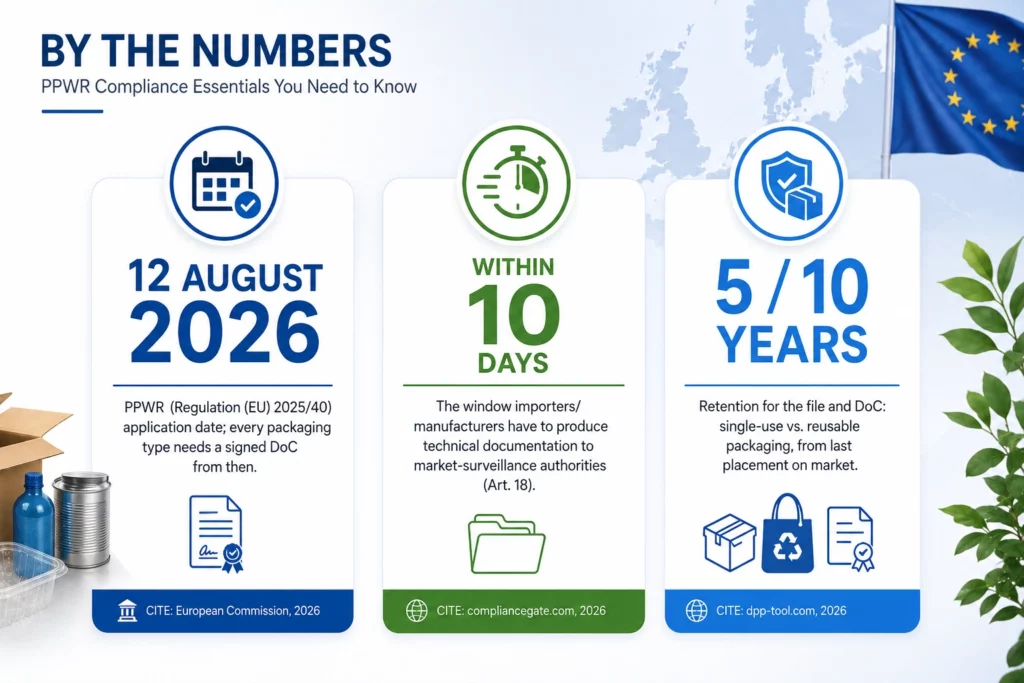
From 12 August 2026, every packaging type on the EU market needs a signed Declaration of Conformity backed by a PPWR technical file (Annex VII). The file proves compliance with Articles 5–12 substance limits, PFAS, recyclability, minimisation, recycled content. Retain it 5 years (single-use) or 10 years (reusable) after last placement on market. Platforms like TraceX auto-collect and pre-validate supplier proof, then export the file audit-ready in one click.
The technical file is the body of evidence; the Declaration of Conformity is the one-page legal conclusion. Under PPWR, the DoC is a self-declaration not a CE mark and not a test certificate in which the manufacturer takes full legal responsibility that a packaging type meets Articles 5–12 of Regulation (EU) 2025/40
Two structural points matter. First, PPWR uses Module A internal production control (Annex VII): the manufacturer runs the conformity assessment in-house, with no third-party notified body in the standard case. Second, the DoC follows a prescriptive Annex VIII template miss any required field and the declaration is treated as if it never existed, which blocks the packaging from market
The harder truth is that PPWR is a data-quality regulation the file fails when supplier data is scattered, unverified, or stale, not when the packaging itself is non-compliant.
Understanding PPWR Starts with a Proper Conformity Assessment
Learn what a PPWR conformity assessment involves, who is responsible, and how businesses can prepare compliant and audit-ready packaging systems.
Read the Complete Guide to PPWR Conformity Assessment →
PPWR doesn’t mandate a fixed format, but the file must let an authority verify compliance quickly and that means eight evidence categories per packaging type. Missing or inconsistent data is the most common cause of enforcement delay . Use this as your master checklist.
| # | Document | What it proves (PPWR article) |
|---|---|---|
| 1 | Packaging description & material breakdown | Type, layers, components, coatings, inks, adhesives |
| 2 | Substance-of-concern data | SoC minimisation; heavy-metal limits (Art. 5) |
| 3 | PFAS test reports | Food-contact PFAS thresholds, ISO/IEC 17025 lab (Art. 5) |
| 4 | Recyclability assessment | Design-for-Recycling grading, sorting compatibility (Art. 6) |
| 5 | Recycled-content evidence | PCR thresholds + recycler certificates of origin (Art. 7) |
| 6 | Minimisation justification report | Weight/volume reduced to minimum necessary (Art. 10) |
| 7 | Standards / specifications applied | Harmonised standards or alternative solutions used |
| 8 | Signed Declaration of Conformity | Annex VIII template, signed by the manufacturer (Art. 39) |
Rows 2, 3, and 5 are the choke points they depend on lab reports and recycler certificates that live with suppliers, and PPWR explicitly says a supplier’s word alone isn’t proof. That’s the fragmentation problem behind most missed deadlines.
Under PPWR, the manufacturer is whoever places packaging on the EU market under its own name or trademark not necessarily the company that physically makes it. Put your brand on a supplier’s bottle and you become the manufacturer, with full obligation to hold the technical file and issue the DoC (Articles 15, 21)
Importers carry their own duty under Article 18: verify the manufacturer completed the conformity assessment, collect a valid DoC for every packaging type, and produce the technical documentation to authorities within 10 days of a request. Non-EU manufacturers need an Authorised Representative (Article 17) to hold the file in the EU but legal responsibility never transfers. [The role you think you hold and the role PPWR assigns are often different; getting it wrong is how obligations fall through the cracks.]
Are You Prepared for PPWR as a Manufacturer?
Explore the requirements, understand your obligations, and learn how manufacturers can build compliant and future-ready packaging programs.
Read the Complete Guide to PPWR Compliance for Manufacturers →
When a compliance lead evaluates how to build the PPWR file, they’re hiring a solution to do four jobs not just to store documents. Naming them clarifies what decision-stage buyers actually compare.
Have a valid, complete DoC and file before 12 August 2026 so product isn’t held at the border. Without a valid declaration, packaging cannot legally be placed on the EU market .
Article 18 gives you ten days to respond to a market-surveillance request. The file has to be version-controlled and instantly exportable per packaging type.
Chase, verify, and store substance results and recycler certificates across hundreds of references without drowning in email threads.
Packaging composition and recycled-content data map directly to CSRD ESRS E5. [Collect the proof once and it feeds PPWR, CSRD, EcoVadis, and customer audits a point most PPWR-only guides miss.]
Preparing a PPWR file follows a repeatable seven-step sequence and most of the effort sits in steps 2 and 3, where verified supplier and substance data get collected and validated. The chart shows where teams typically lose time.
Where teams spend effort building a PPWR technical file (% of total)
| 1. List packaging types | 7% |
|---|---|
| 2. Collect supplier material/substance data | 34% |
| 3. Verify PFAS, PCR, recyclability | 26% |
| 4. Run minimisation justification | 11% |
| 5. Compile & version the file | 9% |
| 6. Pre-validate against Annex VII | 8% |
| 7. Sign & issue Annex VIII DoC | 5% |
Ready to Issue Your PPWR Declaration of Conformity?
Learn the step-by-step process for creating a PPWR Declaration of Conformity, understand what information must be included, and ensure your packaging documentation is audit-ready.
Read the Complete Guide to Creating a PPWR Declaration of Conformity →
PPWR files rarely fail on the packaging itself; they fail because the proof behind them is scattered, unverified, or out of date. Four challenges account for most readiness gaps
Specs in design, substance data in QA, certificates in supplier inboxes. Fix: one platform that ingests all of it into a per-SKU file.
PPWR requires verified test results, not a supplier’s word. Fix: AI-driven document parsing that extracts and flags what still needs lab evidence.
Documentation is required per packaging type. Manual collection collapses at volume. Fix: automated supplier questionnaires that chase missing data at scale.
The retention clock starts at last placement on market, so active product families need continuous updates. [Treating the file as a living dossier not a 2026 deliverable is what separates teams that stay compliant from teams that re-scramble at every spec change.]
For a few SKUs and one supplier, email and spreadsheets survive; across hundreds of packaging types and dozens of suppliers, manual collection breaks down well before a surveillance request lands. The comparison maps the practical difference.
| Capability | Manual (email + spreadsheets) | TraceX platform |
|---|---|---|
| Supplier data extraction | Manual re-keying | Agentic AI auto-parse |
| Proof verification | Ad hoc, easy to miss | Pre-sign validation vs. Annex VII |
| Scale across SKUs | Collapses past ~50 | Automated questionnaires at scale |
| Audit export (10-day rule) | Days of assembly | One-click PDF / XML / CSV |
| Data integrity | Editable, disputable | Blockchain-backed, tamper-proof |
| Reuse for CSRD / EcoVadis | Re-collected each time | Collect once, reuse everywhere |
| Packaging QR / DPP readiness | Not supported | GS1 ESPR Digital Product Passport |
TraceX Angle
PPWR Regulatory Compliance Platform has agentic AI that auto-parses supplier documents (material breakdowns, substance declarations, recycled-content and PFAS test reports), one source of truth with version control, blockchain-backed data integrity, one-click audit-ready export (PDF, XML, CSV), and ESPR Digital Product Passport support relevant to PPWR’s QR/data-carrier labelling phase. The same verified data baseline also feeds CSRD (ESRS E5).
The PPWR declaration is short. The technical file underneath it is the real work verified substance results, recycler certificates, and full material breakdowns for every packaging type, kept current and producible in ten days. The teams that clear the deadline treat the file as a living, system-backed dossier and collect the proof once, so it feeds PPWR, CSRD, and customer audits together.
The technical file (Annex VII) is the full evidence proving a packaging type meets Articles 5–12; the Declaration of Conformity (Annex VIII) is the signed one-page statement on top of it. The DoC is the conclusion; the file is the proof authorities can request within 10 days.
From 12 August 2026. Regulation (EU) 2025/40 entered into force on 11 February 2025, and from the August 2026 application date every unique packaging type on the EU market needs a signed DoC backed by technical documentation, or it cannot legally be marketed.
Retention is fixed by PPWR: at least 5 years for single-use packaging and 10 years for reusable packaging, counted from the last unit placed on the market — not the manufacturing date. Active product families therefore need rolling documentation upkeep.
The manufacturer (whoever places packaging under its own name or trademark) draws up the DoC and holds the file. Importers must verify it exists, hold a copy, and produce documentation to authorities within 10 days under Article 18. Non-EU makers need an EU Authorised Representative.
Yes, on a phased basis. Article 12 requires a QR code or other data carrier conveying packaging information, with harmonised labelling obligations phasing in from 12 August 2028. Building a GS1-based Digital Product Passport now positions you for that step.