PPWR Supply Chain Mapping: Why It Is the First Step Toward Compliance
Published
, 9 minute read
Share this article
Quick summary: PPWR compliance starts with supply chain visibility. By mapping suppliers, packaging components, material origins, and technical documentation early, businesses can build the evidence base needed for conformity assessments, recycled-content claims, and audit-ready declarations.
PPWR supply chain mapping is the process of documenting every supplier, packaging material, component, and technical document across your packaging value chain. It is the first step toward PPWR compliance because every downstream obligation conformity assessment, recycled-content proof, substance restrictions, and the Declaration of Conformity depends on complete, traceable supplier and packaging data.
PPWR supply chain mapping is where packaging compliance begins long before you draft a single Declaration of Conformity. The Packaging and Packaging Waste Regulation is far more than a recycling rule; it is a data regulation. To demonstrate compliance you need visibility across your entire packaging value chain: every supplier, every material, the recycled content in each component, the technical documentation behind it, and the economic operators involved.
Without that visibility, compliance becomes guesswork. Companies cannot prove packaging composition, recycled-content percentages, or substance restrictions if they do not first know who supplies what, where materials originate, and which documents exist. That is precisely why supply chain mapping is the non-negotiable first step.
KEY TAKEAWAYS
Supply chain mapping is the foundation for every PPWR obligation, not a procurement side-task.
You must map suppliers, materials, components, material origin, specifications, and technical documentation.
Mapping directly feeds conformity assessments, the Declaration of Conformity, and recycled-content evidence.
Spreadsheets fail at version control, audit trails, and supplier workflows.
A digital platform like TraceX Cleara AI turns mapping into an audit-ready, reusable compliance foundation.
See If TraceX Fits Your Compliance Needs
Before committing to anything, get an honest assessment of your PPWR gaps and whether a platform is the right fit. No pressure, just clarity.
PPWR supply chain mapping is the structured practice of identifying and connecting every actor and data point in your packaging value chain so that compliance evidence is traceable end to end. It is easy to confuse three related ideas, but they are not the same:
Supplier list — a flat directory of who you buy from. Useful, but static and disconnected from packaging data.
Supply chain map — a connected model linking suppliers to the specific packaging components, materials, and documents they provide.
Packaging traceability — the ability to follow any component back to its origin, recycled content, and supporting declarations.
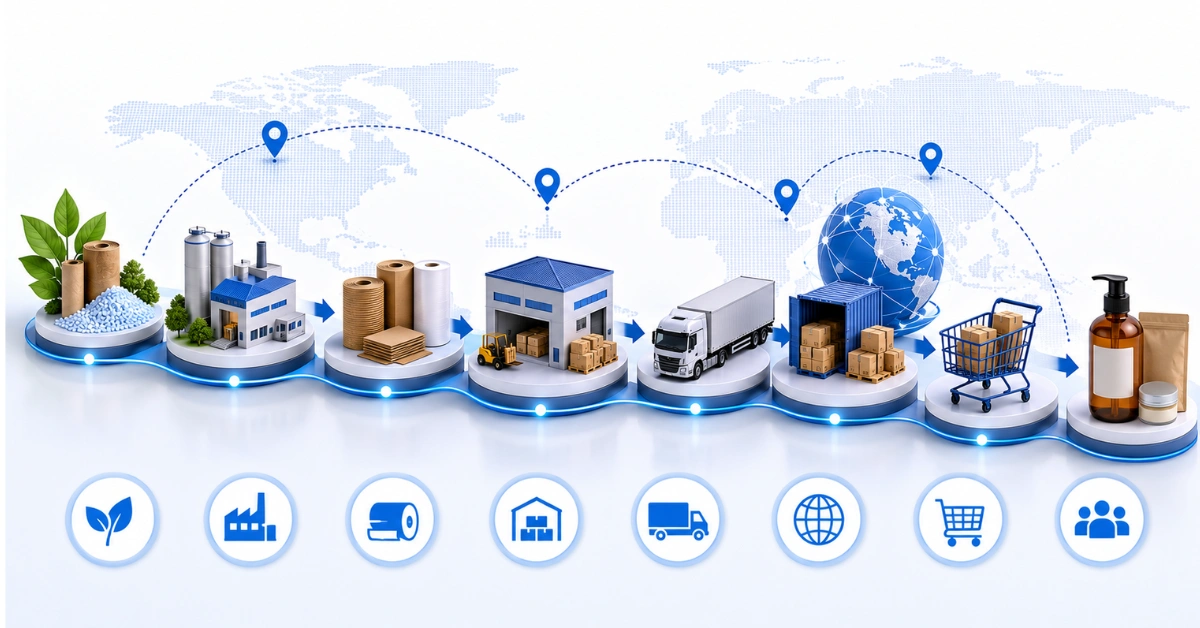
The packaging value chain typically flows: raw material supplier → packaging converter → packaging manufacturer → product manufacturer → importer → distributor → retailer → consumer. Mapping makes each hand-off visible and evidenced.
Why Packaging Supply Chain Mapping Matters Under PPWR
Under PPWR, businesses must demonstrate a defined set of packaging facts and each one traces directly back to supplier data. A robust PPWR supply chain mapping exercise is what makes these demonstrable:
Packaging composition and specifications
Technical documentation and supplier declarations
Declaration of Conformity (DoC)
Recycled content percentages
Substance restrictions (e.g., PFAS where applicable, heavy metals)
Without mapping your suppliers first, collecting this information becomes slow, incomplete, and impossible to audit. The pain is real: compliance teams chase documents by email while deadlines close in. Mapping removes that scramble by building the evidence base up front.
PPWR compliance goes beyond meeting regulatory requirements. It requires accurate packaging data, supplier collaboration, technical documentation, and continuous compliance management. Learn how to build a scalable compliance program that keeps your business audit-ready.
Which Businesses Need Packaging Supply Chain Mapping?
PPWR supply chain mapping applies across the packaging value chain. If you place packaging on the EU market or handle it as an economic operator, you are in scope. That includes:
Manufacturers and brand owners
Importers and authorised representatives
Distributors and retailers
Private-label brands
Packaging manufacturers and packaging suppliers
eCommerce sellers
Your responsibilities under PPWR depend on where your business fits in the packaging value chain. Whether you’re a manufacturer, importer, distributor, supplier, or brand owner, understanding your role is the first step toward compliance.
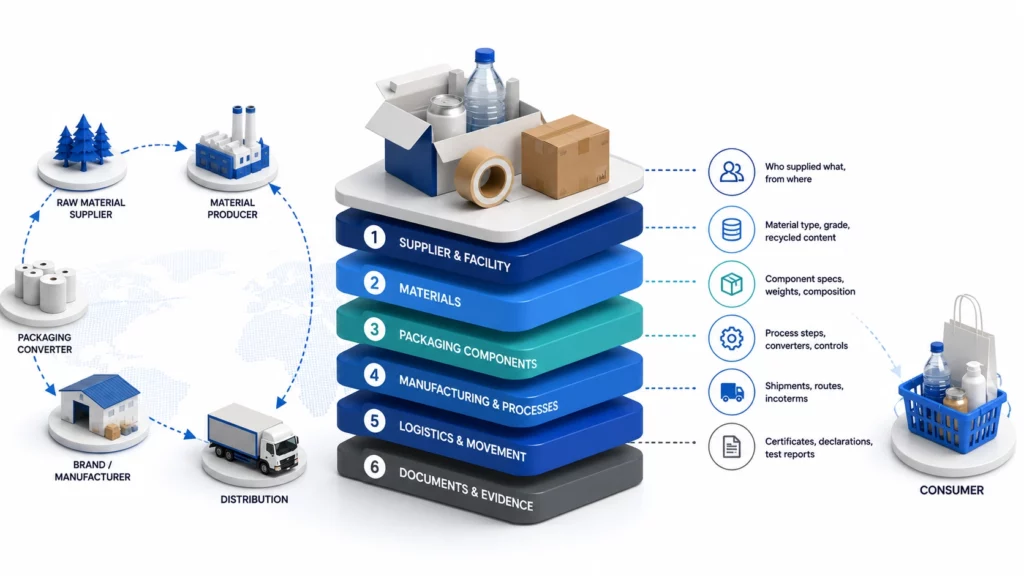
A complete PPWR supply chain map covers six data layers. Miss any one and your technical documentation will have gaps an auditor can find.
Suppliers
Map Tier 1 suppliers, packaging suppliers, material suppliers, converters, and contract manufacturers and record who supplies which component.
Packaging Materials
Track plastic, paper, glass, metal, composites, flexible packaging, labels, adhesives, and inks. Each carries its own recycled-content and substance profile.
Packaging Components
Break packaging into its parts bottle, cap, closure, film, tray, carton, label, pallet, stretch wrap so evidence attaches at the component level.
Material Origin
Capture country of origin, supplier, material type, and supporting declarations for every material.
Packaging Specifications
Maintain weight, dimensions, material composition, the packaging bill of materials (BOM), and the packaging hierarchy (primary, secondary, tertiary).
Technical Documentation
Collect test reports, material declarations, supplier declarations, certificates, laboratory reports, conformity assessments, and the DoC.
PPWR requires businesses to maintain accurate, up-to-date technical documentation that demonstrates packaging conformity. Learn what documents you’ll need, who is responsible, and how to build an audit-ready documentation process.
How Mapping Supports Each PPWR Compliance Requirement
Here is the direct line from supply chain mapping to each obligation the capability, and the benefit it delivers.
Packaging conformity assessment — mapping supplies the supplier evidence, material composition, and supporting documentation the assessment depends on.
Technical documentation — centralised, version-controlled collection means audit readiness instead of a document hunt.
Declaration of Conformity — DoCs depend on supplier data; mapping connects each declaration to the exact packaging components it covers.
Substance restrictions — visibility into PFAS (where applicable), heavy metals, and chemical declarations proves restricted substances are controlled.
Recycled plastic content — supplier evidence of PCR origin, material percentages, certificates, and batch traceability substantiates recycled-content claims.
Packaging minimisation — component-level material analysis lets you compare and optimise packaging to meet minimisation rules.
PPWR introduces new requirements for packaging design, recyclability, technical documentation, conformity assessments, labeling, and economic operators. Learn what applies to your business and how to prepare with confidence.
Monitor supplier changes continuously — track packaging revisions, material changes, and supplier updates.
Why Spreadsheets No Longer Work for PPWR Supply Chain Mapping
Spreadsheets feel free, but they quietly fail at exactly what PPWR demands: version control, audit trails, and supplier workflows. Here is how manual mapping compares to a digital approach.
Capability
Manual / spreadsheets
Digital platform
Version control
None overwrites lose history
Full audit trail per record
Supplier workflows
Manual emails, chasing
Automated onboarding & reminders
Audit readiness
Documents hunted at request
Always audit-ready
Data quality
Duplicates, gaps, decay
Validated, structured records
Reporting
Slow, error-prone
On-demand, exportable
Reusability
Rebuilt per regulation
One dataset, many workflows
Download the PPWR Implementation Handbook
Build a PPWR-ready packaging compliance program with practical guidance on supply chain mapping, technical documentation, conformity assessments, supplier collaboration, and packaging data management.
How Digital Traceability Simplifies Packaging Supply Chain Mapping
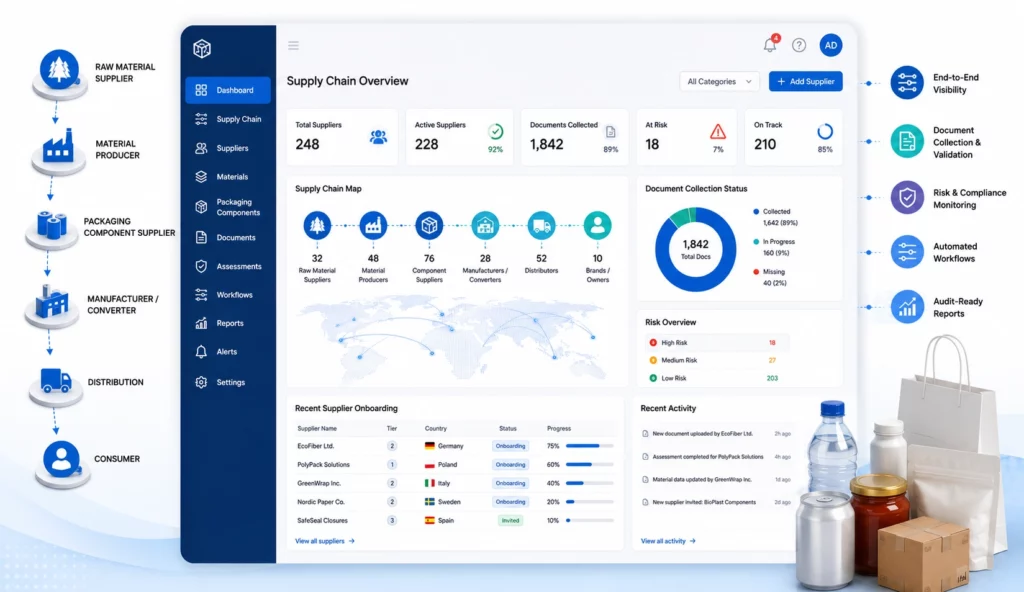
A digital traceability platform collapses the manual burden of supply chain mapping into a single connected system that handles supplier onboarding, document collection, packaging master data, workflow automation, technical documentation, audit trails, version control, packaging hierarchy, and cross-functional collaboration.
How TraceX Simplifies PPWR Supply Chain Mapping
TraceX PPWR Solutions is built to make packaging supply chain mapping fast, complete, and audit-ready. It brings the entire mapping process into one platform:
Supplier onboarding and document collection
Packaging BOM and master-data management
Technical documentation repository with version control
Workflow automation and AI-powered compliance assistance
Packaging conformity workflows and audit readiness
ERP integrations and multi-site management
Meet with a TraceX expert to assess packaging supply chain visibility, identify supplier documentation gaps, review PPWR readiness, build a mapping roadmap, and see how TraceX digitises end-to-end PPWR compliance.
PPWR Supply Chain Mapping Software: A Buyer’s Evaluation Checklist
Use this checklist when evaluating a platform for packaging supply chain mapping:
Does it capture the full packaging BOM and hierarchy at component level?
Can it automate supplier onboarding and document requests?
Does it maintain version control and a complete audit trail?
Can it generate and link the Declaration of Conformity to components?
Does it track recycled content, PCR origin, and substance restrictions?
Does it integrate with your ERP and support multi-site operations?
Will the same dataset support EPR, DPP, and sustainability reporting?
Future-Proof Packaging Compliance Beyond PPWR
The dataset you build for PPWR supply chain mapping is reusable. The same mapped supply chain supports PPWR, Extended Producer Responsibility (EPR), Digital Product Passports (DPP), corporate sustainability reporting, and customer sustainability questionnaires. Centralised packaging and supplier data reduces duplication across regulatory workflows as EU sustainability requirements continue to evolve.
Companies that wait until documentation is requested will struggle. Companies that invest in PPWR supply chain mapping today will be ready tomorrow. Supply chain mapping is no longer just a procurement activity it is the digital foundation for packaging compliance, audit readiness, and long-term sustainability.
Frequently Asked Questions (FAQ’s)
What is PPWR supply chain mapping?
It means documenting every supplier, packaging material, component, and technical document across your packaging value chain so compliance evidence is traceable end to end.
Is supply chain mapping mandatory under PPWR?
PPWR does not name “mapping” as a standalone duty, but the technical documentation, conformity assessment, and Declaration of Conformity obligations are effectively impossible to meet without it.
What information should be mapped?
Suppliers, packaging materials, components, material origin, packaging specifications (weight, dimensions, BOM, hierarchy), and all technical documentation.
How many supplier tiers should companies map?
Start with Tier 1 and packaging/material suppliers, then extend deeper where recycled content, substance restrictions, or material origin require upstream evidence.
How does mapping support technical documentation?
It centralises supplier declarations, test reports, and certificates with version control, so technical documentation is complete and audit-ready.
Can software automate packaging supply chain mapping?
Yes. Platforms from TraceX automate supplier onboarding, document collection, packaging master data, and conformity workflows.
How does TraceX help with packaging supply chain mapping?
TraceX Solutions unifies supplier onboarding, packaging BOM, a technical documentation repository, workflow automation, and ERP integration in one audit-ready platform.
Start using TraceX
Transparency, Trust, & Success for your Climate Journey.
We use cookies on our website to give you the most relevant experience by remembering your preferences and repeat visits. By clicking “Accept All”, you consent to the use of ALL the cookies. However, you may visit "Cookie Settings" to provide a controlled consent.
This website uses cookies to improve your experience while you navigate through the website. Out of these, the cookies that are categorized as necessary are stored on your browser as they are essential for the working of basic functionalities of the website. We also use third-party cookies that help us analyze and understand how you use this website. These cookies will be stored in your browser only with your consent. You also have the option to opt-out of these cookies. But opting out of some of these cookies may affect your browsing experience.
Necessary cookies are absolutely essential for the website to function properly. These cookies ensure basic functionalities and security features of the website, anonymously.
Cookie
Duration
Description
cookielawinfo-checkbox-analytics
11 months
This cookie is set by GDPR Cookie Consent plugin. The cookie is used to store the user consent for the cookies in the category "Analytics".
cookielawinfo-checkbox-functional
11 months
The cookie is set by GDPR cookie consent to record the user consent for the cookies in the category "Functional".
cookielawinfo-checkbox-necessary
11 months
This cookie is set by GDPR Cookie Consent plugin. The cookies is used to store the user consent for the cookies in the category "Necessary".
cookielawinfo-checkbox-others
11 months
This cookie is set by GDPR Cookie Consent plugin. The cookie is used to store the user consent for the cookies in the category "Other.
cookielawinfo-checkbox-performance
11 months
This cookie is set by GDPR Cookie Consent plugin. The cookie is used to store the user consent for the cookies in the category "Performance".
viewed_cookie_policy
11 months
The cookie is set by the GDPR Cookie Consent plugin and is used to store whether or not user has consented to the use of cookies. It does not store any personal data.
Functional cookies help to perform certain functionalities like sharing the content of the website on social media platforms, collect feedbacks, and other third-party features.
Performance cookies are used to understand and analyze the key performance indexes of the website which helps in delivering a better user experience for the visitors.
Analytical cookies are used to understand how visitors interact with the website. These cookies help provide information on metrics the number of visitors, bounce rate, traffic source, etc.
Advertisement cookies are used to provide visitors with relevant ads and marketing campaigns. These cookies track visitors across websites and collect information to provide customized ads.
Download the 2026 Traceability Scorecard and Benchmark Your Supply Chain Across 10 Critical Capabilities.
Download our eBook
Don’t Wait for an Audit to Find Your EUDR Gaps
The 2026 Simplification Package changes how HS codes, DDS pass-through and geolocation rules apply to you. Get the free guide and 20-point readiness checklist before enforcement catches you unprepared.