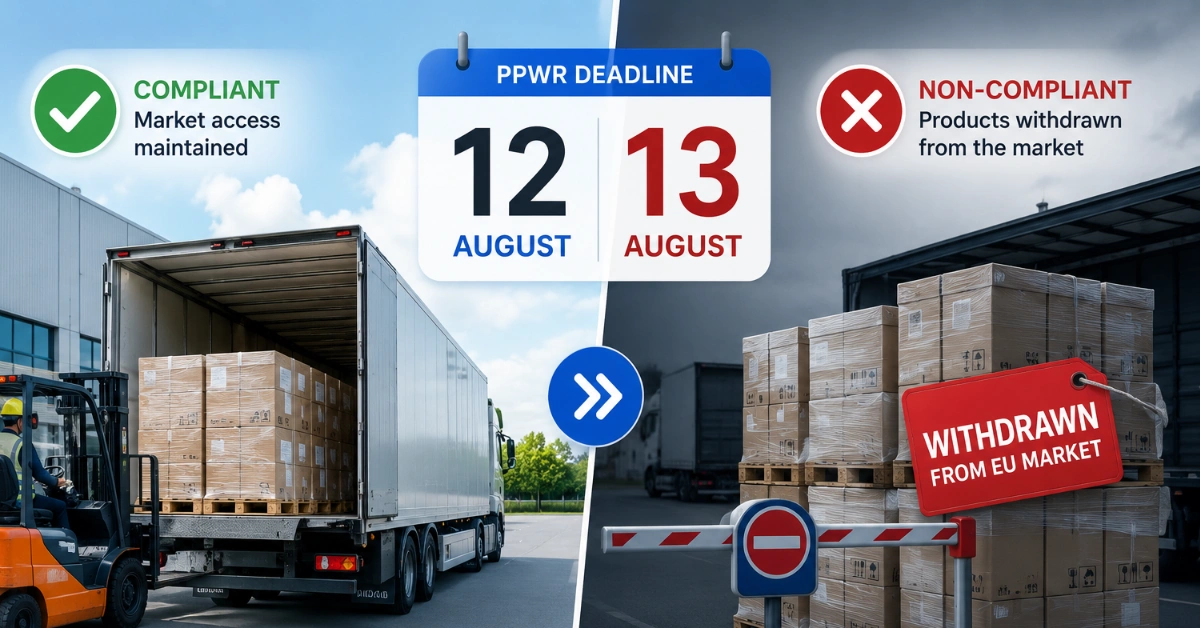
PPWR Regulation 2026: What Happens If Your Packaging Isn’t Ready by 12 August?
Published
, 12 minute read
Share this article
Quick summary: PPWR Regulation 2026 takes effect on 12 August 2026. Learn what happens if your packaging isn't ready and the steps businesses must take to avoid compliance risks.
PPWR Regulation applies across all 27 Member From 12 August 2026States. It replaces a 30-year-old directive and, crucially, it applies directly no national transposition, and no grace period for new stock.
The uncomfortable part for many teams: regulators don’t assess your intentions, they assess your evidence. If your technical files, PFAS test reports, supplier certificates or EPR registrations are incomplete on 12 August, your products may no longer be legally placed on the EU market the very next morning.
This guide walks through where companies actually get caught, what it costs, and the concrete moves that keep you compliant illustrated with the real-world scenarios most likely to land on your desk.
See Your Single Source of Truth in Action
Packaging specs, supplier documentation, technical dossiers, and compliance evidence — all centralized in one platform. See how TraceX helps you prepare for PPWR with confidence.
PPWR Regulation 2026 becomes applicable on 12 August 2026, and companies placing packaged products on the EU market must be ready from day one. There are no grace periods for core compliance obligations. Businesses need complete technical documentation, supplier certificates, packaging data, correct labelling, and country-specific EPR registrations before the deadline. Delaying preparation could result in product withdrawals, fines, sales disruptions, and retroactive compliance costs.
PPWR Regulation Compliance starts on day one there is no “fix it later”
PPWR applies to every economic operator placing packaging or packaged goods on the EU market: manufacturers, brand owners, importers, distributors and e-commerce sellers. The obligations that bite on day one include technical documentation, the PFAS and heavy-metals limits, EU Declarations of Conformity, labelling, and EPR registration.
Italian cosmetics brand selling in Germany
A beauty company assumes it can finalise paperwork after the regulation takes effect. On 13 August 2026, a German market-surveillance authority requests its packaging documentation and the technical files are incomplete.
Result: product withdrawals, delayed shipments, retail penalties, and a real hit to customer confidence.
The deadline doesn’t reward good intentions. It rewards a complete, retrievable evidence file. Treat 12 August as the date your documentation must already be audit-ready, not the date you start assembling it.
Most non-compliance isn’t deliberate it’s a gap that surfaces under audit. Here are the recurring failure points, what triggers them, and what “ready” looks like.
Risk area
Why it catches teams out
What “ready” looks like
Technical files
Every packaging format needs its own file; one gap can block the product.
A complete file per format, version-controlled.
PFAS testing
Lab lead times run 6–8 weeks; supplier word isn’t proof.
Accredited Certificates of Analysis on file.
Supplier documentation
Unverified claims can’t demonstrate compliance.
Third-party-verified declarations collected.
Declarations of Conformity
Similar-looking SKUs may each need their own DoC.
One DoC per format, with retained evidence.
Labelling
Technically compliant packaging still fails on missing sorting info.
Producer + consumer info correct before print.
EPR registration
One registration does not cover the EU.
Registered in every destination country.
Every packaging format needs an audit-ready technical file
For each packaging format, you must be able to produce design descriptions, production drawings, material composition by weight, recyclability (and reusability where relevant) evidence, weight/volume minimisation justification, and separation instructions for multi-material packaging.
Snack manufacturer with 25 SKUs
The range uses corrugated boxes, plastic trays, flexible pouches and protective inserts. Each configuration needs its own technical documentation and missing the file for just one format can stop the associated product from being legally sold.
Solution: Build a packaging-format register first, not an SKU list. Map every distinct format to its required evidence, and treat the technical file as a living record that updates whenever a material or supplier changes.
PFAS testing can’t be replaced with supplier assurances
For food-contact packaging, the PFAS restriction applies from 12 August 2026 and self-declarations are not proof. You need accredited laboratory evidence (Certificates of Analysis), per packaging type. Three thresholds apply:
25 ppb for any individual non-polymeric PFAS (targeted analysis).
250 ppb for the sum of non-polymeric PFAS.
50 ppm for total fluorine / total PFAS, including polymeric below this, packaging is generally considered compliant without further testing.
There’s also no stock-exhaustion period: food-contact packaging placed on the market after 12 August must comply even if it was made earlier. And the limits apply to the packaging unit as a whole inks, coatings and adhesives included.
Frozen-food producer
In June 2026 the company discovers its grease-resistant paper trays have never been PFAS-tested. Testing lead time is 6–8 weeks, so results arrive after the deadline.
Result: four product lines pulled from shelves, emergency logistics costs, and contractual penalties from retailers a problem that six months’ notice would have prevented.
Tip: Use the tiered route a total-fluorine screen (a few hundred euros) clears most materials fast. Reserve full targeted analysis for the formats that fail screening. Start with grease- and moisture-resistant items: wrappers, bakery liners, trays and fast-food packaging are the usual hotspots.
Are your food-contact packaging materials ready for the PFAS requirements under PPWR?
Supplier documentation can become your biggest risk
Your compliance is only as strong as the evidence behind it. Collect and verify compliance certificates, material declarations, hazardous-substance declarations, PFAS statements and recycled-content verification. Third-party verification is essential; unsupported supplier claims won’t stand up under audit.
Private-label beverage company
One packaging supplier can’t provide verified recycled-content certificates. Because the claim is unsupported, the manufacturer can’t demonstrate compliance.
Result: entire product launches are delayed.
Solution: Issue a standard supplier data request now, with a deadline well ahead of August, and make verified documentation a condition of purchase. Where a supplier can’t deliver, you still have time to qualify an alternative something you won’t have in July.
One packaging type = one Declaration of Conformity
Each packaging format needs its own EU Declaration of Conformity, supporting evidence, and version control with document retention (records are kept for five years). Products that look almost identical can still require separate DoCs.
Bottling company
With 10 bottle sizes, 5 cap variations and 3 label configurations, the products look similar but multiple Declarations of Conformity may be required. Poor document management is what creates the compliance gap, not the packaging itself.
Solution: Centralise DoCs and their evidence in one system with clear versioning, so the right declaration is retrievable on request not scattered across inboxes and shared drives.
Do you know how to prepare and maintain a Declaration of Conformity (DoC) under PPWR?
For many businesses, the DoC is one of the most overlooked aspects of packaging compliance—
Labels must be correct before products leave the factory
Packaging must carry the right producer information (company name, address, batch/serial number or digital equivalent) and consumer information (material identification, sorting instructions, recycling symbols, and reuse information where applicable). A technically compliant pack can still be ruled non-compliant on a missing sorting instruction.
Online coffee brand
The packaging is technically compliant, but recycling instructions are missing. Authorities classify it as non-compliant, and the company has to reprint thousands of units.
Solution: Add a labelling-artwork check to your pre-print sign-off, validated against the destination-market requirements catching it at proof stage costs a revision, catching it at the border costs a reprint run.
EPR registration is the requirement most companies underestimate
A common and costly misconception: that one registration covers the whole EU. It doesn’t. EPR obligations are country-specific each Member State runs its own producer register, with its own fees and reporting.
Polish exporter selling to four countries
Products ship to Germany, France, Belgium and the Netherlands. Without a registration in
each
destination country, all four markets are non-compliant.
Result: sales suspension, retroactive EPR fees, multiple regulatory investigations, and potential director liability.
Solution: Map your sales footprint country by country and register everywhere you place packaging appointing Authorised Representatives where you have no local entity.
Selling online across Europe usually means registering in each customer destination country, appointing authorised representatives, and joining local Producer Responsibility Organisations (PROs). Marketplaces increasingly verify registration before they let you sell.
UK supplement brand selling through its website
Orders ship into eight EU countries. The company assumed Brexit customs procedures covered packaging obligations then discovered it needed eight separate EPR registrations.
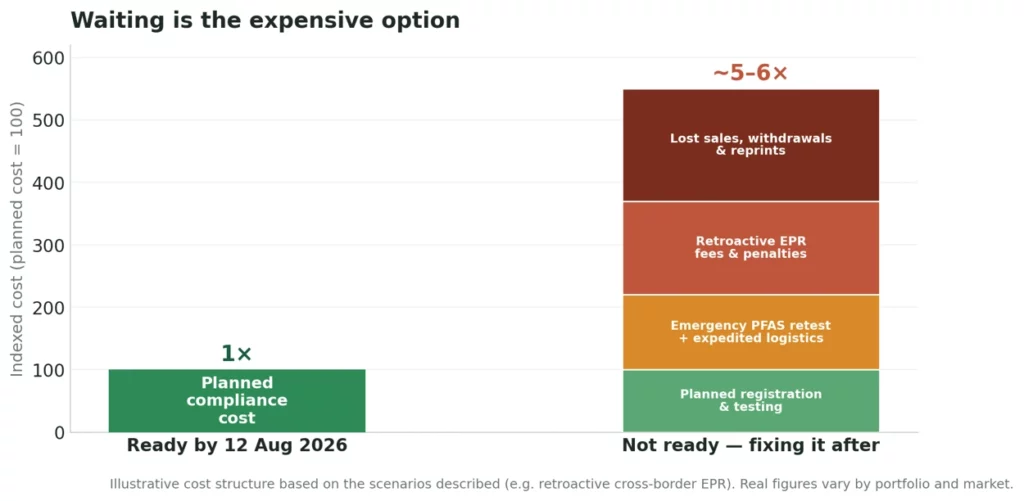
Result: the cost of retroactive compliance ends up many times the original registration cost.
Annual reporting starts immediately – you can’t reconstruct data later
From day one you need systems that record packaging volumes by country, material categories, recycled-content percentages, and packaging types placed on the market. There is no opportunity to rebuild this history after the fact.
Medium-sized electronics company
No country-level tracking system exists. Six months in, annual reporting becomes impossible because the historical packaging data was never captured so consultants are hired to rebuild records manually.
Result: significant avoidable cost, and a reporting position that’s still weaker than if data had been captured from the start.
Solution: Stand up a packaging-data system that captures volumes at the point of sale or shipment, by country and material, so each reporting cycle is a query not a reconstruction project.
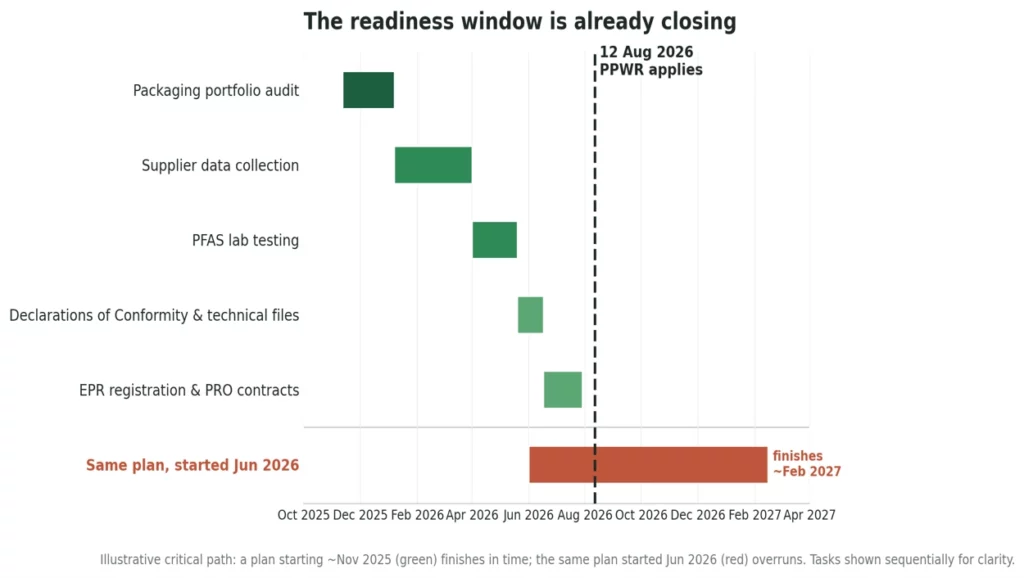
Starting in mid-2026 may already be too late
Preparation has real lead times, and several tasks sit on the critical path. Use this as a back-planning guide:
Activity
Typical lead time
Packaging audits
1–3 months
Supplier data collection
2–4 months
PFAS laboratory testing
6–8 weeks
EPR registration approvals
Several weeks
PRO contracts
Several weeks
Internal reporting systems
Months
Food manufacturer starting in June 2026
By August, testing is unfinished, supplier certificates are outstanding, and EPR registrations are still pending.
Result: products can’t legally enter several EU markets on day one.
Action plan: what to do right now
The companies still selling uninterrupted on 13 August will be the ones that sequenced this work early. A practical order:
Audit every packaging format — primary, secondary, transport and protective materials.
Start PFAS testing now — don’t wait; screen first, then targeted analysis where needed.
Review EPR obligations country by country — map where you sell and register in each market.
Build internal reporting systems — capture packaging data by country and material from day one.
How TraceX helps
TraceX PPWR Solutions helps organisations centralise packaging information, supplier certificates, test reports and compliance records in one place mapped to each packaging format and each market. That means technical files and Declarations of Conformity are retrievable on request, PFAS and recycled-content evidence is verified and linked to the right SKU, EPR obligations are tracked country by country, and packaging volumes are captured from day one for reporting. The result: 12 August becomes a date you’re ready for, not a deadline you’re racing.
Build a Future-Ready Packaging Compliance Strategy
Download our PPWR Handbook and schedule a expert call today to see how TraceX can help you build a future-ready packaging compliance strategy.
☑ Verified supplier declarations and recycled-content certificates on file.
☑ An EU Declaration of Conformity issued per packaging format.
☑ Labels checked for producer and consumer information before printing.
☑ EPR registrations active in every destination country (ARs appointed where needed).
☑ Packaging-data and reporting system capturing volumes from day one.
Final thoughts
12 August 2026 is not a milestone it’s a hard legal deadline. The companies that prepared early will keep selling uninterrupted on 13 August. Those that delayed may face product withdrawals, lost revenue, regulatory penalties, retroactive fees and supply-chain disruption across multiple markets at once.
In packaging compliance, waiting until the deadline is often the most expensive decision a company can make.
Frequently asked questions (FAQ’s)
Is there a grace period after 12 August 2026?
No. PPWR applies directly with no grace period for new stock. Non-compliant packaging can’t be placed on the EU market after the date, though stock already placed before it can generally be sold through (rules vary by Member State).
Does PPWR exempt small companies?
No. There’s no exemption from the core obligations or EPR registration based on company size, though some lighter administrative provisions can apply to the smallest businesses.
What are the PFAS limits for food-contact packaging?
25 ppb for any individual non-polymeric PFAS, 250 ppb for the sum of non-polymeric PFAS, and 50 ppm for total fluorine/total PFAS including polymeric. Below 50 ppm total fluorine, packaging is generally compliant without further testing. Supplier statements are not proof accredited lab Certificates of Analysis are required.
Do I need to register for EPR in every EU country I sell into?
Generally yes. EPR is country-specific: you register in each Member State where you place packaging on the market, appointing an Authorised Representative where you have no local entity.
Does one Declaration of Conformity cover all my packaging?
No. A separate EU Declaration of Conformity is generally required per packaging format, each backed by its own technical documentation and retained for five years.
When does PPWR start applying?
PPWR (Regulation (EU) 2025/40) entered into force on 11 February 2025 and applies from 12 August 2026, with further obligations such as recyclability grades and recycled-content targets phasing in toward 2030.
Start using TraceX
Transparency, Trust, & Success for your Climate Journey.
We use cookies on our website to give you the most relevant experience by remembering your preferences and repeat visits. By clicking “Accept All”, you consent to the use of ALL the cookies. However, you may visit "Cookie Settings" to provide a controlled consent.
This website uses cookies to improve your experience while you navigate through the website. Out of these, the cookies that are categorized as necessary are stored on your browser as they are essential for the working of basic functionalities of the website. We also use third-party cookies that help us analyze and understand how you use this website. These cookies will be stored in your browser only with your consent. You also have the option to opt-out of these cookies. But opting out of some of these cookies may affect your browsing experience.
Necessary cookies are absolutely essential for the website to function properly. These cookies ensure basic functionalities and security features of the website, anonymously.
Cookie
Duration
Description
cookielawinfo-checkbox-analytics
11 months
This cookie is set by GDPR Cookie Consent plugin. The cookie is used to store the user consent for the cookies in the category "Analytics".
cookielawinfo-checkbox-functional
11 months
The cookie is set by GDPR cookie consent to record the user consent for the cookies in the category "Functional".
cookielawinfo-checkbox-necessary
11 months
This cookie is set by GDPR Cookie Consent plugin. The cookies is used to store the user consent for the cookies in the category "Necessary".
cookielawinfo-checkbox-others
11 months
This cookie is set by GDPR Cookie Consent plugin. The cookie is used to store the user consent for the cookies in the category "Other.
cookielawinfo-checkbox-performance
11 months
This cookie is set by GDPR Cookie Consent plugin. The cookie is used to store the user consent for the cookies in the category "Performance".
viewed_cookie_policy
11 months
The cookie is set by the GDPR Cookie Consent plugin and is used to store whether or not user has consented to the use of cookies. It does not store any personal data.
Functional cookies help to perform certain functionalities like sharing the content of the website on social media platforms, collect feedbacks, and other third-party features.
Performance cookies are used to understand and analyze the key performance indexes of the website which helps in delivering a better user experience for the visitors.
Analytical cookies are used to understand how visitors interact with the website. These cookies help provide information on metrics the number of visitors, bounce rate, traffic source, etc.
Advertisement cookies are used to provide visitors with relevant ads and marketing campaigns. These cookies track visitors across websites and collect information to provide customized ads.
Download the 2026 Traceability Scorecard and Benchmark Your Supply Chain Across 10 Critical Capabilities.
Download our eBook
Don’t Wait for an Audit to Find Your EUDR Gaps
The 2026 Simplification Package changes how HS codes, DDS pass-through and geolocation rules apply to you. Get the free guide and 20-point readiness checklist before enforcement catches you unprepared.