PPWR Compliance for Packaging Manufacturers in India
Published
, 7 minute read
Share this article
Quick summary: Learn how packaging manufacturers in India can comply with the EU Packaging and Packaging Waste Regulation (PPWR), including design, recyclability, recycled content, and documentation requirements.
India has become one of the world’s largest packaging production centres, home to major converters, flexible-film producers, glass and rigid-plastic manufacturers, and paperboard suppliers serving food, beverage, pharmaceutical, and industrial customers worldwide — including brands that place packaged products on the EU market. As India is not an EU member, PPWR does not apply domestically. It applies in full, however, to any packaging manufactured in India that ends up in products placed on the EU market, making it a critical regulatory transition for Indian packaging manufacturers serving European customers.
The Packaging and Packaging Waste Regulation (PPWR) is the European Union’s new regulation designed to make packaging more sustainable, recyclable, and circular.
For many packaging manufacturers, PPWR is being viewed as another compliance requirement. That perspective misses the bigger opportunity.
The manufacturers that succeed over the next decade won’t simply produce packaging. They’ll become providers of compliant packaging data.
European brands are no longer asking only:
“Can you manufacture this packaging?”
They’re increasingly asking:
Can you prove it is recyclable?
Can you demonstrate recycled content?
Can you provide a Declaration of Conformity?
Can you maintain a technical dossier?
Can you respond to an audit within hours?
This shift is fundamentally changing how packaging manufacturers compete.
Discover how TraceX Packaging Data Management Platform centralizes packaging specifications, supplier documentation, technical dossiers, and compliance evidence into a single source of truth — helping you prepare for PPWR with confidence.
Historically, packaging procurement focused on cost, lead time, product quality, and manufacturing capability.
Under PPWR, compliance information becomes part of the product itself.
Large FMCG companies, automotive manufacturers, consumer goods brands, pharmaceutical companies, and industrial manufacturers increasingly require packaging suppliers to provide structured compliance data alongside every packaging specification.
In many procurement processes, incomplete documentation may delay approvals — even when the packaging itself meets technical requirements.
This means packaging manufacturers are no longer supplying only bottles, cartons, flexible films, labels, or containers. They’re supplying compliance-ready packaging.
Build a Complete PPWR-Ready Packaging Inventory
A well-managed packaging inventory is the foundation of PPWR compliance. Learn how to centralize packaging data, identify compliance gaps, and create a single source of truth for your packaging portfolio.
India already runs its own well-established Extended Producer Responsibility regime under the Plastic Waste Management Rules, 2016 (as amended), which requires Producers, Importers, and Brand Owners (PIBOs) to register on the CPCB EPR portal, meet recycled-content targets, and use traceable labelling. This domestic system is separate from PPWR, but Indian manufacturers exporting packaging or packaged goods into the EU must satisfy both.
However, PPWR introduces requirements that extend well beyond recycling. Manufacturers must demonstrate evidence related to:
Packaging composition
Material specifications
Design for recyclability
Packaging minimization
Recycled content
Supplier declarations
Restricted substances
Conformity assessments
Technical documentation
For organizations managing thousands of packaging SKUs across multiple customers, collecting this information manually becomes increasingly difficult.
The real challenge is no longer producing packaging. It’s managing packaging information.
The Hidden Cost of Manual Compliance
Many manufacturers currently manage compliance using Excel spreadsheets, shared folders, email chains, PDF specifications, and supplier questionnaires.
While these methods worked under previous regulations, they become difficult to scale under PPWR.
PPWR Makes Packaging Data a Strategic Asset
One of the biggest misconceptions surrounding PPWR is that compliance begins once the regulation applies.
In reality, compliance begins much earlier — during packaging design. Every design decision affects recyclability, material efficiency, technical documentation, supplier qualification, customer approvals, and future regulatory reporting.
This is why leading manufacturers are shifting from document management to Packaging Data Management. Instead of searching for certificates before an audit, they maintain continuously updated digital records throughout the packaging lifecycle.
Turn Packaging Data into PPWR Compliance
Discover how centralized packaging data management helps you maintain technical documentation, improve supplier collaboration, and stay audit-ready for PPWR.
What Indian Packaging Manufacturers Should Prioritize
Rather than reacting to customer requests individually, manufacturers should establish a structured compliance framework.
Centralized Packaging Data
Maintain a single source of truth for packaging specifications, material composition, customer variants, artwork, and product revisions.
Technical Documentation
Build technical dossiers containing material declarations, supplier certificates, test reports, compliance evidence, and supporting documentation. This significantly reduces audit preparation time.
Supplier Compliance
Packaging manufacturers depend heavily on suppliers. Collecting declarations manually from every supplier creates unnecessary delays. Digital supplier onboarding enables businesses to maintain up-to-date compliance records while reducing administrative effort.
Recyclability Assessment
PPWR increasingly emphasizes packaging that can be effectively collected, sorted, and recycled. Manufacturers should evaluate packaging during product development rather than after production. Early assessment reduces redesign costs later.
Declaration of Conformity
Customers increasingly request Declarations of Conformity before approving packaging. Generating these documents manually for thousands of SKUs becomes resource-intensive. Automated workflows simplify document generation while ensuring version control.
Why Compliance Is Becoming a Sales Differentiator
Most manufacturers assume PPWR increases compliance costs. Forward-looking companies recognize it creates commercial opportunities.
Imagine two suppliers: one responds to compliance requests after several weeks, while the other provides a digital technical dossier, Declaration of Conformity, recycled content evidence, and compliance reports within minutes.
Increasingly, procurement decisions depend not only on manufacturing capability but also on the quality and accessibility of compliance information.
Packaging Manufacturers Need Digital Compliance Infrastructure
PPWR is accelerating digital transformation within the packaging industry. Modern manufacturers require platforms capable of managing specifications, master data, supplier documentation, compliance workflows, technical dossiers, and regulatory reporting.
Instead of multiple disconnected spreadsheets, organizations benefit from a centralized compliance platform that provides complete visibility across packaging portfolios.
How TraceX Helps Packaging Manufacturers Prepare for PPWR
TraceX Packaging Data Management Platform enables packaging manufacturers to digitize and simplify PPWR compliance through a centralized, audit-ready solution.
With TraceX, organizations can:
Centralize packaging specifications across multiple production facilities.
Build and maintain digital technical dossiers for every packaging SKU.
Collect supplier declarations and supporting compliance documents through structured workflows.
Manage material composition, recycled content, and regulatory documentation from a single platform.
Generate PPWR Declarations of Conformity with version-controlled records.
Maintain complete audit trails and documentation for customer and regulatory requests.
Improve collaboration across procurement, quality, sustainability, compliance, and product development teams.
Instead of treating compliance as a collection of documents, TraceX helps manufacturers manage packaging compliance as structured, connected data.
Ready to streamline your PPWR compliance journey? Explore how the TraceX PPWR Solution can help you build a compliant, transparent, and future-ready packaging ecosystem.
The Future of Packaging Manufacturing Is Data-Driven
India’s packaging industry has always been recognized for manufacturing strength and cost competitiveness across flexible film, rigid plastics, and paperboard. PPWR expands that expectation for exporters serving EU customers.
Tomorrow’s market leaders will combine manufacturing excellence with digital compliance excellence.
Customers will increasingly choose suppliers who can deliver sustainable packaging, transparent documentation, verified compliance, faster approvals, and reduced regulatory risk.
The companies investing in packaging data management today will be better positioned to meet customer expectations, accelerate product approvals, and strengthen long-term competitiveness.
PPWR is not simply changing packaging regulations. It is redefining what customers expect from packaging manufacturers.
The question is no longer “Can you manufacture compliant packaging?” It is “Can you prove it — instantly?”
Frequently Asked Questions
Does the PPWR apply to packaging manufacturers in India?
Yes. Packaging manufacturers placing packaging on the EU market should assess how the PPWR applies to their products and business activities. The regulation establishes harmonised requirements across EU Member States.
Does the PPWR replace Indian packaging legislation?
The PPWR introduces directly applicable EU-wide requirements. Some national legislation, including existing Indian packaging rules, will continue to operate alongside the regulation where applicable. Businesses should understand how both frameworks interact.
Which packaging materials are covered?
The regulation covers a broad range of packaging materials, including plastic, paper, cardboard, glass, metal, composite, transport, industrial, consumer, and e-commerce packaging.
What documentation should manufacturers maintain?
Manufacturers should retain technical documentation supporting compliance, including material information, product specifications, design assessments, recyclability evidence, supplier declarations, and other records required under the regulation.
How can manufacturers prepare for PPWR compliance?
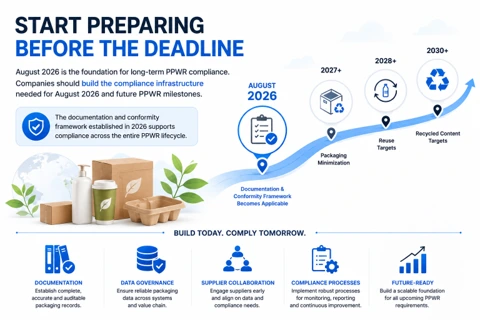
Preparation typically includes reviewing packaging portfolios, engaging suppliers, improving technical documentation, incorporating circular design principles, and implementing robust data management processes. Early planning can help manufacturers meet future regulatory milestones more efficiently.
Start using TraceX
Transparency, Trust, & Success for your Climate Journey.
We use cookies on our website to give you the most relevant experience by remembering your preferences and repeat visits. By clicking “Accept All”, you consent to the use of ALL the cookies. However, you may visit "Cookie Settings" to provide a controlled consent.
This website uses cookies to improve your experience while you navigate through the website. Out of these, the cookies that are categorized as necessary are stored on your browser as they are essential for the working of basic functionalities of the website. We also use third-party cookies that help us analyze and understand how you use this website. These cookies will be stored in your browser only with your consent. You also have the option to opt-out of these cookies. But opting out of some of these cookies may affect your browsing experience.
Necessary cookies are absolutely essential for the website to function properly. These cookies ensure basic functionalities and security features of the website, anonymously.
Cookie
Duration
Description
cookielawinfo-checkbox-analytics
11 months
This cookie is set by GDPR Cookie Consent plugin. The cookie is used to store the user consent for the cookies in the category "Analytics".
cookielawinfo-checkbox-functional
11 months
The cookie is set by GDPR cookie consent to record the user consent for the cookies in the category "Functional".
cookielawinfo-checkbox-necessary
11 months
This cookie is set by GDPR Cookie Consent plugin. The cookies is used to store the user consent for the cookies in the category "Necessary".
cookielawinfo-checkbox-others
11 months
This cookie is set by GDPR Cookie Consent plugin. The cookie is used to store the user consent for the cookies in the category "Other.
cookielawinfo-checkbox-performance
11 months
This cookie is set by GDPR Cookie Consent plugin. The cookie is used to store the user consent for the cookies in the category "Performance".
viewed_cookie_policy
11 months
The cookie is set by the GDPR Cookie Consent plugin and is used to store whether or not user has consented to the use of cookies. It does not store any personal data.
Functional cookies help to perform certain functionalities like sharing the content of the website on social media platforms, collect feedbacks, and other third-party features.
Performance cookies are used to understand and analyze the key performance indexes of the website which helps in delivering a better user experience for the visitors.
Analytical cookies are used to understand how visitors interact with the website. These cookies help provide information on metrics the number of visitors, bounce rate, traffic source, etc.
Advertisement cookies are used to provide visitors with relevant ads and marketing campaigns. These cookies track visitors across websites and collect information to provide customized ads.
Download the 2026 Traceability Scorecard and Benchmark Your Supply Chain Across 10 Critical Capabilities.
Download our eBook
Don’t Wait for an Audit to Find Your EUDR Gaps
The 2026 Simplification Package changes how HS codes, DDS pass-through and geolocation rules apply to you. Get the free guide and 20-point readiness checklist before enforcement catches you unprepared.