Quick summary: PPWR compliance fails on packaging data, not packaging design. See why 73% of teams struggle with supplier data and the 5-layer fix before August 2026.
PPWR compliance hinges on data, not design. The EU Packaging and Packaging Waste Regulation (Regulation (EU) 2025/40) requires companies to collect, verify, and report granular packaging information recycled content percentages, material composition, recyclability grades, substance declarations, and weight for every SKU sold into the EU. Most companies discover too late that this data lives in their suppliers’ systems, not theirs. This is why packaging data management for PPWR compliance is becoming a strategic priority. Organizations that establish a centralized and reliable packaging data foundation will be better equipped to meet reporting obligations, support Declarations of Conformity, and adapt to future circular economy requirements.
Picture this. It’s late 2027. An EU market surveillance authority requests your Declaration of Conformity for a packaging SKU shipped into Germany. You have 14 days to produce verified recycled-content data, substance test results, and a recyclability grade for every component, every coating, every adhesive.
Can you do it without making 17 phone calls to suppliers?
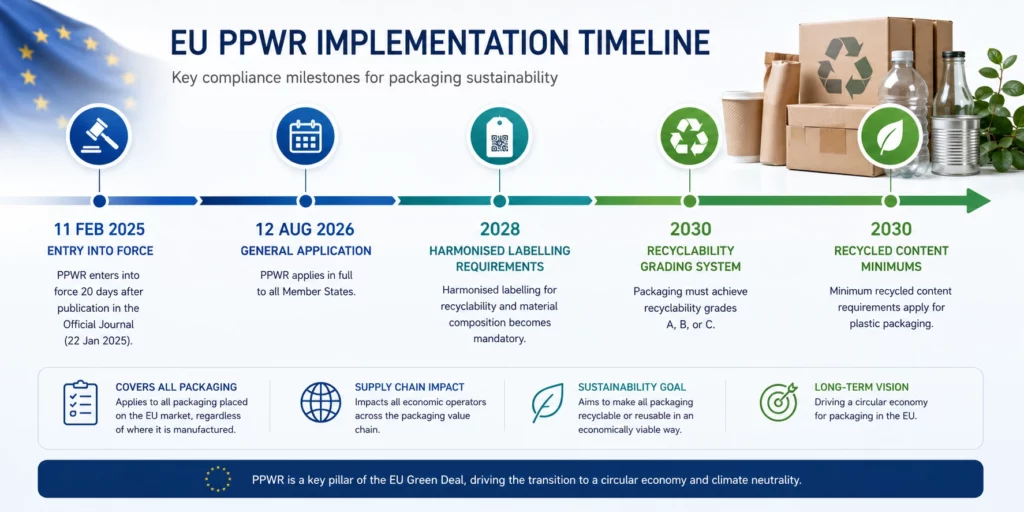
For most agri-food companies, the honest answer is no. The PPWR entered into force on 11 February 2025 and applies from 12 August 2026, with staggered obligations running through 2030. The regulation itself is well-documented. What’s underappreciated is that PPWR is fundamentally a supply chain data problem and that’s where teams are getting stuck.
Your Team Shouldn’t Decode PPWR Alone
Save weeks of internal research. Bring your questions to a PPWR specialist and leave with concrete next steps for your compliance program.
Key Takeaways • PPWR enters general application on 12 August 2026 but its real burden is supply chain data, not packaging design. • Companies must produce verified, per-SKU data on recycled content, material composition, and recyclability traced back to Tier-2 recyclers and converters. • Manual spreadsheets and supplier self-declarations won’t survive 2026 audits structured traceability infrastructure is now baseline.
What does the PPWR actually require companies to report?
PPWR forces companies to collect a level of packaging detail most have never tracked. From 12 August 2026, manufacturers, importers, and distributors must hold technical documentation covering recycled content percentages, material composition, recyclability assessments, substances of concern (including PFAS), packaging weight and volume, and EPR category for every packaging article placed on the EU market (European Commission, Regulation (EU) 2025/40, 2025).
The challenge: most of this data doesn’t live with the brand. It sits with packaging converters, raw material suppliers, and recyclers often three or four tiers deep. A coffee exporter selling roasted beans in flexible pouches needs to know not only the resin blend of the laminate, but the percentage of post-consumer recycled material in each layer, the source recycler’s certificate of origin, and the substance profile of the inks and adhesives.
Across PPWR-affected companies, roughly 73% are still in early-stage readiness, with packaging data infrastructure not packaging design cited as the top blocker. (Source Intelligence PPWR Readiness Survey, 2026)
Discover the key packaging design requirements under PPWR and learn how businesses can create packaging that is both compliant and future-ready.
Why is packaging data the hardest part of PPWR compliance?
Five structural reasons explain why packaging data is harder than packaging design itself. Each one breaks a different part of the readiness program and they compound.
1. Data ownership is distributed, not centralized
A typical packaged-food SKU passes through 5–7 supply chain hands: resin producer → film converter → printer → laminator → pouch maker → co-packer → brand. Each holds a fragment of the truth, and none holds all of it.
2. Self-declarations don’t count as proof
PPWR requires verified evidence, not supplier word-of-honour. Auditors will expect per-lot recycled-content certificates, mass-balance documents, and substance test reports not batch averages or annual estimates.
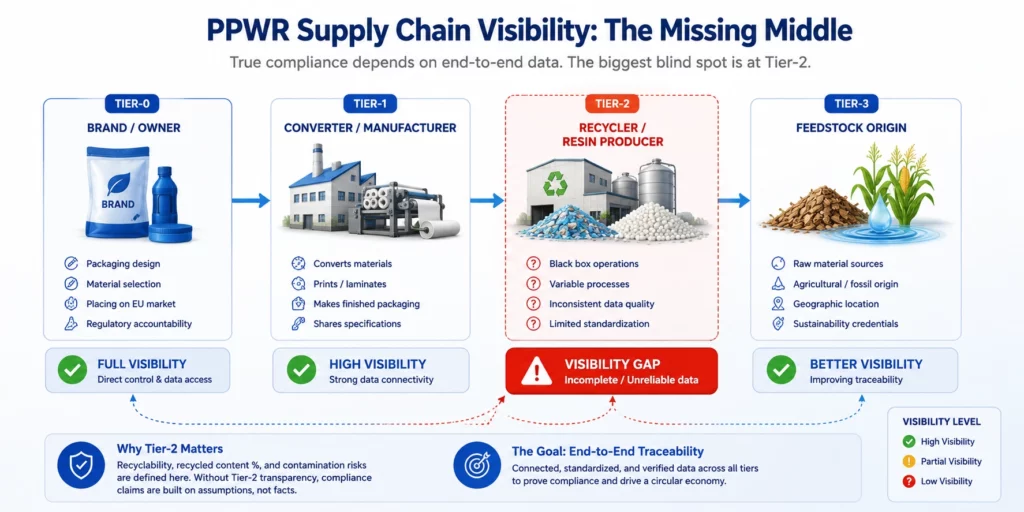
3. Tier-2 visibility is virtually non-existent
Most brands have direct relationships only with their Tier-1 packaging converter. The recycler supplying the PCR pellets the actual source of the recycled-content claim is often invisible. PPWR forces that visibility.
4. Data formats are fragmented
Suppliers respond to packaging data requests in PDFs, emails, spec sheets, and Excel attachments. Without structured ingestion, the data never makes it into a reportable format. Procurement teams describe quarterly data collection as a manual archaeology exercise.
5. The same data feeds five frameworks
Packaging data collected for PPWR also feeds CSRD (ESRS E5), EcoVadis, EPR national registries, and customer audits. Built once correctly, it’s reusable. Built badly, it’s redone every quarter.
Discover what PPWR means for your business, the requirements you need to prepare for, and the practical steps organizations can take to build an audit-ready packaging strategy.
FIGURE 1 — Five structural reasons packaging data breaks PPWR readiness
ROOT CAUSE
DATA SYMPTOM
DOWNSTREAM IMPACT
Distributed ownership
Data spread across 5–7 supply chain tiers
No single source of truth per SKU
Self-declarations only
Word-of-honour, no verified evidence
Audit rejection, fines, market access risk
Tier-2 invisibility
Recycler / feedstock supplier unknown
Cannot prove origin of PCR content
Format fragmentation
PDFs, emails, Excel, spec sheets
Manual re-entry, errors, no automation
Framework duplication
Same data needed for CSRD, EcoVadis, EPR
Quarterly re-collection, rework, burnout
Arla Foods identified over $1M in EPR fee overpayments traceable to inaccurate packaging data. With centralized data infrastructure, those overpayments were eliminated. (Source Intelligence Case Study, 2026)
What are the most common PPWR data collection challenges?
Across food, beverage, and agri-commodity brands working toward PPWR readiness, the same six challenges keep surfacing. Each one breaks a different part of the program.
TABLE 1 — PPWR data challenges, operational impact, and what ‘ready’ looks like
CHALLENGE
OPERATIONAL IMPACT
WHAT PPWR-READY LOOKS LIKE
Missing recycled-content evidence
Cannot sign Declaration of Conformity
Per-lot PCR certificates from named recyclers
Tier-2 supplier blind spots
Material origin claims unverified
Supply chain mapped back to feedstock source
Inconsistent supplier response formats
Manual re-entry, errors, version chaos
Standardized digital questionnaires with validation
No substance-of-concern (SoC) data
PFAS and SoC declarations incomplete
Substance profile per packaging component
EPR data fragmented by country
Misreported fees, audit risk per Member State
Country-level EPR category mapped per SKU
Packaging data disconnected from product master
SKU-level traceability impossible
Packaging article linked to ERP product record
How does the Tier-2 supplier visibility problem break PPWR readiness?
The Tier-2 problem is where most PPWR programs quietly fail. PPWR requires recycled-content claims to be traceable back to the recycler that produced the PCR feedstock not just attested by your Tier-1 converter. For brands sourcing flexible packaging from converters in Asia or Eastern Europe, this means proving the origin of pellets manufactured by companies they’ve never met.
A real-world walkthrough
Consider a tomato paste exporter shipping in laminated stand-up pouches. The Tier-1 converter declares 30% recycled content. The brand accepts the declaration. An EU auditor in 2028 asks for the recycler’s certificate of origin, ISCC PLUS chain-of-custody documentation, and per-lot mass-balance evidence.
The converter doesn’t have it. The recycler is a regional operator in another country. The brand has no contractual right to data the converter never collected. The result: the recycled-content claim is unsupported, the Declaration of Conformity is invalid, and the EU market access window narrows.
The Tier-2 problem isn’t solved by better Tier-1 supplier engagement it requires contractual data flow clauses written into procurement contracts now, with platform infrastructure to ingest the resulting evidence.
Learn how conformity assessments work under PPWR, what documentation may be required, and the steps companies should take to build an audit-ready packaging compliance process.
When sustainability, compliance, and procurement teams describe what they actually need from PPWR data infrastructure, the requests cluster into four jobs-to-be-done. Most PPWR vendor positioning misses three of them.
‘Help me prove our recycled content is verified, per-lot, back to the recycler.’
The compliance manager needs evidence chains, not declarations. The output is a Declaration of Conformity backed by certificates, test reports, and mass-balance documents all version-controlled, all traceable, all audit-ready.
‘Help me collect data from 80+ suppliers without spending three months chasing emails.’
The procurement lead needs automation: standardized digital questionnaires, auto-reminders, gap-flagging, and a single source of truth. Manual chasing doesn’t scale past 20 suppliers. By 80 suppliers, it’s a full-time job. By 200, it’s impossible.
‘Help me link packaging article data to my ERP product master.’
The data and IT lead needs API integration. Packaging records that live in a separate compliance tool, disconnected from the product master, create reconciliation nightmares at quarter-end and break per-SKU reporting.
‘Help me use the same data for PPWR, CSRD, EPR, and EcoVadis without re-collecting.’
The sustainability head needs a re-usable proof library. Data collected once should feed every framework that asks for it. Otherwise, the team is rebuilding the same evidence base four times a year.
Explore the key EU sustainability regulations shaping global trade and learn how businesses can prepare for a more transparent and data-driven future.
Where PPWR data programs break down – three real-world scenarios
Scenario 1: The exporter who passes the audit on paper, fails on evidence
An Indian spices exporter completes its PPWR self-assessment using supplier-provided declarations. On paper, every SKU meets recycled-content thresholds. The first EU customer audit in early 2027 requests per-lot evidence. Three of seven suppliers can’t produce it. The brand spends six weeks reconciling, shipments are held at port, and one EU buyer pauses orders pending verification. Estimated commercial cost: €180,000 in delayed shipments plus the trust hit.
Scenario 2: The FMCG brand that double-pays EPR fees
A mid-market F&B brand reports packaging volumes to national EPR registries using approximate weights from outdated spec sheets. Across five EU markets, the brand consistently over-declares packaging weight by 8–12% because it never updated specs after a lightweighting initiative. Annual EPR overpayment: roughly €340,000. Recovery requires verified per-SKU weight data the brand doesn’t have.
Scenario 3: The agri-commodity processor blindsided by the Digital Product Passport
A coffee processor builds a PPWR program around recycled-content tracking. In 2028, the EU activates harmonised labelling and DPP linkage for packaging. The processor’s compliance dataset has the right fields but no GS1-standard structure and no API for QR-code resolution. The PPWR investment doesn’t transfer to the Digital Product Passport. They start over.
How TraceX closes the PPWR packaging data gap
PPWR data problems aren’t unique. They look almost identical to the supplier data problems TraceX customers already solved for EUDR compliance and the same architecture works.
TraceX’s Regulatory Compliance Platform uses agentic AI to parse supplier documents spec sheets, certificates, test reports and auto-extract recycled content percentages, material compositions, substance declarations, and supplier KYC into structured fields per packaging article. Blockchain-backed records ensure the proof chain is immutable and audit-ready. API integrations push verified data into ERP and procurement systems, so packaging data flows alongside product master records, not in a silo beside them.
Customers already use TraceX for EUDR Due Diligence Statement automation and supplier data collection. The same supplier network, the same field-data capture, the same proof library extends naturally to PPWR verified PCR certificates, substance data, and EPR category mapping on the platform companies already use. The compliance investment compounds across regulations instead of resetting with every new one.
Book a Readiness Consultation with TraceX experts to evaluate your existing processes, identify data and supplier gaps, and receive practical recommendations tailored to your business and regulatory priorities.
Schedule your consultation today and take the first step toward a more traceable, audit-ready, and future-proof supply chain.
What does a PPWR-ready packaging data architecture look like?
FIGURE 2 — The five-layer PPWR-ready packaging data architecture
LAYER
FUNCTION
WHAT GOOD LOOKS LIKE
Layer 5
Evidence Library
Every declaration, test report, certificate version-controlled with validity dates. Same library feeds CSRD, EcoVadis, customer audits.
Layer 4
Country-Level EPR Reporting
Packaging articles classified by EPR category per Member State, with reporting responsibility and fee calculation per country.
Layer 3
Compliance Field Mapping
Recycled content %, recyclability grade, weight, substances of concern, EPR category — populated per article from supplier evidence.
Layer 2
Supplier Evidence Capture
Standardized digital questionnaires sent to converters, recyclers, ink and adhesive suppliers. Auto-extracted, auto-validated, gap-flagged.
Layer 1
Product Master Connection
Every packaging article linked to ERP SKU, with bill-of-materials accuracy down to component (lid, label, primary pouch, secondary case).
When all five layers connect, signing a Declaration of Conformity becomes a 5-minute review, not a 5-week scramble. The PPWR readiness gap closes and the same data infrastructure pays forward into CSRD, DPP, and EPR for years.
Bottom Line
PPWR isn’t a packaging design problem. It’s a supply chain data problem wearing a packaging regulation’s clothes. The brands that will be PPWR-ready in August 2026 aren’t the ones redesigning packaging they’re the ones building verified data flows from recycler to brand, with proof chains that survive audit and a re-usable library that feeds every framework that follows.
The companies starting now have time. The ones waiting for 2026 don’t.
The PPWR Brief to Share with Your Leadership
Need to get stakeholders aligned? This handbook gives you the risks, timelines, and requirements in a format built to drive internal decisions.
The PPWR (Regulation (EU) 2025/40) entered into force on 11 February 2025 and generally applies from 12 August 2026. Several obligations stagger through 2030, including recyclability grades A–C, harmonised labelling (from August 2028), and minimum recycled-content thresholds for plastic packaging. (European Commission, 2025)
What packaging data must companies collect under PPWR?
Companies must collect per-article data on recycled content percentages with proof of origin, material composition, recyclability grade, packaging weight and volume, substances of concern including PFAS, EPR category per Member State, and supporting technical documentation. Self-declarations are not sufficient — verified evidence is required.
Are supplier self-declarations enough for PPWR compliance?
No. PPWR requires verified evidence — per-lot recycled-content certificates from named recyclers, substance test reports, recyclability assessments, and full material breakdowns. Auditors will reject batch-average claims and unverified supplier statements, especially for recycled-content percentages and PFAS declarations. (TraceX Packaging Traceability Guide, 2026)
How does PPWR connect to CSRD and the Digital Product Passport?
PPWR packaging data maps directly to CSRD ESRS E5 (Circularity and Waste Management) disclosures and feeds the EU Digital Product Passport when DPP for packaging activates in stages from 2028 onward. Building the data infrastructure once supports all three frameworks and EcoVadis, EPR, and customer audits as well.
What happens if packaging data is incomplete by August 2026?
Incomplete or unverified packaging data exposes companies to shipment holds at EU borders, market access restrictions, EPR fee disputes and overpayments, customer-audit failures, and reputational risk. From January 2030, packaging without verified recyclability grades A–C cannot be placed on the EU market at all.
Start using TraceX
Transparency, Trust, & Success for your Climate Journey.
We use cookies on our website to give you the most relevant experience by remembering your preferences and repeat visits. By clicking “Accept All”, you consent to the use of ALL the cookies. However, you may visit "Cookie Settings" to provide a controlled consent.
This website uses cookies to improve your experience while you navigate through the website. Out of these, the cookies that are categorized as necessary are stored on your browser as they are essential for the working of basic functionalities of the website. We also use third-party cookies that help us analyze and understand how you use this website. These cookies will be stored in your browser only with your consent. You also have the option to opt-out of these cookies. But opting out of some of these cookies may affect your browsing experience.
Necessary cookies are absolutely essential for the website to function properly. These cookies ensure basic functionalities and security features of the website, anonymously.
Cookie
Duration
Description
cookielawinfo-checkbox-analytics
11 months
This cookie is set by GDPR Cookie Consent plugin. The cookie is used to store the user consent for the cookies in the category "Analytics".
cookielawinfo-checkbox-functional
11 months
The cookie is set by GDPR cookie consent to record the user consent for the cookies in the category "Functional".
cookielawinfo-checkbox-necessary
11 months
This cookie is set by GDPR Cookie Consent plugin. The cookies is used to store the user consent for the cookies in the category "Necessary".
cookielawinfo-checkbox-others
11 months
This cookie is set by GDPR Cookie Consent plugin. The cookie is used to store the user consent for the cookies in the category "Other.
cookielawinfo-checkbox-performance
11 months
This cookie is set by GDPR Cookie Consent plugin. The cookie is used to store the user consent for the cookies in the category "Performance".
viewed_cookie_policy
11 months
The cookie is set by the GDPR Cookie Consent plugin and is used to store whether or not user has consented to the use of cookies. It does not store any personal data.
Functional cookies help to perform certain functionalities like sharing the content of the website on social media platforms, collect feedbacks, and other third-party features.
Performance cookies are used to understand and analyze the key performance indexes of the website which helps in delivering a better user experience for the visitors.
Analytical cookies are used to understand how visitors interact with the website. These cookies help provide information on metrics the number of visitors, bounce rate, traffic source, etc.
Advertisement cookies are used to provide visitors with relevant ads and marketing campaigns. These cookies track visitors across websites and collect information to provide customized ads.
Download the 2026 Traceability Scorecard and Benchmark Your Supply Chain Across 10 Critical Capabilities.
Download our eBook
Don’t Wait for an Audit to Find Your EUDR Gaps
The 2026 Simplification Package changes how HS codes, DDS pass-through and geolocation rules apply to you. Get the free guide and 20-point readiness checklist before enforcement catches you unprepared.