PPWR Compliance for Tire Manufacturers in Spain: Your Packaging Is the Problem, Not Your Tyres
Published
, 10 minute read
Share this article
Quick summary: PPWR compliance for tire manufacturers in Spain hinges on your transport packaging data. See what Reg. (EU) 2025/40 demands and how to prove conformity fast.
PPWR Compliance for Tire manufacturers in Spainmeans proving that the packaging around your tyres stretch film, pallets, cardboard interlayers, banding and labels meets Regulation (EU) 2025/40, which has applied across the EU since 12 August 2026. It does not regulate the tyre itself (that falls under end-of-life tyre rules), but it does require a technical file (Annex VII) and a Declaration of Conformity (Annex VIII) for every packaging type you place on the Spanish market, on top of your existing Royal Decree 1055/2022 producer registration and reporting.
Key takeaways
PPWR governs packaging, not products. For tyre makers, PPWR Compliance for Tire manufacturers in Spain applies to the industrial and transport packaging wrapped around tyres not the tyres themselves.
The regulation is already live. Regulation (EU) 2025/40 applies directly in Spain from 12 August 2026, with no national transposition and no grace period for newly placed stock.
You must document conformity per packaging type. Annex VII technical file and Annex VIII Declaration of Conformity are required for each format, covering substances, recyclability, minimisation and recycled content.
Spanish EPR still applies in parallel. Royal Decree 1055/2022 duties Product Producers Register, SCRAP membership, annual declarations sit alongside PPWR, not instead of it.
It is a data problem. The bottleneck is retrievable, plot-level packaging data which is exactly where a platform like TraceX earns its place.
Download the Free Declaration of Conformity (DoC) Template
PPWR Compliance for Tire Manufacturers in Spain: What the Regulation Actually Covers
PPWR Compliance for Tire manufacturers in Spain starts with a distinction most teams get wrong. The Packaging and Packaging Waste Regulation, Regulation (EU) 2025/40, does not touch the rubber, steel or textile that make up the tyre. It governs everything you wrap around the tyre to move it: stretch and shrink film, pallets, cardboard interlayers and spacers, banding, corner protectors, and the labels stuck to each casing. That is packaging under the Regulation and from 12 August 2026 it must comply directly, in every EU Member State, with no transposition step in between.
For a Spanish plant shipping tyres to OEMs, distributors and replacement-market buyers, this is a blind spot. Procurement treats film and pallets as consumables, not as regulated products carrying documentation duties. That assumption is now expensive.
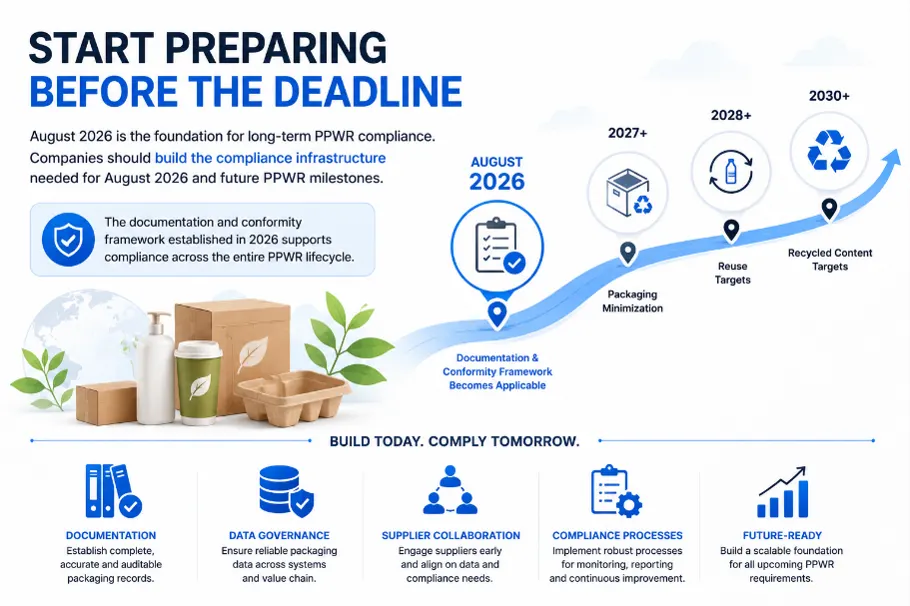
Don’t wait until compliance is due. Start by understanding what your packaging needs to prove.
Read our guide on PPWR Compliance Requirementsto understand the key obligations and the data and documentation you need to start preparing.
The pain: transport packaging was never on the compliance radar
Tyre manufacturers already carry a heavy regulatory load end-of-life tyre take-back, REACH substance controls, product labelling. Packaging around the product rarely made the list. Under PPWR it does, because obligations attach to whoever places the packaged item on the market. If your Spanish facility ships a palletised, film-wrapped load of tyres, you are the operator on the hook for that packaging’s conformity.
The practical trap is data. To prove PPWR Compliance for Tire manufacturers in Spain, you need material composition, weight, recycled-content percentage and substance-of-concern data for each packaging component sourced from suppliers who may never have been asked for it before. Most of that data lives in scattered spec sheets, emails and ERP fields that were never designed to answer a regulator.
The feature: one packaging data layer, mapped to every obligation
This is where the TraceX platform fits. Rather than rebuilding evidence per audit, PPWR Compliance for Tire manufacturers in Spain becomes a matter of structuring packaging data once and mapping it to each requirement. The platform captures supplier-declared material, weight, recycled content and substance data against every packaging SKU, then generates the artefacts the Regulation asks for
Concretely, that means the Annex VII technical file and the Annex VIII Declaration of Conformity are assembled from a single, versioned dataset not re-created by hand for each packaging format. When a substance limit or recycled-content threshold changes, you update the data once and every downstream document reflects it.
The benefit: enforcement readiness becomes a retrieval task
The strategic shift is this: PPWR Compliance for Tire manufacturers in Spain stops being a project you scramble to complete before an audit and becomes a query you can answer on demand. Market-surveillance authorities and customs can request conformity evidence at the border or post-market. If your packaging data is already structured, producing the technical file for a given SKU is retrieval, not reconstruction.
That readiness also compounds. The same packaging dataset that satisfies PPWR Compliance for Tire manufacturers in Spain feeds your Royal Decree 1055/2022 annual declaration, your SCRAP fee reconciliation and your recycled-content targets the one data layer, many regulations logic that keeps you from re-solving the same evidence problem for every rule.
The proof: what “good” looks like in practice
A tyre manufacturer with structured packaging data can, for any given format, show the material breakdown, confirm the combined heavy-metal limit is met, demonstrate design-for-recyclability, and export a signed Declaration of Conformity in minutes rather than weeks
For tyre makers, PPWR is a packaging-data problem wearing a compliance costume. The Regulation doesn’t ask whether your tyres are good it asks whether you can prove, per packaging type, what your film and pallets are made of, how much recycled content they carry, and that they clear substance limits. Teams that treat this as a document exercise will re-do it every audit. Teams that treat it as a data-structuring exercise solve it once.
Read our guide on PPWR Compliance for Manufacturers to understand the key requirements around packaging data, material information, technical documentation, conformity assessment, supplier evidence and Declaration of Conformity workflows.
PPWR Compliance for Tire Manufacturers in Spain: Manual Effort vs. the TraceX Platform
Both routes can technically get you to conformity. The difference is how much re-work each new packaging format, supplier change or regulatory update costs you.
Compliance task
Manual / spreadsheet approach
TraceX platform
Packaging data collection
Chase suppliers by email per audit; data re-keyed into spec sheets
Supplier-declared data captured once against each packaging SKU
Annex VII technical file
Rebuilt manually for each packaging format
Generated from the structured dataset
Annex VIII Declaration of Conformity
Drafted and version-tracked by hand
Exported and versioned per SKU
Royal Decree 1055/2022 reporting
Separate data pull for SCRAP declarations
Same packaging dataset reused for annual declaration
Responding to an audit
Weeks of reconstruction under deadline
Retrieval on demand from a single source
How TraceX Helps French Tire Manufacturers with PPWR
For tire manufacturers in France, PPWR compliance is not limited to the tyre itself it also requires visibility into the packaging used to protect, transport and deliver tyres, such as pallets, plastic films, straps, labels, boxes and other packaging components. TraceX PPWR Solutions helps manufacturers build a structured packaging inventory across SKUs, map each component to its material, weight and supplier, and centralize the technical documentation and compliance evidence received from packaging suppliers. This is particularly useful where packaging is sourced from multiple suppliers or countries. TraceX can also help organize the evidence required for conformity assessment and Declaration of Conformity workflows, while maintaining a traceable record connecting packaging specifications to the relevant products. Under PPWR, manufacturers must prepare technical documentation and a DoC after conformity has been demonstrated, while importers have specific obligations to verify that the manufacturer’s assessment and documentation have been completed.
See how the TraceX platform structures your tyre packaging data into audit-ready Annex VII and Annex VIII evidence.
PPWR Compliance for Tire Manufacturers in Spain: A Buyer’s Evaluation Checklist
If you are scoping a packaging-compliance platform, pressure-test any vendor against the criteria that actually matter for a Spanish tyre operation:
Per-SKU packaging modelling. Can it hold material, weight, recycled-content and substance data at the individual packaging-format level, not just a rolled-up total?
Annex VII and Annex VIII generation. Does it produce the technical file and Declaration of Conformity from that data, or leave you to draft them?
Supplier data capture. Can suppliers submit declarations directly, with an audit trail, rather than by loose email?
Spanish EPR alignment. Does the same dataset feed Royal Decree 1055/2022 declarations and SCRAP reconciliation?
Change management. When a threshold or Annex requirement updates, does the change propagate to every affected document automatically?
Multi-regulation reuse. Can the foundational packaging data extend to future rules (recycled-content targets, labelling from 2028) without a rebuild?
Frequently asked Questions
Does PPWR regulate the tyres themselves?
No. PPWR Compliance for Tire manufacturers in Spain applies to the packaging around your tyres film, pallets, cardboard, banding and labels under Regulation (EU) 2025/40. The tyres themselves fall under separate end-of-life tyre and REACH obligations.
When does PPWR apply in Spain?
Regulation (EU) 2025/40 applies generally across the EU, including Spain, from 12 August 2026. It is a regulation, so it takes direct effect without national transposition, and there is no general grace period for stock placed on the market from that date.
Do I still need to comply with Royal Decree 1055/2022?
Yes. Spain’s Royal Decree 1055/2022 governs Extended Producer Responsibility Product Producers Register enrolment, membership of a SCRAP, and annual packaging declarations. These duties run in parallel with PPWR, not in place of it.
What documents do I need per packaging type?
For each packaging format you place on the market, you need an Annex VII technical file evidencing conformity and an Annex VIII Declaration of Conformity. Both must be backed by material, weight, recycled-content and substance data.
Which substances does PPWR restrict in packaging?
PPWR sets a combined concentration limit for lead, cadmium, mercury and hexavalent chromium in packaging, and requires operators to minimise substances of concern. Verify the current limit and any updates at EUR-Lex before relying on a figure.
Do certification schemes cover PPWR for me?
Recycling-scheme membership and material certifications support your case but do not replace the technical file or Declaration of Conformity. You still need plot-level packaging evidence to demonstrate PPWR Compliance for Tire manufacturers in Spain.
How does the TraceX platform help?
The TraceX platform structures your packaging data once and maps it to each PPWR requirement, generating the technical file and Declaration of Conformity from that single dataset and reusing it for Spanish EPR reporting.
Start using TraceX
Transparency, Trust, & Success for your Climate Journey.
We use cookies on our website to give you the most relevant experience by remembering your preferences and repeat visits. By clicking “Accept All”, you consent to the use of ALL the cookies. However, you may visit "Cookie Settings" to provide a controlled consent.
This website uses cookies to improve your experience while you navigate through the website. Out of these, the cookies that are categorized as necessary are stored on your browser as they are essential for the working of basic functionalities of the website. We also use third-party cookies that help us analyze and understand how you use this website. These cookies will be stored in your browser only with your consent. You also have the option to opt-out of these cookies. But opting out of some of these cookies may affect your browsing experience.
Necessary cookies are absolutely essential for the website to function properly. These cookies ensure basic functionalities and security features of the website, anonymously.
Cookie
Duration
Description
cookielawinfo-checkbox-analytics
11 months
This cookie is set by GDPR Cookie Consent plugin. The cookie is used to store the user consent for the cookies in the category "Analytics".
cookielawinfo-checkbox-functional
11 months
The cookie is set by GDPR cookie consent to record the user consent for the cookies in the category "Functional".
cookielawinfo-checkbox-necessary
11 months
This cookie is set by GDPR Cookie Consent plugin. The cookies is used to store the user consent for the cookies in the category "Necessary".
cookielawinfo-checkbox-others
11 months
This cookie is set by GDPR Cookie Consent plugin. The cookie is used to store the user consent for the cookies in the category "Other.
cookielawinfo-checkbox-performance
11 months
This cookie is set by GDPR Cookie Consent plugin. The cookie is used to store the user consent for the cookies in the category "Performance".
viewed_cookie_policy
11 months
The cookie is set by the GDPR Cookie Consent plugin and is used to store whether or not user has consented to the use of cookies. It does not store any personal data.
Functional cookies help to perform certain functionalities like sharing the content of the website on social media platforms, collect feedbacks, and other third-party features.
Performance cookies are used to understand and analyze the key performance indexes of the website which helps in delivering a better user experience for the visitors.
Analytical cookies are used to understand how visitors interact with the website. These cookies help provide information on metrics the number of visitors, bounce rate, traffic source, etc.
Advertisement cookies are used to provide visitors with relevant ads and marketing campaigns. These cookies track visitors across websites and collect information to provide customized ads.
Download the 2026 Traceability Scorecard and Benchmark Your Supply Chain Across 10 Critical Capabilities.
Download our eBook
Don’t Wait for an Audit to Find Your EUDR Gaps
The 2026 Simplification Package changes how HS codes, DDS pass-through and geolocation rules apply to you. Get the free guide and 20-point readiness checklist before enforcement catches you unprepared.