Quick summary: Learn how tire manufacturers in Germany can prepare for PPWR compliance with guidance on packaging requirements, technical documentation, conformity assessments, packaging data management, and August 2026 readiness.
The Packaging and Packaging Waste Regulation (PPWR) is set to reshape how tire manufacturers design, manage, and demonstrate packaging compliance across the European Union. For tire manufacturers in Germany, the regulation introduces harmonized packaging requirements that extend beyond environmental sustainability to become an integral part of regulatory compliance and supply chain management.
Whether you manufacture passenger car tires, commercial truck tires, agricultural tires, off-highway (OTR) tires, motorcycle tires, industrial tires, or specialty tires, PPWR introduces new obligations covering packaging design, technical documentation, conformity assessments, packaging optimization, supplier collaboration, and packaging data management.
Unlike consumer goods packaging, tire packaging is primarily designed to protect products during storage, transportation, export, and distribution while ensuring safe handling throughout complex global supply chains. Packaging materials such as stretch films, protective wraps, pallets, labels, strapping, and transport packaging play a critical role in maintaining product quality and operational efficiency.
The Packaging and Packaging Waste Regulation applies to all packaging placed on the EU market, including industrial and transport packaging commonly used by tire manufacturers. As a result, organizations must evaluate not only consumer-facing packaging but also the packaging used throughout manufacturing, warehousing, logistics, and export operations.
Unlike the previous Packaging and Packaging Waste Directive, PPWR is a regulation that applies directly across all EU Member States. This creates a harmonized compliance framework while increasing accountability for organizations placing packaged products on the European market.
For tire manufacturers operating multiple production facilities, managing international supplier networks, and shipping products to OEMs, distributors, and aftermarket customers worldwide, compliance requires much more than replacing packaging materials. It demands centralized packaging data, standardized supplier documentation, structured technical documentation, and digital compliance processes that can scale across global manufacturing operations.
Organizations that begin preparing now will be better positioned to meet the first PPWR implementation milestones, improve packaging governance, strengthen operational efficiency, and reduce long-term compliance risks while supporting the automotive industry’s transition toward a more circular economy.
Key Takeaways
If your company manufactures or supplies tires in Germany, PPWR introduces new responsibilities throughout the packaging lifecycle.
Key compliance priorities include:
Packaging conformity assessment
Technical documentation
Declaration of Conformity (DoC)
Packaging data management
Packaging minimization
Design for recyclability
Supplier documentation
Substance restrictions
Transport packaging compliance
Audit readiness
Rather than approaching PPWR as a standalone compliance exercise, tire manufacturers should establish scalable packaging governance processes that support manufacturing, logistics, exports, customer requirements, and future sustainability regulations.
Prepare for PPWR Before Compliance Deadlines Arrive
Preparing for PPWR requires more than understanding the legislation it requires a structured implementation strategy supported by accurate packaging data and robust documentation.
Download your complimentary PPWR Implementation Handbook.
What Is the Packaging and Packaging Waste Regulation (PPWR)?
Its objective is to reduce packaging waste, improve recyclability, increase the use of recycled materials, encourage packaging optimization, and accelerate the EU’s transition toward a circular economy.
Unlike the Packaging and Packaging Waste Directive, which required implementation through national legislation, PPWR applies directly across all EU Member States. This creates a consistent regulatory framework while standardizing packaging obligations for manufacturers, importers, distributors, and other economic operators.
The regulation addresses packaging throughout its lifecycle, including:
Packaging design
Packaging minimization
Design for recyclability
Recycled plastic content
Reuse systems
Packaging labelling
Technical documentation
Declaration of Conformity
Market surveillance
Extended Producer Responsibility (EPR)
For tire manufacturers, compliance extends beyond selecting environmentally preferable packaging materials. Organizations must demonstrate compliance through documented evidence, conformity assessments, supplier collaboration, and structured packaging data management that supports inspections and future regulatory requirements.
Why PPWR Matters for Tire Manufacturers in Germany
Germany is one of Europe’s largest automotive manufacturing hubs and home to several leading tire manufacturers supplying both original equipment manufacturers (OEMs) and the replacement tire market worldwide.
The German tire industry manufactures a wide range of products, including:
Passenger car tires
SUV tires
Truck and bus tires
Agricultural tires
Industrial tires
Motorcycle tires
Bicycle tires
Off-the-road (OTR) tires
Construction equipment tires
Specialty tires
These products rely on a variety of industrial packaging formats, including:
Stretch films
Protective plastic wrapping
Corrugated cartons
Tire labels
RFID tags
Plastic strapping
Wooden pallets
Plastic pallets
Corner protectors
Export packaging
Returnable transport packaging
Under PPWR, manufacturers are responsible for ensuring that these packaging materials comply with the applicable regulatory requirements before products are placed on the EU market.
Compliance therefore extends well beyond procurement.
Tire manufacturers must collaborate with packaging suppliers, material suppliers, logistics providers, distributors, warehouses, and contract manufacturing partners to collect, verify, and maintain packaging compliance evidence throughout the supply chain.
Without structured packaging governance, organizations may encounter:
Incomplete supplier documentation
Delays in packaging approvals
Increased audit preparation
Higher compliance costs
Difficulty responding to customer sustainability requests
Limited visibility into packaging materials
Inconsistent packaging records across manufacturing sites
At the same time, automotive OEMs, fleet operators, distributors, investors, and regulators increasingly expect manufacturers to reduce packaging waste while maintaining product protection and supply chain efficiency.
PPWR presents an opportunity for tire manufacturers to modernize packaging governance, improve packaging transparency, and build digital compliance capabilities that support future sustainability initiatives.
Understand Your Responsibilities Under PPWR
PPWR assigns different obligations to manufacturers, importers, distributors, and other economic operators.
Understanding your responsibilities is the first step toward developing a successful compliance strategy.
What Should Tire Manufacturers Prioritize Before the August 2026 PPWR Deadline?
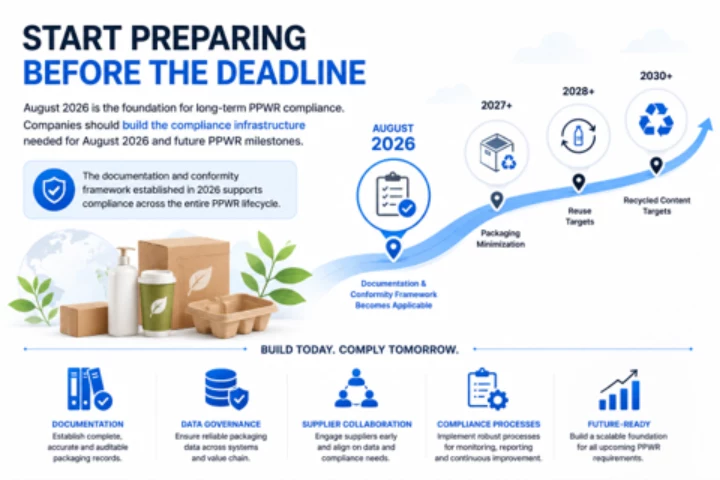
Although several PPWR obligations including packaging minimization, recycled-content targets, and reuse requirements will be introduced progressively, 12 August 2026 marks the first major compliance milestone.
From this date, organizations placing packaged products on the EU market should be prepared to demonstrate compliance with the applicable provisions of the regulation.
Rather than waiting until regulatory deadlines approach, tire manufacturers should establish the governance, documentation, and digital infrastructure needed to support long-term compliance.
The following six priorities should form the foundation of every PPWR compliance strategy.
1. Conduct Packaging Conformity Assessments
Packaging conformity assessments help manufacturers demonstrate that packaging complies with applicable PPWR requirements before products are placed on the EU market.
Embedding conformity assessments into packaging design and approval processes reduces compliance risks and strengthens governance.
2. Maintain Comprehensive Technical Documentation
Technical documentation provides the evidence supporting packaging compliance.
Tire manufacturers should establish centralized repositories containing documentation for every packaging component used throughout manufacturing and distribution operations.
Centralized documentation improves visibility while simplifying customer requests, regulatory inspections, and internal audits.
3. Establish Declaration of Conformity (DoC) Processes
PPWR introduces the requirement for an EU Declaration of Conformity (DoC) confirming that packaging complies with applicable regulatory provisions.
For tire manufacturers managing multiple product lines, packaging formats, production facilities, and export markets, maintaining DoCs manually can quickly become resource-intensive.
Digital workflows significantly improve efficiency while reducing compliance risks.
4. Verify Compliance with Substance Restrictions
Industrial packaging materials frequently contain plastics, coatings, adhesives, inks, polymers, and additives that require careful review.
Early supplier engagement helps reduce documentation gaps while improving packaging transparency.
5. Understand Your Responsibilities as an Economic Operator
PPWR assigns responsibilities according to an organization’s role within the supply chain.
Tire companies may operate as:
Manufacturer
Brand owner
Importer
Distributor
OEM supplier
Exporter
Each role carries different obligations relating to packaging compliance, documentation, and placing products on the EU market.
Cross-functional governance will be essential for maintaining consistent compliance across manufacturing operations.
6. Build a Robust Packaging Data Management Strategy
Packaging compliance depends on accurate, complete, and accessible information.
However, many tire manufacturers continue managing packaging data across disconnected systems, including:
ERP systems
PLM platforms
Supplier portals
Procurement systems
Warehouse management systems
Shared drives
Email communications
Individual spreadsheets
As PPWR requirements expand, fragmented packaging information creates unnecessary complexity and increases compliance risks.
A centralized packaging data management strategy strengthens audit readiness, improves collaboration across manufacturing sites, and creates a scalable foundation for future PPWR obligations and broader sustainability reporting.
Which Tire Packaging Is Covered Under PPWR?
One of the most common questions tire manufacturers ask is whether PPWR applies only to consumer-facing packaging or whether it also covers the industrial packaging used throughout manufacturing, warehousing, and distribution.
The answer is straightforward PPWR applies to virtually all packaging placed on the EU market, regardless of whether it protects consumer goods or industrial products.
For tire manufacturers, this means the regulation extends beyond labels and protective wrapping to include secondary packaging, transport packaging, export packaging, and reusable logistics packaging used throughout the supply chain.
Whether you manufacture passenger vehicle tires, commercial truck tires, agricultural tires, construction equipment tires, mining tires, industrial tires, or motorcycle tires, the packaging accompanying these products generally falls within the scope of PPWR.
Because tires are heavy, bulky products requiring specialized handling and transportation, manufacturers must balance packaging optimization with product protection, logistics efficiency, workplace safety, and customer requirements.
Primary Packaging
Primary packaging refers to packaging components directly associated with an individual tire and designed to protect, identify, or prepare it for sale or distribution.
Examples include:
Protective plastic wraps
Stretch films
Tire covers
Tire labels
RFID tags
Barcode labels
Product identification tags
Protective sleeves
Surface protection films
Although primary packaging for tires is relatively limited compared to consumer products, every component should be reviewed for compliance with applicable PPWR requirements.
Manufacturers should assess:
Material composition
Packaging weight
Packaging functionality
Recyclability
Supplier documentation
Supporting technical evidence
Secondary Packaging
Secondary packaging groups one or more tires together for retail, wholesale, or distributor operations.
Examples include:
Corrugated cartons
Dealer packaging
Multipacks
Bundled tire sets
Retail display packaging
Protective cardboard inserts
Paper wrapping systems
Although secondary packaging does not directly contact the tire, it remains fully within the scope of PPWR.
Manufacturers should therefore include secondary packaging within conformity assessments and technical documentation.
Transport Packaging
Transport packaging is one of the largest packaging categories within tire manufacturing.
Its primary purpose is protecting products throughout storage, export, warehousing, and distribution while maintaining load stability.
Examples include:
Wooden pallets
Plastic pallets
Stretch wrap
Plastic strapping
Steel strapping
Corner protectors
Corrugated pallet sheets
Export packaging
Returnable transport packaging
Reusable shipping frames
Because transport packaging often represents significant packaging volumes, optimizing these materials can reduce costs while supporting future PPWR compliance objectives.
Imported Packaging
Many German tire manufacturers source packaging materials and packaging components from suppliers across Europe, Asia, and North America.
Where imported packaging is placed on the EU market, manufacturers should ensure suppliers provide appropriate compliance documentation.
This typically includes:
Packaging specifications
Material declarations
Supplier declarations
Technical documentation
Laboratory reports
Packaging certifications
Recycled-content information where applicable
Developing standardized supplier documentation processes helps improve visibility while reducing compliance risks across international supply chains.
Does PPWR Apply to Every Packaging Material?
Yes.
Manufacturers should evaluate every packaging material used throughout their operations.
This includes:
Plastic films
Stretch wrap
Corrugated cardboard
Paper
Steel strapping
Plastic strapping
Wooden pallets
Plastic pallets
Protective foam
Composite materials
Labels
Adhesives
Packaging inks
Each material presents different sustainability considerations relating to recyclability, recycled content, material composition, and future regulatory obligations.
Developing a complete packaging inventory enables manufacturers to prioritize compliance activities and identify opportunities for packaging optimization.
Know Which Packaging Falls Under PPWR
Understanding the scope of PPWR is the first step toward building a successful compliance program.
PPWR introduces several interconnected requirements that affect packaging design, procurement, supplier collaboration, technical documentation, and manufacturing operations.
Rather than treating these obligations individually, tire manufacturers should integrate them into existing packaging engineering, procurement, logistics, and quality management processes.
1. Packaging Minimization
PPWR aims to reduce unnecessary packaging by ensuring that packaging contains only the amount of material necessary to protect, transport, and handle products safely.
Although Article 10 packaging minimization requirements become applicable later in the PPWR implementation timeline, tire manufacturers should begin evaluating packaging efficiency today.
For industrial products like tires, packaging optimization must maintain:
Load stability
Product protection
Safe transportation
Warehouse handling
Export performance
Reducing packaging should never compromise logistics efficiency or product quality.
2. Design for Recyclability
PPWR encourages packaging that supports effective collection, sorting, and recycling.
Simplifying packaging materials wherever practical can improve recyclability while supporting future regulatory requirements.
3. Recycled Plastic Content
PPWR introduces phased recycled-content targets for specific plastic packaging categories.
Early preparation reduces future implementation effort and supports broader sustainability goals.
4. Substance Restrictions
Packaging materials frequently contain plastics, coatings, adhesives, inks, and additives that require careful evaluation.
Working closely with suppliers strengthens documentation quality while improving packaging transparency.
5. Packaging Labelling
PPWR introduces harmonized packaging labelling intended to improve waste sorting and recycling across the European Union.
Manufacturers should review packaging artwork and product identification processes to accommodate future labelling requirements without disrupting existing logistics operations.
6. Technical Documentation and Declaration of Conformity
From 12 August 2026, manufacturers should be prepared to maintain technical documentation and issue an EU Declaration of Conformity (DoC) demonstrating that packaging complies with the applicable PPWR requirements.
Digital document management improves consistency while reducing administrative effort.
Understand the PPWR Requirements Before They Affect Your Packaging Operations
PPWR introduces significant changes across packaging design, documentation, recyclability, supplier collaboration, and conformity assessments.
Although packaging suppliers manufacture packaging materials and components, tire manufacturers remain responsible for ensuring packaging complies before products are placed on the EU market.
Compliance requires collaboration across:
Procurement
Packaging Engineering
Manufacturing
Logistics
Supply Chain
Sustainability
Quality Assurance
Regulatory Affairs
Legal
Compliance
Organizations operating multiple manufacturing plants and supplying OEMs, distributors, and export markets should establish standardized compliance processes across the enterprise.
Documentation Required for PPWR Compliance
Documentation forms the foundation of PPWR compliance.
Manufacturers should maintain centralized, version-controlled documentation to improve governance, transparency, and audit readiness.
Product Documentation
Maintain:
Packaging specifications
Material composition
Packaging Bills of Materials (BOMs)
Packaging weights
Packaging dimensions
Packaging component lists
Supplier Documentation
Collect:
Supplier declarations
Material certifications
Chemical declarations
Compliance statements
Laboratory reports
Recycled-content declarations
Technical specifications
Packaging Design Documentation
Maintain:
Engineering drawings
Packaging calculations
Packaging performance testing
Recyclability assessments
Packaging optimization studies
Load stability reports
Compliance Documentation
Maintain:
Technical documentation
Conformity assessment records
Declaration of Conformity
Internal compliance procedures
Risk assessments
Laboratory reports
Version-controlled documentation
Packaging revision history
Maintaining structured documentation enables tire manufacturers to respond efficiently to regulatory inspections, customer sustainability requests, OEM audits, and internal compliance reviews while reducing manual administration.
Can You Demonstrate That Your Tire Packaging Meets PPWR Requirements?
Technical documentation is more than a regulatory requirement it’s the evidence that supports every packaging compliance decision.
Building a Future-Ready PPWR Compliance Strategy for Tire Manufacturers
As the Packaging and Packaging Waste Regulation (PPWR) moves toward implementation, tire manufacturers must rethink how packaging compliance is managed across manufacturing, logistics, warehousing, exports, and distribution.
Unlike consumer products, tire packaging is designed primarily for product protection, load stability, warehouse efficiency, and safe transportation. Packaging systems often include stretch films, plastic strapping, pallets, protective covers, export packaging, and reusable transport systems that move through complex global supply chains.
PPWR introduces new expectations around packaging design, technical documentation, recyclability, packaging optimization, and compliance evidence. For tire manufacturers, meeting these obligations requires more than replacing packaging materials—it demands a centralized, data-driven approach to packaging governance.
Organizations that invest in digital packaging management today will not only improve PPWR readiness but also reduce packaging costs, improve supplier collaboration, strengthen audit readiness, and support broader sustainability objectives.
Common PPWR Compliance Challenges for Tire Manufacturers
1. Managing Complex Global Supplier Networks
Packaging materials often come from numerous suppliers across Europe, Asia, and North America.
Each supplier provides different documentation formats and compliance information.
Unlike consumer goods, tires require packaging capable of withstanding:
Heavy loads
Long-distance transportation
Export handling
Warehouse storage
Outdoor conditions
Mechanical handling
Reducing packaging material should never compromise transportation performance or increase product damage.
3. Export Packaging Complexity
Many German tire manufacturers export products globally.
Different regions often require different packaging configurations depending on:
Customer specifications
Shipping methods
Climate conditions
Import requirements
Warehouse handling
Managing multiple packaging variants increases documentation requirements and makes packaging governance more challenging.
4. Packaging Change Management
Packaging frequently changes due to:
New suppliers
Packaging redesign
Material substitutions
Sustainability initiatives
Cost optimization
Customer requirements
Without structured change management, compliance records can quickly become outdated.
5. Multiple Manufacturing Facilities
Large tire manufacturers often operate production facilities across multiple countries.
Packaging practices may vary between plants due to:
Local suppliers
Regional logistics
Customer requirements
Packaging equipment
Material availability
Maintaining consistent packaging compliance across multiple sites requires standardized governance and centralized packaging information.
6. Fragmented Packaging Data
Packaging information is often stored across:
ERP systems
PLM platforms
Procurement software
Warehouse Management Systems (WMS)
Supplier portals
Shared drives
Email correspondence
Individual spreadsheets
A centralized packaging repository significantly improves visibility and governance.
7. Preparing for Future PPWR Requirements
Many PPWR obligations will be introduced progressively over the coming years.
Manufacturers should therefore prepare for future requirements relating to:
Packaging minimization
Design for recyclability
Recycled plastic content
Harmonized labelling
Extended Producer Responsibility (EPR)
Digital compliance documentation
Organizations that establish scalable compliance processes today will adapt more easily as future obligations become applicable.
–
How Digital Traceability Supports PPWR Compliance
Managing packaging compliance across multiple manufacturing facilities, suppliers, and export markets requires connected, accurate, and continuously updated packaging information.
Digital traceability platforms enable tire manufacturers to centralize packaging compliance while improving collaboration across internal teams and suppliers.
Centralized Packaging Data Management
Maintain structured information relating to:
Packaging specifications
Material composition
Packaging Bills of Materials
Packaging hierarchies
Packaging weights
Product-to-packaging relationships
A centralized repository eliminates duplicate records while improving data quality.
Digital Supplier Collaboration
Digitally onboard suppliers and collect:
Material declarations
Technical documentation
Packaging specifications
Laboratory reports
Compliance certificates
Recycled-content declarations
Automated workflows improve supplier responsiveness while reducing manual administration.
Centralized documentation simplifies audits and regulatory inspections.
Workflow Automation
Automate packaging approval workflows including:
Supplier reviews
Documentation validation
Internal approvals
Packaging revisions
Compliance verification
Automation improves consistency while maintaining complete audit trails.
Audit Readiness
Respond quickly to:
Customer sustainability questionnaires
OEM audits
Regulatory inspections
Internal audits
Market surveillance requests
Centralized packaging documentation ensures evidence is always available when required.
Cross-Functional Collaboration
Enable Procurement, Packaging Engineering, Manufacturing, Logistics, Sustainability, Quality, Regulatory Affairs, and Supply Chain teams to work from a single source of truth.
Improved collaboration reduces duplication while strengthening packaging governance.
Simplify PPWR Compliance with TraceX
Managing PPWR compliance across multiple manufacturing sites, suppliers, packaging formats, and global logistics networks requires more than spreadsheets and disconnected systems.
TraceX’s PPWR Solution provides tire manufacturers with a centralized platform to manage packaging data, supplier documentation, technical documentation, conformity assessments, and audit-ready compliance records throughout the packaging lifecycle.
Whether you manufacture passenger car tires, truck tires, agricultural tires, industrial tires, or off-highway tires, TraceX helps simplify packaging compliance while improving operational efficiency.
With TraceX, Tire Manufacturers Can:
Centralize packaging specifications across manufacturing facilities
Manage packaging Bills of Materials and material composition
Digitize supplier onboarding and documentation collection
Maintain technical documentation with complete version control
Monitor supplier documentation status in real time
Improve collaboration across Procurement, Packaging Engineering, Logistics, Manufacturing, Sustainability, and Quality teams
Respond quickly to audits, customer requests, and regulatory inspections
Instead of managing packaging compliance through disconnected spreadsheets, TraceX enables tire manufacturers to build a continuous, digital, and audit-ready compliance program.
PPWR is only one of several sustainability regulations reshaping manufacturing and supply chains.
By investing in centralized packaging data, digital supplier collaboration, and automated documentation today, tire manufacturers can build a compliance foundation that also supports future requirements such as Digital Product Passports (DPP), evolving EPR schemes, and broader ESG reporting obligations.
Organizations that treat packaging data as a strategic asset not just a compliance requirement will be better positioned to respond to regulatory change while improving operational efficiency and customer trust.
Conclusion
The Packaging and Packaging Waste Regulation represents a significant shift in how tire manufacturers manage packaging throughout the product lifecycle.
Meeting PPWR requirements will require organizations to move beyond fragmented documentation and manual processes toward integrated packaging governance supported by digital systems.
Manufacturers that begin preparing now can reduce compliance risks, optimize packaging operations, strengthen supplier collaboration, and improve visibility across global supply chains.
With the 12 August 2026 implementation milestone approaching, now is the time to centralize packaging data, digitize technical documentation, standardize supplier collaboration, and integrate PPWR into packaging engineering and logistics workflows.
A proactive approach will not only support compliance but also drive packaging innovation, operational resilience, and long-term sustainability.
Frequently Asked Questions
Does PPWR apply to tire manufacturers in Germany?
Yes. Tire manufacturers placing packaged products on the EU market must ensure that all applicable packaging complies with the PPWR requirements and maintain the supporting technical documentation and Declaration of Conformity.
Does PPWR apply to transport packaging used for tires?
Yes. PPWR generally covers transport packaging, including pallets, stretch wrap, strapping, protective materials, and other packaging placed on the EU market, subject to the applicable provisions of the regulation.
What documentation should tire manufacturers maintain?
Manufacturers should maintain packaging specifications, Bills of Materials, material declarations, supplier declarations, technical documentation, packaging performance reports, conformity assessment records, engineering drawings, packaging calculations, and Declarations of Conformity.
How can tire manufacturers prepare for August 2026?
Organizations should centralize packaging data, conduct conformity assessments, strengthen supplier collaboration, maintain technical documentation, standardize packaging governance, and establish digital compliance workflows that can scale across multiple manufacturing sites.
How can TraceX help simplify PPWR compliance?
TraceX provides a centralized digital platform for packaging data management, supplier collaboration, technical documentation, conformity assessments, Declaration of Conformity management, workflow automation, and audit readiness—helping tire manufacturers build a scalable and future-ready PPWR compliance program.
Start using TraceX
Transparency, Trust, & Success for your Climate Journey.
We use cookies on our website to give you the most relevant experience by remembering your preferences and repeat visits. By clicking “Accept All”, you consent to the use of ALL the cookies. However, you may visit "Cookie Settings" to provide a controlled consent.
This website uses cookies to improve your experience while you navigate through the website. Out of these, the cookies that are categorized as necessary are stored on your browser as they are essential for the working of basic functionalities of the website. We also use third-party cookies that help us analyze and understand how you use this website. These cookies will be stored in your browser only with your consent. You also have the option to opt-out of these cookies. But opting out of some of these cookies may affect your browsing experience.
Necessary cookies are absolutely essential for the website to function properly. These cookies ensure basic functionalities and security features of the website, anonymously.
Cookie
Duration
Description
cookielawinfo-checkbox-analytics
11 months
This cookie is set by GDPR Cookie Consent plugin. The cookie is used to store the user consent for the cookies in the category "Analytics".
cookielawinfo-checkbox-functional
11 months
The cookie is set by GDPR cookie consent to record the user consent for the cookies in the category "Functional".
cookielawinfo-checkbox-necessary
11 months
This cookie is set by GDPR Cookie Consent plugin. The cookies is used to store the user consent for the cookies in the category "Necessary".
cookielawinfo-checkbox-others
11 months
This cookie is set by GDPR Cookie Consent plugin. The cookie is used to store the user consent for the cookies in the category "Other.
cookielawinfo-checkbox-performance
11 months
This cookie is set by GDPR Cookie Consent plugin. The cookie is used to store the user consent for the cookies in the category "Performance".
viewed_cookie_policy
11 months
The cookie is set by the GDPR Cookie Consent plugin and is used to store whether or not user has consented to the use of cookies. It does not store any personal data.
Functional cookies help to perform certain functionalities like sharing the content of the website on social media platforms, collect feedbacks, and other third-party features.
Performance cookies are used to understand and analyze the key performance indexes of the website which helps in delivering a better user experience for the visitors.
Analytical cookies are used to understand how visitors interact with the website. These cookies help provide information on metrics the number of visitors, bounce rate, traffic source, etc.
Advertisement cookies are used to provide visitors with relevant ads and marketing campaigns. These cookies track visitors across websites and collect information to provide customized ads.
Download the 2026 Traceability Scorecard and Benchmark Your Supply Chain Across 10 Critical Capabilities.
Download our eBook
Don’t Wait for an Audit to Find Your EUDR Gaps
The 2026 Simplification Package changes how HS codes, DDS pass-through and geolocation rules apply to you. Get the free guide and 20-point readiness checklist before enforcement catches you unprepared.