
Quick summary: Learn how pharmaceutical manufacturers in Germany can prepare for PPWR compliance with guidance on packaging requirements, technical documentation, conformity assessments, packaging data management, and August 2026 readiness.
The Packaging and Packaging Waste Regulation (PPWR) is set to transform how pharmaceutical manufacturers design, manage, and demonstrate packaging compliance across the European Union. For pharmaceutical companies operating in Germany, PPWR introduces harmonized packaging requirements that extend beyond environmental sustainability to become a core component of regulatory compliance and product stewardship.
Whether you manufacture prescription medicines, over-the-counter (OTC) products, biologics, vaccines, medical gases, nutritional products, or veterinary medicines, PPWR introduces new obligations covering packaging design, recyclability, technical documentation, conformity assessments, supplier collaboration, and packaging data management.
Unlike many industries, pharmaceutical packaging performs far more than a marketing function. It protects product integrity, maintains sterility, supports patient safety, preserves shelf life, enables traceability, and complies with stringent pharmaceutical regulations. Consequently, packaging decisions are often governed by quality, safety, and regulatory requirements in addition to sustainability objectives.
Unlike the previous Packaging and Packaging Waste Directive, PPWR is a regulation that applies directly across all EU Member States. This creates a harmonized compliance framework while increasing accountability for manufacturers placing packaged pharmaceutical products on the European market.
For pharmaceutical manufacturers managing multiple production sites, complex packaging configurations, contract manufacturing organizations (CMOs), and global supplier networks, achieving PPWR compliance requires much more than selecting sustainable packaging materials. It demands centralized packaging data, structured technical documentation, supplier collaboration, and digital compliance processes capable of supporting highly regulated manufacturing environments.
Organizations that begin preparing now will be better positioned to meet regulatory milestones, reduce compliance risks, strengthen packaging governance, and improve operational efficiency while supporting the pharmaceutical industry’s transition toward more sustainable packaging.

Key Takeaways
If your company manufactures pharmaceutical products in Germany, PPWR introduces new responsibilities throughout the packaging lifecycle.
Key compliance priorities include:
Rather than viewing PPWR as another regulatory obligation, pharmaceutical manufacturers should establish scalable packaging governance processes that support regulatory compliance, product quality, sustainability, and future packaging innovation.
What Is the Packaging and Packaging Waste Regulation (PPWR)?
The Packaging and Packaging Waste Regulation (PPWR) establishes a harmonized legal framework governing packaging placed on the European Union market.
Its objective is to reduce packaging waste while improving recyclability, increasing recycled content, promoting reuse where applicable, and supporting the European Union’s transition to a circular economy.
Unlike the Packaging and Packaging Waste Directive, which required implementation through national legislation, PPWR applies directly across all Member States. This creates consistent compliance obligations for organizations placing packaged products on the EU market.
For pharmaceutical manufacturers, compliance extends beyond packaging design. Organizations must demonstrate compliance through documented evidence, supplier collaboration, conformity assessments, and robust packaging data management while ensuring that packaging continues to meet stringent pharmaceutical quality and safety requirements.
Why PPWR Matters for Pharmaceutical Manufacturers in Germany
Germany is one of Europe’s largest pharmaceutical manufacturing hubs, producing medicines for domestic healthcare systems and export throughout the European Union and global markets.
The industry manufactures a wide variety of products, including:
These products rely on diverse packaging formats such as:
Under PPWR, manufacturers are responsible for ensuring that these packaging formats comply with applicable regulatory requirements before products are placed on the EU market.
Compliance therefore extends far beyond packaging procurement.
Pharmaceutical manufacturers must collaborate with packaging suppliers, raw material providers, converters, laboratories, contract manufacturers, logistics partners, and quality teams to collect, verify, and maintain compliance evidence throughout the packaging lifecycle.
At the same time, healthcare providers, regulators, investors, and consumers increasingly expect pharmaceutical companies to reduce packaging waste while maintaining the highest standards of product safety and quality.
PPWR presents an opportunity to modernize packaging governance, improve packaging transparency, and establish digital compliance processes that support both sustainability and regulatory excellence.
Understand Your Responsibilities Under PPWR
PPWR assigns different obligations to manufacturers, importers, distributors, and other economic operators.
Read our complete guide to PPWR Roles & Responsibilities.
What Should Pharmaceutical Manufacturers Prioritize Before the August 2026 PPWR Deadline?
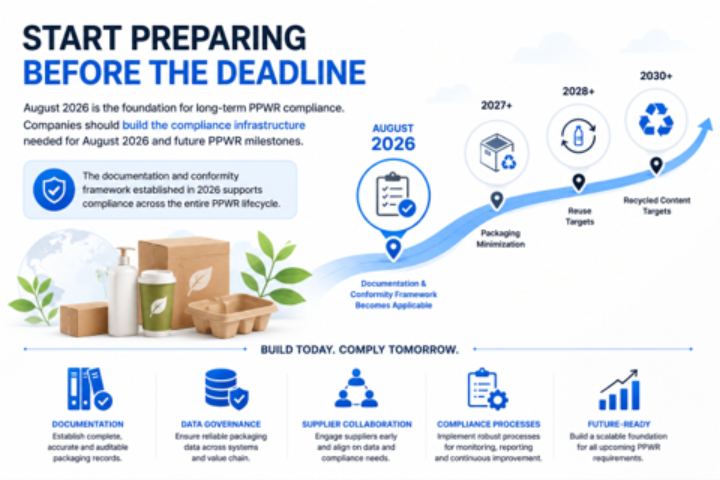
Although several PPWR obligations including packaging minimization, recycled content targets, and reuse requirements will be implemented progressively, 12 August 2026 marks the first major compliance milestone.
From this date, pharmaceutical manufacturers placing packaged products on the EU market should be prepared to demonstrate compliance with the applicable provisions of the regulation.
Rather than waiting until implementation deadlines approach, organizations should begin establishing the governance, documentation, and digital infrastructure necessary to support long-term compliance.
The following six priorities should form the foundation of every pharmaceutical manufacturer’s PPWR strategy.
1. Conduct Packaging Conformity Assessments
Packaging conformity assessments help demonstrate that pharmaceutical packaging complies with applicable PPWR requirements before products are placed on the market.
Conformity assessments should become part of packaging development, quality assurance, regulatory review, and product approval workflows.
2. Maintain Comprehensive Technical Documentation
Technical documentation provides the evidence supporting packaging compliance throughout the product lifecycle.
Pharmaceutical manufacturers should establish centralized repositories containing documentation for every packaging component.
Centralized documentation improves governance while supporting inspections, customer requests, and regulatory audits.
3. Establish Declaration of Conformity (DoC) Processes
PPWR introduces the requirement for an EU Declaration of Conformity (DoC) confirming that packaging complies with applicable regulatory provisions.
For pharmaceutical companies managing thousands of SKUs across multiple production facilities and markets, maintaining Declarations of Conformity manually can become highly resource-intensive.
Digital workflows improve efficiency while reducing compliance risks.
4. Verify Compliance with Substance Restrictions
Pharmaceutical packaging frequently includes plastics, glass, aluminium, coatings, adhesives, inks, elastomers, and specialized barrier materials.
Early supplier engagement helps prevent documentation gaps while improving packaging transparency.
5. Understand Your Responsibilities as an Economic Operator
PPWR assigns responsibilities according to an organization’s role within the supply chain.
Pharmaceutical companies may operate as:
Each role carries different obligations relating to packaging compliance, documentation, and market placement.
Building cross-functional governance today will simplify compliance as PPWR requirements evolve.
6. Build a Robust Packaging Data Management Strategy
Packaging compliance depends on complete, accurate, and accessible data.
However, many pharmaceutical companies continue managing packaging information across disconnected systems, including:
As PPWR requirements expand, fragmented packaging data increases administrative burden and compliance risk.
A centralized packaging data management strategy improves visibility across products and manufacturing sites while strengthening audit readiness and supporting future PPWR obligations.
Which Pharmaceutical Packaging Is Covered Under PPWR?
One of the first questions pharmaceutical manufacturers ask is whether PPWR applies only to external packaging or whether it also covers the specialized packaging used to protect medicinal products.
The answer is straightforward PPWR applies to virtually all packaging placed on the EU market, irrespective of the product it contains or the material from which it is made.
For pharmaceutical manufacturers, this includes packaging used for prescription medicines, over-the-counter (OTC) products, biologics, vaccines, diagnostics, veterinary medicines, and healthcare products.
The regulation covers packaging throughout the supply chain—from packaging that directly contains medicinal products to transport packaging used for distribution.
For pharmaceutical companies, packaging performs multiple critical functions beyond sustainability. It protects product integrity, ensures sterility, supports patient safety, enables traceability, preserves efficacy, and complies with pharmaceutical quality standards. PPWR therefore requires manufacturers to balance sustainability objectives with strict regulatory and product performance requirements.
Primary Packaging
Primary packaging comes into direct contact with pharmaceutical products and is essential for maintaining product quality, sterility, stability, and shelf life.
Examples include:
Primary packaging often undergoes extensive testing and validation to ensure compatibility with medicinal products. Manufacturers should therefore carefully evaluate any packaging modifications introduced to support future PPWR compliance.
Secondary Packaging
Secondary packaging provides additional protection, facilitates distribution, and delivers essential product information.
Examples include:
Secondary packaging is fully covered under PPWR and should be included within technical documentation and conformity assessment processes.
Tertiary (Transport) Packaging
Transport packaging protects pharmaceutical products throughout warehousing, cold-chain logistics, and distribution.
Examples include:
Because pharmaceutical products frequently require temperature-controlled transportation, manufacturers should ensure transport packaging remains compliant while preserving product quality.
Imported Pharmaceutical Packaging
Many pharmaceutical manufacturers source packaging materials and packaging components globally.
Where imported packaging is placed on the EU market, manufacturers and importers should ensure suppliers provide supporting compliance documentation.
This typically includes:
Strong supplier collaboration is essential for maintaining complete documentation and ensuring compliance across global supply chains.
Does PPWR Apply to Every Packaging Material?
Yes.
Pharmaceutical manufacturers should evaluate every packaging material used throughout their product portfolio.
This includes:
Each material presents unique compliance considerations relating to recyclability, material composition, performance, and future sustainability requirements.
Creating a complete packaging inventory enables manufacturers to understand where compliance risks may exist and prioritize packaging reviews.
Know Which Pharmaceutical Packaging Falls Under PPWR
Understanding the scope of PPWR is the first step toward building an effective compliance strategy.
Read our complete guide to PPWR Scope.
Key PPWR Requirements for Pharmaceutical Manufacturers
PPWR introduces several interconnected obligations that influence packaging design, material selection, documentation, supplier collaboration, and product development.
For pharmaceutical companies, these obligations must be implemented without compromising product quality, sterility, stability, or patient safety.
1. Packaging Minimization
Packaging should contain only the amount of material necessary to ensure product protection, handling, transport, storage, hygiene, and patient safety.
Although Article 10 packaging minimization requirements become applicable later in the PPWR implementation timeline, pharmaceutical manufacturers should begin reviewing packaging designs now.
Areas for evaluation include:
Balancing sustainability and product protection will be one of the pharmaceutical industry’s most important PPWR challenges.
2. Design for Recyclability
PPWR promotes packaging that supports efficient collection, sorting, and recycling.
Manufacturers should evaluate:
Many pharmaceutical packaging formats combine multiple materials to preserve product efficacy, making recyclability assessments more complex than in other industries.
Early collaboration between packaging engineering, quality assurance, and sustainability teams will help identify practical improvement opportunities.
3. Recycled Plastic Content
PPWR introduces phased recycled-content targets for certain plastic packaging categories.
While pharmaceutical packaging may be subject to product-specific safety and quality requirements, manufacturers should begin preparing by:
Early planning will simplify future compliance as implementation deadlines approach.
4. Substance Restrictions
Pharmaceutical packaging contains a wide range of specialized materials, including polymers, elastomers, coatings, adhesives, printing inks, and barrier materials.
Manufacturers should maintain visibility into:
Obtaining complete supplier documentation strengthens compliance while improving packaging transparency.
5. Packaging Labelling
PPWR introduces harmonized packaging labelling intended to improve waste sorting and recycling throughout the European Union.
Packaging artwork approval processes should be updated to incorporate future PPWR labelling obligations without affecting existing medicinal product labelling requirements.
6. Technical Documentation and Declaration of Conformity
From August 2026, manufacturers should be prepared to maintain technical documentation and issue an EU Declaration of Conformity (DoC) demonstrating compliance with the applicable PPWR requirements.
This documentation should be linked to:
Digital document management significantly improves consistency, governance, and audit readiness.
Understand the PPWR Requirements Before They Affect Your Packaging Portfolio
PPWR introduces significant changes across packaging design, documentation, recyclability, supplier collaboration, and conformity assessments.
Read our complete guide to PPWR Requirements.

Responsibilities of Pharmaceutical Manufacturers Under PPWR
Although packaging suppliers manufacture packaging components, pharmaceutical manufacturers remain responsible for ensuring packaging complies before products are placed on the EU market.
Compliance requires collaboration across multiple business functions, including:
Organizations managing multiple manufacturing facilities, contract manufacturing partners, and international suppliers should establish standardized compliance processes across the enterprise.
Documentation Required for PPWR Compliance
Documentation forms the foundation of pharmaceutical packaging compliance.
Manufacturers should maintain centralized, version-controlled documentation to improve governance and inspection readiness.
Product Documentation
Maintain:
Supplier Documentation
Collect:
Packaging Design Documentation
Maintain:
Compliance Documentation
Maintain:
Maintaining structured documentation enables pharmaceutical manufacturers to respond efficiently to regulatory inspections, customer requests, internal quality audits, and market surveillance while reducing administrative effort.
Can You Demonstrate That Your Pharmaceutical Packaging Meets PPWR Requirements?
Technical documentation is more than a regulatory obligation—it’s the evidence supporting every packaging compliance decision.
Read our complete guide to PPWR Technical Documentation.
Building a Future-Ready PPWR Compliance Strategy for Pharmaceutical Manufacturers
As the Packaging and Packaging Waste Regulation (PPWR) moves toward implementation, pharmaceutical manufacturers must rethink how packaging compliance is managed across the organization. Compliance is no longer limited to ensuring that packaging protects medicinal products it now requires manufacturers to demonstrate that packaging also meets evolving sustainability and circular economy requirements.
For pharmaceutical companies, this presents a unique challenge. Packaging must continue to maintain sterility, product stability, tamper evidence, patient safety, and regulatory compliance while also meeting PPWR obligations related to packaging design, documentation, recyclability, and material transparency.
Organizations that establish digital packaging governance today will be better positioned to reduce compliance risks, streamline documentation, and respond confidently to future regulatory requirements.
Common PPWR Compliance Challenges for Pharmaceutical Manufacturers
1. Managing Highly Regulated Packaging Systems
Pharmaceutical packaging is subject to stringent quality and regulatory controls.
Unlike many consumer products, packaging changes often require extensive assessments, validation activities, and cross-functional approvals.
Even minor packaging modifications may require significant documentation and internal review before implementation.
2. Complex Multi-Component Packaging
Many pharmaceutical products consist of multiple packaging components supplied by different manufacturers.
Each component requires supporting documentation, supplier declarations, and technical information.
Without centralized management, maintaining complete packaging records becomes increasingly difficult.
3. Global Supplier Networks
Pharmaceutical companies often source packaging materials from suppliers across Europe, Asia, and North America.
Digital supplier collaboration significantly improves documentation quality while reducing administrative effort.
4. Packaging Change Control
Packaging frequently changes due to:
Structured change management is essential for maintaining compliance.
5. Extensive Documentation Requirements
Pharmaceutical manufacturers already maintain substantial documentation to support GMP, quality systems, and regulatory approvals.
PPWR introduces another layer of packaging-specific documentation.
Managing this manually across thousands of products increases administrative burden and compliance risk.
6. Audit and Inspection Readiness
Pharmaceutical manufacturers routinely undergo inspections by regulatory authorities, customers, and certification bodies.
Adding PPWR documentation to existing inspection requirements means organizations must be able to retrieve packaging information quickly and consistently.
Centralized packaging information simplifies inspection readiness.
7. Balancing Sustainability with Product Safety
Unlike many industries, pharmaceutical manufacturers cannot simply redesign packaging to improve sustainability.
This requires careful evaluation of every packaging modification while maintaining documented evidence supporting both compliance and product quality.
How Digital Traceability Supports PPWR Compliance
Managing packaging compliance across hundreds or thousands of pharmaceutical products requires connected, accurate, and continuously updated packaging information.
Digital traceability platforms enable manufacturers to centralize packaging data while improving collaboration across suppliers, manufacturing sites, and business functions.
Centralized Packaging Data Management
Maintain structured information relating to:
A centralized repository improves visibility while reducing duplicate records.
Digital Supplier Collaboration
Digitally onboard suppliers and collect:
Automated reminders and document tracking improve supplier responsiveness.
Technical Documentation Management
Maintain a centralized repository for:
Version-controlled documentation simplifies inspections and audits.
Workflow Automation
Digitize packaging approval workflows by automating:
Automation reduces manual effort while maintaining complete audit trails.
Audit Readiness
Respond quickly to:
Centralized documentation ensures packaging evidence is always accessible.
Cross-Functional Collaboration
Provide Regulatory Affairs, Packaging Engineering, Procurement, Manufacturing, Sustainability, and Quality teams with a single source of truth for packaging compliance.
This reduces duplication while improving governance across the organization.
Simplify PPWR Compliance with TraceX
Managing PPWR compliance across multiple manufacturing facilities, suppliers, packaging formats, and medicinal products requires more than spreadsheets and disconnected systems.
TraceX’s PPWR Solution provides pharmaceutical manufacturers with a centralized platform to manage packaging data, supplier documentation, technical files, conformity assessments, and audit-ready compliance records throughout the packaging lifecycle.
Whether you manufacture prescription medicines, biologics, vaccines, OTC products, or veterinary medicines, TraceX helps simplify packaging compliance while improving operational efficiency.
With TraceX, Pharmaceutical Manufacturers Can:
Instead of preparing documentation only when inspections occur, TraceX enables continuous, digital, and audit-ready packaging compliance.
Future-Proof Your Packaging Compliance
PPWR is one of several sustainability regulations affecting pharmaceutical manufacturers.
By investing in centralized packaging data, digital supplier collaboration, and automated documentation today, organizations can build a compliance foundation that supports future requirements, including Digital Product Passports, evolving EPR schemes, and other EU sustainability initiatives.
Conclusion
The Packaging and Packaging Waste Regulation represents a significant evolution in packaging compliance for pharmaceutical manufacturers.
Meeting PPWR requirements will require organizations to move beyond fragmented documentation and manual processes toward integrated packaging governance supported by digital systems.
Manufacturers that begin preparing today can reduce compliance risks, improve operational efficiency, strengthen supplier collaboration, and maintain the documentation needed to demonstrate regulatory compliance.
With the 12 August 2026 implementation milestone approaching, now is the time to establish centralized packaging data, digitize technical documentation, and embed PPWR into existing quality and regulatory processes.
A proactive approach will not only support compliance but also help pharmaceutical manufacturers achieve greater packaging transparency, operational resilience, and long-term sustainability.
Yes. Pharmaceutical manufacturers placing packaged medicinal products on the EU market must ensure their packaging complies with the applicable PPWR requirements while maintaining supporting technical documentation and Declarations of Conformity.
Yes. PPWR generally applies to pharmaceutical packaging, including primary, secondary, and transport packaging. However, manufacturers should also consider any product-specific pharmaceutical legislation that may affect packaging design and labelling.
Manufacturers should maintain packaging specifications, Bills of Materials, supplier declarations, technical documentation, packaging validation reports, conformity assessment records, laboratory reports, packaging drawings, and Declarations of Conformity.
Organizations should begin by centralizing packaging data, conducting conformity assessments, strengthening supplier collaboration, maintaining technical documentation, and establishing digital compliance workflows that can scale across manufacturing operations.
TraceX provides an end-to-end digital platform for packaging data management, supplier collaboration, technical documentation, conformity assessments, Declaration of Conformity management, and audit readiness, enabling pharmaceutical manufacturers to build a scalable and future-ready PPWR compliance program.