Food Supply Chains in India: Closing the Supplier-to-Customer Traceability Gaps
Published
, 8 minute read
Share this article
Quick summary: Food Supply Chains in India lose ₹1.5 trillion a year to fragmentation. See where the traceability gaps are and how farm-to-fork visibility closes them.
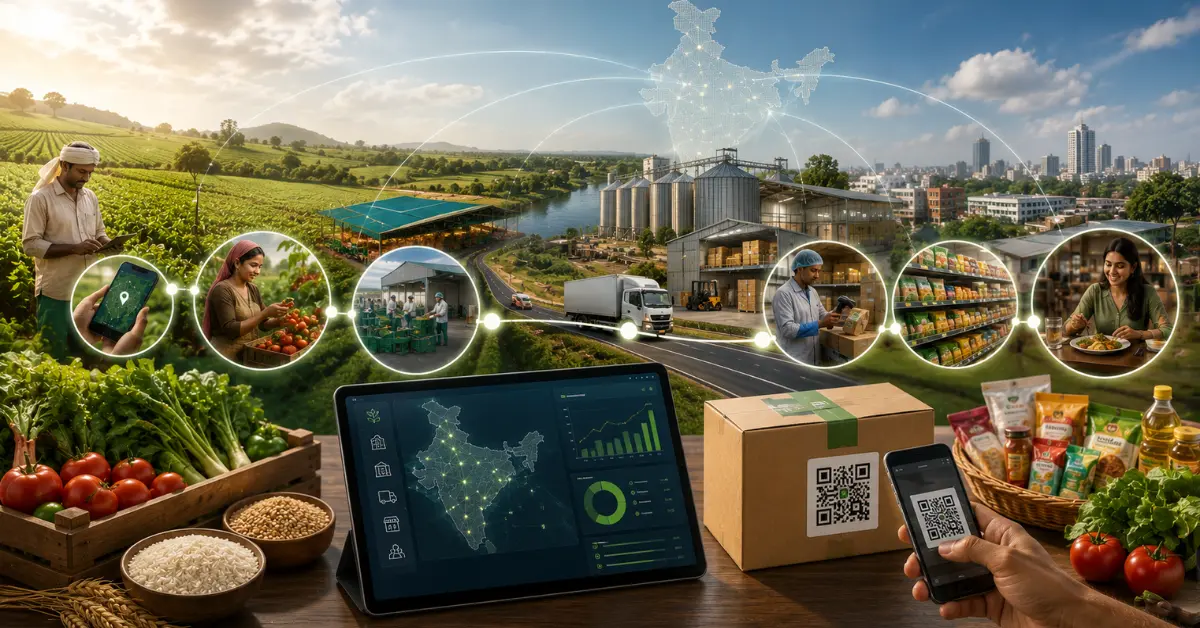
Food supply chains in India move produce from millions of small farms to consumers through long chains of aggregators, traders, processors and retailers and that fragmentation is where visibility breaks. Because most links keep their own records on paper or in spreadsheets, no single party can trace a product end to end. The result is roughly a quarter to a third of output lost after harvest, avoidable food-safety risk, and export rejections. Supplier-to-customer traceability closes those gaps by connecting every link to one shared data layer, so any batch can be tracked from farm to fork and back again in a recall.
KEY TAKEAWAYS
Food supply chains in India are long and fragmented produce from millions of smallholders passes through many intermediaries before it reaches the customer.
Food supply chains in India are longer and more fragmented than they look
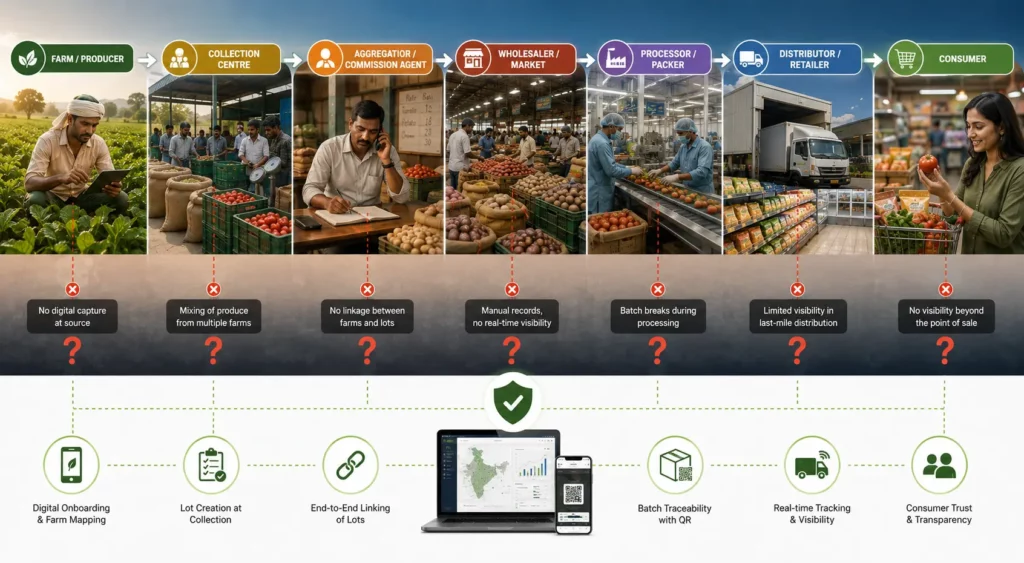
Food supply chains in India are among the most complex on earth. A single tomato, sack of rice, or crate of grapes can pass through a farmer, a village aggregator, a commission agent, a wholesaler, a processor, a distributor, and a retailer before a customer ever touches it. Each handoff adds cost, time, and crucially a break in visibility. India produced a record 357.73 million tonnes of foodgrain in 2024–25, yet a striking share of that output never delivers value, because the chain that carries it cannot see itself.
The fragmentation is structural. Most produce originates on small and marginal farms, then flows through layers of intermediaries who each keep their own records if any. When one link works on paper and the next on a spreadsheet, nobody owns the end-to-end picture. That is the single biggest weakness of food supply chains in India: not any one broken link, but the absence of a shared thread running through all of them.
Why the traceability gaps in food supply chains in India cost so much
The price of poor visibility is easy to underestimate until you add it up. India loses food worth roughly ₹1.53 trillion about US$18.5 billion every year to post-harvest inefficiencies, according to a NABCONS study cited by ICRIER. Peer-reviewed reviews put total post-harvest losses at around 25–30% of output, spread across harvesting, transport, storage, and retail.
But loss is only the visible cost. The hidden costs surface when something goes wrong and the chain cannot answer a simple question: where did this batch come from, and where did it go?
Real-world example: when the chain can’t trace back
The MDH and Everest episode of April 2024 is the cautionary tale. After Hong Kong and Singapore flagged ethylene oxide in several spice blends, the damage spread to bans and enquiries across multiple markets. The deeper problem such cases expose is speed: when sourcing and processing records are fragmented across food supply chains in India, isolating the exact affected lots and proving the rest are clean takes far longer than the market or the regulator will wait.
Multiply that across perishables, exports, and modern retail, and the pattern is clear. Fragmented chains do not just waste produce; they turn every quality incident into a slow, expensive, reputation-denting scramble.
Read our complete guide to Food Recalls in India and learn how stronger traceability can help you respond with confidence.
How supplier-to-customer traceability closes the gaps in food supply chains in India
Supplier-to-customer traceability means every link in the chain records what it received, what it did, and what it shipped onto one connected data layer instead of a dozen disconnected ones. That single change is what closes the gaps in food supply chains in India. Instead of reconstructing the journey after a problem, you already have it.
A modern traceability platform makes that practical at scale:
Farm-to-fork visibility: a continuous record from the plot, through every intermediary, to the customer.
Batch and lot tracking: every consignment carries an identity you can query in seconds, in either direction.
Geolocation of sourcing: plot-level origin data that satisfies buyers, regulators, and export markets alike.
Supplier onboarding: even small, low-tech suppliers can be brought onto the chain with simple digital capture.
One data layer, many uses: the same records serve food-safety, export documentation, and sustainability reporting. [Verify capability]
Done well, this turns food supply chains in India from a series of blind handoffs into a system that can see itself and prove it to anyone who asks.
Read our complete guide to Digital Traceability Systems and discover how technology can close critical supply-chain visibility gaps.
Food Supply Chains in India: What Good Traceability Looks Like
For Indian food businesses, good traceability is more than knowing who supplied a raw material. It means being able to follow a product through every critical stage from supplier and procurement to processing, batch creation, inventory, distribution and the final customer. This visibility becomes particularly valuable when a quality issue or recall occurs, because teams can identify affected batches, trace them back to their source and determine where they were distributed. Traceability also reduces dependence on disconnected spreadsheets and manual records, creating a more consistent evidence trail across the supply chain. Traceability systems are widely used to connect production and distribution events and support faster, more targeted recalls.
How TraceX enables this
TraceX Food Traceability Solutions helps Indian food businesses digitise this journey through a connected platform covering supplier and farmer onboarding, procurement, raw-material and batch tracking, inventory, processing, quality-related records and distribution. Its mobile-first architecture also supports field-level data capture, including farmer and farm information, while connecting that data to downstream procurement and traceability workflows.
The result is a digital, searchable trail from source to sale helping food businesses improve supply-chain visibility, strengthen recall readiness and build more reliable compliance evidence.
Good traceability isn’t about collecting more data. It’s about being able to connect the right data when it matters.
See how one connected data layer gives you farm-to-fork visibility cutting loss, speeding recalls, and protecting export access.
Fragmented vs traceable: comparing food supply chains in India
Capability
Fragmented chain
Traceable chain
Origin of a batch
Unknown past the last handoff
Plot-level, on demand
Trace a problem back
Days of phone calls
Minutes by batch/lot
Post-harvest loss
High , blind spots hide waste
Lower ,waste is visible & actionable
Recall / export rejection
Broad, slow, costly
Targeted and fast
Compliance reuse
Rebuilt per regulation
One data layer, many regulations
Building traceable food supply chains in India: a buyer’s checklist
If you are evaluating traceability software to close the gaps in your own food supply chains in India, use this checklist to compare vendors:
End-to-end coverage: can it connect the full chain farm, aggregator, processor, distributor, retailer not just one segment?
Plot-level origin: does it capture geolocation and farm-level data?
Low-tech supplier onboarding: can smallholders and informal intermediaries participate easily?
Two-way trace speed: can you trace forward (where did it go) and backward (where did it come from) in minutes?
Regulation coverage: does one data layer serve FSSAI, export/MRL, and sustainability needs together?
Loss & quality analytics: does it surface where waste and quality issues occur, so you can fix them?
Time to value: how quickly can it map an existing, fragmented chain and go live?
Frequently Asked Questions
What makes food supply chains in India so fragmented?
Food supply chains in India start with millions of small and marginal farms and pass through many intermediaries aggregators, commission agents, wholesalers, processors, distributors, and retailers each keeping separate records, so no single party sees the whole chain.
How much food is lost in India’s supply chain?
Estimates put total post-harvest losses at around 25–30% of output, worth roughly ₹1.53 trillion (about US$18.5 billion) a year, driven by poor storage, transport, and visibility.
What is supplier-to-customer traceability?
It is the practice of recording, at every link, what was received, what was done to it, and what was shipped all onto one connected data layer so any batch can be traced from farm to customer and back again.
Does traceability help with food safety recalls?
Yes. Traceable supply chains let a business isolate affected batches in minutes, notify the chain, and prove recovery turning a slow, broad recall into a fast, targeted one.
Can small farmers be included in a traceability system?
Yes. Modern platforms support simple digital capture and assisted onboarding, so even low-tech smallholders and informal intermediaries can be brought onto the shared chain.
How does traceability support exports?
Export markets demand origin, residue, and safety documentation. A traceability system that captures plot-level data and test results makes that documentation automatic, reducing rejections and protecting market access.
Start using TraceX
Transparency, Trust, & Success for your Climate Journey.
We use cookies on our website to give you the most relevant experience by remembering your preferences and repeat visits. By clicking “Accept All”, you consent to the use of ALL the cookies. However, you may visit "Cookie Settings" to provide a controlled consent.
This website uses cookies to improve your experience while you navigate through the website. Out of these, the cookies that are categorized as necessary are stored on your browser as they are essential for the working of basic functionalities of the website. We also use third-party cookies that help us analyze and understand how you use this website. These cookies will be stored in your browser only with your consent. You also have the option to opt-out of these cookies. But opting out of some of these cookies may affect your browsing experience.
Necessary cookies are absolutely essential for the website to function properly. These cookies ensure basic functionalities and security features of the website, anonymously.
Cookie
Duration
Description
cookielawinfo-checkbox-analytics
11 months
This cookie is set by GDPR Cookie Consent plugin. The cookie is used to store the user consent for the cookies in the category "Analytics".
cookielawinfo-checkbox-functional
11 months
The cookie is set by GDPR cookie consent to record the user consent for the cookies in the category "Functional".
cookielawinfo-checkbox-necessary
11 months
This cookie is set by GDPR Cookie Consent plugin. The cookies is used to store the user consent for the cookies in the category "Necessary".
cookielawinfo-checkbox-others
11 months
This cookie is set by GDPR Cookie Consent plugin. The cookie is used to store the user consent for the cookies in the category "Other.
cookielawinfo-checkbox-performance
11 months
This cookie is set by GDPR Cookie Consent plugin. The cookie is used to store the user consent for the cookies in the category "Performance".
viewed_cookie_policy
11 months
The cookie is set by the GDPR Cookie Consent plugin and is used to store whether or not user has consented to the use of cookies. It does not store any personal data.
Functional cookies help to perform certain functionalities like sharing the content of the website on social media platforms, collect feedbacks, and other third-party features.
Performance cookies are used to understand and analyze the key performance indexes of the website which helps in delivering a better user experience for the visitors.
Analytical cookies are used to understand how visitors interact with the website. These cookies help provide information on metrics the number of visitors, bounce rate, traffic source, etc.
Advertisement cookies are used to provide visitors with relevant ads and marketing campaigns. These cookies track visitors across websites and collect information to provide customized ads.
Download the 2026 Traceability Scorecard and Benchmark Your Supply Chain Across 10 Critical Capabilities.
Download our eBook
Don’t Wait for an Audit to Find Your EUDR Gaps
The 2026 Simplification Package changes how HS codes, DDS pass-through and geolocation rules apply to you. Get the free guide and 20-point readiness checklist before enforcement catches you unprepared.