EUDR for Chocolate Manufacturers: Downstream Obligations Explained
Published
, 10 minute read
Share this article
Quick summary: Chocolate manufacturers sourcing cocoa from EU suppliers need to understand their EUDR downstream obligations. Learn when DDS references are required, what records to retain, and how to manage supply-chain compliance under the EU Deforestation Regulation.
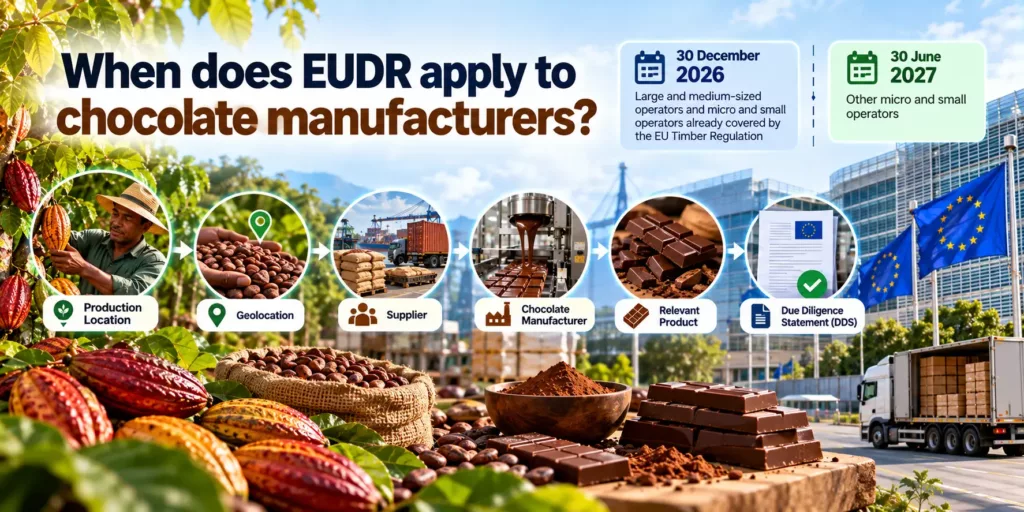
EUDR for chocolate manufacturers explains downstream compliance obligations, DDS reference requirements, and supplier traceability under the EU Deforestation Regulation. Chocolate manufacturers selling products in the European Union face an important question under the EU Deforestation Regulation (EUDR): Do you need to submit a new Due Diligence Statement (DDS) for every finished chocolate product?
The answer depends on your role in the supply chain.
If your business buys cocoa ingredients from a supplier established in the EU and those ingredients have already been covered by the required due diligence, your obligations may differ significantly from those of a business importing cocoa directly from outside the EU.
The distinction matters. Understanding whether your business is an operator or a downstream operator helps you determine what information to collect, how to manage DDS references and what records to retain.
This guide explains the practical requirements under Regulation (EU) 2023/1115, including the relevant provisions of Articles 3, 5, 8 and 9.
Key takeaway
For EU chocolate manufacturers, EUDR compliance is not simply about filing a DDS for every finished product.
It starts with identifying the correct role in the supply chain, confirming upstream coverage and maintaining the supplier and declaration information required under Article 5.
With a clear process for managing traceability and compliance evidence, manufacturers can prepare for the EUDR requirements without creating unnecessary declaration workflows.
Is your supply chain actually ready?
Move from spreadsheets and fragmented supplier data to a traceable, audit-ready EUDR workflow with TraceX.
Yes. Chocolate and other food preparations containing cocoa are listed under HS heading 1806 in Annex I of the EUDR. Cocoa beans, cocoa paste, cocoa butter and cocoa powder are also included under their respective classifications.
However, the obligations applying to a chocolate manufacturer depend on how the ingredients are sourced and whether the business is placing a product on the EU market for the first time or handling a product already covered by upstream due diligence.
Consider two common scenarios:
Scenario A — Direct import: A chocolate manufacturer imports cocoa butter or cocoa powder directly from a supplier outside the EU. It may be the operator responsible for conducting due diligence and submitting the required DDS before placing the relevant product on the EU market.
Scenario B — EU-based supplier: A chocolate manufacturer purchases cocoa ingredients from an EU-based supplier that has already placed the relevant products on the market and completed the required due diligence. The manufacturer may qualify as a downstream operator if the regulatory conditions are met.
These roles should not be confused. Buying from an EU-based supplier does not automatically make a business a downstream operator in every situation; the relevant products and their compliance status must be assessed.
Under the EUDR’s amended framework, a downstream operator is a business placing on the market or exporting relevant products made using relevant products that are all covered by a DDS or a simplified declaration.
Whether you’re an operator, downstream operator or trader, your obligations can differ significantly. Read our guide toEUDR rolesto understand your responsibilities, DDS requirements and the steps your business needs to take towards compliance.
What are the downstream obligations under EUDR?
Article 5 sets out the obligations for downstream operators and traders. The revised framework removes the general requirement for these businesses to submit a new DDS simply because they further process or distribute an already-covered product.
That does not mean there are no compliance obligations.
Collect and maintain supplier information
Under Article 5(3), downstream operators and traders must collect and keep specified information about the relevant products they handle. This includes:
The name, registered trade name or trademark of the business supplying the product.
The supplier’s postal address and email address, and website where available.
The DDS reference numbers or declaration identifiers associated with the products where the supplier is an operator.
The corresponding identification details of downstream operators or traders to whom the business supplies relevant products.
Article 5(4) requires this information to be retained for at least five years from the date the product is placed or made available on the market, or exported. The information must be provided to competent authorities upon request.
Register where required
Article 5(2) requires downstream operators and traders that are not SMEs to register in the EUDR Information System before placing or making relevant products available on the market, or exporting them. Chocolate manufacturers should assess their company size and supply-chain role instead of assuming that all businesses have identical registration requirements.
Respond to new information or compliance concerns
Article 5(5) requires downstream operators and traders to inform the relevant competent authorities and the downstream businesses they supplied if they learn of new information including substantiated concerns indicating that a product they have already placed or made available may not comply with the EUDR.
Article 5(6) adds requirements for non-SME downstream operators and non-SME traders that become aware of relevant information indicating non-compliance before placing or making products available on the market or exporting them. Where there are substantiated concerns, they must verify that due diligence was exercised and that no or only negligible risk was found before proceeding.
Understand what downstream operators and traders need to do, how DDS references should be managed, and which records must be retained.Read our guide to EUDR downstream complianceto clarify your responsibilities and prepare your supply chain for compliance.
Do chocolate manufacturers need a new DDS for every finished product?
No. A downstream operator does not generally need to submit a new DDS for every finished chocolate product when the relevant inputs are already covered by the required due diligence.
This is one of the most important distinctions for chocolate manufacturers to understand.
For example, a manufacturer may use the same compliant cocoa butter and cocoa powder across several chocolate bars, pralines and seasonal products. The manufacturer should not assume that every finished product requires a separate DDS submission simply because it has a different product name, recipe or packaging format.
Instead, the business should maintain the information required under Article 5, including the relevant supplier details and applicable DDS reference numbers or declaration identifiers.
The distinction is between submitting a DDS and retaining traceability information. Downstream operators and traders have recordkeeping and other obligations, but the amended EUDR framework does not generally require them to submit a fresh DDS for every finished product.
The exact treatment still depends on the business’s role, the products involved and whether the relevant inputs are covered by the required declarations.
Practical example: An EU chocolate manufacturer buying cocoa from an EU supplier
Consider a hypothetical chocolate manufacturer based in Germany. The company buys cocoa powder and cocoa butter from an EU-based supplier. It uses these ingredients to manufacture dark chocolate bars, milk chocolate bars and assorted pralines.
Here is how the company can approach its EUDR obligations:
Step 1: Obtain cocoa ingredients. The manufacturer obtains cocoa powder and cocoa butter from an EU supplier. It confirms the supplier’s role and whether the relevant ingredients are covered by the required DDS or simplified declaration.
Step 2: Collect compliance information. The manufacturer records the supplier’s required business details and the applicable DDS reference numbers or declaration identifiers, where Article 5 requires them.
Step 3: Manufacture finished products. The company produces multiple chocolate products using the covered ingredients. It maintains records that allow it to connect relevant incoming materials to the applicable compliance information.
Step 4: Retain records and respond to concerns. The company retains the required information for at least five years and can retrieve it if requested by a competent authority. It also follows the applicable notification requirements if it becomes aware of relevant compliance concerns.
In this scenario, the manufacturer does not automatically need to file a separate DDS for every chocolate product. Its priority is to establish its correct regulatory role and maintain reliable records linking its ingredients, suppliers and relevant declarations.
Which EUDR Articles should chocolate manufacturers understand?
EUDR provision
Why it matters
Article 3
Establishes the core requirements: relevant products must be deforestation-free, produced in accordance with relevant legislation in the country of production, and covered by the required due diligence statement or simplified declaration.
Article 5
Defines the information collection, record-retention, registration and notification obligations for downstream operators and traders.
Article 8
Sets out the due diligence framework for operators, including information collection, risk assessment and risk mitigation.
Article 9
Specifies information operators must collect, including product descriptions, quantity, country of production, geolocation and production details, as applicable.
These provisions serve different purposes. In particular, Articles 8 and 9 are central to the upstream due diligence process, while Article 5 is particularly relevant to downstream chocolate manufacturers that receive products already covered by the required declarations.
A practical EUDR compliance checklist for chocolate manufacturers
Confirm product scope: Verify the relevant Combined Nomenclature (CN) codes for cocoa ingredients and finished products against the applicable version of Annex I.
Identify your role: Determine whether your business acts as an operator, downstream operator or trader for each relevant product flow.
Verify upstream coverage: Establish whether the cocoa ingredients you receive are covered by the required DDS or simplified declaration.
Collect supplier details: Maintain the business information required under Article 5(3).
Capture declaration references: Retain the applicable DDS reference numbers or declaration identifiers when required by Article 5.
Connect records across the supply chain: Ensure relevant incoming materials can be linked to supplier records, purchase orders, batches and finished-product records where needed.
Retain records for five years: Make the required information accessible for competent-authority checks.
Define an escalation process: Establish how teams will handle substantiated concerns or new information suggesting possible non-compliance.
Assess registration requirements: Confirm whether the business must register in the EUDR Information System as a non-SME downstream operator or trader.
A checklist is a useful starting point, but businesses should also document the reasoning behind their classification and the way their records are maintained.
How can TraceX help chocolate manufacturers manage EUDR compliance?
Understanding the regulation is one challenge. Managing supplier information, traceability records and compliance evidence across a changing supply chain is another.
TraceX EUDR Solutions supports businesses with capabilities that can help organise this work:
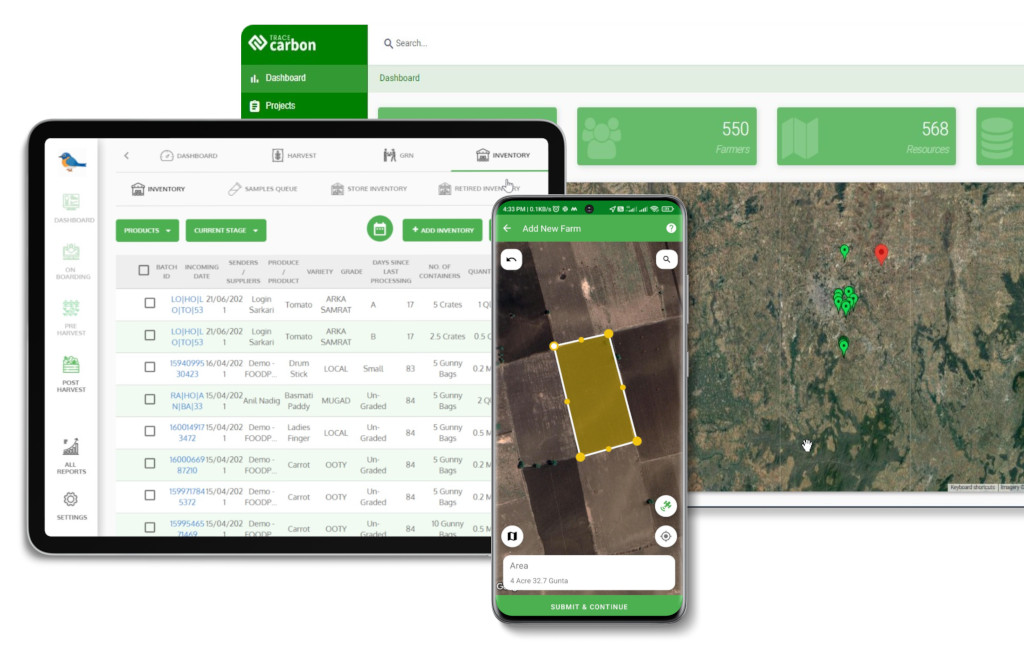
Supplier and supply-chain traceability: Maintain structured supplier and sourcing information across relevant supply-chain relationships.
Geolocation and deforestation risk assessment: Support the collection and assessment of plot-level geolocation and deforestation-related evidence for relevant upstream sourcing.
Centralised compliance evidence: Organise supporting documentation and compliance records so teams can retrieve the information they need more efficiently.
For chocolate manufacturers, the objective is not to create unnecessary DDS submissions. It is to establish the correct obligations, maintain the required information and build a reliable connection between cocoa sourcing and the finished products that use those ingredients.
Planning your EUDR readiness?
Discuss your supply-chain structure, downstream obligations and approach to managing DDS references and compliance evidence.
Does an EU chocolate manufacturer need to submit a DDS for every chocolate bar?
No, not simply because each bar is a different finished product. A downstream operator does not generally submit a new DDS for every finished product when the relevant inputs are already covered by the required declarations. The business must still meet its applicable Article 5 obligations.
What if a chocolate manufacturer buys cocoa from an EU supplier?
The manufacturer should establish whether the supplier has already placed the relevant cocoa product on the EU market and whether the required declaration covers it. If the manufacturer qualifies as a downstream operator, Article 5’s information collection and retention requirements will be particularly relevant.
How long must EUDR records be retained by downstream operators?
Article 5(4) requires the specified information to be retained for at least five years from the relevant placing on the market, making available on the market or export date.
Do downstream chocolate manufacturers need to collect DDS reference numbers?
They must collect the DDS reference numbers or declaration identifiers associated with relevant products where their supplier is an operator, as specified in Article 5(3)(a). The precise requirement depends on the supplier’s role and the relevant product flow.
Is every chocolate product covered by the EUDR?
Chocolate and other food preparations containing cocoa are listed under HS heading 1806 in Annex I. Businesses should verify the applicable CN classification and the current legal scope for each product rather than relying solely on a commercial product name.
Start using TraceX
Transparency, Trust, & Success for your Climate Journey.
We use cookies on our website to give you the most relevant experience by remembering your preferences and repeat visits. By clicking “Accept All”, you consent to the use of ALL the cookies. However, you may visit "Cookie Settings" to provide a controlled consent.
This website uses cookies to improve your experience while you navigate through the website. Out of these, the cookies that are categorized as necessary are stored on your browser as they are essential for the working of basic functionalities of the website. We also use third-party cookies that help us analyze and understand how you use this website. These cookies will be stored in your browser only with your consent. You also have the option to opt-out of these cookies. But opting out of some of these cookies may affect your browsing experience.
Necessary cookies are absolutely essential for the website to function properly. These cookies ensure basic functionalities and security features of the website, anonymously.
Cookie
Duration
Description
cookielawinfo-checkbox-analytics
11 months
This cookie is set by GDPR Cookie Consent plugin. The cookie is used to store the user consent for the cookies in the category "Analytics".
cookielawinfo-checkbox-functional
11 months
The cookie is set by GDPR cookie consent to record the user consent for the cookies in the category "Functional".
cookielawinfo-checkbox-necessary
11 months
This cookie is set by GDPR Cookie Consent plugin. The cookies is used to store the user consent for the cookies in the category "Necessary".
cookielawinfo-checkbox-others
11 months
This cookie is set by GDPR Cookie Consent plugin. The cookie is used to store the user consent for the cookies in the category "Other.
cookielawinfo-checkbox-performance
11 months
This cookie is set by GDPR Cookie Consent plugin. The cookie is used to store the user consent for the cookies in the category "Performance".
viewed_cookie_policy
11 months
The cookie is set by the GDPR Cookie Consent plugin and is used to store whether or not user has consented to the use of cookies. It does not store any personal data.
Functional cookies help to perform certain functionalities like sharing the content of the website on social media platforms, collect feedbacks, and other third-party features.
Performance cookies are used to understand and analyze the key performance indexes of the website which helps in delivering a better user experience for the visitors.
Analytical cookies are used to understand how visitors interact with the website. These cookies help provide information on metrics the number of visitors, bounce rate, traffic source, etc.
Advertisement cookies are used to provide visitors with relevant ads and marketing campaigns. These cookies track visitors across websites and collect information to provide customized ads.
Download the 2026 Traceability Scorecard and Benchmark Your Supply Chain Across 10 Critical Capabilities.
Download our eBook
Don’t Wait for an Audit to Find Your EUDR Gaps
The 2026 Simplification Package changes how HS codes, DDS pass-through and geolocation rules apply to you. Get the free guide and 20-point readiness checklist before enforcement catches you unprepared.