EUDR Roles and Responsibilities: Which One Are You, and What Must You Prove?
Published
, 9 minute read
Share this article
Quick summary: EUDR compliance assigns different obligations to operators, traders, and retailers. Discover your role, your due diligence duties, and the penalties for non-compliance
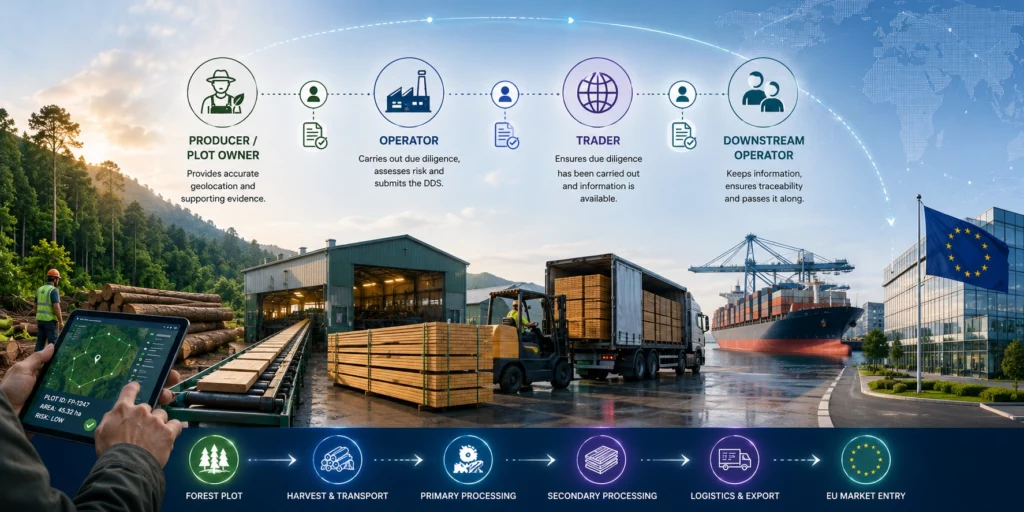
Under the EU Deforestation Regulation (Regulation (EU) 2023/1115, as amended by (EU) 2025/2650), EUDR roles and responsibilities fall into four groups: operators, traders, downstream operators, and authorised representatives. Your role not your industry decides whether you file a full Due Diligence Statement (DDS) in EU TRACES, reference an upstream one, or simply keep traceability records. Operators placing a commodity on the EU market for the first time carry the heaviest EUDR roles and responsibilities; downstream operators and most SME traders carry lighter, traceability-focused duties
Key takeaways
Your EUDR roles and responsibilities are set by the Article 2 definitions and your position in the chain not by company size alone.
Operators file a full DDS; non-SME traders do too. SME traders and downstream operators mostly reference and retain.
Getting your classification wrong is the costliest EUDR mistake over-compliance and under-compliance both drain budget and stall shipments.
Binding deadlines: 30 December 2026 (large/medium operators & traders) and 30 June 2027 (micro/small non-timber operators). Cut-off: 31 December 2020.
December 2026 is approaching. Is your supply chain actually ready?
Move from spreadsheets and fragmented supplier data to a traceable, audit-ready EUDR workflow with TraceX
Why EUDR roles and responsibilities decide your entire compliance workload
Confirm your role first everything else follows from it.
Your role sets whether you build plot-level geolocation, file a DDS, or pass a reference down the chain.
Guessing wrong means over-building (duplicating upstream work) or under-building (a blocked shipment).
If you source or sell coffee, cocoa, soy, palm oil, rubber, cattle, or wood into the EU, the first question a competent authority, a customs officer, or your EU buyer asks is not “are you compliant?” It is “what role do you play?” Your EUDR roles and responsibilities determine every downstream cost. The regulation itself is knowable in an afternoon; the pain shows up when you map it onto real data. Your ERP stores invoices and supplier addresses not GPS polygons, land-use history, or deforestation cut-off checks. Mapping your EUDR roles and responsibilities onto evidence you can actually produce on demand is where compliance breaks for most teams.
EUDR roles and responsibilities defined: operator, trader, downstream operator
Here are the EUDR roles and responsibilities exactly as the regulation defines them, with the obligation each one triggers.
Operator (Article 2(15))
Any natural or legal person who, in the course of a commercial activity, places relevant commodities or products on the EU market for the first time, or exports them. Operators carry the full weight: collect geolocation for every production plot, run risk assessment and mitigation, and file a Due Diligence Statement in EU TRACES before the goods move. Importers, first-placers, and exporters sit here.
Are You an Upstream Operator Under EUDR?
Our guide breaks down EUDR requirements for upstream operators, helping you understand your role, obligations and the evidence you need to maintain.
Any person in the supply chain, other than the operator, who makes relevant products available on the market. Non-SME traders are treated like operators and file a full DDS. SME traders may reference an existing upstream DDS by its reference number and retain record but a substantiated concern or a direct import from outside the EU can pull them back into full DDS territory.
Are You a Trader Under EUDR?
Our guide breaks down EUDR requirements for traders, helping you understand your responsibilities and prepare for compliance.
Downstream operator (new under Regulation (EU) 2025/2650)
An entity that places on the market or exports products already covered by a DDS filed upstream. Downstream operators skip fresh due diligence, but they must register in the system, collect and retain upstream DDS reference numbers, keep traceability records, and act on red flags. Less paperwork, zero permission to ignore compliance.
What Does EUDR Mean for Downstream Operators?
Our guide breaks down EUDR requirements for downstream operators, including the key responsibilities, data requirements and compliance considerations you need to understand.
Authorised representative and micro/small primary operators
Micro-enterprises and natural persons may mandate the next operator or trader down the chain as an authorised representative. Micro and small primary producers can use a simplified one-time declaration rather than a full DDS per shipment.
Are You a Micro or Small Operator Under EUDR?
If you’re unsure whether your business qualifies or what the rules mean for your operations, this guide is a good place to start.
How EUDR roles and responsibilities map to what you must file
Once you know your role, your EUDR roles and responsibilities become a finite checklist instead of an open-ended fear. This is what each actor actually owns:
Role
Files a DDS?
Plot geolocation duty
Core obligation
Operator
Yes — full
Yes — collect & verify
Due diligence + DDS in EU TRACES before placing on market
Non-SME trader
Yes — full
Yes (via suppliers)
Treated as an operator; full due diligence and DDS
SME trader
Reference
No — reference upstream
Retain DDS references; act on substantiated concern
One-time simplified declaration; may use a representative
EUDR roles and responsibilities under the 2026–2027 timeline
The amended regulation did not change your EUDR roles and responsibilities it changed when they bite.
30 December 2026 — large and medium operators and traders must comply. Micro/small operators already covered by the old EU Timber Regulation share this date.
30 June 2027 — natural persons and micro/small non-timber operators.
31 December 2020 — the deforestation cut-off. Land cleared after this date makes the product non-compliant. Unchanged by either postponement.
Penalties — fines up to 4% of EU-wide annual turnover, goods and revenue seizure, and exclusion from the EU market. The same penalty exposure applies whether you are an operator or a trader.
EUDR roles and responsibilities are a data-retrieval problem, not a policy problem. Every role operator, trader, downstream operator ultimately has to produce the same underlying evidence on demand: geolocation, DDS references, supplier records, chain of custody. Companies that stay audit-ready run all of it from one data layer, not fifteen spreadsheets and a WhatsApp thread.
TraceX EUDR Solutions helps companies operationalize EUDR roles and responsibilities by mapping each supply-chain actor to the workflows and evidence relevant to their role. For upstream operators, TraceX supports supplier onboarding, plot-level geolocation, legality documentation, deforestation-risk assessment, risk mitigation and DDS preparation. Micro and small primary operators can be managed through simplified data and declaration workflows where applicable. For downstream operators, TraceX helps connect processed products to upstream EUDR evidence, maintain supplier and product traceability, and retain the required records. Traders can use TraceX to capture supplier/customer information, link products to upstream compliance evidence and maintain audit-ready records. For companies acting in multiple roles, TraceX provides a unified view of obligations, suppliers, products, transactions and compliance evidence, helping teams apply the right workflow to each transaction rather than treating the entire supply chain the same way.
Not sure which EUDR role you fall under?
Book a 20-minute EUDR readiness call we will classify each of your entities and map your obligations to the data you already hold.
How to confirm your EUDR roles and responsibilities before you buy a solution
Before you sign with any traceability vendor, pressure-test it against your actual EUDR roles and responsibilities:
Does it classify each legal entity you operate as operator, trader, or downstream operator and flag when a substantiated concern reclassifies you?
Can it capture GPS polygon geolocation at plot level for the roles that need it, validated against satellite deforestation data (cut-off 31 Dec 2020)?
Does it generate a TRACES-ready DDS for operators and non-SME traders in one workflow?
Can it store and pass DDS reference numbers downstream for traders and downstream operators?
Does it hold an immutable 5-year audit trail so any role can prove compliance on request?
Does it map one data layer across EUDR, and reuse it for CSDDD and other regulations you face?
Frequently Asked Questions (FAQ’s)
What are the EUDR roles and responsibilities in simple terms?
EUDR roles and responsibilities split into four groups. Operators place a commodity on the EU market first and file a full DDS. Traders resell within the EU non-SMEs file a full DDS, SMEs reference an upstream one. Downstream operators handle products already covered by a DDS and mainly keep records. Authorised representatives act on behalf of micro-enterprises and natural persons.
How do I know if I am an operator or a trader under EUDR?
If you place a relevant commodity or product on the EU market for the first time, or export it, you are an operator (Article 2(15)). If you make products available on the market after that first placement, you are a trader (Article 2(16)). The first-placement test, not your business label, decides.
Do traders have to file a Due Diligence Statement?
Non-SME traders must file a full DDS, just like operators. SME traders may reference an existing upstream DDS by its reference number and retain records unless a substantiated concern or a direct non-EU import triggers full obligations.
What is a downstream operator under the 2025 amendment?
Regulation (EU) 2025/2650 introduced the downstream operator: an entity placing or exporting products already covered by an upstream DDS. They skip fresh due diligence but must register, retain DDS references, keep traceability records, and monitor for red flags.
Do EUDR roles and responsibilities change with company size?
Size affects the timeline and some obligations, not your core role. Micro and small operators get to 30 June 2027 (non-timber) and can use simplified declarations, but they are still in scope not exempt.
What happens if I misclassify my EUDR role?
Both directions cost you. Over-classifying wastes budget duplicating upstream due diligence; under-classifying risks a missing DDS, a rejected shipment, and fines of up to 4% of EU-wide turnover. Confirming your role first is the cheapest insurance.
When do EUDR obligations start to apply?
For large and medium operators and traders, 30 December 2026. For natural persons and micro/small non-timber operators, 30 June 2027. The 31 December 2020 deforestation cut-off applies regardless of role or size.
Start using TraceX
Transparency, Trust, & Success for your Climate Journey.
We use cookies on our website to give you the most relevant experience by remembering your preferences and repeat visits. By clicking “Accept All”, you consent to the use of ALL the cookies. However, you may visit "Cookie Settings" to provide a controlled consent.
This website uses cookies to improve your experience while you navigate through the website. Out of these, the cookies that are categorized as necessary are stored on your browser as they are essential for the working of basic functionalities of the website. We also use third-party cookies that help us analyze and understand how you use this website. These cookies will be stored in your browser only with your consent. You also have the option to opt-out of these cookies. But opting out of some of these cookies may affect your browsing experience.
Necessary cookies are absolutely essential for the website to function properly. These cookies ensure basic functionalities and security features of the website, anonymously.
Cookie
Duration
Description
cookielawinfo-checkbox-analytics
11 months
This cookie is set by GDPR Cookie Consent plugin. The cookie is used to store the user consent for the cookies in the category "Analytics".
cookielawinfo-checkbox-functional
11 months
The cookie is set by GDPR cookie consent to record the user consent for the cookies in the category "Functional".
cookielawinfo-checkbox-necessary
11 months
This cookie is set by GDPR Cookie Consent plugin. The cookies is used to store the user consent for the cookies in the category "Necessary".
cookielawinfo-checkbox-others
11 months
This cookie is set by GDPR Cookie Consent plugin. The cookie is used to store the user consent for the cookies in the category "Other.
cookielawinfo-checkbox-performance
11 months
This cookie is set by GDPR Cookie Consent plugin. The cookie is used to store the user consent for the cookies in the category "Performance".
viewed_cookie_policy
11 months
The cookie is set by the GDPR Cookie Consent plugin and is used to store whether or not user has consented to the use of cookies. It does not store any personal data.
Functional cookies help to perform certain functionalities like sharing the content of the website on social media platforms, collect feedbacks, and other third-party features.
Performance cookies are used to understand and analyze the key performance indexes of the website which helps in delivering a better user experience for the visitors.
Analytical cookies are used to understand how visitors interact with the website. These cookies help provide information on metrics the number of visitors, bounce rate, traffic source, etc.
Advertisement cookies are used to provide visitors with relevant ads and marketing campaigns. These cookies track visitors across websites and collect information to provide customized ads.
Download the 2026 Traceability Scorecard and Benchmark Your Supply Chain Across 10 Critical Capabilities.
Download our eBook
Don’t Wait for an Audit to Find Your EUDR Gaps
The 2026 Simplification Package changes how HS codes, DDS pass-through and geolocation rules apply to you. Get the free guide and 20-point readiness checklist before enforcement catches you unprepared.