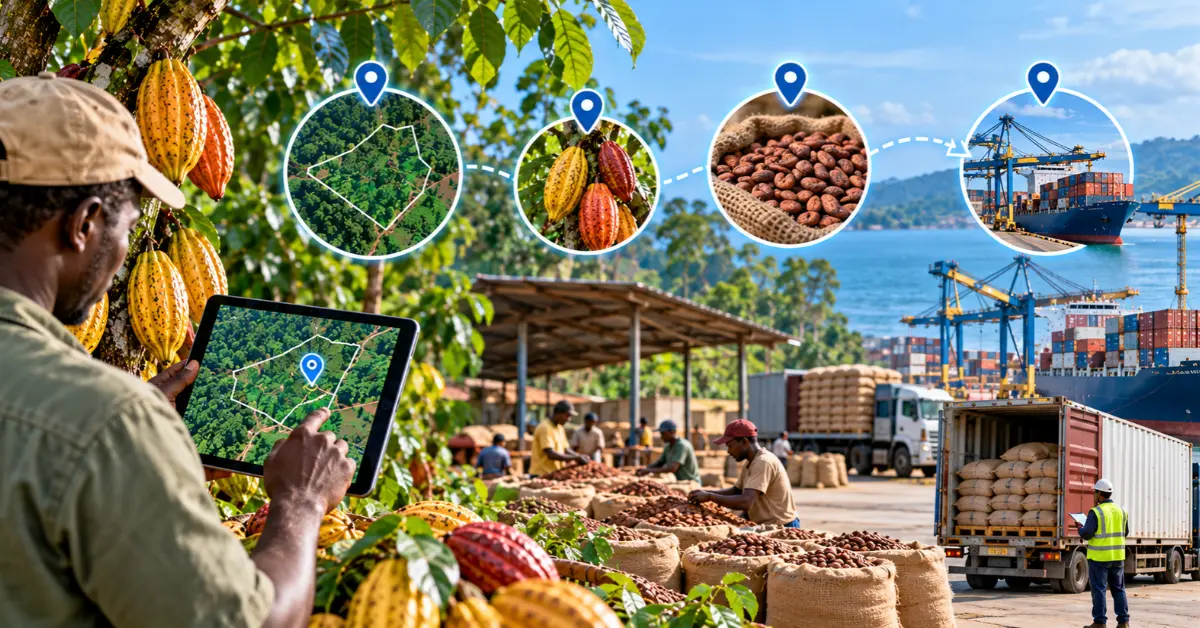
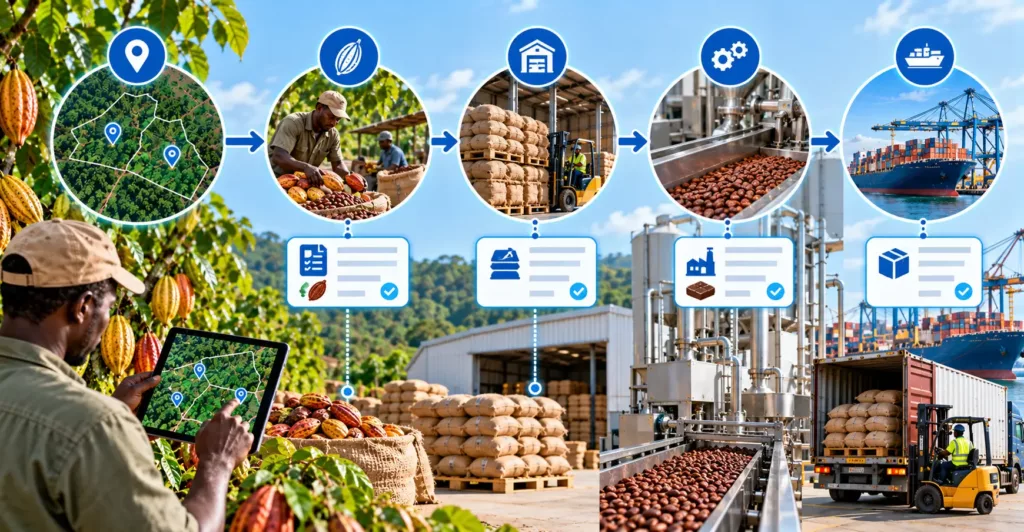
EUDR Compliance for Cocoa Exporters: A Practical Guide to Plot-Level Traceability
Published
, 9 minute read
Share this article
Quick summary: Learn how cocoa exporters can collect farmer data, validate plot geolocation, manage deforestation risk evidence and support EUDR due diligence.
EUDR compliance for cocoa exporters begins with a reliable connection between the cocoa being supplied and the farms where it was produced. For exporters working with cooperatives, aggregators, and thousands of smallholder farmers, collecting accurate plot-level information can be one of the most demanding parts of preparing data for European Union customers.
The EU Deforestation Regulation (EUDR) sets requirements for relevant cocoa products placed on the EU market or exported from it. Although legal obligations depend on a company’s role in the supply chain, exporters outside the EU may need to provide customers with accurate supplier, plot, production, and supporting evidence. A consistent data collection and validation process helps reduce missing information, repeated follow-ups, and delays in due diligence.
Key Takeaways: EUDR Compliance for Cocoa Exporters
Accurate farmer data is the foundation of compliance
Collect valid plot-level geolocation
Validate geospatial data before submission
Connect plots to procurement and shipments
Support deforestation and legality risk assessments
Resolve data gaps early
Use digital tools to improve traceability.
Download our eBook
Assess your EUDR readiness, uncover data gaps, and take proactive steps towards stronger compliance.
A supplier name or cooperative address alone does not show where cocoa was grown. Businesses need plot-level geolocation for relevant production areas, along with information about the product, quantity, country of production, suppliers, and production date or time range. These records help the responsible operator assess whether the cocoa meets the Regulation’s deforestation-free and legality requirements.
The EUDR cut-off date for deforestation is 31 December 2020. Geolocation helps connect sourcing records with evidence used to assess whether production meets the deforestation-free requirement, but coordinates by themselves do not establish compliance. They must be considered alongside other relevant information and evidence.
Step 1: Build a reliable farmer and supplier register
Begin with a structured register for farmers, cooperatives, aggregators, and other suppliers. Capture unique identifiers, contact and location details, supplier relationships, farm or plot identifiers, and links to procurement records. Avoid relying only on names, since spelling variations, duplicate records, and shared names can make it difficult to connect a plot to the correct farmer.
Where a supplier manages multiple farmers or plots, maintain those relationships explicitly. Define who collects information, who checks it, and how missing or inconsistent records are returned for correction. A repeatable onboarding process is easier to maintain than disconnected spreadsheets and email attachments.
Collect the geolocation of all plots where the relevant cocoa was produced. Under the EUDR, plots larger than four hectares used to produce relevant commodities such as cocoa require polygon geolocation describing the plot perimeter; plots of four hectares or less may be represented by a point, in accordance with the applicable legal requirements.
Explain the data requirements to field teams and suppliers before collection. Make sure the captured geometry represents the production plot not a farmer’s home, collection centre, warehouse, or village centroid. Record the production period and preserve the link between each geometry, farmer, supplier, harvest, and lot.
Read our practical guide toEUDR geolocation requirementsto understand plot mapping, polygon validation, and common data errors to avoid.
Step 3: Validate plot data before using it
Geospatial files can contain technical errors that are easy to miss when data is collected at scale. A validation workflow should check that coordinates are present and readable, points fall in plausible locations, polygon boundaries are properly closed, geometries are valid, and duplicate or overlapping records are reviewed. It should also flag missing farmer identifiers, incomplete production dates, unsupported file formats, and plots that are not linked to procurement records.
When using GeoJSON, KML, or shapefile data, check the coordinate reference system and file structure before importing the information into a compliance workflow. Do not silently correct questionable coordinates or discard a plot because it fails validation. Route exceptions to an assigned reviewer, document the correction, and retain an audit trail of what changed and why.
Step 4: Connect plots to cocoa purchases and shipments
Plot data is more useful when it can be connected to the physical flow of cocoa. Link each supplier delivery to procurement transactions, quantities, aggregation lots, warehouse inventory, processing batches where applicable, and outgoing shipments. This helps an exporter respond when a customer asks which farms contributed to a specific delivery and whether all relevant plots have supporting information.
Set controls for missing source records, unexplained quantity differences, and mixing of material with unknown origin. A digital traceability system can help maintain these links, but the process must reflect how cocoa is actually collected, stored, aggregated, and shipped.
Step 5: Support the buyer’s risk assessment with evidence
Validated plot data is one input into EUDR due diligence. Buyers may need supporting evidence about production, land-use history, and compliance with relevant laws in the country of production. Exporters should agree with customers on how requested evidence will be organized, shared, updated, and tied to the relevant plots and shipments.
Satellite monitoring and forest datasets can help identify areas requiring review, but a map result or automated alert should not be treated as a complete legal conclusion. Investigate alerts, check the relevant dates and context, document the review, and provide supporting material where available. The responsible operator must perform the due diligence required for its role and must not proceed where the Regulation’s conditions are not met.
Read ourpractical guide to EUDR cocoa complianceto understand the key requirements, common challenges, and steps toward a more transparent, traceable supply chain.
Common plot-data mistakes to avoid
1. Collecting village or cooperative locations instead of individual production plots
Example: A cocoa cooperative submits one GPS point for its village instead of the locations of the farms supplying the cocoa.
How digital solutions help: Farm mapping tools capture individual plot coordinates or boundaries and link them to the relevant farmer profiles, supporting plot-level traceability.
2. Submitting invalid polygons, incorrect coordinate formats, or duplicate plot records
Example: A supplier uploads a polygon with overlapping boundaries, missing coordinates, or the same farm registered twice.
How digital solutions help: Geospatial validation tools check coordinate formats, polygon geometry, missing data, and potential duplicates before the data proceeds to risk assessment.
3. Failing to link farmer profiles and geolocation to the correct purchase lot or shipment
Example: An exporter cannot identify which farms contributed to a specific cocoa shipment because purchase records are not linked to farm locations.
How digital solutions help: Digital traceability systems connect farmer profiles and plot records with procurement transactions, batches, inventory, and shipments, making origin information easier to retrieve.
4. Leaving production dates or supplier details incomplete
Example: A shipment record contains the supplier’s name but is missing the relevant production period or other required information.
How digital solutions help: Configurable data fields, mandatory-field checks, and supplier onboarding workflows help identify missing information before records are used for due diligence.
5. Treating a sustainability certificate or geolocation file as proof of EUDR compliance by itself
Example: An importer accepts a supplier’s sustainability certificate and farm coordinates without checking deforestation risk, legality evidence, or other applicable due diligence requirements.
How digital solutions help: Compliance platforms bring together geolocation, supporting documents, satellite-based checks, risk assessments, and due diligence records. These tools support verification but do not automatically establish compliance.
6. Correcting data without recording who made the change and what evidence supports it
Example: A farm boundary is updated after a validation issue, but there is no record of who changed it or why.
How digital solutions help: Audit trails record data changes, user actions, timestamps, and supporting evidence, helping teams review corrections and maintain traceable records.
Key takeaway: Accurate plot data is only the starting point. Businesses need to validate geolocation, connect plots to products and shipments, maintain supporting evidence, and document changes to support a reliable EUDR due diligence process.
As farmer networks grow, manual collection can create repeated follow-ups, inconsistent formats, and limited visibility into which plots are ready for review. Digital workflows can centralize farmer profiles, guide data collection, validate geospatial files, flag missing fields, and connect plots to procurement and shipment records. They can also make exceptions easier to assign, resolve, and audit.
TraceX provides digital traceability and geospatial workflows that can help businesses organize supplier information, plot data, and sourcing records. The right implementation depends on the exporter’s operating model and customer requirements; software can support the process but cannot replace legal review or the responsible operator’s due diligence.
EUDR compliance for cocoa exporters depends on more than collecting coordinates. It requires accurate farmer records, validated plot boundaries, reliable links to sourcing transactions, and timely evidence sharing with customers. Establishing a consistent process can help reduce avoidable data gaps and make due diligence support more efficient.
Want to improve your plot-data workflow?
Explore digital supplier data, geospatial validation, and traceability workflows.
What data should cocoa exporters collect for EUDR?
Cocoa exporters should collect relevant information that includes supplier and product details, country of production, plot geolocation, production date or time range, and supporting evidence needed by the responsible operator. The exact data flow should be agreed with the customer and mapped to current legal requirements.
Do cocoa farms need polygon geolocation?
Yes cocoa farms need polygon location ,under the EUDR, plots larger than four hectares used to produce cocoa require polygon geolocation. Smaller plots may be represented by a point, subject to the Regulation’s conditions.
Does valid geolocation prove cocoa is EUDR compliant?
No.Geolocation supports traceability and risk assessment, but the relevant product must also meet deforestation-free and legality requirements and the applicable due diligence process.
Can exporters use Excel to manage plot data?
Spreadsheets may help with small datasets, but large or frequently updated networks can benefit from validation rules, unique identifiers, controlled corrections, and traceable links to lots and shipments.
Who submits the Due Diligence Statement?
This depends on the entity’s role under the Regulation. Exporters should clarify responsibilities with EU customers; the relevant operator must fulfil the legal obligations applicable to its role.
Start using TraceX
Transparency, Trust, & Success for your Climate Journey.
We use cookies on our website to give you the most relevant experience by remembering your preferences and repeat visits. By clicking “Accept All”, you consent to the use of ALL the cookies. However, you may visit "Cookie Settings" to provide a controlled consent.
This website uses cookies to improve your experience while you navigate through the website. Out of these, the cookies that are categorized as necessary are stored on your browser as they are essential for the working of basic functionalities of the website. We also use third-party cookies that help us analyze and understand how you use this website. These cookies will be stored in your browser only with your consent. You also have the option to opt-out of these cookies. But opting out of some of these cookies may affect your browsing experience.
Necessary cookies are absolutely essential for the website to function properly. These cookies ensure basic functionalities and security features of the website, anonymously.
Cookie
Duration
Description
cookielawinfo-checkbox-analytics
11 months
This cookie is set by GDPR Cookie Consent plugin. The cookie is used to store the user consent for the cookies in the category "Analytics".
cookielawinfo-checkbox-functional
11 months
The cookie is set by GDPR cookie consent to record the user consent for the cookies in the category "Functional".
cookielawinfo-checkbox-necessary
11 months
This cookie is set by GDPR Cookie Consent plugin. The cookies is used to store the user consent for the cookies in the category "Necessary".
cookielawinfo-checkbox-others
11 months
This cookie is set by GDPR Cookie Consent plugin. The cookie is used to store the user consent for the cookies in the category "Other.
cookielawinfo-checkbox-performance
11 months
This cookie is set by GDPR Cookie Consent plugin. The cookie is used to store the user consent for the cookies in the category "Performance".
viewed_cookie_policy
11 months
The cookie is set by the GDPR Cookie Consent plugin and is used to store whether or not user has consented to the use of cookies. It does not store any personal data.
Functional cookies help to perform certain functionalities like sharing the content of the website on social media platforms, collect feedbacks, and other third-party features.
Performance cookies are used to understand and analyze the key performance indexes of the website which helps in delivering a better user experience for the visitors.
Analytical cookies are used to understand how visitors interact with the website. These cookies help provide information on metrics the number of visitors, bounce rate, traffic source, etc.
Advertisement cookies are used to provide visitors with relevant ads and marketing campaigns. These cookies track visitors across websites and collect information to provide customized ads.