EUDR Due Diligence for Cocoa Importers: Managing Supplier Evidence, Risk and DDS Workflows
Published
, 11 minute read
Share this article
Quick summary: Learn how cocoa importers can organize supplier evidence, assess deforestation and legality risks, manage DDS workflows, and improve EUDR due diligence readiness.
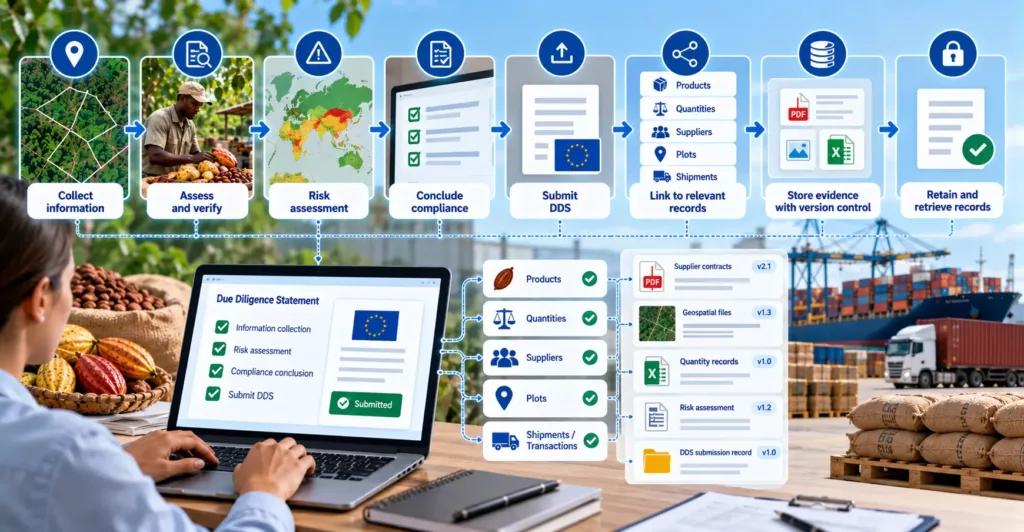
EUDR due diligence for cocoa importers is not simply a matter of collecting a supplier declaration or obtaining a Due Diligence Statement (DDS) reference. Importers placing relevant cocoa products on the European Union market need a structured process to gather the required information, assess risk, take mitigation measures where necessary, and complete the applicable obligations before the product is placed on the market.
Cocoa sourcing networks can involve farmers, cooperatives, aggregators, exporters, traders, processors, and logistics partners. Information may arrive in different formats, while plot geolocation, production dates, legality evidence, and shipment records may sit in separate systems. This guide explains how importers can organize these inputs into a repeatable due diligence workflow and where digital traceability can help.
Key Takeaways
Maintain reliable supplier data
Validate geolocation and production data
Assess deforestation and legality risks
Connect supplier evidence to cocoa shipments
Organize DDS workflows
Address data gaps early
Use digital tools to improve visibility.
Download our eBook
Assess your EUDR readiness, uncover data gaps, and take proactive steps towards stronger compliance.
The EU Deforestation Regulation (EUDR), Regulation (EU) 2023/1115, covers cocoa and relevant products listed in Annex I. The exact scope depends on the applicable product classification, so importers should verify the relevant CN code rather than assume every cocoa-containing product is treated identically.
For relevant products, the responsible operator must establish that the product is deforestation-free, was produced in accordance with relevant legislation in the country of production, and is covered by the required due diligence process and statement. The deforestation cut-off date is 31 December 2020. Importers should confirm their legal role and the latest application dates and requirements against current official EU guidance.
The supplier may provide important source information, but receiving data does not automatically transfer or remove an importer’s legal responsibilities. The steps required depend on whether the business is an operator, trader, or another actor under the Regulation.
1. Confirm product scope and responsibility before requesting documents
Start by mapping the cocoa products you import and checking each product’s Annex I status and customs classification. Record the supplier, country of production, product description, quantity, and intended market. Where products are processed or composite, verify the exact classification and current guidance rather than relying on a general label such as “chocolate.”
Next, document the role your business plays in the transaction. Establish who is responsible for collecting information, conducting due diligence, submitting the relevant DDS, and sharing reference details with downstream partners. Align these responsibilities with contracts and operational processes, but do not treat contractual language as a substitute for the obligations imposed by law.
Discover how to streamline due diligence, strengthen supply chain traceability, and organize the evidence needed to support compliance.
Create a standard evidence checklist for each relevant product flow. Depending on the product and applicable requirements, information may include supplier and customer details, product descriptions and quantities, country of production, geolocation of all relevant plots, production date or time range, and evidence supporting deforestation-free production and compliance with relevant legislation.
Request data in a consistent format and assign each record a unique identifier. Supplier names alone are often insufficient because different spellings, duplicate entries, and intermediary relationships can make records hard to reconcile. Link supplier profiles to plot identifiers, purchase orders, lots, invoices, transport documents, and shipment records wherever applicable.
Track evidence status explicitly: received, under review, incomplete, rejected, or approved for the next review step. For each missing item, assign an owner and a due date. This makes it easier to identify blockers before a shipment is ready for due diligence review.
Discover how a structured supplier onboarding process can improve data accuracy, strengthen traceability, and help prepare your supply chain for EUDR due diligence.
3. Validate geolocation and production information
Geolocation is central to EUDR cocoa due diligence because it connects the product to the land where the cocoa was produced. Importers should check that the information covers all relevant plots, not just a cooperative office or collection point, and that each plot is linked to the appropriate supplier and sourcing records.
Under the Regulation, plots larger than four hectares used to produce relevant commodities such as cocoa require polygon geolocation describing the plot perimeter; plots of four hectares or less may be represented by a point, subject to the applicable requirements. Check the coordinates, geometry validity, missing fields, duplicate plots, and links to production dates and lots.
If a GeoJSON, KML, or other geospatial file fails validation, route it back for correction rather than assuming the data is accurate. Keep a record of the issue, who corrected it, and the evidence supporting the change. Geolocation validation improves data quality, but it does not by itself prove that a product meets EUDR requirements.
Discover how geolocation validation helps identify data issues, improve plot-level accuracy, and strengthen your supply chain traceability.
After gathering the required information, the responsible operator must assess whether there is a risk that the product is non-compliant. The assessment should consider the relevant criteria under the Regulation, including country or region context, complexity of the supply chain, reliability and completeness of information, and the possibility of mixing with material of unknown origin.
Satellite monitoring and forest datasets can support the review by identifying areas or plots that need further investigation. However, an automated alert is a signal to assess—not a complete legal conclusion. Review the relevant time period, plot boundaries, data quality, and other supporting evidence, and document how the finding was resolved.
If the assessment identifies more than negligible risk, the operator must take appropriate mitigation measures before proceeding. If the risk cannot be reduced to the level required by the Regulation, the relevant product must not be placed on the EU market or exported. Keep a written record of the assessment, evidence reviewed, decisions taken, and any mitigation actions.
Discover how deforestation risk assessment helps businesses identify potential forest loss, evaluate supply chain risks, and strengthen their due diligence process.
5. Manage DDS workflows without treating the reference as proof
The Due Diligence Statement is an important part of the EUDR process, but a DDS reference does not replace the underlying due diligence. Before submitting the applicable statement, the responsible operator needs to complete the required information collection and risk assessment and conclude that the Regulation’s conditions are met.
Create a controlled workflow that links the DDS and its reference to the relevant products, quantities, suppliers, plots, and shipment or transaction records. Define who prepares, reviews, submits, and records the statement, and how reference information is passed to relevant downstream parties. Reconcile any discrepancies between product quantities, source records, and shipment documents before closing the workflow.
Maintain the records required by the Regulation for the applicable retention period and make them retrievable for internal review or requests from competent authorities. Store evidence with clear version history and access controls so that teams can identify which documents supported a particular decision.
Discover how to strengthen cocoa traceability, organize supplier information, and streamline due diligence across your supply chain.
EUDR due diligence can be delayed when product information, supplier records, geolocation data and supporting evidence are incomplete or disconnected. Digital solutions can help importers identify these gaps earlier and maintain a more consistent compliance workflow.
1. Incorrect product scope or CN code
Example: A cocoa importer assumes that every product containing cocoa falls under the same EUDR requirements without checking the exact product classification.
How digital solutions help: Maintain a product master with CN codes, product descriptions and scope-review status. Flag products requiring verification before they enter the due diligence workflow.
2. Inconsistent supplier, plot and shipment identifiers
Example: A supplier uses one farm ID in its geolocation file, another ID in its purchase records and a different reference on the shipment documents, making it difficult to connect the records.
How digital solutions help: Use unique supplier, plot, batch and shipment IDs to connect procurement, geolocation, inventory and shipment records in one traceability workflow.
3. Invalid or incomplete geolocation files
Example: A cocoa supplier submits a GeoJSON file containing an invalid plot polygon, duplicate farm records or missing coordinates.
How digital solutions help: Automatically validate file formats, coordinate completeness, polygon geometry and duplicate records. Flag errors for correction before the data is used in due diligence.
4. Incomplete evidence of legality or deforestation-free production
Example: An importer receives farm coordinates but lacks sufficient supporting information to assess deforestation risks or verify applicable land-use legality requirements.
How digital solutions help: Maintain a centralized evidence repository linked to suppliers and plots. Use configurable document checklists, satellite-based monitoring and risk-assessment workflows to identify missing evidence and areas requiring further investigation. Digital checks support due diligence but do not independently prove legal compliance.
5. Risk alerts closed without documented action
Example: A plot is flagged for a potential forest-cover change, but the alert is marked as resolved without recording the investigation, supporting evidence or mitigation decision.
How digital solutions help: Create a structured exception workflow requiring an assigned reviewer, investigation notes, supporting documents, a decision and an audit trail before closure.
6. DDS references disconnected from products and evidence
Example: An importer stores a DDS reference in a spreadsheet but cannot quickly identify the supplier records, production plots and product quantities associated with it.
How digital solutions help: Link DDS references to relevant products, quantities, suppliers, geolocation records and shipments. Provide a consolidated view of supporting evidence and declaration status.
7. Unclear responsibility for due diligence tasks
Example: Procurement expects the compliance team to collect supplier documents, while the compliance team assumes procurement has already obtained them. The missing information is discovered just before shipment.
How digital solutions help: Assign task owners and review responsibilities for supplier onboarding, document collection, risk assessment and DDS preparation. Use reminders, approval steps and dashboards to track outstanding actions.
Key takeaway: Digital due diligence is not just about generating a DDS. It helps importers connect product scope, supplier data, plot-level evidence, risk assessments and shipment records in a consistent workflowmaking gaps easier to identify, investigate and resolve before submission.
Transform Cocoa Procurement with Digital Traceability
Discover how TraceX helps cocoa exporters digitize LBA procurement, track farmer-level volumes, manage batch aggregation and gain visibility into warehouse inventory.
A digital workflow can bring supplier profiles, geolocation files, evidence status, risk-review notes, and DDS references into a connected process. It can flag missing fields, support geospatial validation, connect source plots with procurement and shipment records, and help teams follow up on unresolved exceptions. The practical benefit is not just storing documents; it is being able to explain which information supported a due diligence decision for a relevant product flow.
TraceX supports digital traceability and geospatial workflows that can help businesses organize supplier information, plot-level records, and compliance evidence. The right implementation depends on the importer’s role, product scope, sourcing model, and existing systems. Software can support the process but does not replace legal advice or the operator’s responsibility to fulfil applicable EUDR obligations.
Effective EUDR due diligence for cocoa importers depends on complete supplier information, validated plot data, documented risk decisions, and a controlled DDS workflow. Establishing these steps as a repeatable process helps teams identify gaps earlier, reduce document chasing, and retrieve the evidence behind a decision.
Ready to organize your workflow?
Explore digital supplier data, geospatial validation, and traceability workflows.
What information should cocoa importers collect for EUDR?
Relevant information that cocoa importers can collect include product and supplier details, quantities, country of production, geolocation of all relevant plots, production date or time range, and supporting evidence required for the due diligence process.
Does a supplier’s DDS reference mean the importer has completed due diligence?
Not automatically. Responsibilities depend on the importer’s role under the Regulation, and a reference does not replace the information collection and risk assessment required of the responsible operator.
How should cocoa importers handle incomplete farm data?
Cocoa importers can handle incomplete farm data by identifying the missing or inconsistent fields, request corrections from the relevant supplier, validate the updated data, and document the review. Do not treat unresolved gaps as proof of compliance.
Can satellite monitoring prove EUDR compliance?
No satellite monitoring cannot prove EUDR compliance. Satellite and forest-monitoring data can support risk assessment, but findings must be reviewed in context and combined with the other information and evidence required by the Regulation.
How can importers improve audit readiness?
Importers can improve audit readiness by maintaining linked records for supplier information, geolocation, risk assessments, mitigation actions, supporting documents, and relevant DDS references, with clear ownership and version history.
Start using TraceX
Transparency, Trust, & Success for your Climate Journey.
We use cookies on our website to give you the most relevant experience by remembering your preferences and repeat visits. By clicking “Accept All”, you consent to the use of ALL the cookies. However, you may visit "Cookie Settings" to provide a controlled consent.
This website uses cookies to improve your experience while you navigate through the website. Out of these, the cookies that are categorized as necessary are stored on your browser as they are essential for the working of basic functionalities of the website. We also use third-party cookies that help us analyze and understand how you use this website. These cookies will be stored in your browser only with your consent. You also have the option to opt-out of these cookies. But opting out of some of these cookies may affect your browsing experience.
Necessary cookies are absolutely essential for the website to function properly. These cookies ensure basic functionalities and security features of the website, anonymously.
Cookie
Duration
Description
cookielawinfo-checkbox-analytics
11 months
This cookie is set by GDPR Cookie Consent plugin. The cookie is used to store the user consent for the cookies in the category "Analytics".
cookielawinfo-checkbox-functional
11 months
The cookie is set by GDPR cookie consent to record the user consent for the cookies in the category "Functional".
cookielawinfo-checkbox-necessary
11 months
This cookie is set by GDPR Cookie Consent plugin. The cookies is used to store the user consent for the cookies in the category "Necessary".
cookielawinfo-checkbox-others
11 months
This cookie is set by GDPR Cookie Consent plugin. The cookie is used to store the user consent for the cookies in the category "Other.
cookielawinfo-checkbox-performance
11 months
This cookie is set by GDPR Cookie Consent plugin. The cookie is used to store the user consent for the cookies in the category "Performance".
viewed_cookie_policy
11 months
The cookie is set by the GDPR Cookie Consent plugin and is used to store whether or not user has consented to the use of cookies. It does not store any personal data.
Functional cookies help to perform certain functionalities like sharing the content of the website on social media platforms, collect feedbacks, and other third-party features.
Performance cookies are used to understand and analyze the key performance indexes of the website which helps in delivering a better user experience for the visitors.
Analytical cookies are used to understand how visitors interact with the website. These cookies help provide information on metrics the number of visitors, bounce rate, traffic source, etc.
Advertisement cookies are used to provide visitors with relevant ads and marketing campaigns. These cookies track visitors across websites and collect information to provide customized ads.