EUDR Compliance Costs vs. Non-Compliance Risks: What Is the Real Cost to Your Business?
Published
, 13 minute read
Share this article
Quick summary: Understand EUDR compliance costs, the risks of inadequate due diligence, and how to manage supplier data, geolocation and traceability.
EUDR compliance has a cost. Businesses may need to invest in supplier onboarding, plot-level geolocation, document collection, risk assessment, traceability, staff training and due diligence workflows. But those costs should be compared with the potential cost of weak data, delayed shipments, corrective work, lost commercial opportunities and regulatory enforcement.
The right question is not simply, “How much will EUDR compliance cost?” It is: “What will it cost us to build a reliable process and what financial and operational exposure remains if we do not?” The answer depends on product scope, business role, sourcing complexity, existing systems and the quality of available evidence.
In brief: Budget for the work required to meet applicable obligations, measure the cost of manual processes and model realistic risk scenarios. Do not assume every company has the same obligations or that buying software alone establishes compliance.
Key Takeaways: EUDR Compliance Costs vs. Non-Compliance Risks
1. EUDR compliance is a business investment, not just a regulatory expense.
2. Manual compliance can create hidden costs.
3. Incomplete supplier data creates compliance risks.
4. Non-compliance can have financial consequences.
5. Poor traceability can affect market access and customer relationships.
6. Compliance costs should be compared with potential business exposure.
7. Digital tools can simplify EUDR preparation
8. Early preparation gives businesses more time to address data gaps.
9. EUDR compliance requires continuous data management.
Download our eBook
Assess your EUDR readiness, uncover data gaps, and take proactive steps towards stronger compliance.
The EU Deforestation Regulation (Regulation (EU) 2023/1115) sets requirements for covered commodities and products placed on or made available on the EU market, or exported from it. In broad terms, relevant products must be deforestation-free, produced in accordance with relevant legislation in the country of production, and covered by the applicable due diligence statement or simplified declaration. Exact duties depend on the product, the actor’s role and the current legal text.
The regulation covers cattle, cocoa, coffee, oil palm, rubber, soy and wood, along with specified derived products listed in Annex I. Not every product made from these commodities is automatically in scope; check the exact product description and applicable CN/HS classification against the current Annex I.
As of October 2026, the European Commission lists application dates of 30 December 2026 for large and medium-sized operators and micro and small operators already covered by the EU Timber Regulation, and 30 June 2027 for most other micro and small operators. Verify the date and obligations that apply to your role and products against current official guidance.
What does EUDR compliance actually cost?
EUDR costs are not limited to a software subscription. They can include one-time setup work, recurring operational tasks and the effort needed to keep supplier, plot, product and shipment records consistent. The actual cost depends on how much of this capability already exists.
Supplier onboarding and engagement: Collecting supplier identities, production information, geolocation and supporting records; following up when submissions are incomplete.
Plot mapping and geolocation validation: Capturing relevant production plot locations, checking coordinate formats and polygon geometry, resolving duplicates and correcting errors.
Evidence and document management: Collecting and organizing product, production, legality and due diligence records and connecting evidence to the right supplier, plot and product.
Risk assessment and review: Evaluating relevant risks using available evidence and documenting how findings are handled; some cases may require deeper review.
Traceability and reconciliation: Connecting source plots and procurement records with lots, processing, inventory and shipments where applicable.
People, training and governance: Assigning responsibilities, training staff and suppliers, maintaining procedures and reviewing records.
Technology and integration: Using or adapting systems to manage data, validation, workflows, reporting and applicable information-system processes.
Separate one-time costs such as data cleanup, process design, integrations and initial onboarding from recurring costs such as new supplier onboarding, monitoring, reviews, training and evidence maintenance. This prevents implementation costs from being confused with the ongoing cost of operating the process.
Discover how EUDR compliance software can help you streamline supplier onboarding, automate data validation, organise compliance documentation and manage due diligence workflows in one place.
A manual process may appear inexpensive when the visible cost is a spreadsheet or existing employee time. The full cost becomes clearer when teams measure the work needed to collect, check, reconcile and retrieve information.
Repeated supplier follow-ups because required fields or documents are missing.
Re-entering the same supplier or plot information into multiple files and systems.
Manually reviewing geolocation files and returning invalid polygons for correction.
Searching across emails, spreadsheets and folders to reconstruct evidence for a purchase or shipment.
Reconciling supplier declarations against purchase volumes, processing records and available plot data.
Repeating reviews because identifiers, document versions or assessment decisions were not recorded consistently.
Estimate these costs rather than guessing. Track hours per supplier, the percentage of submissions requiring correction, average time to resolve a data gap and the time needed to assemble an evidence package. Establish a baseline before claiming that a new tool or process will reduce costs.
Discover how EUDR compliance software compares with manual compliance processes and how digital tools can help reduce administrative effort, improve data visibility and streamline supplier and risk management workflows.
The cost of non-compliance is not one fixed penalty. It can include regulatory consequences, corrective work, operational disruption and commercial losses. Consequences depend on the facts, product, business role, applicable provisions and decisions of relevant authorities or customers.
Regulatory and corrective-action exposure
Under the EUDR, competent authorities can require corrective action where non-compliance is established. Depending on the case, this can include correcting formal shortcomings, preventing a product from being placed on or made available on the market or exported, withdrawing or recalling relevant products, or other measures in the regulation. Member States establish and enforce applicable penalties. Article 25 provides for fines and other measures; the maximum fine for a legal person must be at least 4% of the relevant total annual Union-wide turnover in the preceding financial year, with the amount increased where necessary to exceed the potential economic benefit gained. This is a legal framework, not an automatic fine applied to every mistake.
Operational and commercial exposure
Shipment or order disruption: A missing data point or unresolved finding may delay internal release decisions or customer acceptance while evidence is investigated.
Remediation and rework: Teams may need to remap plots, correct records, repeat assessments, obtain documents or rebuild a traceability trail under time pressure.
Lost sales or customer confidence: A buyer may defer an order or reconsider a supplier relationship if required information or evidence is unavailable.
Management and legal costs: Responding to an investigation, customer audit or corrective-action request can consume internal capacity and require external advice.
Reputational exposure: Stakeholder confidence may be affected when responsible-sourcing claims cannot be supported.
These are possible scenarios, not guaranteed consequences of every data gap. A missing field, an unresolved alert and an established regulatory infringement are not the same thing. A sound process distinguishes data-quality issues, potential risk signals, confirmed findings and formal non-compliance.
The cost of incomplete supplier and plot data
A recurring source of avoidable cost is information that cannot be connected or verified. For example, a cocoa exporter may have a supplier list, farm coordinates and purchase records but if records use different identifiers, the team may struggle to show which plots contributed to a particular purchase lot or shipment.
Data gap
Example
Potential business impact
Incomplete plot geolocation
A cooperative location is supplied instead of relevant production plots.
Follow-up work and inability to establish required origin information.
Invalid or duplicate polygons
A plot file has invalid geometry or the same plot is registered twice.
Manual correction, unreliable overlays and repeat processing.
Disconnected records
Farmer, purchase lot and shipment records use unrelated identifiers.
More time spent reconstructing traceability and answering buyer queries.
Missing legality or production evidence
Required records are absent, inconsistent or difficult to retrieve.
Additional supplier engagement and delayed review.
Unexplained risk finding
An alert exists but the investigation and decision are not documented.
Repeated reviews and difficulty explaining the outcome.
No audit trail for corrections
A boundary is changed without recording who changed it and why.
Reduced transparency and extra effort to verify record history.
Digital tools can apply validation rules, maintain stable identifiers, link evidence to relevant records and preserve a history of decisions. They cannot make missing source information true, guarantee document authenticity or replace the responsible business’s due diligence obligations.
EUDR compliance costs vs. non-compliance exposure
A useful comparison considers both the cost of prevention and the expected cost of adverse scenarios. The aim is not to assume non-compliance will happen or that a compliance investment eliminates all risk. It is to make assumptions visible and compare plausible outcomes.
Cost category
Compliance-readiness cost
Potential non-compliance exposure
People and time
Supplier onboarding, training, reviews and process ownership.
Urgent investigation, rework, escalation and external support.
Data and evidence
Mapping, validation, document collection and record maintenance.
Repeated data collection, evidence reconstruction and unresolved gaps.
Technology and workflow
Software, integrations, reporting and maintenance.
Manual workarounds, delays and fragmented records during a review.
Trade and operations
Planned checks before relevant transactions or shipments.
Potential delays, restrictions, corrective action or lost orders, depending on circumstances.
Governance
Documented rules, responsibilities, audit trail and review.
Difficulty explaining decisions or responding consistently.
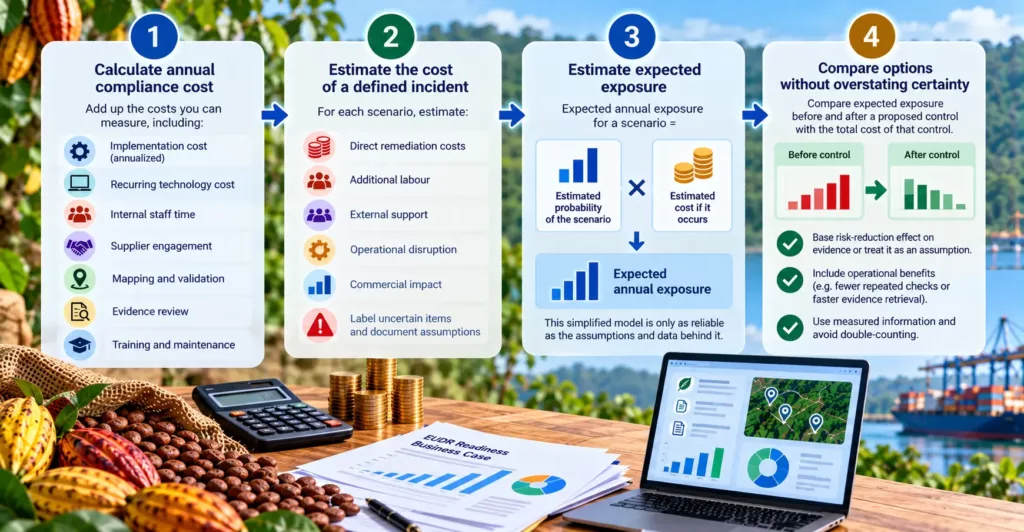
How to calculate the business case for EUDR readiness
Start with costs the organization can measure, then model a few credible scenarios. This framework supports internal planning; it is not a prediction of penalties or a guarantee of ROI.
Step 1: Calculate annual compliance cost
Step 2: Estimate the cost of a defined incident
Step 3: Estimate expected exposure
Step 4: Compare options without overstating certainty
Illustrative example: a cocoa exporter with 500 suppliers
Consider a hypothetical exporter that must organize supplier information and relevant plot data for covered products. Its plan could include supplier onboarding, plot mapping, geolocation validation, document collection, risk assessment and links between procurement lots and shipments. If records are fragmented, measure the hours spent correcting data, following up with suppliers and preparing evidence.
Compare the measured cost of improving this workflow with realistic scenarios such as repeated correction, delayed order fulfilment or additional work following a buyer review. Do not insert generic penalty figures or claim guaranteed savings. Use company-specific costs, transaction volumes, historical issues and approved assumptions.
A spreadsheet can model low, central and high scenarios. Show each input, source, owner and review date so Finance, Procurement and Compliance can challenge and update the model.
How digital EUDR tools can help manage compliance costs
Digital tools are most useful when they address a defined bottleneck in due diligence. A platform should not substitute for the legal assessment or evidence required from the business; it can help teams organize and execute the process more consistently.
Supplier onboarding workflows: Standardize data collection, identify missing fields and track follow-ups.
Geolocation validation: Check coordinate formats, polygon geometry and duplicate records before geospatial assessment; route exceptions for correction.
Satellite-based screening: Compare plot locations with available spatial datasets and surface signals for investigation. A signal should not automatically be described as proof of deforestation.
Evidence management: Keep supplier details, documents, assessment results and supporting records connected and retrievable.
Traceability and reconciliation: Link relevant plots and supplier records with purchases, batches, inventory and shipments where supported.
Risk review and audit trails: Record findings, review decisions, changes, owners and evidence to make assessments easier to explain.
DDS workflow support: Help organize information for the applicable due diligence process and submission workflow. Users remain responsible for verifying information and requirements.
When evaluating a solution, ask vendors to demonstrate a realistic workflow: upload plot data, identify a validation issue, link a supplier record to a purchase lot, review a risk finding, record the decision and retrieve the evidence. This reveals more than a feature checklist alone.
Have we checked whether the exact product and CN code are listed in the current Annex I?
Have we confirmed our supply-chain role and the obligations that apply to it?
Do we know which suppliers, plots, products and transactions need to be covered?
Can we collect and validate required plot-level geolocation and production information?
Can we connect relevant supplier and plot records with purchase lots, products and shipments?
Do we have a documented approach to risk assessment, escalation, investigation and mitigation?
Can we retrieve supporting evidence and explain who changed a record or decision?
Have we measured staff effort, correction rates and supplier follow-up workload?
Have we assigned owners and timelines to material gaps?
Have we checked current European Commission guidance and the application date relevant to our business?
A readiness assessment should produce a prioritized action plan, not just a list of software features. Start with scope, data quality, evidence and responsibility; then estimate the resources needed to close each material gap.
Turn compliance into a business decision
EUDR readiness is easier to manage when treated as an operational capability rather than a last-minute document exercise. Finance can quantify costs; Procurement can coordinate suppliers; Compliance can define review and escalation requirements; IT and Product teams can support reliable data flows; and leadership can assign accountability.
Track a small set of indicators over time:
Percentage of relevant suppliers with complete required information.
Percentage of submitted plot files passing defined validation checks.
Average time to resolve supplier data gaps.
Average time to retrieve evidence for a selected lot or shipment.
Number and age of unresolved high-priority findings.
Manual hours spent on repeated data entry, correction and review.
These measures help teams monitor operations. They do not, by themselves, prove EUDR compliance.
Prepare your EUDR process with TraceX
Managing EUDR information across suppliers, production plots, documents, risk assessments and shipments can be difficult when data is spread across spreadsheets and disconnected systems.
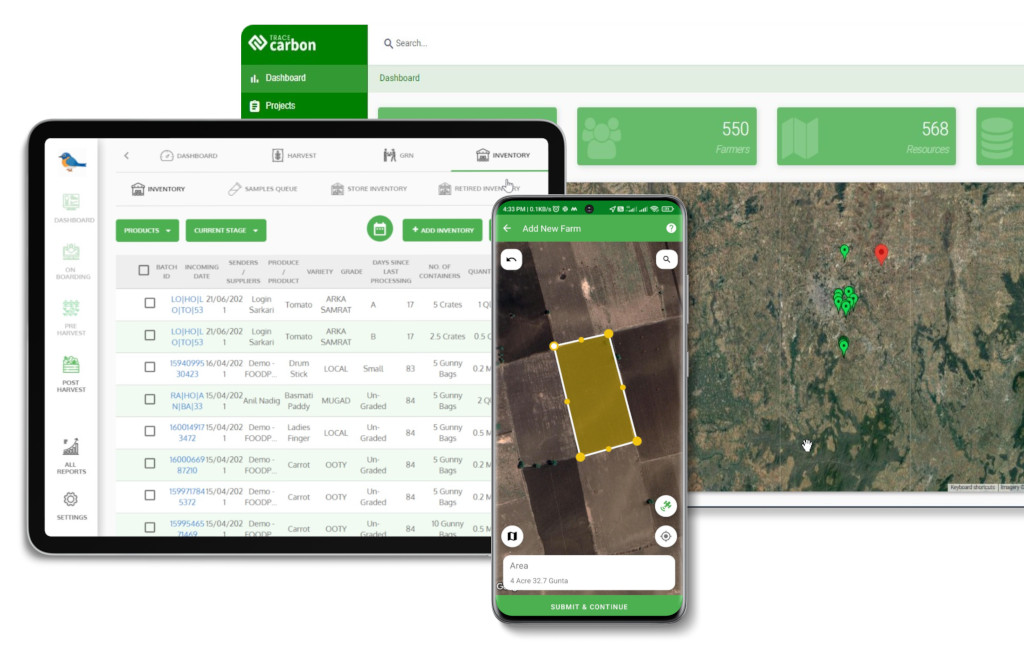
TraceX helps businesses organize supply-chain traceability and compliance workflows, including supplier information, plot-level geolocation, geospatial screening, risk assessment and evidence management. The right workflow depends on your products, role and existing systems.
Want to understand where your EUDR process has gaps?
Discuss your supplier onboarding, geolocation and due diligence workflow with our team.
There is no single cost for every business. Costs depend on product scope, business role, supplier count, sourcing complexity, existing traceability systems, data quality and manual effort. Build a budget from actual workflows and obligations.
What are the risks of EUDR non-compliance?
Depending on the circumstances, EUDR non compliance risks can include corrective action, restrictions on placing or making relevant products available on the market or exporting them, withdrawal or recall measures, penalties, operational disruption and commercial or reputational impact. Not every data gap leads to every consequence.
Can EUDR compliance software eliminate non-compliance risk?
No. Software can help organize records, validate data, support risk assessment and document workflows. It cannot guarantee source information is correct or that all legal obligations have been met.
Is a sustainability certificate enough for EUDR compliance?
No a sustainability certificate is not enough for EUDR compliance. A certificate or third-party scheme may provide useful supporting information, but should not automatically be treated as sufficient proof that all applicable EUDR requirements are met. Assess how the evidence supports the relevant criteria.
When does EUDR apply?
As of October 2026, the European Commission lists 30 December 2026 for large and medium-sized operators and micro and small operators already covered by the EU Timber Regulation, and 30 June 2027 for most other micro and small operators. Check current official guidance for the exact product and role.
How can companies reduce manual EUDR work?
Companies can reduce manual EUDR work with standardized supplier onboarding, validated geolocation, linked product and transaction records, centralized evidence, clear review ownership and documented workflows can reduce duplication and make gaps easier to identify. Measure the effect against a baseline.
Start using TraceX
Transparency, Trust, & Success for your Climate Journey.
We use cookies on our website to give you the most relevant experience by remembering your preferences and repeat visits. By clicking “Accept All”, you consent to the use of ALL the cookies. However, you may visit "Cookie Settings" to provide a controlled consent.
This website uses cookies to improve your experience while you navigate through the website. Out of these, the cookies that are categorized as necessary are stored on your browser as they are essential for the working of basic functionalities of the website. We also use third-party cookies that help us analyze and understand how you use this website. These cookies will be stored in your browser only with your consent. You also have the option to opt-out of these cookies. But opting out of some of these cookies may affect your browsing experience.
Necessary cookies are absolutely essential for the website to function properly. These cookies ensure basic functionalities and security features of the website, anonymously.
Cookie
Duration
Description
cookielawinfo-checkbox-analytics
11 months
This cookie is set by GDPR Cookie Consent plugin. The cookie is used to store the user consent for the cookies in the category "Analytics".
cookielawinfo-checkbox-functional
11 months
The cookie is set by GDPR cookie consent to record the user consent for the cookies in the category "Functional".
cookielawinfo-checkbox-necessary
11 months
This cookie is set by GDPR Cookie Consent plugin. The cookies is used to store the user consent for the cookies in the category "Necessary".
cookielawinfo-checkbox-others
11 months
This cookie is set by GDPR Cookie Consent plugin. The cookie is used to store the user consent for the cookies in the category "Other.
cookielawinfo-checkbox-performance
11 months
This cookie is set by GDPR Cookie Consent plugin. The cookie is used to store the user consent for the cookies in the category "Performance".
viewed_cookie_policy
11 months
The cookie is set by the GDPR Cookie Consent plugin and is used to store whether or not user has consented to the use of cookies. It does not store any personal data.
Functional cookies help to perform certain functionalities like sharing the content of the website on social media platforms, collect feedbacks, and other third-party features.
Performance cookies are used to understand and analyze the key performance indexes of the website which helps in delivering a better user experience for the visitors.
Analytical cookies are used to understand how visitors interact with the website. These cookies help provide information on metrics the number of visitors, bounce rate, traffic source, etc.
Advertisement cookies are used to provide visitors with relevant ads and marketing campaigns. These cookies track visitors across websites and collect information to provide customized ads.
Download the 2026 Traceability Scorecard and Benchmark Your Supply Chain Across 10 Critical Capabilities.
Download our eBook
Don’t Wait for an Audit to Find Your EUDR Gaps
The 2026 Simplification Package changes how HS codes, DDS pass-through and geolocation rules apply to you. Get the free guide and 20-point readiness checklist before enforcement catches you unprepared.