Do You Really Need EUDR Software? A Complete Buyer’s Guide
Published
, 11 minute read
Share this article
Quick summary: Do you really need EUDR software? Compare Excel, ERP, consultants, internal builds and dedicated EUDR platforms to choose the right approach for EUDR compliance.
How to evaluate Excel, ERP, consultants, internal builds and dedicated EUDR technology
If your company sells or exports products covered by the EU Deforestation Regulation (EUDR), the first technology question is not “Which EUDR softwareshould we buy?” It is “Do we need dedicated EUDR software at all?”
Many companies already have Excel trackers, an ERP such as SAP, an EUDR consultant, certification schemes, internal IT teams or the European Commission’s EUDR Information System. It is reasonable to ask whether another platform is necessary.
The answer depends on the complexity of your supply chain and, more importantly, whether your existing process can reliably connect source information, suppliers, geolocation, materials, production, evidence and EU shipments. The Commission’s current DDS API describes due diligence as information gathering, risk assessment and risk mitigation, with DDS submission occurring through the EUDR Information System.
Key Takeaways
EUDR compliance goes beyond submitting a DDS — it requires reliable source data, geolocation, evidence, risk assessment, and traceability.
Excel, ERP systems, consultants, and certifications can support compliance, but may not provide end-to-end traceability across complex supply chains.
EUDR software becomes valuable when scale and complexity increase, especially across multiple suppliers, source plots, products, batches, and EU shipments.
The right technology should connect the entire compliance workflow—from supplier and source data to batch traceability, evidence management, risk controls, and shipment readiness.
December 2026 is approaching. Is your supply chain actually ready?
Move from spreadsheets and fragmented supplier data to a traceable, audit-ready EUDR workflow with TraceX.
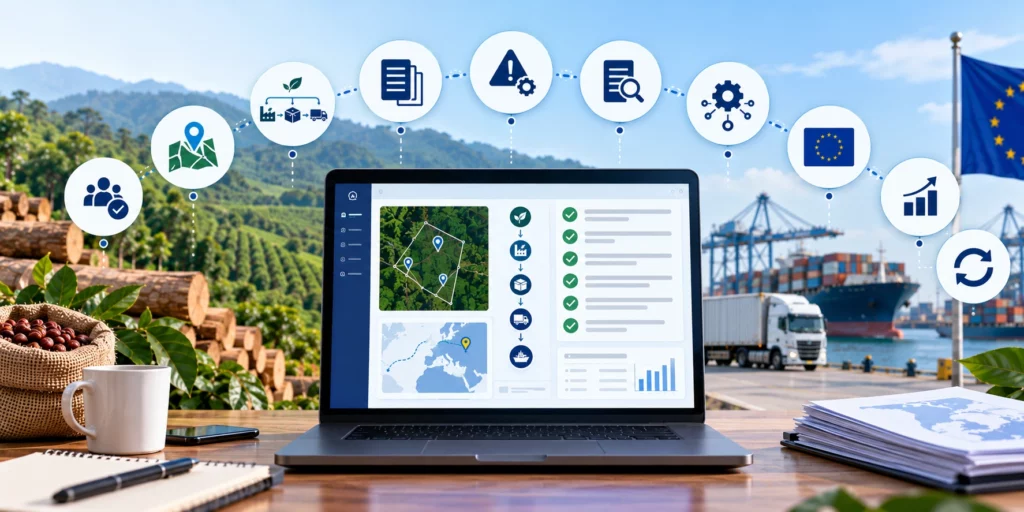
EUDR software should not be viewed simply as a tool for generating a Due Diligence Statement (DDS). The DDS is an output of a broader process. The underlying challenge is creating reliable, structured and traceable information that can support the due diligence process.
Supplier and source information needs to be collected consistently; geolocation and product information need to be managed; materials need to be connected to production, products and shipments; evidence needs to be retrievable; and risks and exceptions need a controlled workflow.
The Commission’s current API documentation is explicitly intended for economic operators with IT systems that manage DDS information electronically, as well as software providers building solutions to support operators.
Confused About the EUDR Information System?Understand how the EU’s EUDR Information System works, what businesses need to submit, and how DDS, geolocation, APIs, and reference numbers fit into the compliance process.
For a small, simple supply chain, spreadsheets may be a practical starting point. The question is what happens when the number of suppliers, production areas, products and shipments grows.
Typical pressure points include supplier data arriving in different formats, geolocation files requiring validation, products involving multiple relevant source areas, material moving through several production stages, evidence being scattered across folders and email, and changes to suppliers or source areas requiring updates across records.
Excel is therefore less about being “wrong” and more about whether it remains controlled, auditable and scalable. If your team can trace a real EU shipment from source to finished product without manual reconstruction, your current process may be adequate. If not, dedicated technology becomes easier to justify.
2. Why Do You Need EUDR Software If SAP or Another ERP Already Has the Data?
An ERP can be essential to the EUDR process without being the complete EUDR solution. ERP systems are designed primarily around transactions, procurement, inventory, production, sales and financial operations. EUDR introduces a different layer of source-level information, geolocation, evidence and due diligence workflow.
The key question is not whether your ERP contains data. It is whether your current systems can connect that data into a defensible EUDR chain: Supplier → Source/Geolocation → Material → Production → Product → Shipment → Evidence → Due Diligence.
If your ERP can already provide this chain with the required information and controls, you may not need a separate platform. If source data and compliance evidence live outside the ERP, an EUDR technology layer can bridge the operational and regulatory workflows.
Your ERP may manage procurement, inventory and productionbut can it connect source-level geolocation, supplier data, evidence and end-to-end traceability? Discover what your ERP canand cannotdo for EUDR compliance.
3. Do You Need Software If an EUDR Consultant Manages Compliance?
Consultants and technology solve different problems. A consultant can help interpret requirements, design a compliance approach, identify gaps and advise on risk. Technology helps operationalise that approach repeatedly across suppliers, products, batches, evidence and shipments.
A useful question is: “After our consultant tells us what we need to collect, where does that information live, who validates it, how is it linked to products and shipments, and how do we keep it current?”
For many companies, the strongest model is not consultant versus software, but consultant plus technology: expertise defines the process; technology makes the process repeatable.
From supplier data and geolocation to traceability, risk assessment, evidence management and DDS readiness, discover how the right technology can simplify EUDR compliance at scale.
Certification can be valuable supporting evidence, but companies should not assume that holding a certification automatically eliminates their EUDR due diligence responsibilities. The relevant question is whether the information and evidence required for the EUDR process can be established for the products and supply chain being assessed.
Ask: Can you connect your certification and supplier documentation to the relevant material, source information, production flow and EU shipment? Can you retrieve the underlying evidence when required?
For timber, plywood, furniture and paper supply chains, this distinction is particularly important because commercial products can contain material from multiple sources and processing stages.
FSC certification can support your sustainability and traceability efforts, but does it meet all EUDR requirements? Explore the key differences between FSC certification and EUDR due diligence—and what additional data and traceability you may need.
An internal build can make sense for organisations with strong software engineering, GIS, integration and compliance-product capabilities. But building a durable EUDR workflow means more than creating a DDS submission form.
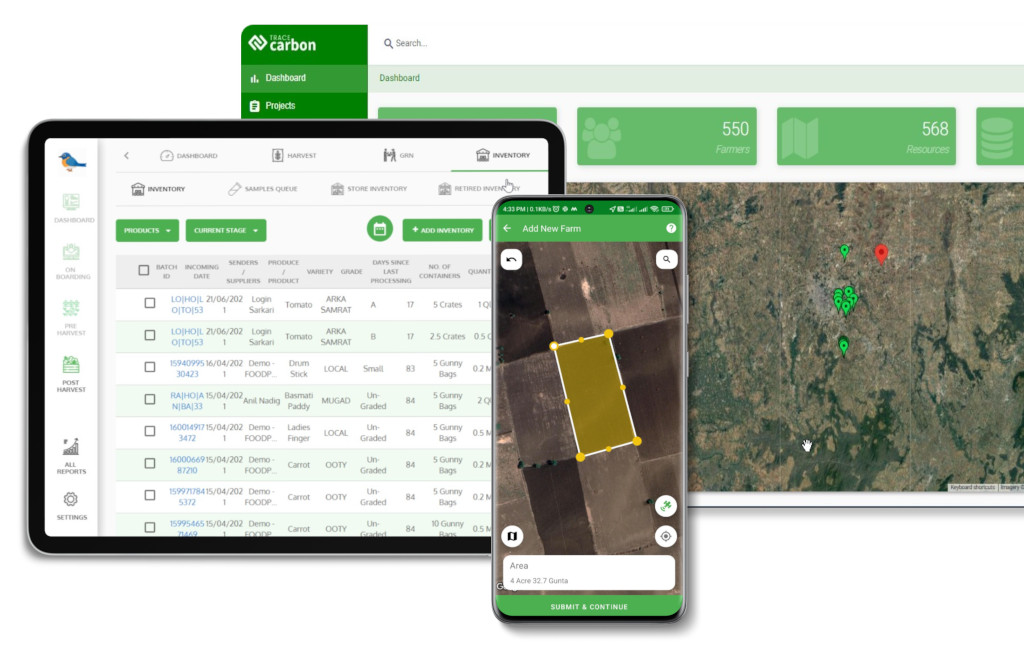
An internal build can require supplier portals, geolocation ingestion and validation, traceability and quantity relationships, evidence management, risk and exception workflows, role-based approvals, ERP/MES/WMS integrations, regulatory and Information System changes, security and ongoing maintenance.
The decision should compare the total cost and ownership burden of building and maintaining the capability against adopting a specialised EUDR platform.
6. Why Pay for EUDR Software When the EU Information System Is Free?
This is one of the most important buyer questions. The European Commission operates the EUDR Information System where operators submit DDSs. The existence of that system does not remove the need for companies to gather, structure, validate and manage the information that feeds the due diligence process.
The Commission’s current API documentation explicitly supports integration for economic operators whose IT systems manage DDS information electronically and for software providers developing solutions for operators.
Think of the distinction this way: EU Information System = regulatory submission environment. EUDR technology platform = operational data, traceability, evidence, workflow and integration layer.
When Does an EUDR Platform Become Necessary?
There is no universal company-size threshold. Complexity is the better indicator. Multiple suppliers or sourcing countries, multiple production areas, large numbers of products or shipments, multiple processing stages, manual supplier data collection, fragmented evidence, recurring shipment-level traceability, integration requirements and frequent source changes all strengthen the case for dedicated EUDR software.
The more of these conditions apply, the stronger the case for a dedicated EUDR technology layer.
Before buying any EUDR platform, test your current process with one real EU-bound shipment. Can you identify the suppliers, relevant production areas, quantities and product information, production records, finished product, supporting evidence, reviewers and the time required to reconstruct the chain?
If answering these questions requires emails, spreadsheets, folder searches and supplier calls, the gap is operational traceability and that is where EUDR software can create value.
What Should You Look for in EUDR Software?
Supplier onboarding — Can suppliers provide and update structured information themselves?
Geolocation — Can the platform ingest, validate and manage source geolocation?
Traceability — Can I connect source → material → production → product → shipment?
Evidence — Can supporting documents and records be linked to the relevant chain?
Risk — Can teams manage risk assessment, mitigation and exceptions?
Audit trail — Can we see what changed, who changed it and when?
Integration — Can it connect with ERP/MES/WMS and support APIs?
EUDR Information System — Can it support the current submission/integration model?
Scalability — Can it handle our supplier, SKU and shipment volumes?
Change management — Can we manage supplier/source changes without rebuilding the process?
Build vs Buy: A Simple Decision Framework
Approach
Best Fit
Main Risk
Ask Yourself
Excel
Low complexity
Manual validation and scaling
Can we maintain traceability as volume grows?
ERP only
Strong transactional data
Source-level EUDR data may remain fragmented
Can our ERP trace one shipment to source and evidence?
Consultant
Need regulatory/process expertise
Execution remains manual
Who operationalises the consultant’s requirements?
Internal build
Strong IT/GIS team
Long-term maintenance burden
Do we want to own an EUDR product?
EUDR platform
Complex recurring EUDR operations
Implementation and adoption
Can it solve our actual source-to-shipment workflow?
A Practical EUDR Technology Architecture
The strongest approach is usually not “replace everything.” It is to create a compliance layer that connects existing operational systems with source-level and regulatory requirements.
ERP / Procurement / Production / WMS → EUDR Traceability & Evidence Layer → EUDR Information System
Existing systems can remain the source of operational transactions where appropriate, while the EUDR layer organises source, geolocation, traceability, evidence and workflow. APIs can reduce duplicate entry where integration is appropriate. The Commission API documentation includes submission and retrieval operations and describes integration by economic operators and software providers.
Why TraceX?
TraceX EUDR Solutions approaches EUDR as a supply-chain traceability problem rather than only a regulatory submission problem. The objective is to connect source data, suppliers, materials, production, products, shipments and evidence into a controlled digital workflow.
Core positioning: “EUDR compliance starts at the source not at the DDS screen. TraceX helps companies build the traceability and evidence layer needed to make EUDR compliance repeatable at scale.”
Identify where source data, geolocation, traceability and evidence break down—and determine whether your current process is ready for EUDR.
Can you trace one finished product back to its relevant source areas?
How do you validate supplier geolocation?
Can you manage multiple source areas for one product?
How do you connect material to production batches?
How are quantities reconciled across the chain?
How are missing supplier records and exceptions handled?
Can suppliers enter and update their own information?
How are documents and evidence connected to the traceability chain?
How is the audit trail maintained?
Can the platform integrate with our ERP/MES/WMS?
How does the platform connect to the EUDR Information System?
How are regulatory and API changes managed?
Can you demonstrate the workflow using our real shipment?
The Final Buying Question
Don’t ask only: “Do we need EUDR software?” Ask instead: “Can our current process reliably connect source → supplier → material → production → product → shipment → evidence, at the scale and frequency of our EU business?”
If the answer is yes, document and test that process. If the answer is no, the technology discussion becomes clearer: you are not buying another compliance dashboard; you are investing in operational infrastructure required to manage EUDR data and traceability at scale.
Frequently Asked Questions (FAQ’s)
Is EUDR software mandatory?
The EUDR requires due diligence and applicable submissions for covered operators; it does not require a particular commercial software product. The technology decision is about how the company operationalises the required process.
Can I use Excel for EUDR?
You can use manual tools where they are adequate for your complexity. The key test is whether the process remains accurate, traceable, auditable and scalable.
Does SAP replace EUDR software?
It depends on your architecture. An ERP may contain important transaction data, while EUDR workflows may require additional source, geolocation, evidence and compliance capabilities.
Does an EUDR consultant replace software?
Not necessarily. A consultant can provide regulatory and process expertise; software can operationalise the resulting workflow across suppliers and transactions.
Is FSC certification enough for EUDR?
Certification may provide supporting evidence, but companies should assess whether all required EUDR information and due diligence steps are covered for their relevant products and supply chain.
Why use an EUDR platform if the EU Information System is free?
The Commission system is the regulatory information environment for submissions. A commercial platform can provide the upstream data, traceability, evidence, workflow and integration layer needed to prepare those submissions.
Start using TraceX
Transparency, Trust, & Success for your Climate Journey.
We use cookies on our website to give you the most relevant experience by remembering your preferences and repeat visits. By clicking “Accept All”, you consent to the use of ALL the cookies. However, you may visit "Cookie Settings" to provide a controlled consent.
This website uses cookies to improve your experience while you navigate through the website. Out of these, the cookies that are categorized as necessary are stored on your browser as they are essential for the working of basic functionalities of the website. We also use third-party cookies that help us analyze and understand how you use this website. These cookies will be stored in your browser only with your consent. You also have the option to opt-out of these cookies. But opting out of some of these cookies may affect your browsing experience.
Necessary cookies are absolutely essential for the website to function properly. These cookies ensure basic functionalities and security features of the website, anonymously.
Cookie
Duration
Description
cookielawinfo-checkbox-analytics
11 months
This cookie is set by GDPR Cookie Consent plugin. The cookie is used to store the user consent for the cookies in the category "Analytics".
cookielawinfo-checkbox-functional
11 months
The cookie is set by GDPR cookie consent to record the user consent for the cookies in the category "Functional".
cookielawinfo-checkbox-necessary
11 months
This cookie is set by GDPR Cookie Consent plugin. The cookies is used to store the user consent for the cookies in the category "Necessary".
cookielawinfo-checkbox-others
11 months
This cookie is set by GDPR Cookie Consent plugin. The cookie is used to store the user consent for the cookies in the category "Other.
cookielawinfo-checkbox-performance
11 months
This cookie is set by GDPR Cookie Consent plugin. The cookie is used to store the user consent for the cookies in the category "Performance".
viewed_cookie_policy
11 months
The cookie is set by the GDPR Cookie Consent plugin and is used to store whether or not user has consented to the use of cookies. It does not store any personal data.
Functional cookies help to perform certain functionalities like sharing the content of the website on social media platforms, collect feedbacks, and other third-party features.
Performance cookies are used to understand and analyze the key performance indexes of the website which helps in delivering a better user experience for the visitors.
Analytical cookies are used to understand how visitors interact with the website. These cookies help provide information on metrics the number of visitors, bounce rate, traffic source, etc.
Advertisement cookies are used to provide visitors with relevant ads and marketing campaigns. These cookies track visitors across websites and collect information to provide customized ads.
Download the 2026 Traceability Scorecard and Benchmark Your Supply Chain Across 10 Critical Capabilities.
Download our eBook
Don’t Wait for an Audit to Find Your EUDR Gaps
The 2026 Simplification Package changes how HS codes, DDS pass-through and geolocation rules apply to you. Get the free guide and 20-point readiness checklist before enforcement catches you unprepared.