EUDR Software vs. Manual Compliance: Costs, Risks and Efficiency Compared
Published
, 9 minute read
Share this article
Quick summary: EUDR software vs. manual compliance compared on cost, risk and efficiency. See where spreadsheets break and what to automate before 30 December 2026.
EUDR software vs. manual compliance comes down to one question: can your team collect, verify and file plot-level evidence for every shipment at scale? Manual compliance (spreadsheets, email and PDF folders) can work for a few mapped suppliers, but cost, error risk and filing delays rise with every new plot. EUDR software validates geolocation, screens deforestation risk and prepares the Due Diligence Statement (DDS) in one audit-ready workflow, so compliance keeps pace with trade volume.
EUDR software vs. manual compliance is the operating decision every company placing cattle, cocoa, coffee, oil palm, rubber, soy or wood on the EU market has to settle before 30 December 2026. Manual compliance means running due diligence through spreadsheets, email, shared drives and PDF certificates. EUDR software means a dedicated platform that collects supplier data, validates plot geolocation, assesses deforestation risk and prepares the DDS in one place.
Both routes must produce the same legal evidence. The difference is what that evidence costs, how often it goes wrong and how fast it moves with your shipments.
KEY TAKEAWAYS
The EUDR applies from 30 December 2026 for large and medium companies and from 30 June 2027 for most micro and small companies. No further delay had been proposed as of late October 2026.
Manual compliance looks cheaper upfront, but labour, rework and audit preparation grow with every supplier, plot and shipment.
The biggest manual risks are invalid geolocation files, broken audit trails and DDS errors that can hold shipments.
EUDR software makes due diligence repeatable, so compliance capacity scales with trade volume instead of headcount.
Certifications support risk mitigation but never replace plot-level geolocation or the DDS.
Download our eBook
Assess your EUDR readiness, uncover data gaps, and take proactive steps towards stronger compliance.
EUDR Software vs. Manual Compliance: The Core Difference
The choice is less about tools and more about whether your due diligence can scale.
How most teams run EUDR compliance today
Where the manual approach hits its limit
When a manual process can still hold
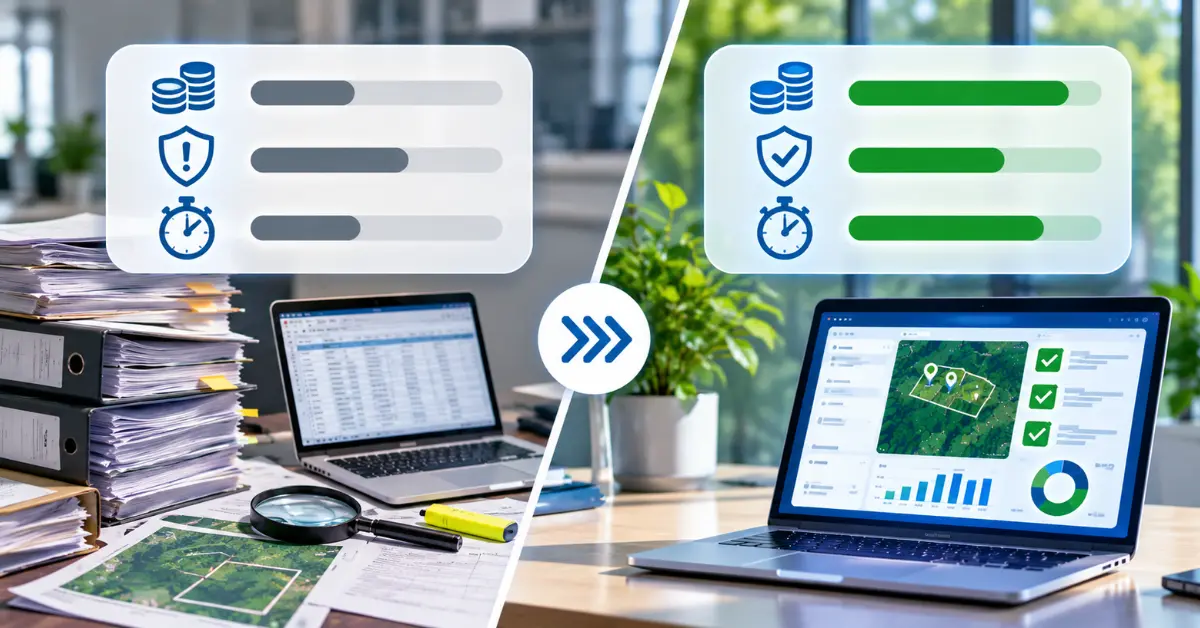
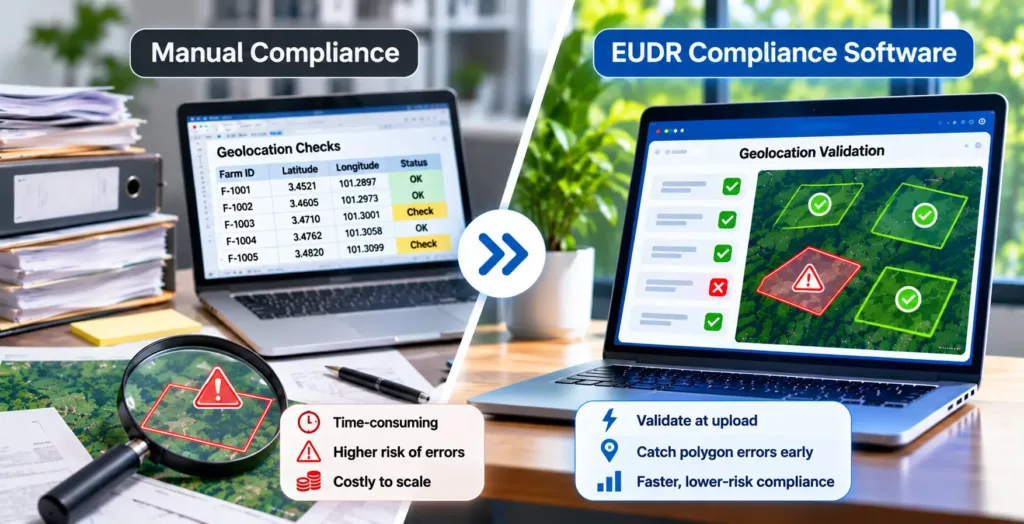
Manual compliance relies on people to move and check data. EUDR software relies on rules that check data as it arrives.
Most teams start the same way: a compliance lead requests GPS points from suppliers by email, pastes them into a spreadsheet, spot-checks a few against satellite imagery and files the DDS by hand. That works for a pilot. It stops working when one coffee exporter buys from 2,000 smallholders across three regions every season.
So EUDR software vs. manual compliance is really a question of volume and repeatability. If you source from a handful of large, already-mapped estates, a disciplined manual process may hold. If you aggregate from smallholders, cooperatives or intermediaries, you face a forced tradeoff: add headcount every harvest, or accept more errors.
Manual compliance rarely fails on day one. It fails on the 200th plot, the third supplier resubmission and the first audit request.
Discover why spreadsheets fall short and what it takes to build a reliable, audit-ready compliance process.
EUDR Compliance Obligations Both Approaches Must Meet
Whatever you choose, the regulation sets the same evidence bar.
The three conditions every product must meet
Geolocation, risk assessment and DDS duties
Record retention and penalties
Before weighing EUDR software vs. manual compliance, fix the evidence bar. Under Regulation (EU) 2023/1115, as amended by Regulation (EU) 2025/2650, relevant products must be deforestation-free after 31 December 2020, produced in line with the laws of the country of production and covered by a DDS. In practice that means:
Geolocation for every plot of land, with polygons for plots above four hectares (cattle excepted).
A documented risk assessment and, where risk is not negligible, risk mitigation, informed by the low, standard and high country benchmarking tiers.
DDS submission through the EU Information System before products are placed on, or exported from, the EU market.
Five-year record retention, available to competent authorities on request.
Member state penalties can include fines with a maximum of at least 4% of total annual EU turnover, confiscation of products and revenues, and temporary exclusion from public procurement. Certifications such as FSC, RSPO or Rainforest Alliance support risk mitigation, but they never replace plot-level geolocation, verifiable evidence or the DDS.
Understand the key requirements, from geolocation and deforestation checks to risk assessment, due diligence and DDS filing.
EUDR Manual Compliance Costs: The Hidden Line Items
Manual compliance avoids a licence fee but moves the cost into people, rework and delay.
Labour and rework every harvest
Audit preparation across five years of records
The commercial cost of held shipments
EUDR manual compliance costs in labour and rework
Every plot must be collected, cleaned, checked and linked to a shipment. When a supplier sends coordinates in the wrong format or a polygon that does not close, someone has to spot it, ask again and re-enter it. That cycle repeats each season.
EUDR manual compliance costs at audit time
When a competent authority requests evidence, manual teams rebuild the trail from inboxes and folders. Five years of retention multiplies that effort with every shipment you add.
EUDR manual compliance costs from shipment delays
A missing or incorrect DDS reference can hold goods. For perishable or contract-bound commodities, the commercial cost of one held shipment can outweigh the cost of the system meant to prevent it.
To compare EUDR software vs. manual compliance fairly, model total cost of ownership: hours per DDS, rework rate, audit preparation time and the value of shipments at risk, not just the licence price.
EUDR Compliance Risks: Manual Workflows vs. Software Controls
Most EUDR failures are data failures, and manual processes create more of them.
Geolocation errors spreadsheets miss
Broken audit trails and version confusion
Key-person dependency
Common manual errors include swapped latitude and longitude, unclosed polygons, overlapping plots and points that land in the sea or a protected forest. A spreadsheet flags none of them. Neither does email.
Audit trails break as versions multiply. Which file was submitted? Which supplier update came after it? Who approved the risk conclusion? In manual setups that knowledge often sits with one person, and if they leave mid-season, so does your evidence.
The consequence is not only a fine. It is a rejected DDS, a held shipment and an EU buyer who starts qualifying a second supplier. This is where EUDR software vs. manual compliance shows its sharpest gap: software validates data on entry, logs every change and links each DDS to its evidence.
Check your plot data in minutes
Upload a supplier file to the free TraceX GeoJSON validator and see format, closure and overlap errors before they reach your DDS.
EUDR Software Efficiency: Capabilities That Replace Manual Work
Efficiency comes from specific capabilities, not from automation in general.
Geolocation validation at upload
Satellite-based deforestation screening
Supplier document capture
DDS preparation and submission
When buyers assess EUDR software vs. manual compliance, the useful question is which manual steps disappear. Four capabilities do most of the work.
EUDR geolocation validation at upload
TraceX EUDR Solutions checks GeoJSON and polygon files for format, closure and overlap errors as suppliers submit them, so bad data is fixed at the source instead of at filing time.
EUDR deforestation risk screening with satellite data
Plots are screened against global satellite forest-loss datasets with alerts for changes after the 31 December 2020 cut-off.
EUDR supplier document capture
Agentic AI extracts land tenure, legality and certification documents from supplier emails and attaches them to the right plot.
EUDR DDS preparation and submission
DDS records are generated from validated data and submitted to the EU Information System via API, with reference numbers stored against each shipment.
TraceX EUDR Solutions is built for EU importers and non-EU exporters who source from fragmented, smallholder-heavy supply chains. Its EUDR legal methodology was validated by Maruszkin Law Firm, a specialist in EU environmental law, and the platform is GDPR, ISO 27001 and SOC 1 and SOC 2 compliant.
Its defensible risk assessment engine records why each plot was rated low, standard or high risk, so the conclusion holds up under competent authority review.
See TraceX Cleara AI for EUDR on your own supply chain.
Start a 15-day free trial and run your first plots through validation, risk screening and DDS preparation.
EUDR Software vs. Manual Compliance: Side-by-Side Comparison
A quick reference for internal business cases and procurement reviews.
Cost profile as volume grows
Data quality and audit readiness
Best-fit scenarios for each approach
Use this table to pressure-test EUDR software vs. manual compliance against your own supplier count and shipment frequency.
Factor
Manual compliance
EUDR software
Upfront cost
Low: existing tools and staff
Subscription and onboarding
Cost as volume grows
Rises with every plot and shipment
Largely flat per added plot
Geolocation validation
Spot checks by hand
Automated on upload
Deforestation screening
Manual imagery review
Satellite screening and alerts
Supplier documents
Email and shared folders
Captured and linked to plots
DDS filing
Typed into the Information System
Generated from validated data
Audit trail
Rebuilt on request
Logged automatically
Five-year retention
Scattered files
Central, searchable records
Key-person risk
High
Low
Best fit
Few, already-mapped plots
Smallholder or multi-origin sourcing
EUDR Software Buyer Checklist: 7 Questions Before You Buy
Use these questions to separate real EUDR capability from generic traceability claims.
Data validation and satellite sources
Information System integration
Security, field usability and legal backing
Does it validate GeoJSON and polygons on upload, including the four-hectare polygon rule?
Which satellite datasets power deforestation checks, and how is the 31 December 2020 cut-off applied?
Can it submit DDS records to the EU Information System via API and track reference numbers?
Does it document risk assessment logic in a way a competent authority can follow?
Can smallholders and field agents submit data offline and in local languages?
Does the vendor hold ISO 27001 and SOC 2 for the supplier data you will store?
Who validated the vendor’s EUDR legal methodology?
The bottom line: EUDR software vs. manual compliance is a scaling decision. If your plot count, origins or shipment frequency will grow after 30 December 2026, the manual route gets more expensive and riskier every season.
Frequently Asked Questions
Is EUDR software mandatory?
No. The regulation sets required outcomes, not tools. With EUDR software vs. manual compliance, both routes must produce the same geolocation, risk assessment and DDS evidence.
When does the EUDR apply?
EUDR applies from 30 December 2026 for large and medium operators and traders, and for micro and small operators already covered by the EU Timber Regulation. Most other micro and small operators follow on 30 June 2027. Products newly added to Annex I apply from 30 December 2027.
Can a small exporter stay manual?
Possibly, if you have few, already-mapped plots and infrequent shipments. Revisit EUDR software vs. manual compliance once supplier numbers or origins grow.
Do certifications replace EUDR due diligence?
No. FSC, RSPO, Rainforest Alliance and similar schemes support risk mitigation, but they do not replace plot-level geolocation, verifiable evidence or the DDS.
What should we migrate first?
Start with existing plot geolocation data, because it is the most common failure point, then supplier documents and past DDS reference numbers.
Start using TraceX
Transparency, Trust, & Success for your Climate Journey.
We use cookies on our website to give you the most relevant experience by remembering your preferences and repeat visits. By clicking “Accept All”, you consent to the use of ALL the cookies. However, you may visit "Cookie Settings" to provide a controlled consent.
This website uses cookies to improve your experience while you navigate through the website. Out of these, the cookies that are categorized as necessary are stored on your browser as they are essential for the working of basic functionalities of the website. We also use third-party cookies that help us analyze and understand how you use this website. These cookies will be stored in your browser only with your consent. You also have the option to opt-out of these cookies. But opting out of some of these cookies may affect your browsing experience.
Necessary cookies are absolutely essential for the website to function properly. These cookies ensure basic functionalities and security features of the website, anonymously.
Cookie
Duration
Description
cookielawinfo-checkbox-analytics
11 months
This cookie is set by GDPR Cookie Consent plugin. The cookie is used to store the user consent for the cookies in the category "Analytics".
cookielawinfo-checkbox-functional
11 months
The cookie is set by GDPR cookie consent to record the user consent for the cookies in the category "Functional".
cookielawinfo-checkbox-necessary
11 months
This cookie is set by GDPR Cookie Consent plugin. The cookies is used to store the user consent for the cookies in the category "Necessary".
cookielawinfo-checkbox-others
11 months
This cookie is set by GDPR Cookie Consent plugin. The cookie is used to store the user consent for the cookies in the category "Other.
cookielawinfo-checkbox-performance
11 months
This cookie is set by GDPR Cookie Consent plugin. The cookie is used to store the user consent for the cookies in the category "Performance".
viewed_cookie_policy
11 months
The cookie is set by the GDPR Cookie Consent plugin and is used to store whether or not user has consented to the use of cookies. It does not store any personal data.
Functional cookies help to perform certain functionalities like sharing the content of the website on social media platforms, collect feedbacks, and other third-party features.
Performance cookies are used to understand and analyze the key performance indexes of the website which helps in delivering a better user experience for the visitors.
Analytical cookies are used to understand how visitors interact with the website. These cookies help provide information on metrics the number of visitors, bounce rate, traffic source, etc.
Advertisement cookies are used to provide visitors with relevant ads and marketing campaigns. These cookies track visitors across websites and collect information to provide customized ads.