EUDR Compliance for Beef: A Practical Guide to Cattle Traceability, Geolocation and Due Diligence
Published
, 15 minute read
Share this article
Quick summary: Understand EUDR compliance for beef and cattle supply chains. Learn product scope, cattle establishment geolocation, legality evidence, deforestation checks and due diligence steps.
EUDR compliance for beef means that cattle products covered by Annex I of the EU Deforestation Regulation (Regulation (EU) 2023/1115) must be deforestation-free, produced in accordance with relevant legislation in the country of production, and supported by the required due diligence information and statement or applicable simplified declaration. For cattle products, the required geolocation is linked to every establishment where the cattle were kept not simply the slaughterhouse, processor or exporter address. Businesses must be able to connect cattle and establishments to the beef products and quantities they place on the EU market or export from it.
The legal test is product- and role-specific. Businesses should verify the exact Combined Nomenclature (CN) code against the current Annex I before deciding whether a product or transaction is in scope.
Key Takeaways
Cattle establishment geolocation is essential: Capture the location of every relevant establishment where cattle were kept, from breeding and rearing farms to feedlots and finishing facilities. Mapping only the final farm is not sufficient.
The 31 December 2020 cut-off matters: Beef products must meet the EUDR deforestation-free requirement. Cattle must not have been raised on land subject to deforestation after this date.
Legality evidence must be maintained: Businesses need relevant documentation demonstrating that cattle production complies with applicable laws in the country of production, including relevant land-use, environmental and labour requirements.
Traceability must continue beyond the farm: Establish clear links between cattle identification, animal movements, slaughter records, carcasses, processing batches, boxing lots and export shipments.
Risk assessment goes beyond satellite screening: Assess geospatial information, legality, supplier reliability, supply-chain complexity, mixing risks and potential circumvention. Satellite alerts should be investigated rather than treated as automatic proof of non-compliance.
Responsibilities depend on the business’s legal role: The operator responsible for placing products on the EU market or exporting them from the EU must fulfil the applicable due diligence obligations. Upstream suppliers may need to provide the information required to support this process.
Due diligence must be documented: Collect the required information, assess deforestation and legality risks, implement mitigation measures where necessary, and submit the applicable due diligence statement or simplified declaration through the EUDR Information System.
Digital traceability can simplify compliance management: A connected platform can help businesses manage supplier information, establishment geolocation, supporting documents, risk screening and product-level traceability across the beef supply chain.
Download our eBook
Assess your EUDR readiness, uncover data gaps, and take proactive steps towards stronger compliance.
The EU Deforestation Regulation (EUDR) is designed to prevent products associated with deforestation and forest degradation from being placed on or made available in the EU market, or exported from the EU. Cattle is one of the seven relevant commodities covered by the Regulation. The cattle supply chain can include ranches, breeding farms, calf-rearing locations, fattening operations, livestock traders, slaughterhouses, meat processors, cold stores, exporters, importers and retailers.
This multi-stage structure makes cattle traceability especially important. An animal may move between several establishments before slaughter. A business therefore needs a reliable way to identify the establishments where the cattle were kept and link those locations to the relevant meat or other covered cattle products.
For beef exporters and EU-facing buyers, EUDR readiness is not just a mapping exercise. It requires coordinated supplier data collection, animal and batch identification, legality evidence, geospatial screening, risk assessment and documented decision-making.
Which beef and cattle products are covered by EUDR?
Annex I lists relevant products by CN code. The cattle category includes, among other listed products, live cattle (ex 0102), fresh or chilled cattle meat (ex 0201), frozen cattle meat (ex 0202), specified edible offal (ex 0206) and other prepared or preserved meat, meat offal or blood of cattle (ex 1602 50). The word “ex” means that only the part of the CN heading described by the Annex is covered; it does not automatically bring every product under the broader heading into scope.
The exact scope must be checked against the current consolidated Annex I and the product’s customs classification. Do not assume that every meat preparation, animal by-product, mixed product or item containing an animal-derived ingredient is automatically covered. Confirm the product description, composition and CN code.
This article focuses on beef and cattle products. Other cattle-derived products or newly amended Annex I entries may have different scope details and application dates. Confirm the current legal text before relying on a product classification for customs or market-access decisions.
Explore our detailed guide to understand the key amendments, their implications for operators, traders and exporters, and the practical steps businesses should take to prepare for EUDR compliance.
Cattle products must be linked to cattle raised on establishments that do not involve land subject to deforestation after 31 December 2020. Under the Regulation, deforestation means conversion of forest to agricultural use, whether human-induced or not. Rearing livestock is an agricultural use. The cut-off date is fixed: a business must assess the relevant production locations against the post-31 December 2020 deforestation prohibition.
Satellite imagery, forest-cover datasets and geospatial analysis can help identify potential land-use change. However, a map alert should be treated as a risk indicator that requires investigation not as an automatic legal conclusion. Businesses should retain the data sources, dates, analysis and supporting evidence used to reach a decision.
Legal production
The cattle must have been produced in accordance with relevant legislation in the country of production. Relevant areas can include land-use rights, environmental protection, forest-related rules, third-party rights, labour rights, human rights protected under international law, tax, anti-corruption, trade and customs where applicable.
There is no single universal legality-document checklist for every cattle-producing country. Evidence will depend on the country, production model, legal framework and supply-chain circumstances. It may include land tenure or use rights, ranch or farm registration, environmental permits, animal identification and movement records, veterinary or health documentation, tax and business records, transport permits and slaughter or inspection records. These are examples of evidence to assess, not a statement that every item is mandatory in every jurisdiction.
Due diligence and the required declaration
Before placing relevant products on the EU market or exporting them from the EU, an operator must exercise due diligence. The process includes collecting the information required by Article 9, assessing risk under Article 10 and taking mitigation measures under Article 11 where risk is more than negligible. Products cannot be placed on the market or exported if the assessment does not establish no or only negligible risk.
The operator or its authorised representative uses the EUDR Information System within TRACES to submit the applicable due diligence statement or simplified declaration. An authorised representative may submit on an operator’s behalf under a mandate, but the operator retains the responsibility specified in the Regulation.
Cattle geolocation: why establishments matter
One of the most important cattle-specific EUDR requirements concerns geolocation. For relevant products that contain or have been made using cattle and for relevant products that have been fed with relevant products the geolocation must refer to all establishments where the cattle were kept. This differs from the plot-based geolocation approach used for most other relevant commodities.
An establishment can include premises, structures or, in open-air farming, an environment or place where livestock are kept temporarily or permanently. Depending on the animal’s life cycle and movement history, this can mean that multiple locations need to be captured and linked to the cattle and resulting product.
Read our practical guide toEUDR Cattle Geolocationand learn how to strengthen your beef supply chain’s EUDR readiness.
Important: do not substitute a slaughterhouse coordinate or exporter’s registered address for the cattle establishment locations. The legal requirement is to identify all relevant establishments where the cattle were kept.
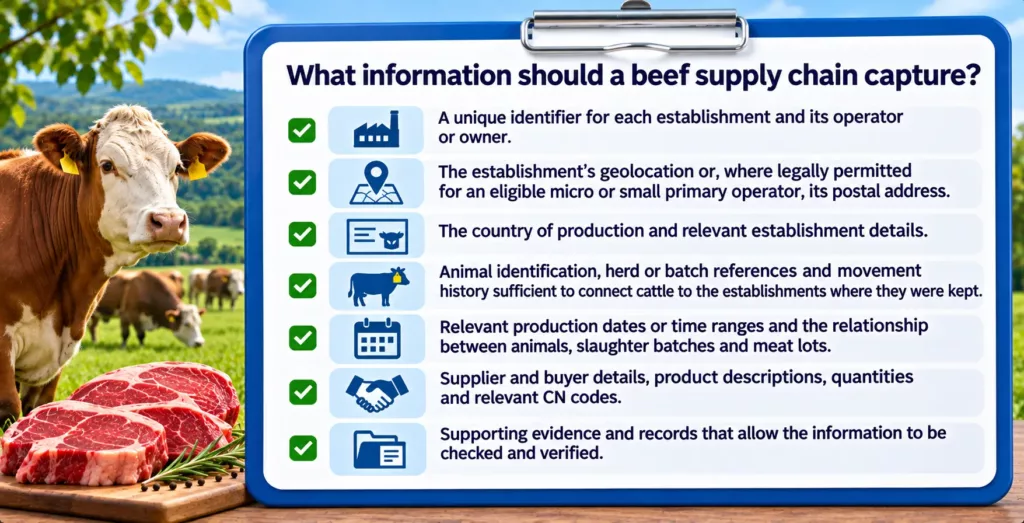
A practical EUDR traceability model should connect the animal’s production history to the product placed on the EU market. A typical information flow may look like this:
Ranch or breeding establishment: identify the establishment, its location, operator and relevant production records.
Rearing and fattening establishments: capture each additional location where the cattle were kept and retain movement records.
Livestock aggregation or trading: preserve animal or group identifiers and avoid losing the link to origin establishments.
Slaughterhouse: connect incoming animal identifiers to slaughter dates, carcass references and production lots.
Meat processing and packing: map carcasses or input lots to cuts, processed products, finished-goods batches and quantities.
Export and EU market placement: link the finished product, CN code, quantity, shipment and due diligence reference where applicable.
The level of detail and data model will vary by supply chain. The key outcome is that an operator can demonstrate which cattle and establishments are associated with a specific relevant product and quantity. Where inputs from different origins are mixed, the business needs controls that prevent products of unknown or non-compliant origin from being treated as compliant.
Risk assessment for beef and cattle products
EUDR risk assessment is broader than checking whether a point falls inside a forest layer. Article 10 requires operators to verify and analyse the Article 9 information and consider relevant risk factors. These include the country or sub-national risk classification, forest presence, deforestation prevalence, reliability of information, corruption and document-falsification risks, human-rights concerns, supply-chain complexity, mixing and circumvention risks.
A practical risk review should examine:
Geospatial risk: whether any cattle establishment is associated with land deforested after 31 December 2020.
Location and tenure risk: whether the supplier has credible rights to use the land and whether there are competing claims.
Legality risk: whether available records support compliance with relevant laws in the country of production.
Traceability risk: whether animal movements and establishment histories are complete and consistent.
Mixing risk: whether cattle or meat of unknown origin could enter the same herd, slaughter batch, processing lot or shipment.
Data integrity risk: whether coordinates, animal IDs, dates, quantities and documents are consistent, current and verifiable.
If the initial assessment identifies more than negligible risk, the operator must take adequate mitigation measures before placing the product on the market or exporting it. These may include requesting additional records, independent surveys or audits, and other measures that address the identified information gaps. If risk cannot be reduced to no or negligible, the product must not be placed on the market or exported.
What legality and traceability documents should beef businesses collect?
The EUDR does not prescribe one fixed document pack for every country. Businesses should develop a country- and supplier-specific evidence matrix. Depending on the applicable law and the supply-chain model, relevant records may include:
Ranch or farm registration and business identity records.
Land ownership, lease, concession or other lawful land-use documentation.
Cattle identification, herd registers and official animal movement records.
Veterinary, animal health, vaccination and disease-control records where relevant to the applicable legal framework.
Environmental licences, land-use approvals or other permits where required by local law.
Transport, slaughter, inspection and meat-processing records.
Tax, customs, labour and other legal-compliance records relevant to the production activity.
Supplier declarations, audit reports or certification information as supplementary evidence, where reliable and relevant.
Certification and third-party audits may support risk assessment, but they do not automatically replace the operator’s own EUDR due diligence. The operator must assess whether the evidence is relevant, reliable, current and sufficiently conclusive for the legal requirements.
Who is responsible for EUDR compliance in the beef supply chain?
Responsibilities depend on the company’s legal role and the transaction not simply whether it is called a rancher, slaughterhouse, processor, exporter, importer or distributor. The operator is generally the person placing a relevant product on the EU market for the first time or exporting it from the EU, subject to the Regulation’s definitions and specific provisions. The 2025 amendment introduced a more differentiated framework for downstream operators and traders.
Non-EU producers and exporters are not directly subject to EUDR obligations merely because they supply the EU. However, they may need to provide establishment geolocation, animal traceability and legality information to the EU operator so that it can complete its due diligence. Contractual data requirements may therefore extend upstream.
Before assigning responsibilities, map each entity’s role for each product flow and check the current Articles 4 and 5. Do not assume that every participant must submit a separate DDS or that every shipment automatically requires a new statement.
As of 18 November 2026, the European Commission states that EUDR obligations apply from 30 December 2026 for large and medium-sized operators and traders, and for micro and small operators already covered by the EU Timber Regulation. For most other micro and small operators, the application date is 30 June 2027. The exact date for a business depends on its legal classification and the applicable transitional provisions.
The cattle product entries relevant to beef should be checked against the current Annex I. The separate 30 December 2027 date applies to products newly added to the Annex by the 2026 delegated act; it should not be treated as a general extension for ordinary beef products.
A practical EUDR compliance checklist for beef exporters and buyers
Confirm the product’s exact CN code and whether it is listed in the current Annex I.
Determine the legal role of each company in the transaction and identify the responsible operator.
Map the full cattle supply chain, including all establishments where the cattle were kept.
Collect and validate establishment geolocation or an eligible postal-address alternative.
Connect animal identifiers and movement records to slaughter batches, processing lots and finished products.
Collect relevant legality evidence for the country and production model.
Screen establishment locations against appropriate forest and land-use information using the 31 December 2020 cut-off.
Assess country, supplier, geospatial, legality, traceability, mixing and circumvention risks.
Resolve data gaps and implement mitigation measures where required.
Maintain a due diligence system, decision records and supporting documents for the required retention period.
Submit the applicable DDS or simplified declaration through the EUDR Information System when legally required.
Review the process regularly and update it when new information or material changes arise.
How digital traceability software supports EUDR compliance for beef
Managing cattle establishment data, animal movements, slaughter records, processing batches and export documentation across spreadsheets and disconnected systems can create gaps in traceability. A digital platform can help businesses bring these records into a controlled workflow and make information easier to validate, retrieve and share.
A beef-focused EUDR workflow may use digital tools to:
Onboard suppliers, ranches, farms and other cattle establishments with structured profiles.
Capture establishment coordinates or eligible address information and validate location data.
Maintain animal, herd, movement and supplier references that connect production locations to downstream batches.
Screen establishment locations against forest-monitoring datasets and flag locations for review.
Collect and organise legality documents, supplier declarations and audit evidence.
Connect slaughter, processing, inventory and shipment records to support product-level traceability.
Generate audit-ready records and support the preparation of information required for due diligence workflows.
TraceX EUDR Solutions supports organisations with supplier onboarding, geospatial data management, satellite-based screening, traceability workflows and compliance evidence management. The platform can support EUDR readiness; it does not replace the operator’s legal assessment, guarantee a no-risk conclusion or transfer statutory responsibility.
Prepare your beef supply chain for EUDR compliance
EUDR compliance for beef depends on reliable cattle establishment data, defensible legality evidence and traceability that connects animals to the meat products and quantities entering the EU market. Businesses that start by mapping their supply chain, validating establishment information and closing data gaps will be better positioned to operate a repeatable due diligence process.
Looking to strengthen cattle traceability and EUDR readiness?
Connect with TraceX to explore supplier onboarding, establishment geolocation, satellite screening, legality evidence management and end-to-end batch traceability for your beef supply chain.
Yes. Certain cattle products listed in Annex I are covered, including specified live cattle, fresh or chilled cattle meat, frozen cattle meat, edible offal and prepared or preserved cattle meat. Always verify the exact CN code and product description.
What is the EUDR geolocation requirement for cattle?
For relevant products that contain or have been made using cattle, geolocation must refer to all establishments where the cattle were kept. This is different from the plot geolocation rule used for most other commodities.
Do beef exporters need ranch coordinates?
EU operators need the required geolocation information for all relevant cattle establishments. Non-EU exporters may be asked by their EU customers to provide this information so the responsible operator can complete due diligence.
Is the slaughterhouse location enough for EUDR?
No. The requirement refers to all establishments where the cattle were kept, not only the slaughterhouse, processor or exporter address.
Does EUDR require animal-level traceability?
The Regulation requires the information needed to trace cattle products to all relevant establishments and assess compliance. Animal identification and movement records are often important practical mechanisms for establishing that link; the precise system depends on the supply chain and applicable national rules.
Can a certification scheme replace EUDR due diligence?
No. Certification or third-party verification may provide complementary information, but the operator remains responsible for assessing the evidence and meeting EUDR requirements.
What happens if a cattle establishment is linked to deforestation after 31 December 2020?
Relevant cattle products associated with that establishment may fail the deforestation-free condition. The operator must investigate and cannot place or export non-compliant products. A geospatial alert should be assessed with reliable evidence before a final decision.
Do non-EU beef suppliers have direct EUDR obligations?
Not solely because they supply the EU. EUDR obligations generally attach to the relevant EU-market operator or exporter from the EU. Non-EU suppliers may nevertheless need to provide information and evidence required by their EU customers.
When does EUDR apply to beef?
The general application date is 30 December 2026 for large and medium operators and traders, and for micro or small operators already covered by the EUTR. Most other micro and small operators have until 30 June 2027, subject to the legal transitional provisions.
Does every beef shipment need a separate DDS?
Not automatically. The applicable statement and reference management depend on the operator’s role, product flow, quantities and the EUDR Information System rules. Businesses should not assume that each shipment always requires a new DDS.
Start using TraceX
Transparency, Trust, & Success for your Climate Journey.
We use cookies on our website to give you the most relevant experience by remembering your preferences and repeat visits. By clicking “Accept All”, you consent to the use of ALL the cookies. However, you may visit "Cookie Settings" to provide a controlled consent.
This website uses cookies to improve your experience while you navigate through the website. Out of these, the cookies that are categorized as necessary are stored on your browser as they are essential for the working of basic functionalities of the website. We also use third-party cookies that help us analyze and understand how you use this website. These cookies will be stored in your browser only with your consent. You also have the option to opt-out of these cookies. But opting out of some of these cookies may affect your browsing experience.
Necessary cookies are absolutely essential for the website to function properly. These cookies ensure basic functionalities and security features of the website, anonymously.
Cookie
Duration
Description
cookielawinfo-checkbox-analytics
11 months
This cookie is set by GDPR Cookie Consent plugin. The cookie is used to store the user consent for the cookies in the category "Analytics".
cookielawinfo-checkbox-functional
11 months
The cookie is set by GDPR cookie consent to record the user consent for the cookies in the category "Functional".
cookielawinfo-checkbox-necessary
11 months
This cookie is set by GDPR Cookie Consent plugin. The cookies is used to store the user consent for the cookies in the category "Necessary".
cookielawinfo-checkbox-others
11 months
This cookie is set by GDPR Cookie Consent plugin. The cookie is used to store the user consent for the cookies in the category "Other.
cookielawinfo-checkbox-performance
11 months
This cookie is set by GDPR Cookie Consent plugin. The cookie is used to store the user consent for the cookies in the category "Performance".
viewed_cookie_policy
11 months
The cookie is set by the GDPR Cookie Consent plugin and is used to store whether or not user has consented to the use of cookies. It does not store any personal data.
Functional cookies help to perform certain functionalities like sharing the content of the website on social media platforms, collect feedbacks, and other third-party features.
Performance cookies are used to understand and analyze the key performance indexes of the website which helps in delivering a better user experience for the visitors.
Analytical cookies are used to understand how visitors interact with the website. These cookies help provide information on metrics the number of visitors, bounce rate, traffic source, etc.
Advertisement cookies are used to provide visitors with relevant ads and marketing campaigns. These cookies track visitors across websites and collect information to provide customized ads.