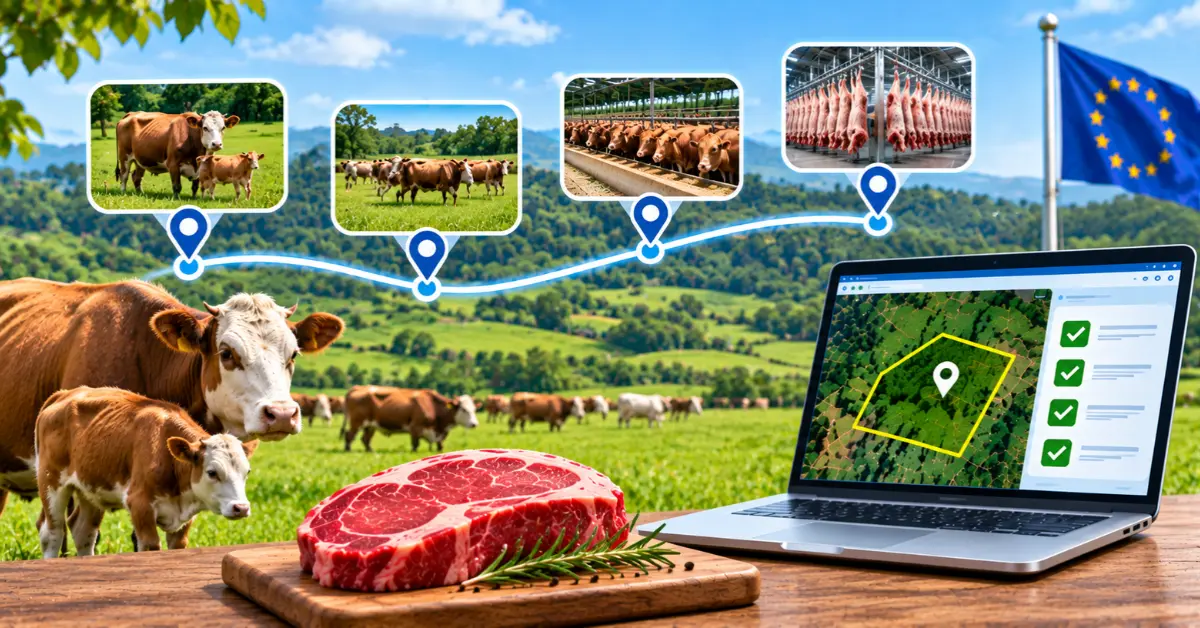
EUDR Cattle Geolocation: Why Mapping Only the Finishing Farm Is Not Enough
Published
, 13 minute read
Share this article
Quick summary: Learn what EUDR cattle geolocation requires. Understand why every establishment matters, how to capture coordinates and link cattle movements to beef batches.
A practical guide for beef exporters, slaughterhouses, meat processors and EU-facing suppliers
Key Takeaways
Capture every relevant establishment: Identify all locations where cattle were kept, including breeding farms, rearing facilities, grazing locations and feedlots, from birth to slaughter.
Do not rely only on the finishing farm: Recording only the final farm can leave gaps in the cattle’s production history and make it difficult to establish the required origin information.
Use establishment-level coordinates: A single geolocation point can identify each cattle establishment. This is different from the plot polygon requirements applicable to certain other EUDR commodities.
Maintain animal movement records: Connect cattle identification details with their movement history so that each animal or group can be linked to the establishments where it was kept.
Connect upstream data to downstream products: Link establishment records to slaughter events, carcass references, processing batches and finished beef products.
Validate supplier information: Check that coordinates or eligible postal addresses identify the actual cattle establishments, rather than a supplier’s head office, collection centre or slaughterhouse.
Address missing location data early: Incomplete establishment histories can create due diligence gaps. Beef exporters and processors should establish clear data-sharing processes with ranchers, livestock aggregators and feedlots.
Use digital traceability to maintain visibility: A centralised platform can help manage establishment profiles, geolocation, supplier records and cattle-to-product traceability across multiple supply-chain participants.
Download our eBook
Assess your EUDR readiness, uncover data gaps, and take proactive steps towards stronger compliance.
For relevant products that contain or have been made using cattle, the EUDR requires the geolocation of all establishments where the cattle were kept. This means a beef supply chain may need to identify several locations associated with an animal’s rearing history not only the final feedlot, finishing farm or slaughterhouse. The European Commission’s guidance explains that cattle establishments can be represented by a single geolocation point. Eligible micro or small primary operators may use the postal address of the relevant establishments instead of geolocation, subject to the applicable conditions.
The practical challenge is linking those establishment locations to the cattle, their movement history and the meat products made from them. If a packer knows only the finishing farm, it may not have enough information to establish the full location history required for due diligence.
Why cattle geolocation is different under EUDR
The EU Deforestation Regulation (EUDR), Regulation (EU) 2023/1115, covers cattle and certain products derived from cattle listed in Annex I. Before relevant products are placed on the EU market or exported from the EU, the responsible operator must carry out due diligence to establish that the products are deforestation-free, legally produced and covered by the required due diligence statement or applicable simplified declaration.
For most relevant commodities, geolocation is tied to the plots of land where the commodity was produced. Cattle follow a different rule. Article 9 requires geolocation to refer to all establishments where the cattle were kept. This reflects the way cattle production works: animals can move between breeding farms, rearing premises, grazing locations, feedlots and finishing farms before slaughter.
The Regulation defines an establishment broadly. It can be premises or a structure, or, in open-air farming, an environment or place where livestock are kept temporarily or permanently. The location record therefore needs to reflect the places where the animals were actually kept, not simply the address of the company that sold them.
Which cattle establishments need to be identified?
The relevant locations depend on the animal’s actual production and movement history. A typical beef animal may pass through several establishments:
Birth or breeding establishment: the premises where the calf was born or initially kept.
Calf-rearing establishment: a farm or facility where the young animal was kept after birth.
Growing or backgrounding farm: a location where the animal was raised before finishing.
Grazing or open-air holding location: a place where cattle were kept, including temporary locations where relevant.
Feedlot or finishing establishment: the premises where cattle were kept before slaughter.
This is an illustrative supply-chain sequence, not a fixed list that applies identically to every animal. Businesses should identify all establishments relevant to the cattle covered by the product and use reliable animal identification and movement records to establish that history.
A slaughterhouse is an important traceability point, but it is not a substitute for the earlier establishments where the animal was kept. Likewise, an exporter’s registered office or a livestock trader’s business address does not establish where the cattle were raised.
Why mapping only the finishing farm creates a compliance gap
A common data gap arises when a meat processor receives cattle from a feedlot or finishing farm and records only that supplier’s location. The animal may have spent earlier stages of its life on other farms or ranches. If those locations are not captured, the operator may be unable to provide the complete establishment geolocation information required by Article 9.
This can affect more than the initial data submission. Missing locations can make it harder to:
Verify the cattle’s full production geography and assess deforestation risk.
Connect animal movement records with the correct establishment coordinates.
Resolve inconsistencies between supplier declarations, animal identification records and slaughter data.
Respond to buyer due-diligence questionnaires or requests from competent authorities.
Demonstrate that the product’s origin information is complete and adequately supported.
A supplier declaration that names only the last farm may therefore be insufficient where the cattle were kept at additional establishments. Buyers and operators should establish the required data fields and evidence trail before animals enter the slaughter and processing chain.
Does EUDR require a polygon or a single coordinate for cattle establishments?
Cattle geolocation should not be confused with the plot-mapping rules for commodities such as coffee, cocoa, rubber, soy, oil palm and wood. The European Commission’s EUDR FAQ explains that an establishment where cattle are kept can be described using a single geolocation coordinate point. The cattle-specific rule is establishment-based; the requirement is not to draw a polygon around every ranch or feedlot simply because cattle are present there.
A coordinate point must identify the establishment concerned. Businesses should capture the point accurately, use a consistent coordinate reference convention, retain the source of the coordinate and validate that it corresponds to the actual place where the cattle were kept. A point that represents a head office, collection centre or slaughterhouse rather than the relevant cattle establishment does not solve the requirement.
There is also a specific flexibility for eligible micro or small primary operators. Under the amended EUDR framework, qualifying operators may use the postal address of the establishment instead of geolocation, subject to the legal conditions and the address clearly identifying the relevant establishment. This is not a general alternative available to every company in the supply chain.
Practical takeaway: for cattle, focus on complete establishment coverage and accurate identification of each location. Do not apply the more-than-four-hectare polygon rule used for certain other commodities to cattle establishments.
How to connect establishment coordinates to cattle and beef batches
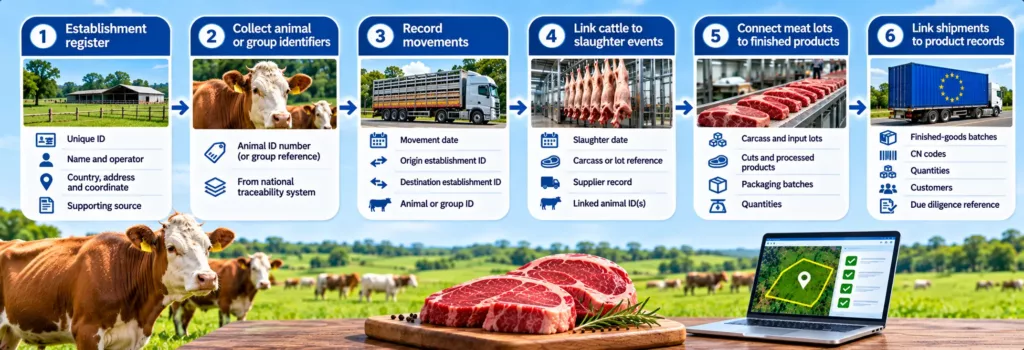
Collecting coordinates is only one part of the task. The business must be able to show which cattle were kept at which establishments and how those animals relate to the meat products being placed on the market or exported. This requires a consistent connection between supplier records, animal identification, movement events, slaughter records and processing batches.
The data model will vary depending on the country’s animal identification system and the operator’s supply chain. The objective is consistent: a business should be able to trace a relevant product back to the establishments where the cattle were kept and retrieve the evidence supporting that link.
Example: tracing one animal through multiple establishments
Consider an animal that is born on Ranch A, moved to Rearing Farm B, transferred to Feedlot C and then sent to Slaughterhouse D. The packer receives the carcass and produces boxed beef for export to the EU.
A finishing-farm-only record would capture Feedlot C but omit Ranch A and Rearing Farm B. A more complete record would preserve the animal’s movement history and identify the locations of Ranch A, Rearing Farm B and Feedlot C as establishments where the animal was kept. The slaughterhouse record then connects the animal to the carcass and the resulting meat batch.
The example illustrates why the data collection process must start upstream. The slaughterhouse or packer may not be able to reconstruct the animal’s full history after the cattle have entered the processing chain unless the information has been collected and retained by suppliers and livestock intermediaries.
Who should provide cattle establishment data?
EUDR obligations attach according to the legal role of the company and the relevant product flow. The operator responsible for placing a relevant product on the EU market or exporting it from the EU must ensure that the required information is available and that due diligence is performed. A non-EU rancher or exporter is not automatically the EUDR operator simply because it supplies cattle or beef to an EU customer.
In practice, however, the EU-facing operator may need information from every upstream participant. Responsibilities should be agreed contractually and operationally:
Ranchers and cattle producers: provide accurate establishment details and available animal identification or movement records.
Livestock aggregators and traders: preserve the link between animals, origin suppliers and each establishment in the movement chain.
Feedlots and finishing farms: record cattle received, source establishments and onward movements.
Slaughterhouses: connect incoming cattle identifiers and supplier records to slaughter events and carcass or lot IDs.
Meat processors and exporters: maintain links from slaughter and processing lots to finished products, quantities and shipment records.
EU operators and responsible compliance teams: verify the information, complete the risk assessment and submit the required statement or declaration where applicable.
This allocation is a practical operating model, not a substitute for determining each entity’s legal status under the current EUDR provisions.
Identify every establishment where the cattle covered by the relevant product were kept.
Create a unique ID for each establishment and record its operator, country and address.
Capture a single geolocation point for each establishment where geolocation is required.
Check whether a qualifying micro or small primary operator can use the permitted postal-address alternative.
Validate that each coordinate or address identifies the actual cattle establishment.
Collect animal identification and movement records that connect cattle to each establishment.
Link animal records to slaughter events, carcass references and processing batches.
Maintain records of data sources, supplier confirmations, corrections and validation checks.
Identify missing or inconsistent locations and resolve them before the due diligence process is completed.
Connect the resulting product batches and quantities to the relevant EUDR due diligence workflow.
How digital traceability software can close cattle geolocation gaps
When establishment data is collected through emails, spreadsheets and disconnected livestock systems, it can be difficult to maintain a reliable history as cattle move between suppliers and facilities. A digital traceability workflow can help standardise establishment records and connect location information to animal, slaughter and product-batch data.
A digital platform can support the process by:
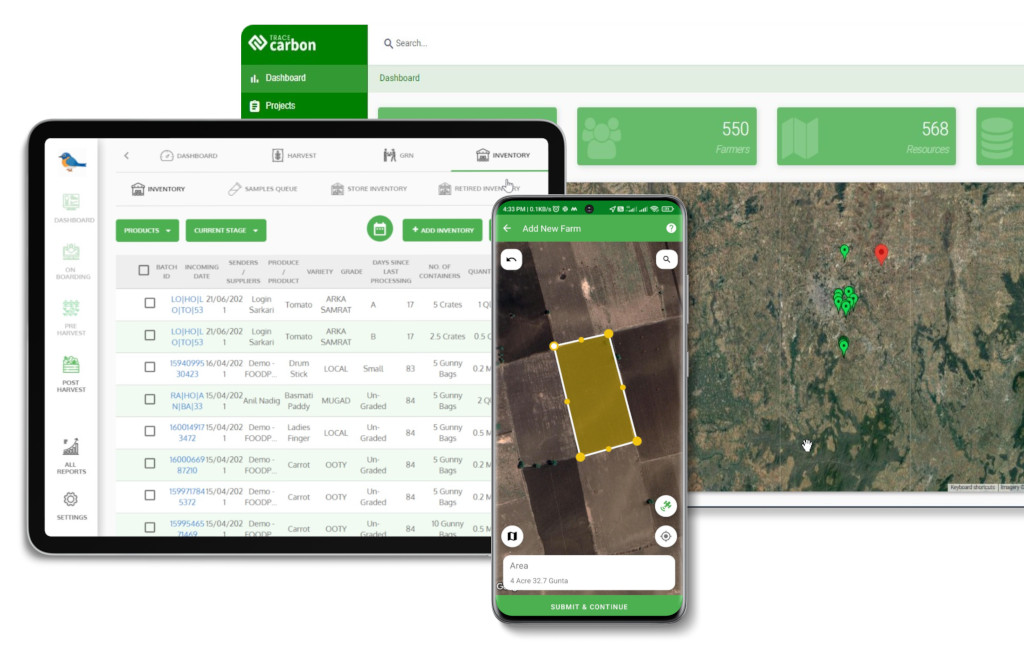
Creating structured profiles for ranches, farms, feedlots and other cattle establishments.
Capturing coordinates or eligible postal-address information and validating required fields.
Maintaining supplier and establishment relationships across multiple tiers.
Recording or importing animal movement and batch references from connected systems.
Linking cattle intake and slaughter records to downstream processing and shipment batches.
Flagging missing establishment details and inconsistent records for follow-up.
Organising supporting documents and maintaining an auditable history of updates.
TraceX EUDR Solutions supports supplier onboarding, geospatial data management, satellite-based screening, traceability workflows and compliance evidence management. For beef supply chains, these capabilities can help organisations structure establishment information and connect upstream data with downstream product records. TraceX supports EUDR readiness; it does not replace the operator’s legal assessment or guarantee a compliance outcome.
Want to strengthen cattle establishment mapping and beef traceability?
Connect with TraceX to explore supplier onboarding, geospatial data validation, satellite screening and end-to-end traceability workflows for your beef supply chain.
Close the cattle geolocation gap before your next EU shipment
For beef supply chains, EUDR geolocation is not simply about pinning the final farm on a map. It is about identifying all relevant establishments where cattle were kept and maintaining a traceable connection between those locations, animal movements, slaughter records and finished meat products.
If your current supplier data captures only the finishing farm, start by mapping the upstream establishments and agreeing how each supplier will provide location and movement information. A structured process can help reduce last-minute data gaps and make due diligence easier to evidence.
Frequently asked questions
Does EUDR require geolocation for every farm where cattle were kept?
For relevant cattle products, Article 9 requires geolocation to refer to all establishments where the cattle were kept. The relevant locations depend on the animals’ actual production and movement history.
Is one coordinate enough for each cattle establishment?
The European Commission’s FAQ explains that an establishment where cattle are kept can be described using a single geolocation coordinate point. The point must identify the relevant establishment.
Do beef exporters need to map the birthplace of cattle?
The Commission’s guidance describes cattle geolocation as covering premises or structures associated with raising the cattle, including the birthplace and farms where they were kept up to slaughter. Exporters should collect the establishment history needed to meet Article 9.
Is the finishing farm sufficient for EUDR?
Not where cattle were also kept at other establishments. The geolocation requirement refers to all relevant establishments, not only the final feedlot or finishing farm.
Do cattle establishments need polygons?
The cattle-specific geolocation requirement is establishment-based. Commission FAQ guidance states that an establishment can be represented by a single point. Do not confuse this with the polygon rules for plots used to produce other relevant commodities.
Can an address be used instead of coordinates?
Eligible micro or small primary operators may use the postal address of the relevant establishment instead of geolocation, subject to the amended Regulation and applicable conditions. This is not a general exemption for all supply-chain participants.
Does the slaughterhouse coordinate satisfy cattle geolocation?
No. The slaughterhouse is not a substitute for the other establishments where the cattle were kept before slaughter.
Who is responsible for collecting the information?
The legal operator must ensure that the required information is available for due diligence. In practice, ranchers, livestock traders, feedlots, slaughterhouses and processors may all need to contribute records. The precise legal duties depend on each entity’s role.
What if the cattle movement history is incomplete?
The operator should treat missing establishment information as a due-diligence data gap, request reliable supporting records and assess whether the required information and risk conclusions can be established. Do not assume that an unknown location can be ignored.
Start using TraceX
Transparency, Trust, & Success for your Climate Journey.
We use cookies on our website to give you the most relevant experience by remembering your preferences and repeat visits. By clicking “Accept All”, you consent to the use of ALL the cookies. However, you may visit "Cookie Settings" to provide a controlled consent.
This website uses cookies to improve your experience while you navigate through the website. Out of these, the cookies that are categorized as necessary are stored on your browser as they are essential for the working of basic functionalities of the website. We also use third-party cookies that help us analyze and understand how you use this website. These cookies will be stored in your browser only with your consent. You also have the option to opt-out of these cookies. But opting out of some of these cookies may affect your browsing experience.
Necessary cookies are absolutely essential for the website to function properly. These cookies ensure basic functionalities and security features of the website, anonymously.
Cookie
Duration
Description
cookielawinfo-checkbox-analytics
11 months
This cookie is set by GDPR Cookie Consent plugin. The cookie is used to store the user consent for the cookies in the category "Analytics".
cookielawinfo-checkbox-functional
11 months
The cookie is set by GDPR cookie consent to record the user consent for the cookies in the category "Functional".
cookielawinfo-checkbox-necessary
11 months
This cookie is set by GDPR Cookie Consent plugin. The cookies is used to store the user consent for the cookies in the category "Necessary".
cookielawinfo-checkbox-others
11 months
This cookie is set by GDPR Cookie Consent plugin. The cookie is used to store the user consent for the cookies in the category "Other.
cookielawinfo-checkbox-performance
11 months
This cookie is set by GDPR Cookie Consent plugin. The cookie is used to store the user consent for the cookies in the category "Performance".
viewed_cookie_policy
11 months
The cookie is set by the GDPR Cookie Consent plugin and is used to store whether or not user has consented to the use of cookies. It does not store any personal data.
Functional cookies help to perform certain functionalities like sharing the content of the website on social media platforms, collect feedbacks, and other third-party features.
Performance cookies are used to understand and analyze the key performance indexes of the website which helps in delivering a better user experience for the visitors.
Analytical cookies are used to understand how visitors interact with the website. These cookies help provide information on metrics the number of visitors, bounce rate, traffic source, etc.
Advertisement cookies are used to provide visitors with relevant ads and marketing campaigns. These cookies track visitors across websites and collect information to provide customized ads.