Quick summary: Discover how sustainable procurement practices, powered by the TraceX EUDR compliance platform, can help your business meet EUDR requirements and drive a responsible, deforestation-free future.
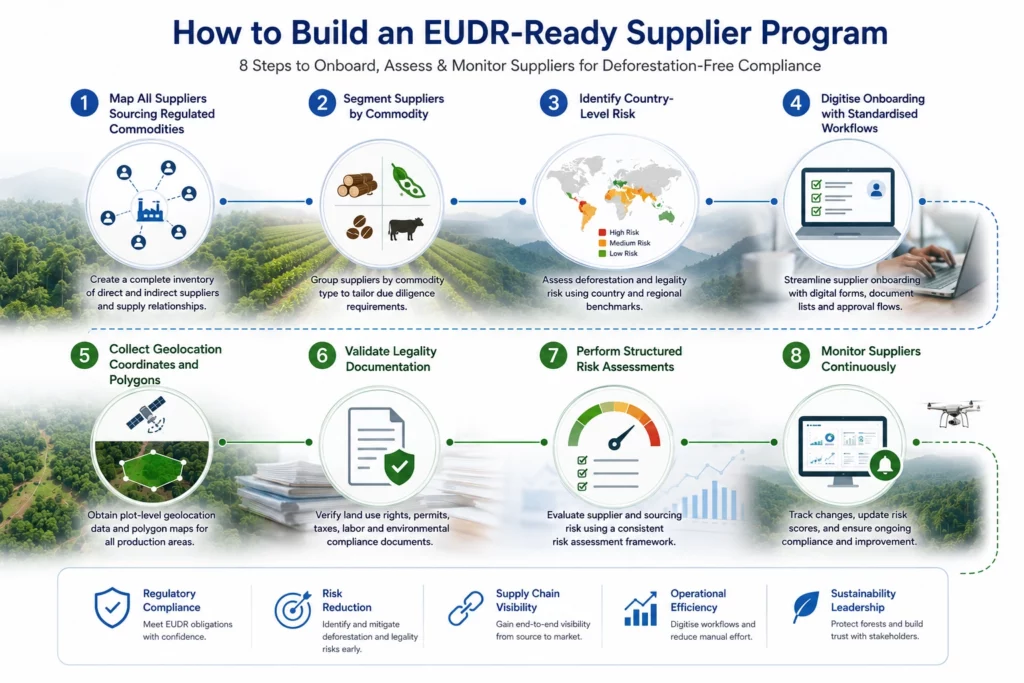
EUDR procurement is the practice of qualifying, onboarding, and monitoring suppliers so that every commodity entering the EU market meets the EU Deforestation Regulation. Under EUDR, procurement teams must collect geolocation coordinates, legality evidence, and traceability records not just commercial documents before goods can be placed on the market.
When does EUDR apply?
Under Regulation (EU) 2025/2650, obligations apply from 30 December 2026 for large and medium operators (and micro/small operators in the timber sector), and from 30 June 2027 for micro and small operators outside timber. The 4 May 2026 simplification package confirmed there will be no further postponement.
EUDR procurement is no longer a routine sourcing function it is now the frontline of deforestation compliance. For procurement teams, the EU Deforestation Regulation fundamentally changes how suppliers are qualified, monitored, and managed. In plain terms, EUDR procurement is the discipline of gathering and verifying deforestation-free evidence from every supplier before a regulated commodity is placed on the EU market.
Every supplier providing timber, coffee, cocoa, rubber, soy, palm oil, or cattle-derived products must now provide far more than commercial documents. Teams must collect geolocation coordinates, legality evidence, traceability records, and supplier declarations and keep them audit-ready for five years. Without structured supplier onboarding and digital traceability, procurement quickly becomes the biggest bottleneck in EUDR compliance.
Key takeaways
EUDR procurement turns supplier onboarding into a continuous, evidence-based process commercial documents alone no longer qualify a supplier.
Procurement teams must collect geolocation data, legality documentation, and farm/forest-level traceability before products reach the EU market.
Manual onboarding fails at scale spreadsheets break across hundreds or thousands of suppliers and leave no audit trail.
Certifications such as RSPO and FSC support risk mitigation but do not replace due diligence statements, geolocation, or plot-level evidence.
Digitising procurement now ahead of the 30 December 2026 deadline reduces compliance risk and protects uninterrupted EU market access.
December 2026 is approaching. Is your supply chain actually ready?
Move from spreadsheets and fragmented supplier data to a traceable, audit-ready EUDR workflow with TraceX.
Procurement sits at the exact point where compliance data enters the organisation. Everything the due diligence statement depends on originates with the supplier which makes the procurement function central to EUDR compliance success. Key responsibilities now include:
Acting as the first line of supplier engagement and qualification
Collecting supplier information, geolocation, and legality evidence at source
Coordinating with sustainability and legal teams on risk
Supporting compliance teams with verified, audit-ready records
Reducing sourcing risk before it becomes a shipment delay
EUDR Supplier Management vs Traditional Sourcing
Legacy sourcing was built around price, quality, and an annual review. EUDR demands continuous, evidence-based supplier management instead. The shift looks like this:
Traditional Sourcing
EUDR Sourcing
Commercial documents only
Commercial + compliance documents
Price & quality
Price + risk + legality + traceability
Annual supplier review
Continuous monitoring
Manual onboarding
Digital onboarding
Unverified supplier declarations
Verified evidence
ERP-driven
Supply chain intelligence
EUDR Supplier Onboarding Checklist
Effective EUDR supplier onboarding starts with a standardised sequence. Every supplier should provide, in order:
Company information
Products supplied
Commodity classification
Country of origin
Production region
Geolocation coordinates
Farm / forest polygons
Legality documentation
Harvest information
Supply chain mapping
Risk declaration
Supporting certificates
Due diligence statement (DDS) references
Certifications such as RSPO or FSC belong in the “supporting certificates” step they strengthen a risk case but never substitute for geolocation, legality evidence, or the DDS itself.
Your due diligence is only as strong as the data your suppliers provide. Learn how to streamline supplier onboarding, collect critical compliance information, and build a resilient, audit-ready supply chain.
Challenge 1 — Suppliers Don’t Know What EUDR Requires
Most suppliers have never collected GPS coordinates, polygon files, farm boundaries, or land-ownership evidence. The result is months of back-and-forth communication before a single supplier is fully qualified.
Challenge 2 — Supplier Data Arrives in Every Format
Evidence lands as Excel files, PDFs, WhatsApp messages, emails, shared drives, and even paper documents. Procurement is then forced to normalise everything by hand before it can be used in a due diligence statement.
Challenge 3 — Thousands of Suppliers
A single buyer may manage 500, 1,000, or 5,000+ suppliers across coffee, palm, timber, rubber, and cocoa. Manual onboarding simply does not scale to that volume without breaking.
See How a Global Tire Manufacturer Scaled EUDR Geolocation Compliance
Discover how large-scale polygon mapping, supplier collaboration, and digital traceability helped a leading tire manufacturer prepare its natural rubber supply chain for EUDR.
A supplier hands over an invoice but where did the raw material originate? Who owned the farm? Which forest, which plot? Tier-1 visibility is not enough to satisfy EUDR traceability obligations.
Challenge 5 — Constant Supplier Changes
New farms, new traders, new exporters, different harvests, and new sourcing regions all change the compliance picture. Every change ripples into the due diligence record, so due diligence must be continuous rather than one-off.
Hidden Risks in EUDR Due Diligence
These are the failure modes that quietly invalidate a due diligence statement or trigger an audit finding:
Incorrect supplier GPS → the DDS becomes invalid and the shipment is delayed.
A farm polygon overlaps deforested land → the entire shipment is flagged.
A missing legality document → the DDS cannot be completed.
Inconsistent commodity codes across suppliers → submission errors.
A reused, outdated supplier declaration → direct compliance risk.
No proof of supplier verification → audit findings.
Why EUDR Procurement Needs Digital Traceability
Spreadsheets were never designed for regulated supply chain evidence, and they fail EUDR compliance in predictable ways:
No version control and duplicate supplier records
Missing documents with no audit trail
No automated reminders for expiring evidence
No supplier portals for direct data submission
No way to visualise traceability from product back to plot
Difficult collaboration across procurement, legal, sustainability, and compliance
Digital traceability replaces this patchwork with a single, audit-ready system of record the foundation every mature EUDR program eventually needs.
Empower suppliers to securely upload geolocation data, legality documents, certifications, and compliance evidence through a centralized self-service portal, reducing manual follow-ups.
Automated Supplier Onboarding
Digitize supplier onboarding with standardized workflows, automated validations, and configurable approval processes to accelerate compliance readiness.
Geolocation Management
Capture, validate, and manage GPS coordinates and polygon data at scale, ensuring accurate sourcing information for EUDR due diligence.
Risk Assessment
Automatically assess supplier and sourcing risks using configurable criteria, helping prioritize due diligence and focus on high-risk suppliers.
End-to-End Traceability
Connect suppliers, commodities, sourcing locations, and products to establish complete traceability across the value chain and support audit-ready compliance.
Centralized Document Repository
Maintain a single source of truth for legality documents, supplier declarations, certifications, Due Diligence Statements (DDS), and supporting evidence with complete version control.
AI-Powered Compliance Monitoring
Proactively identify missing documentation, high-risk suppliers, expiring certificates, traceability gaps, and incomplete supplier profiles before they impact compliance or audits.
See how TraceX digitises supplier onboarding, automates risk assessment, and builds audit-ready traceability.
Use this buyer self-assessment to gauge how prepared your EUDR procurement is today:
Do you know every supplier sourcing EUDR commodities?
Can every supplier provide geolocation data?
Is supplier onboarding standardised?
Can you identify sourcing regions by commodity?
Are legality documents centrally stored?
Can you trace products back to farm or forest?
Are supplier risks reviewed regularly?
Can you generate audit-ready records on demand?
Score your readiness
0–3: High risk — significant gaps across onboarding and traceability.
4–6: Progressing, but meaningful gaps remain before the deadline.
7–8: Strong foundation — automation will improve resilience and audit-readiness.
Frequently Asked Questions (FAQ’s)
What is EUDR procurement?
It is the process of qualifying, onboarding, and monitoring suppliers so that every regulated commodity meets the EU Deforestation Regulation including geolocation, legality, and traceability evidence before it enters the EU market.
Which commodities does EUDR cover?
The seven regulated commodities are cattle, cocoa, coffee, palm oil, rubber, soy, and wood, plus a wide range of derived products.
When do EUDR obligations start?
Under Regulation (EU) 2025/2650, obligations apply from 30 December 2026 for large and medium operators (and micro/small timber operators), and from 30 June 2027 for micro and small operators outside the timber sector. [Verify at publication.]
What data must suppliers provide under EUDR?
Suppliers must provide geolocation coordinates, farm or forest polygons, legality documentation, harvest information, commodity classification, and supporting declarations.
Do RSPO or FSC certifications satisfy EUDR?
No. Certifications such as RSPO and FSC support a risk-mitigation case but do not replace due diligence statements, geolocation data, or plot-level legality evidence.
Why do spreadsheets fail for EUDR procurement?
Spreadsheets lack version control, audit trails, automated reminders, supplier portals, and traceability visualisation, and they collapse across hundreds or thousands of suppliers.
How does EUDR software help?
EUDR software digitises supplier onboarding, validates geolocation, automates risk scoring, centralises documents, and monitors compliance continuously so teams stay audit-ready.
Start using TraceX
Transparency, Trust, & Success for your Climate Journey.
We use cookies on our website to give you the most relevant experience by remembering your preferences and repeat visits. By clicking “Accept All”, you consent to the use of ALL the cookies. However, you may visit "Cookie Settings" to provide a controlled consent.
This website uses cookies to improve your experience while you navigate through the website. Out of these, the cookies that are categorized as necessary are stored on your browser as they are essential for the working of basic functionalities of the website. We also use third-party cookies that help us analyze and understand how you use this website. These cookies will be stored in your browser only with your consent. You also have the option to opt-out of these cookies. But opting out of some of these cookies may affect your browsing experience.
Necessary cookies are absolutely essential for the website to function properly. These cookies ensure basic functionalities and security features of the website, anonymously.
Cookie
Duration
Description
cookielawinfo-checkbox-analytics
11 months
This cookie is set by GDPR Cookie Consent plugin. The cookie is used to store the user consent for the cookies in the category "Analytics".
cookielawinfo-checkbox-functional
11 months
The cookie is set by GDPR cookie consent to record the user consent for the cookies in the category "Functional".
cookielawinfo-checkbox-necessary
11 months
This cookie is set by GDPR Cookie Consent plugin. The cookies is used to store the user consent for the cookies in the category "Necessary".
cookielawinfo-checkbox-others
11 months
This cookie is set by GDPR Cookie Consent plugin. The cookie is used to store the user consent for the cookies in the category "Other.
cookielawinfo-checkbox-performance
11 months
This cookie is set by GDPR Cookie Consent plugin. The cookie is used to store the user consent for the cookies in the category "Performance".
viewed_cookie_policy
11 months
The cookie is set by the GDPR Cookie Consent plugin and is used to store whether or not user has consented to the use of cookies. It does not store any personal data.
Functional cookies help to perform certain functionalities like sharing the content of the website on social media platforms, collect feedbacks, and other third-party features.
Performance cookies are used to understand and analyze the key performance indexes of the website which helps in delivering a better user experience for the visitors.
Analytical cookies are used to understand how visitors interact with the website. These cookies help provide information on metrics the number of visitors, bounce rate, traffic source, etc.
Advertisement cookies are used to provide visitors with relevant ads and marketing campaigns. These cookies track visitors across websites and collect information to provide customized ads.
Download the 2026 Traceability Scorecard and Benchmark Your Supply Chain Across 10 Critical Capabilities.
Download our eBook
Don’t Wait for an Audit to Find Your EUDR Gaps
The 2026 Simplification Package changes how HS codes, DDS pass-through and geolocation rules apply to you. Get the free guide and 20-point readiness checklist before enforcement catches you unprepared.