Battery Passport for Industrial Battery Manufacturers: Your 18 February 2027 Readiness Guide
Published
, 7 minute read
Share this article
Quick summary: Battery passport for industrial battery manufacturers: what Article 77 requires by 18 Feb 2027, which data you need, and how to prepare without spreadsheets.
Battery passport for industrial battery manufacturers refers to the digital record that Article 77 of the EU Batteries Regulation (EU) 2023/1542 requires for every industrial battery with a capacity above 2 kWh placed on the EU market from 18 February 2027. It is reached through a QR code on the battery and holds identity, composition, compliance, circularity and performance data. The economic operator placing the battery on the market is responsible for it.
Key takeaways
The date is fixed. 18 February 2027 applies to industrial batteries above 2 kWh. The due diligence postponement to 18 August 2027 did not move it.
You own it. The operator placing the battery on the market answers for the passport, even if a third party runs it.
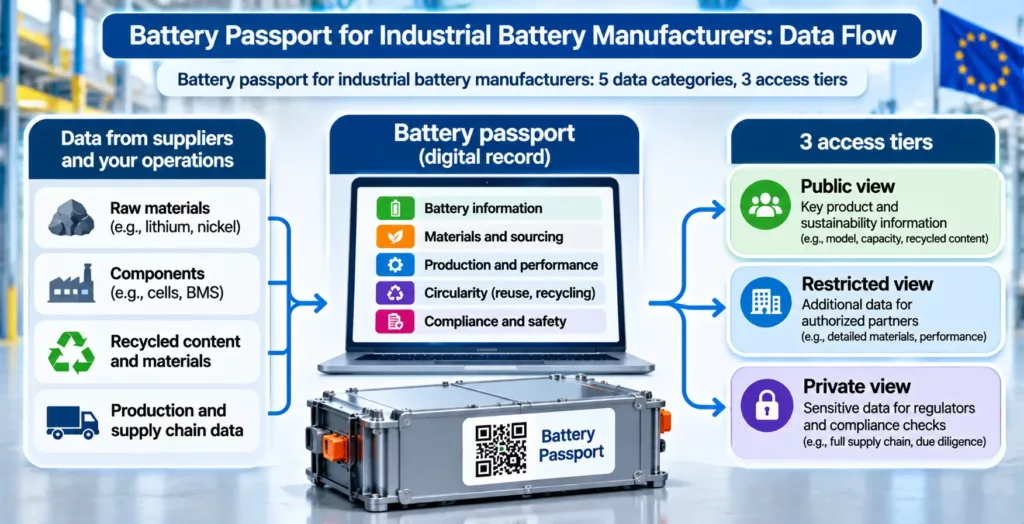
Data is tiered. Some fields are public; others are restricted to authorities and people with a legitimate interest.
It is a live record. Performance data such as state of health must stay current, and second-life batteries need a new, linked passport.
Spreadsheets will break. Unique IDs, access control and lifecycle updates at volume need a dedicated platform.
If you build stationary energy storage systems, material-handling traction batteries, or large UPS and telecom backup packs, roughly 15 weeks separate you from the deadline. After that, any in-scope unit without a passport cannot legally be placed on the EU market. This guide covers what the battery passport for industrial battery manufacturers requires, what data you need to collect, and how to judge whether your current setup will hold.
Download our eBook
Explore the key steps, challenges and considerations for building a reliable Battery Passport strategy.
Battery Passport for Industrial Battery Manufacturers: Scope and Ownership
Before collecting any data, confirm which products are in scope and who carries the legal duty.
Which industrial batteries need a passport
Who is responsible for issuing and maintaining it
Battery passport scope for industrial batteries
For the battery passport for industrial battery manufacturers, the trigger is capacity, not chemistry. Article 77(1) covers every industrial battery with a capacity greater than 2 kWh, alongside EV and LMT batteries. Industrial batteries at or below 2 kWh fall outside the passport requirement on that basis alone. Country of manufacture does not matter: imported batteries face the same rule as those built in the EU.
Battery passport responsibility: who issues it
The obligation sits with the economic operator that places the battery on the market or puts it into service. For most readers that means you, the manufacturer; for imported packs it can be the importer. That operator may authorise another company in writing to manage the passport, but must still make sure the information is accurate, complete and up to date. For a battery passport for industrial battery manufacturers who rely on cell suppliers and integrators, this means upstream data quality becomes your compliance risk.
A battery without a passport after 18 February 2027 is not a poorly documented product. It is a non-compliant one, open to withdrawal or recall by market surveillance authorities.
Understand which battery categories are in scope, who must comply and the key applicability timelines.
Battery Passport Data Requirements for Industrial Batteries
The passport is a structured data set defined in Annex XIII, split by audience and updated over the battery’s life.
Five data categories
Three access tiers
Lifecycle updates and second life
Battery passport data categories
General information: manufacturer, model, unique identifier, place and date of manufacture, weight, capacity and chemistry.
Compliance: EU declaration of conformity, carbon footprint information where it applies, and the due diligence report.
Materials and composition: hazardous substances, critical raw materials and recycled content.
Circularity and safety: dismantling, removal and safety guidance for repair and end-of-life operators.
Performance and durability: rated capacity, expected lifetime and state of health.
In August 2026 the European Commission published guidance listing data points by battery category, showing which are mandatory, optional, or not yet required as of February 2027. Any battery passport for industrial battery manufacturers should map to that document, not to a generic template.
Explore the key data requirements, from battery composition and carbon footprint to supply chain due diligence, performance and sustainability information.
Article 77(2) separates information for the general public from information for people with a legitimate interest and the Commission, and information reserved for notified bodies and market surveillance authorities. The implementing act defining “legitimate interest” was due by 18 August 2026 and had not been adopted at the time of writing. Choose a system where access rules are configurable, so you can adjust when the act is published.
Battery passport updates through the lifecycle
Stationary storage lives for years, and the passport must follow it. Dynamic values such as state of health need to stay current. When a battery is repurposed or remanufactured, responsibility passes to the operator placing it back on the market, who issues a new passport linked to the original. The passport ends once the battery has been recycled.
Battery Passport Deadlines Industrial Manufacturers Must Track
Four dates shape your plan, and only one of them is the passport itself.
Date
What happens
20 July 2026
EU Digital Product Passport registry opened; passport unique identifiers are registered there
18 August 2026
Deadline for the Commission act on legitimate-interest access; not yet adopted
Battery due diligence obligations apply after postponement by Regulation (EU) 2025/1561
Industry associations have asked lawmakers for a phased passport rollout through the ongoing Omnibus negotiations. As of November 2026, Article 77 is unchanged and carries no conditional extension clause, so plan the battery passport for industrial battery manufacturers on a February 2027 timeline.
Battery Passport Software vs Spreadsheets: Manual vs Platform
Many teams start in Excel. Here is where that approach stops working.
Requirement
Spreadsheets and email
Battery passport platform
Unique ID and QR per battery
Manual, error-prone at volume
Generated and linked automatically
Supplier composition data
Chased by email, hard to verify
Collected through supplier portals with evidence
Access tiers
Not enforceable
Role-based public and restricted views
State-of-health updates
Static snapshot
Updated through integrations
Second-life passports
No linkage
New passport linked to the original
Audit trail
Version chaos
Timestamped change history
The regulation also requires passport data to rest on open, interoperable standards. That rules out two shortcuts in a battery passport for industrial battery manufacturers: a record frozen at the factory gate, and one locked inside a single vendor.
Battery Passport Readiness with the TraceX DPP Platform
How TraceX helps
Getting a battery passport for industrial battery manufacturers live is a data-collection problem before it is a software problem. The TraceX Battery DPP platform collects multi-tier supplier and material data, maps it to your bill of materials, generates unique identifiers and QR codes, and publishes tiered public and restricted passport views.
TraceX is GDPR, ISO 27001 and SOC 1 and 2 compliant and works with a European law firm on regulatory interpretation.
Battery Passport Evaluation Checklist for Industrial Manufacturers
Use these questions to assess any battery passport for industrial battery manufacturers, including TraceX.
Does it map to the Commission’s August 2026 data-points guidance for industrial batteries?
Can suppliers submit composition and recycled-content data with supporting evidence?
Are access tiers configurable for when the legitimate-interest act is adopted?
Can it receive state-of-health data from your battery management or monitoring systems?
Does it issue linked passports for repurposed and remanufactured batteries?
Is data exportable in open formats if you change providers?
Does it register identifiers with the EU DPP registry?
Frequently Asked Questions
Do industrial batteries under 2 kWh need a battery passport?
No. The Article 77 passport applies to industrial batteries with a capacity greater than 2 kWh. Other labelling and information duties under the Batteries Regulation still apply.
Did the Omnibus delay the battery passport?
No. Regulation (EU) 2025/1561 postponed battery due diligence to 18 August 2027. The battery passport for industrial battery manufacturers still applies from 18 February 2027, though amendments remain under negotiation.
Can a third party manage our passport?
Yes, with a written mandate. You remain responsible for the information being accurate, complete and current.
What happens when a battery is repurposed?
The operator placing the repurposed battery on the market issues a new passport linked to the original one.
Can we add passports after shipping?
Not for in-scope batteries placed on the market from 18 February 2027. The passport is a condition of market access.
Start using TraceX
Transparency, Trust, & Success for your Climate Journey.
We use cookies on our website to give you the most relevant experience by remembering your preferences and repeat visits. By clicking “Accept All”, you consent to the use of ALL the cookies. However, you may visit "Cookie Settings" to provide a controlled consent.
This website uses cookies to improve your experience while you navigate through the website. Out of these, the cookies that are categorized as necessary are stored on your browser as they are essential for the working of basic functionalities of the website. We also use third-party cookies that help us analyze and understand how you use this website. These cookies will be stored in your browser only with your consent. You also have the option to opt-out of these cookies. But opting out of some of these cookies may affect your browsing experience.
Necessary cookies are absolutely essential for the website to function properly. These cookies ensure basic functionalities and security features of the website, anonymously.
Cookie
Duration
Description
cookielawinfo-checkbox-analytics
11 months
This cookie is set by GDPR Cookie Consent plugin. The cookie is used to store the user consent for the cookies in the category "Analytics".
cookielawinfo-checkbox-functional
11 months
The cookie is set by GDPR cookie consent to record the user consent for the cookies in the category "Functional".
cookielawinfo-checkbox-necessary
11 months
This cookie is set by GDPR Cookie Consent plugin. The cookies is used to store the user consent for the cookies in the category "Necessary".
cookielawinfo-checkbox-others
11 months
This cookie is set by GDPR Cookie Consent plugin. The cookie is used to store the user consent for the cookies in the category "Other.
cookielawinfo-checkbox-performance
11 months
This cookie is set by GDPR Cookie Consent plugin. The cookie is used to store the user consent for the cookies in the category "Performance".
viewed_cookie_policy
11 months
The cookie is set by the GDPR Cookie Consent plugin and is used to store whether or not user has consented to the use of cookies. It does not store any personal data.
Functional cookies help to perform certain functionalities like sharing the content of the website on social media platforms, collect feedbacks, and other third-party features.
Performance cookies are used to understand and analyze the key performance indexes of the website which helps in delivering a better user experience for the visitors.
Analytical cookies are used to understand how visitors interact with the website. These cookies help provide information on metrics the number of visitors, bounce rate, traffic source, etc.
Advertisement cookies are used to provide visitors with relevant ads and marketing campaigns. These cookies track visitors across websites and collect information to provide customized ads.
Download the 2026 Traceability Scorecard and Benchmark Your Supply Chain Across 10 Critical Capabilities.
Download our eBook
Don’t Wait for an Audit to Find Your EUDR Gaps
The 2026 Simplification Package changes how HS codes, DDS pass-through and geolocation rules apply to you. Get the free guide and 20-point readiness checklist before enforcement catches you unprepared.