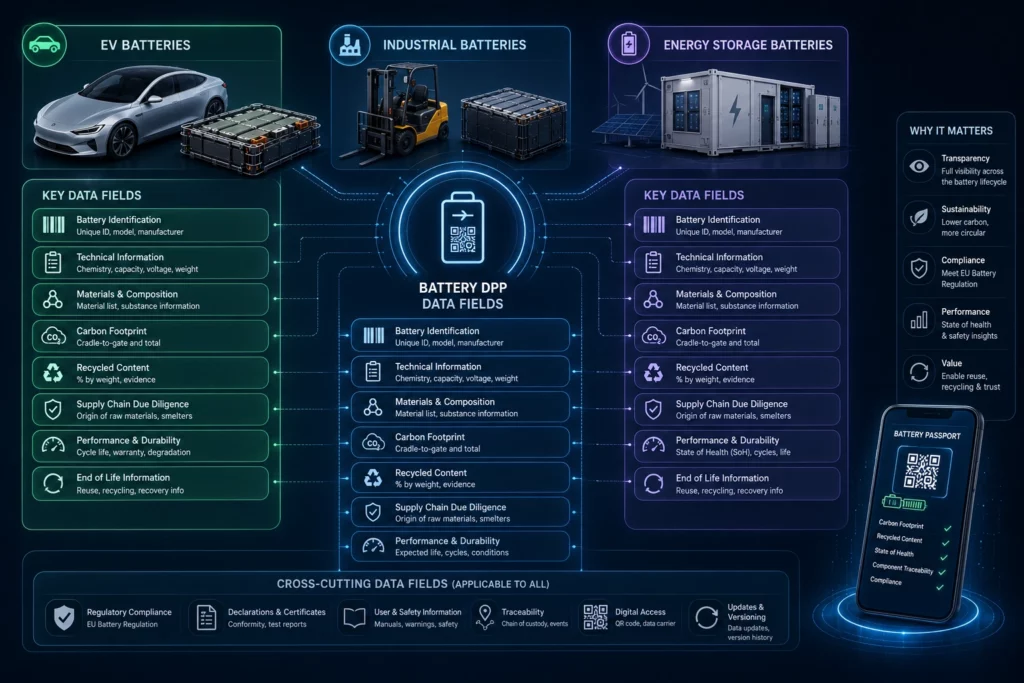
Quick summary: Battery DPP scope by battery type EV, industrial, energy storage & automotive. See the data the EU Battery Regulation requires before the 18 Feb 2027 deadline.
Battery DPP scope covers the battery categories that Regulation (EU) 2023/1542 places in scope for a digital product passport: electric vehicle (EV) batteries, light means of transport (LMT) batteries, and industrial batteries above 2 kWh. Energy storage and automotive traction packs fall inside those legal categories rather than forming separate ones. From 18 February 2027, every in-scope battery placed on the EU market must carry a battery DPP accessible through a QR code linked to a unique identifier, holding verified data for the public, authorities, and parties with a legitimate interest.
A battery digital product passport (battery DPP) is a structured, machine-readable data record linked to a physical battery by a QR code, storing lifecycle information chemistry, carbon footprint, recycled content, state of health, and due diligence data across the battery’s life.
Key takeaways
The passport becomes mandatory on 18 February 2027 for EV, LMT, and industrial (>2 kWh) batteries under Article 77.
There is no separate “energy storage” or “automotive” legal category both map onto industrial or EV scope.
Carbon footprint declarations already apply: EV since 18 Feb 2025, industrial >2 kWh since 18 Feb 2026.
Each battery model, per manufacturing plant, needs its own dataset spreadsheets rarely survive an audit.
Most data originates with tier-1 and tier-2 suppliers, so mapping must start well before 2027.
The Battery DPP introduces new expectations around battery data, traceability, sustainability information and digital access across the battery lifecycle.
Our eBook breaks down the key requirements and practical considerations businesses need to understand as they prepare for implementation.
Battery DPP scope: what the EU Battery Regulation actually covers
The first mistake teams make is treating the battery DPP as a labelling task. Regulation (EU) 2023/1542 the EU Battery Regulation, directly applicable in all 27 member states since it replaced the old Batteries Directive defines a narrow set of in-scope categories, and everything else in the catalogue is out of scope for the passport itself. Getting the boundary wrong wastes budget on portable cells that never needed a passport, or worse, leaves an EV pack non-compliant weeks before shipment. The battery DPP applies to:
Electric vehicle (EV) batteries
Light means of transport (LMT) batteries — e-bikes, e-scooters and similar
Industrial rechargeable batteries with a capacity above 2 kWh — the category that captures energy storage
Portable batteries and industrial batteries at or below 2 kWh sit outside passport scope for now, though other Battery Regulation duties labelling, collection, and recycled-content rules can still apply to them.
Preparing for the EU Battery Digital Product Passport?
Our guide to Battery DPP explains the key information businesses need to preparefrom battery identity and material composition to environmental performance, compliance evidence and lifecycle information.
Battery DPP scope for EV batteries
For EV manufacturers and their battery-pack suppliers, the battery DPP is the most demanding branch of scope because two obligations stack on top of each other. Carbon footprint declarations for EV batteries have applied since 18 February 2025, so the lifecycle data model already exists the 2027 passport simply exposes it alongside chemistry, recycled cobalt, lithium, nickel and lead percentages, state of health, and supply-chain due diligence. An EV battery DPP therefore needs primary data reaching back to raw-material extraction, not just tidy factory-gate figures, and it must stay accurate as the pack moves into second life.
Unique identifier plus QR code issued per battery
Carbon footprint value in kg CO₂e per kWh over service life
Recycled-content declarations for cobalt, lithium, nickel and lead
State-of-health and durability parameters (dynamic data)
Due diligence declaration under Article 48 / Annex X
Our practical Battery DPP Compliance Ebook takes you beyond the regulation and focuses on what teams actually need to dofrom mapping battery data and supplier information to managing compliance evidence, assessing readiness and building a DPP-ready workflow.
Download the Battery DPP Compliance Ebook
Battery DPP scope for industrial batteries
Industrial battery DPP scope switches on above the 2 kWh capacity threshold. The carbon footprint declaration for rechargeable industrial batteries above 2 kWh has applied since 18 February 2026, which puts industrial makers a year behind EV OEMs on the same readiness curve. The industrial battery DPP carries the same core dataset, but scope hinges on correct classification: a pack marketed as “industrial” yet under 2 kWh sits outside passport scope, while a borderline unit needs a documented capacity basis to defend that call to a market-surveillance authority.
Capacity confirmation against the 2 kWh threshold
Carbon footprint declaration (in force since 18 Feb 2026)
Recycled-content and hazardous-substance data
Removability and replaceability by qualified professionals
Battery DPP scope for energy storage systems
This is the most misunderstood corner of scope. Stationary battery energy storage systems (SBESS) do not get their own legal category they are treated as industrial batteries, so any storage system above 2 kWh needs a battery DPP on the same 18 February 2027 timeline. Grid-scale, commercial, and residential storage vendors therefore inherit the full industrial passport dataset, plus the specific safety-testing evidence the regulation adds for SBESS. Framing energy storage as “just industrial, above 2 kWh” keeps programmes anchored to the correct obligations instead of chasing a category that does not exist in law.
SBESS above 2 kWh = industrial scope, same 2027 deadline
Full industrial battery dataset applies
Additional SBESS safety-test evidence expected
Module- and pack-level identifiers for serviceable systems
Battery DPP scope for automotive manufacturers and suppliers
Automotive battery DPP scope is really EV scope viewed through the value chain. The OEM placing the vehicle on the market usually holds responsibility for the battery DPP, but the underlying data originates with cell makers, pack assemblers, and tier-2 material suppliers. Whoever is named the responsible economic operator has to aggregate a defensible dataset from every tier which is why automotive programmes that start supplier data contracts in 2025 tend to clear 2027, and those that wait rarely do. Battery-pack manufacturers, in particular, become the connective tissue between raw-material carbon inputs and the finished vehicle record.
OEM / responsible economic operator owns the passport of record
Battery-pack manufacturers supply cell-to-pack lifecycle data
Tier-2 suppliers provide material origin and carbon inputs
Contractual data-sharing clauses close the tier-2 data gap
Are you ready for Battery DPP compliance?
Our guide to Battery DPP Compliance Requirements explains the key information businesses need to prepare from battery identification and material composition to environmental performance, compliance evidence and lifecycle information.
Battery DPP scope: mapping requirements to each battery type
Once scope is settled, the real work is mapping every required field to a battery type, a deadline, and a data owner. The core battery DPP dataset is common across categories, but the triggers and dates differ the table below shows how scope resolves by type.
Battery type
In-scope trigger
Carbon footprint declaration
Passport deadline
EV batteries
All EV batteries
In force 18 Feb 2025
18 Feb 2027
Industrial >2 kWh
Capacity above 2 kWh
In force 18 Feb 2026
18 Feb 2027
Energy storage (SBESS)
Treated as industrial, >2 kWh
18 Feb 2026 (as industrial)
18 Feb 2027
LMT batteries
E-bikes, e-scooters
From 18 Aug 2028
18 Feb 2027
Portable / ≤2 kWh industrial
Out of passport scope
Not applicable
Not in scope
The battery DPP is not a document you write once it is a live data record that has to stay accurate through a battery’s second life and recycling. Teams that treat 2027 as a publishing deadline miss the point; the harder problem is keeping tier-2 carbon and material data audit-ready for years. The TraceX Battery DPP platform is built to hold that data as a single source of record rather than a spreadsheet snapshot
TraceX Battery DPP solutions help manufacturers build the data and traceability foundation behind the Battery Digital Product Passport by connecting product, component, material, supplier and lifecycle information in one structured workflow. TraceX supports supplier data collection, product master management, compliance assessments, evidence management and DPP readiness monitoring, helping teams connect certificates, declarations and other supporting documents to the relevant battery records. It can also help organisations identify missing or incomplete information and create a more auditable trail across the battery lifecycle. This enables manufacturers to move from fragmented supplier files and enterprise systems to a connected, structured and DPP-ready battery data record, making it easier to prepare and maintain the information required for the Battery DPP.
Not sure what your battery needs to comply with?
Book a TraceX Battery DPP Consultation to assess your scope, data requirements and readiness gaps.
If you are evaluating a solution, test it against battery DPP scope not generic DPP marketing. A tool that treats all batteries the same will fail at the 2 kWh boundary and the EV-versus-industrial split.
Handles EV, industrial (>2 kWh), and SBESS scope distinctly
Auto-classifies borderline units against the 2 kWh threshold
Ingests carbon footprint data in kg CO₂e / kWh
Captures recycled-content declarations for cobalt, lithium, nickel, lead
Supports dynamic state-of-health data through second life
Issues QR-linked unique identifiers per battery
Manages tiered supplier data with access controls
Produces an audit-ready trail for market-surveillance authorities
Frequently Asked Questions (FAQ’s)
What is a battery DPP?
It is a digital product passport for a battery: a machine-readable record linked by QR code to a unique identifier, holding the lifecycle data required under Regulation (EU) 2023/1542.
When does the passport become mandatory?
From 18 February 2027 for EV, LMT, and industrial (above 2 kWh) batteries placed on the EU market, under Article 77.
Is the scope the same for energy storage systems?
In effect, yes. Stationary storage above 2 kWh is treated as an industrial battery, so it follows industrial scope and the same 2027 deadline.
Do EV and automotive batteries need a different passport?
No. Automotive traction batteries are EV batteries under the regulation; the automotive “cluster” is EV scope, with the OEM typically the responsible economic operator.
What data goes into the record?
Identification, chemistry, carbon footprint (kg CO₂e/kWh), recycled content, state of health, durability, and due diligence data split across public and restricted access layers.
Are portable batteries included?
No. Portable batteries and industrial batteries at or below 2 kWh are outside passport scope, though other Battery Regulation duties may still apply.
Who is responsible for it?
The economic operator placing the battery on the EU market for vehicles usually the OEM aggregating data from cell, pack, and material suppliers.
Start using TraceX
Transparency, Trust, & Success for your Climate Journey.
We use cookies on our website to give you the most relevant experience by remembering your preferences and repeat visits. By clicking “Accept All”, you consent to the use of ALL the cookies. However, you may visit "Cookie Settings" to provide a controlled consent.
This website uses cookies to improve your experience while you navigate through the website. Out of these, the cookies that are categorized as necessary are stored on your browser as they are essential for the working of basic functionalities of the website. We also use third-party cookies that help us analyze and understand how you use this website. These cookies will be stored in your browser only with your consent. You also have the option to opt-out of these cookies. But opting out of some of these cookies may affect your browsing experience.
Necessary cookies are absolutely essential for the website to function properly. These cookies ensure basic functionalities and security features of the website, anonymously.
Cookie
Duration
Description
cookielawinfo-checkbox-analytics
11 months
This cookie is set by GDPR Cookie Consent plugin. The cookie is used to store the user consent for the cookies in the category "Analytics".
cookielawinfo-checkbox-functional
11 months
The cookie is set by GDPR cookie consent to record the user consent for the cookies in the category "Functional".
cookielawinfo-checkbox-necessary
11 months
This cookie is set by GDPR Cookie Consent plugin. The cookies is used to store the user consent for the cookies in the category "Necessary".
cookielawinfo-checkbox-others
11 months
This cookie is set by GDPR Cookie Consent plugin. The cookie is used to store the user consent for the cookies in the category "Other.
cookielawinfo-checkbox-performance
11 months
This cookie is set by GDPR Cookie Consent plugin. The cookie is used to store the user consent for the cookies in the category "Performance".
viewed_cookie_policy
11 months
The cookie is set by the GDPR Cookie Consent plugin and is used to store whether or not user has consented to the use of cookies. It does not store any personal data.
Functional cookies help to perform certain functionalities like sharing the content of the website on social media platforms, collect feedbacks, and other third-party features.
Performance cookies are used to understand and analyze the key performance indexes of the website which helps in delivering a better user experience for the visitors.
Analytical cookies are used to understand how visitors interact with the website. These cookies help provide information on metrics the number of visitors, bounce rate, traffic source, etc.
Advertisement cookies are used to provide visitors with relevant ads and marketing campaigns. These cookies track visitors across websites and collect information to provide customized ads.
Download the 2026 Traceability Scorecard and Benchmark Your Supply Chain Across 10 Critical Capabilities.
Download our eBook
Don’t Wait for an Audit to Find Your EUDR Gaps
The 2026 Simplification Package changes how HS codes, DDS pass-through and geolocation rules apply to you. Get the free guide and 20-point readiness checklist before enforcement catches you unprepared.