EU Battery Digital Product Passport: Article 77 Explained
Published
, 12 minute read
Share this article
Quick summary: Article 77 of the EU Battery Regulation sets out which batteries need a Digital Battery Passport, what information it must contain, who can access it and which economic operator is responsible for ensuring it is available.
Article 77 of the EU Battery Regulation establishes the requirements for a Digital Battery Passport, making it essential for businesses to prepare for the new transparency, data-sharing and compliance obligations. From 18 February 2027, specific batteries placed on the EU market or put into service must have a digital Battery Passport. For manufacturers, importers and other businesses in the battery value chain, the requirement is not simply about generating a QR code. It involves identifying the finished battery that is in scope, compiling the applicable information, managing access rights, assigning responsibility for the passport and completing the required registry steps.
Article 77 of Regulation (EU) 2023/1542 establishes the Battery Passport obligation. This guide explains its key provisions in practical terms and highlights the operational questions businesses should address before implementation.
Key Takeaways
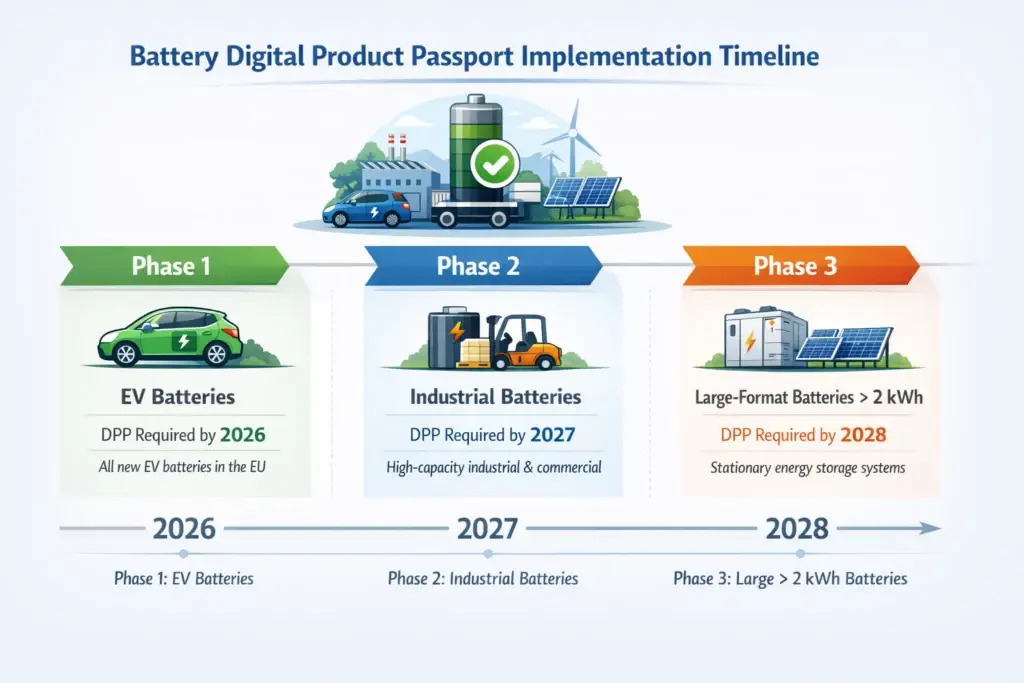
Mandatory from 18 February 2027: Article 77 of the EU Batteries Regulation requires a Digital Battery Passport for electric vehicle (EV) batteries, light means of transport (LMT) batteries and industrial batteries with a capacity greater than 2 kWh placed on the EU market or put into service.
Unique Digital Identity: Each battery must have a unique identifier linked to a QR code, providing access to its digital passport.
Comprehensive Battery Information: The passport contains information about the battery model and individual battery, including relevant information generated during its use.
Role-Based Data Access: Information is divided into public data, information for notified bodies and authorities, and restricted information for parties with a legitimate interest.
Accuracy and Accountability: The economic operator placing the battery on the market is responsible for ensuring that passport information is accurate, complete and up to date. This responsibility can be delegated in writing, but accountability remains with the responsible operator.
Interoperability and Data Security: Battery Passports must support interoperability, data authentication, reliability, integrity, privacy and secure access.
Lifecycle Transparency: The passport supports access to relevant battery information for activities such as repair, reuse, repurposing, remanufacturing and recycling.
Preparation Requires Data Readiness: Businesses should start identifying relevant battery data, information owners, supplier dependencies and systems needed to maintain passport information.
Download our eBook
Explore the key steps, challenges and considerations for building a reliable Battery Passport strategy.
Article 77(1) applies from 18 February 2027 to each light means of transport (LMT) battery, each industrial battery with a capacity greater than 2 kWh, and each electric vehicle battery placed on the market or put into service.
The obligation relates to the finished battery, not automatically to every cell, module or component supplied during manufacturing. The European Commission explains that a battery is generally the finished, safely functioning product capable of delivering electrical energy. Where several packs rely on a common battery management system or other common components to operate as one battery, the system may be treated as the battery. The assessment depends on the product configuration.
Businesses should therefore confirm the battery category, whether the product is a finished battery, its capacity where relevant, and the point at which it is placed on the EU market or put into service.
What information must the Battery Passport contain?
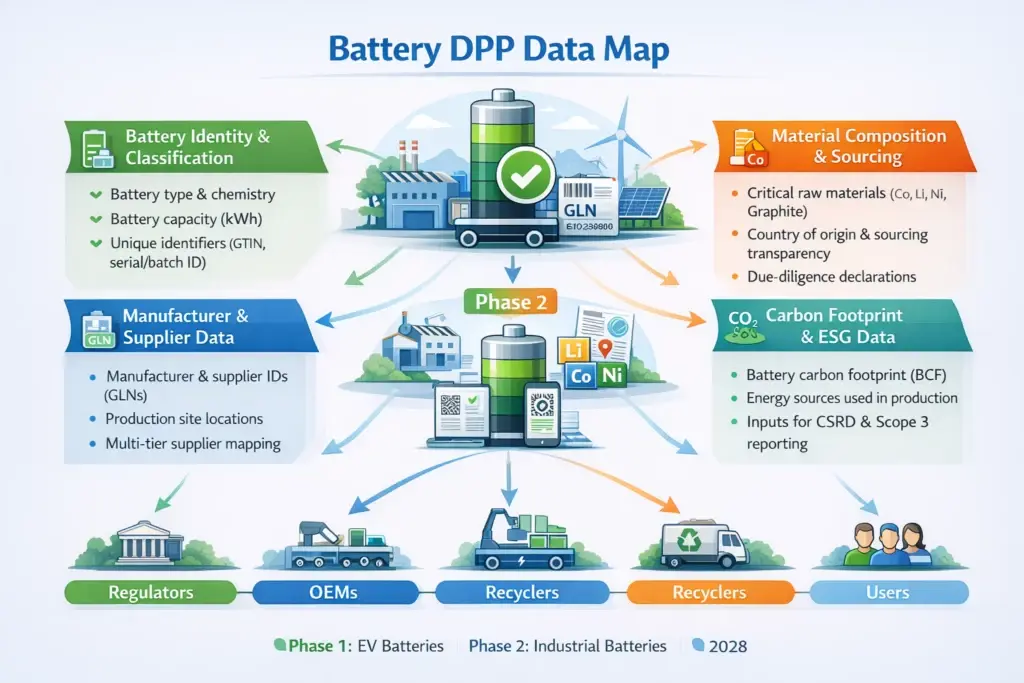
Under Article 77(2), the passport contains information relating to the battery model and information specific to the individual battery, including information resulting from its use. The applicable information is set out in Annex XIII and varies according to the battery category and the relevant data point.
Depending on applicability, the data model can include battery identification and model information, composition, performance and durability, status and use-related information, and information relevant to repair, dismantling and end-of-life activities. Do not assume that every Annex XIII field is mandatory for every battery from day one.
The Commission’s published data-point guidance distinguishes information required from February 2027, information required only in particular circumstances, information not required at that date and information applicable only to certain battery types. It also clarifies that carbon footprint, recycled-content and due-diligence information are subject to their own application dates and are not all required in the passport from February 2027.
Understand the key compliance requirements under Article 77, the mandatory data points, QR code requirements and upcoming deadlines. Read our blog to learn what battery manufacturers and economic operators need to do to get ready for the 2027 deadline.
Article 77 access rights: Who can see which information?
Article 77(2) divides Battery Passport information into three access categories. The precise data points assigned to each category must be checked against Annex XIII and the applicable access rules.
Access category
Who may access it
Practical explanation
Public information
General public
Information designated for public access under point 1 of Annex XIII.
Regulatory-only information
Notified bodies, market surveillance authorities and the European Commission
Information restricted to these authorities under the relevant Annex XIII provisions.
Legitimate-interest information
Natural or legal persons with a legitimate interest, for the purposes specified in Article 77
Relevant restricted information for qualifying activities, subject to the applicable legal and access conditions.
Legitimate-interest access is not a general right to view the complete passport. Article 77 identifies specific purposes. These include access to information about dismantling, including safety measures, and detailed battery-model composition where essential for repairers, remanufacturers, second-life operators and recyclers to conduct their activities. For individual batteries, it also includes information essential to the purchaser or parties acting on the purchaser’s behalf for making the battery available to independent energy aggregators or energy market participants.
Important implementation status: as of 30 October 2026, the Commission FAQ states that the implementing act specifying access to restricted data and clarifying which users qualify for access is still being developed. Avoid presenting every authentication method or detailed permission as finalised. Use the latest Commission guidance and legal act when configuring access.
Who is responsible for the Battery Passport?
Article 77(4) states that the economic operator placing the battery on the market must ensure that the information in the Battery Passport is accurate, complete and up to date. Identifying the responsible operator requires understanding who places the finished battery on the market and the role each party plays in completing the battery.
For example, the Commission FAQ explains that where a finished battery is supplied to an EV manufacturer and the EV manufacturer simply installs it, the battery manufacturer remains responsible for that battery’s passport. If the EV manufacturer completes the battery by adding a battery management system or other essential components, responsibility may instead lie with the party that completes and places the finished battery on the market. Imported products containing a finished battery can raise a different responsibility question, commonly involving the importer.
Explore who must create, maintain and update Battery Passport information, who is responsible for data accuracy, and what businesses need to do before the 18 February 2027 deadline.
Yes. Under Article 77(4), the responsible economic operator may give another operator written authorisation to act on its behalf. This may allow a service provider, non-EU manufacturer, cell manufacturer or OEM to carry out practical tasks relating to the passport.
However, written authorisation does not transfer ultimate legal responsibility. The economic operator placing the battery on the market remains responsible for compliance and for the information included in the passport. Businesses should document the scope of the authorisation, define data owners and approval workflows, and retain oversight of accuracy, completeness and updates.
Creating and updating the passport is different from registry registration
Businesses should plan for two connected but distinct activities. First, the Battery Passport record must be created and maintained, with the required information made available through the passport mechanism. Second, the responsible economic operator must complete the applicable registration steps in the European Commission’s DPP Registry.
The Commission FAQ confirms that the economic operator placing the battery on the market or putting it into service is required to register the Battery Passport in the Registry under the applicable rules. For Battery Passports, the Commission also clarifies that registration is to be carried out by the economic operator that places the battery on the EU market.
The Registry does not host the complete Battery Passport. According to the Commission FAQ, the passport is hosted by the economic operator or an operator authorised to act on its behalf; that operator manages access to the passport data. The Registry primarily records registration and metadata and facilitates access for public authorities where legislation provides for it.
The Registry became operational on 20 July 2026. The Commission has published Implementing Regulation (EU) 2026/1778 for the DPP Registry. Companies should consult the Registry User Guide and testing environment to confirm current registration workflows, identifiers and technical options.
What happens when a battery is repurposed or remanufactured?
Article 77(7) addresses changes in a battery’s lifecycle. Where a battery is repurposed or remanufactured, or where a battery that has become waste is prepared for reuse or repurposing, a new Battery Passport is required in the circumstances set out in the Regulation. The new passport must be linked to the previous passport so that the battery’s history and lineage can be followed.
The Commission FAQ distinguishes a simple repair from remanufacturing: a simple repair does not, by itself, require a new passport. Businesses should assess the nature of the intervention and the applicable legal definitions before deciding whether a new passport is required.
Interoperability, data quality and security
Article 77 requires passport information to be based on open standards and provided in an interoperable format, transferable through an open interoperable data-exchange network without vendor lock-in, and machine-readable, structured and searchable. Article 78 sets out further essential requirements for the technical design and operation of the passport, including interoperability, access based on rights and security.
For manufacturers, this makes data governance a practical implementation priority. Data should have identifiable sources and owners, a process for validation and correction, controlled update rights and a record of changes. The passport architecture should also support the relevant access categories without exposing information to users who are not entitled to it.
Battery DPP readiness checklist for manufacturers
Identify which products are finished batteries and confirm whether they fall within Article 77(1).
Determine the economic operator responsible for the finished battery placed on the EU market.
Map applicable Annex XIII data points to source systems, suppliers and internal data owners.
Classify each data point using the applicable access category and current legal mapping.
Define supplier data collection, validation, correction and update workflows.
Document written authorisations for any third party creating or updating passport information.
Separate passport hosting and maintenance from DPP Registry registration tasks.
Review the Registry User Guide, verification requirements, identifier options and available integration methods.
Define processes for repair, repurposing, remanufacturing and end-of-life status changes.
Test data completeness, access controls, interoperability and the user experience before launch.
Common mistakes businesses should avoid
Treating the QR code as the passport: The QR code provides a way to access the passport. It does not replace the underlying digital record or the required information.
Assuming every data point is mandatory in February 2027: Applicability varies by battery category, data point and legal application date. Use the latest Commission data-point guidance.
Making all passport information public: Article 77 establishes different access categories. Field-level access must follow Annex XIII and applicable implementing rules.
Assuming a service provider takes over legal responsibility: Written authorisation can delegate practical tasks, but the responsible economic operator retains ultimate responsibility.
Confusing passport creation with Registry registration: The passport record and the Registry serve different functions and should be managed as separate workstreams.
Treating the passport as a static document: Certain information may need to be updated as the battery is used, changes status or undergoes repurposing or remanufacturing.
How digital traceability platforms can support Battery DPP readiness
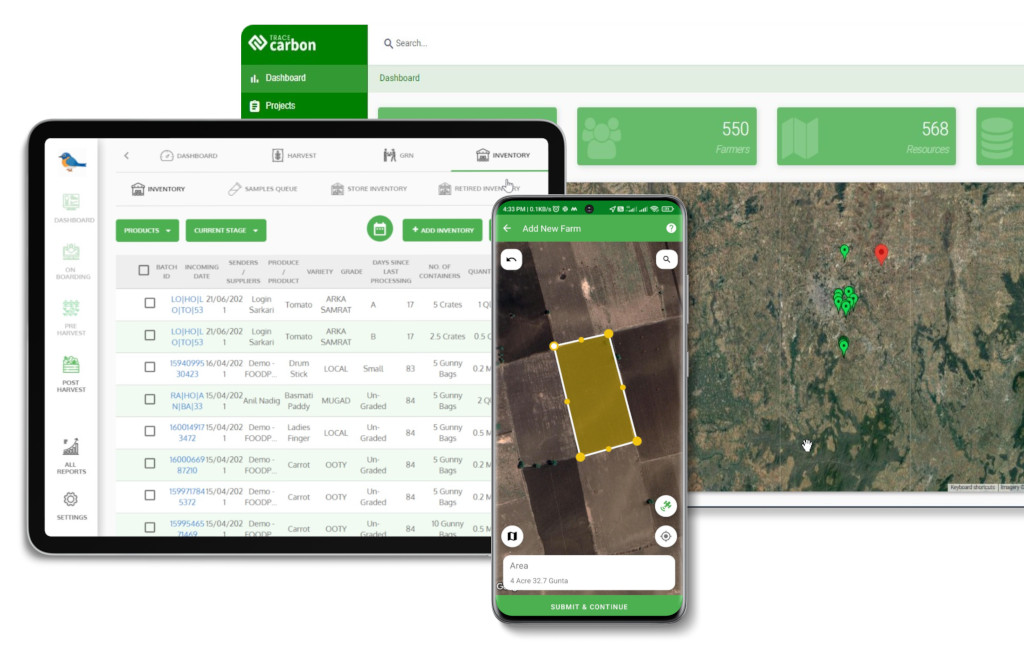
A digital traceability platform can help organisations collect information from supply-chain partners, connect supplier and product records, organise supporting evidence and maintain traceability across business processes. Depending on the platform’s capabilities, it may also support data validation, role-based workflows, audit trails and integrations with enterprise systems.
Technology does not replace the economic operator’s legal responsibility, nor does a platform automatically guarantee compliance. Businesses should evaluate solutions against their applicable data points, access requirements, interoperability needs, registry workflow and lifecycle update processes.
Prepare your business for the EU Battery Passport
Article 77 makes Battery Passport readiness a data, responsibility and process challenge not simply a QR-code exercise. Manufacturers and other responsible operators should identify the finished battery in scope, map the applicable information, decide who owns each data point, establish access and update controls, and prepare for the required Registry steps.
TraceX Battery Passport Solutions helps businesses strengthen supply-chain traceability and organise supplier, product and compliance information through digital workflows. If your organisation is preparing for Battery DPP, speak with our team about your data readiness, traceability requirements and implementation priorities.
Article 77 establishes the Battery Passport requirement, including which batteries are in scope, the information the passport contains, access categories, responsibility for passport information and related lifecycle and registry provisions.
Which batteries need a Battery Passport from 18 February 2027?
Each LMT battery, each industrial battery with a capacity greater than 2 kWh and each electric vehicle battery placed on the market or put into service is covered by Article 77(1).
Who is responsible for creating and maintaining the Battery Passport?
The economic operator placing the battery on the market must ensure the passport information is accurate, complete and up to date. The responsible party depends on the finished battery and the roles of the businesses involved.
Can a third party manage a Battery Passport?
Yes. The responsible economic operator may give another operator written authorisation to act on its behalf. This does not transfer ultimate legal responsibility.
Is Battery Passport registration the same as creating the passport?
No. Creating and maintaining the passport concerns the passport data itself. Registration involves submitting the required information to the DPP Registry. The Commission FAQ treats these as distinct activities.
Does the DPP Registry host the complete Battery Passport?
No. The Commission FAQ states that the passport is hosted by the economic operator or its authorised operator. The Registry primarily records registration and metadata and supports public-authority access where provided by law.
Does a battery need a new passport after remanufacturing?
A new passport is required in the circumstances specified in Article 77(7), including remanufacturing and repurposing. The new passport must be linked to the previous passport.
Are all Battery Passport data fields mandatory from February 2027?
No. The Commission guidance identifies data required from February 2027, data required only in particular circumstances, data not required at that date and data applicable only to certain battery types.
Start using TraceX
Transparency, Trust, & Success for your Climate Journey.
We use cookies on our website to give you the most relevant experience by remembering your preferences and repeat visits. By clicking “Accept All”, you consent to the use of ALL the cookies. However, you may visit "Cookie Settings" to provide a controlled consent.
This website uses cookies to improve your experience while you navigate through the website. Out of these, the cookies that are categorized as necessary are stored on your browser as they are essential for the working of basic functionalities of the website. We also use third-party cookies that help us analyze and understand how you use this website. These cookies will be stored in your browser only with your consent. You also have the option to opt-out of these cookies. But opting out of some of these cookies may affect your browsing experience.
Necessary cookies are absolutely essential for the website to function properly. These cookies ensure basic functionalities and security features of the website, anonymously.
Cookie
Duration
Description
cookielawinfo-checkbox-analytics
11 months
This cookie is set by GDPR Cookie Consent plugin. The cookie is used to store the user consent for the cookies in the category "Analytics".
cookielawinfo-checkbox-functional
11 months
The cookie is set by GDPR cookie consent to record the user consent for the cookies in the category "Functional".
cookielawinfo-checkbox-necessary
11 months
This cookie is set by GDPR Cookie Consent plugin. The cookies is used to store the user consent for the cookies in the category "Necessary".
cookielawinfo-checkbox-others
11 months
This cookie is set by GDPR Cookie Consent plugin. The cookie is used to store the user consent for the cookies in the category "Other.
cookielawinfo-checkbox-performance
11 months
This cookie is set by GDPR Cookie Consent plugin. The cookie is used to store the user consent for the cookies in the category "Performance".
viewed_cookie_policy
11 months
The cookie is set by the GDPR Cookie Consent plugin and is used to store whether or not user has consented to the use of cookies. It does not store any personal data.
Functional cookies help to perform certain functionalities like sharing the content of the website on social media platforms, collect feedbacks, and other third-party features.
Performance cookies are used to understand and analyze the key performance indexes of the website which helps in delivering a better user experience for the visitors.
Analytical cookies are used to understand how visitors interact with the website. These cookies help provide information on metrics the number of visitors, bounce rate, traffic source, etc.
Advertisement cookies are used to provide visitors with relevant ads and marketing campaigns. These cookies track visitors across websites and collect information to provide customized ads.
Other uncategorized cookies are those that are being analyzed and have not been classified into a category as yet.
WhatsApp us
Download our eBook
Is Your Battery Supply Chain Ready for EU DPP Mandates?
The EU Battery Regulation sets strict data, carbon footprint, and circularity requirements. Download our comprehensive guide to understand key deadlines, technical standards, and the roadmap to achieve compliance without disrupting operations.
Get your free trial
Request for a Demo Session
Download your EU Battery Digital Product Passport: Article 77 Explained here
Download your EU Battery Digital Product Passport: Article 77 Explained here
Download your EU Battery Digital Product Passport: Article 77 Explained here
Download the 2026 Traceability Scorecard and Benchmark Your Supply Chain Across 10 Critical Capabilities.
Download our eBook
Don’t Wait for an Audit to Find Your EUDR Gaps
The 2026 Simplification Package changes how HS codes, DDS pass-through and geolocation rules apply to you. Get the free guide and 20-point readiness checklist before enforcement catches you unprepared.