EUDR Compliance for Palm Oil Derivatives: New CN Codes, Traceability Requirements and DDS Obligations
Published
, 10 minute read
Share this article
Quick summary: EUDR compliance for palm oil derivatives: new CN codes from December 2027, plot-level traceability rules and who files the DDS. See what to prepare now.
EUDR compliance for palm oil derivatives means proving that every oleochemical, fraction or soap you place on the EU market traces back to geolocated plots that were not deforested after 31 December 2020. Delegated Regulation (EU) 2026/2102 tightened existing palm entries from 18 September 2026 and adds new CN codes, including fatty alcohols, hydrogenated palm oils, crude glycerol and palm-based soap, from 30 December 2027. Only the operator that first places the product on the EU market files the Due Diligence Statement (DDS).
Key Takeaways
Existing palm entries (palm oil, kernel oil, glycerol, industrial fatty acids and alcohols) apply from 30 December 2026.
New derivative codes and palm-based soap apply from 30 December 2027.
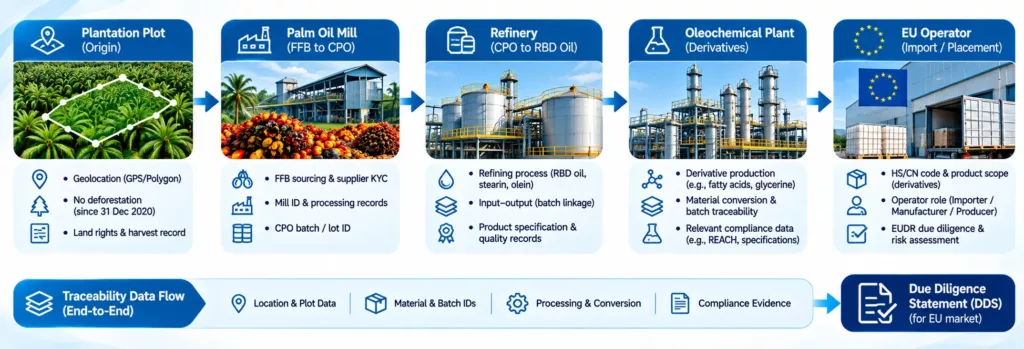
Derivatives must trace back to plot-level geolocation, through every refining and oleochemical step.
Only the first operator files a DDS; downstream operators and traders keep reference numbers.
RSPO and other certifications support risk mitigation but do not replace the DDS or plot evidence.
EUDR compliance for palm oil derivatives just got broader. The EU Deforestation Regulation (EUDR) already covered palm oil, palm kernel oil, glycerol and industrial fatty acids. Delegated Regulation (EU) 2026/2102, in force since 18 September 2026, extends Annex I deeper into the oleochemical chain that feeds cosmetics, detergents, lubricants and food. If you import, refine or trade palm-based ingredients, your product list, traceability model and filing process all need a second look.
Download our eBook
Assess your EUDR readiness, uncover data gaps, and take proactive steps towards stronger compliance.
Three conditions every in-scope derivative must meet
Scope is decided by the CN code, not the ingredient list
Applies to imports, products made in the EU and exports
In plain terms, EUDR compliance for palm oil derivatives means a derivative can only be placed on the EU market, made available on it, or exported from it if three conditions hold. It must be deforestation-free against the 31 December 2020 cut-off date. It must be produced in line with the relevant laws of the country of production. And it must be covered by a due diligence statement.
Whether a derivative is in scope depends on one thing: its Combined Nomenclature (CN) code in Annex I of the regulation. If the code is not listed, the product is out of scope, even if it contains palm oil.
EUDR Compliance for Palm Oil Derivatives: New CN Codes Explained
Delegated Regulation (EU) 2026/2102 changes palm oil scope on two separate timelines.
Existing palm codes were rewritten and narrowed from 18 September 2026
New derivative and soap codes apply from 30 December 2027
Exclusions for medicines, other palm species and certain waste are written code by code
Explore our blog on EUDR Palm Oil Complianceto understand the key requirements, traceability challenges, and steps palm oil businesses need to take to ensure deforestation-free supply chains and meet EU market requirements.
Palm Oil Derivative CN Codes: Current vs Added
The European Commission adopted the delegated act on 13 July 2026 under Article 34 of the EUDR, which lets it amend Annex I without reopening the base regulation. It was published in the Official Journal on 17 September 2026. Existing derivative entries now apply only where the product was made using oil palm
CN code
Product
Applies from
ex 1207 10 00
Palm nuts and kernels
30 Dec 2026
ex 1511
Palm oil and its fractions, not chemically modified
30 Dec 2026
ex 1513 21, ex 1513 29
Palm kernel oil and its fractions
30 Dec 2026
ex 2306 60 00
Palm nut or kernel oilcake
30 Dec 2026
ex 2905 45
Glycerol, purity of 95% or more
30 Dec 2026
ex 2915 70, ex 2915 90
Palmitic and stearic acids; other saturated monocarboxylic acids
30 Dec 2026
ex 3823 11 00, ex 3823 12 00, ex 3823 19, ex 3823 70 00
Hydrogenated, inter-esterified or re-esterified palm oils
30 Dec 2027
ex 1518 00 (new)
Chemically modified palm oils; inedible mixtures
30 Dec 2027
ex 1520 00 (new)
Crude glycerol, glycerol waters and lyes
30 Dec 2027
ex 2905 16, ex 2905 17 00, ex 2905 19 00 (new)
Fatty alcohols: octanol, lauryl, cetyl, stearyl and others
30 Dec 2027
ex 2915 39, ex 2916 15, ex 2916 19 10 (new)
Acetic esters; oleic, linoleic and linolenic acids; undecenoic acids
30 Dec 2027
ex 2921, ex 2923, ex 2924 (new)
Palm-derived amines and related compounds [verify entries on EUR-Lex]
30 Dec 2027
ex 3401 11 00, ex 3401 20 (new)
Toilet soap and soap in other forms containing or made using oil palm
30 Dec 2027
ex 3824 99, ex 3907 29 (new)
Other chemical preparations and polyethers made using oil palm
30 Dec 2027
Palm Oil Derivative Exclusions That Narrow Scope
Medicinal products: most new and rewritten palm entries exclude derivatives used to manufacture human or veterinary medicines.
Other palm species: babassu oil (Attalea spp.) and oils from non-Elaeis palms are outside scope.
Waste: selected entries, such as ex 3823 19, carry waste exemptions.
The composite-product rule still matters. A face cream classified under its own cosmetic code is not in scope just because it contains palm glycerol; the glycerol is in scope when it is placed on the market as a product in its own right. For EUDR compliance for palm oil derivatives, the practical first step is to confirm every SKU’s eight-digit CN code in writing with your customs broker and tag it with its application date.
EUDR Compliance for Palm Oil Derivatives: Traceability Requirements
Geolocation for every plot that supplied the oil palm fruit
No material of unknown origin in the batch
Country risk sets how deep due diligence must go
Palm Oil Plot Geolocation From Plantation to Refinery
Each derivative must link back to the geolocation of all plots where the oil palm was grown. Plots above four hectares need polygon coordinates; smaller plots can use a single point. A fatty alcohol may pass through a mill, a kernel crusher, a refinery and an oleochemical plant before it reaches the EU. This is where EUDR compliance for palm oil derivatives gets hard: plot data has to travel with the material through every transformation step.
Palm Oil Traceability: Why Mass Balance Falls Short
Certification schemes such asRSPOsupport risk mitigation, but they never replace the DDS, plot-level geolocation or verifiable evidence. Mass-balance claims mix certified and uncertified oil, so they cannot show which plots fed a specific batch. Compliant material can be combined, but every contributing plot must be declared, and material of unknown origin cannot enter the batch.
Palm Oil Country Risk: Indonesia and Malaysia
Indonesia and Malaysia, the two largest producers, are classified as standard risk. That means full due diligence: information collection, risk assessment and risk mitigation. Competent authorities check 3% of operators sourcing from standard-risk countries. The Commission planned a review of the classification in 2026, so confirm the current list before each filing.
Not sure which of your products are in scope?
Run your CN codes through TraceX’s free EUDR Scope Check before you plan supplier data collection.
EUDR Compliance for Palm Oil Derivatives: DDS Obligations
Large and medium operators comply from 30 December 2026
Micro and small operators generally follow on 30 June 2027
Downstream operators and traders keep reference numbers instead of filing
Only the operator that first places a palm derivative on the EU market, or exports it, submits a DDS through the EUDR Information System. Micro and small operators established by 31 December 2024 generally apply from 30 June 2027 and may use a simplified declaration in eligible cases. Downstream operators and traders of every size start on 30 December 2026, but they do not file their own statement. They collect and keep the reference numbers of the upstream statements.
Role
What you file
From
Large or medium operator (first placer or exporter)
Full DDS after due diligence
30 Dec 2026
Micro or small operator
DDS or simplified declaration where eligible
30 Jun 2027 (generally)
Downstream operator or trader
No DDS; keep upstream reference numbers
30 Dec 2026
The DDS reference number goes into the customs declaration, so a missing statement stops goods at the border. Penalties can reach at least 4% of EU-wide annual turnover. For EUDR compliance for palm oil derivatives, that makes the importer of record the critical control point, and it makes supplier data quality a commercial issue, not just a legal one.
Discover our blog on EUDR Due Diligence for Palm Oil Importersto understand importer obligations, supplier due diligence, plot-level traceability, deforestation risk assessment, and the key steps to prepare your palm oil supply chain for EUDR compliance.
How TraceX Supports EUDR Compliance for Palm Oil Derivatives
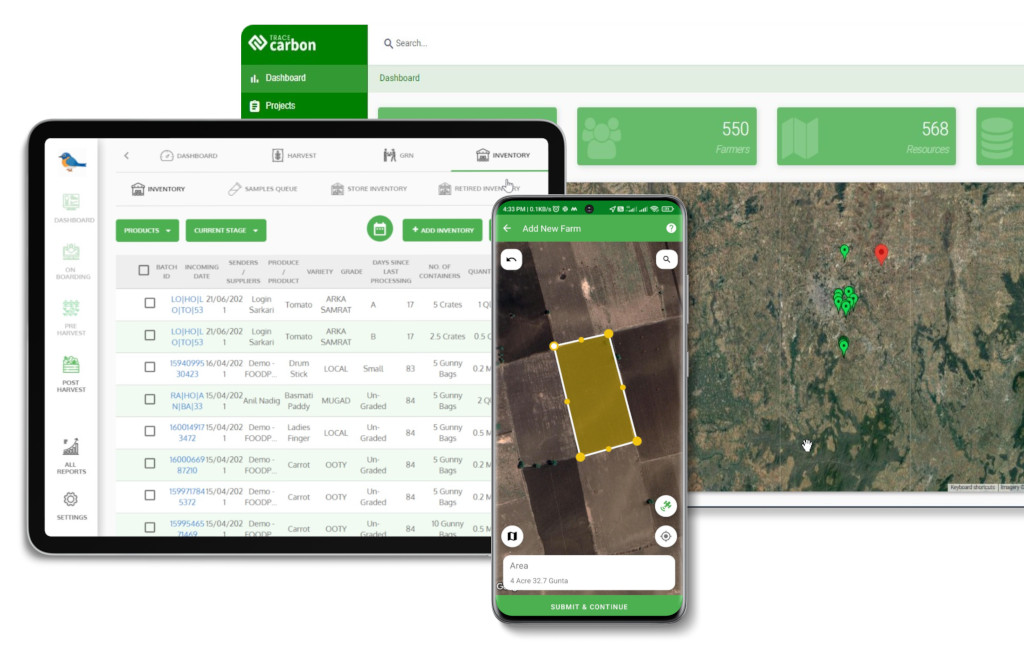
TraceX’s EUDR compliance solution connects plot-level geolocation captured in the field to the derivative batches you place on the market. The offline mobile app supports 15 languages for smallholder data collection, the free GeoJSON validator checks plot polygons before they reach a DDS, and deforestation checks run against global datasets.
CN-code mapping for the new 2027 palm derivative codes
Batch-level linkage through refinery and oleochemical transformation
DDS reference number capture for downstream customers
The legal methodology was validated by Maruszkin Law Firm, the platform is GDPR, ISO 27001 and SOC 1 and 2 compliant, and typical onboarding takes four weeks.
Look at TraceX’s EUDR compliance solution with full platform access, no credit card required.
EUDR Compliance for Palm Oil Derivatives: Manual vs Platform
Compare effort, error risk and audit readiness
Focus on batch linkage and DDS handling
Teams usually start EUDR compliance for palm oil derivatives in spreadsheets. Here is how that compares with a dedicated platform.
Task
Manual (spreadsheets, email)
Platform
CN code mapping
Static list, updated by hand when Annex I changes
Product catalogue tagged with code and application date
Plot geolocation
Files collected by email, format errors common
Validated polygons and points at intake
Batch linkage
Breaks at mills, refineries and oleochemical plants
Plot data carried through each transformation
Deforestation check
Ad hoc map reviews
Automated checks against global datasets
DDS submission
Re-keyed into the EUDR Information System
Structured data ready for submission
Record keeping (5 years)
Scattered across inboxes
Central, audit-ready evidence trail
Buyer Checklist for EUDR Compliance for Palm Oil Derivatives
Before you choose a tool for EUDR compliance for palm oil derivatives, check that it can:
Tag every SKU with its eight-digit CN code and its 2026 or 2027 application date
Collect plot geolocation offline from smallholders and validate GeoJSON at intake
Link plots to batches through mills, refineries and oleochemical plants
Run deforestation checks against the 31 December 2020 cut-off
Prepare DDS data and store reference numbers for downstream customers
Hold five years of audit-ready evidence
Show a legally validated methodology and security certifications
Next Steps for EUDR Compliance for Palm Oil Derivatives
Map codes now, collect plot data next, then test DDS flow
Start EUDR compliance for palm oil derivatives with your CN code list, split it into the 2026 and 2027 groups, and push plot data requests to suppliers before the first deadline. The 2027 codes will reuse the same traceability foundation, so building it once saves rework.
Frequently Asked Questions
When do the new palm oil derivative CN codes apply?
The new palm oil derivative CN codes apply from 30 December 2027. Existing palm entries, including glycerol and industrial fatty acids, apply from 30 December 2026 for large and medium operators.
Is soap made with palm oil covered by the EUDR?
Yes, from 30 December 2027, under ex 3401 11 00 and ex 3401 20, where the soap contains or was made using oil palm.
Are cosmetics containing palm glycerol in scope?
Only if the cosmetic’s own CN code is listed in Annex I. The glycerol itself is in scope when placed on the market as a standalone product.
Do downstream buyers of palm derivatives file a DDS?
No. Since Regulation (EU) 2025/2650, downstream operators and traders keep the upstream reference numbers instead of filing their own statement.
Does RSPO certification satisfy EUDR compliance for palm oil derivatives?
No. RSPO supports risk mitigation, but you still need plot-level geolocation, a risk assessment and a DDS.
Are palm derivatives used in medicines covered?
Most new and rewritten palm entries exclude derivatives used to manufacture human or veterinary medicinal products.
Start using TraceX
Transparency, Trust, & Success for your Climate Journey.
We use cookies on our website to give you the most relevant experience by remembering your preferences and repeat visits. By clicking “Accept All”, you consent to the use of ALL the cookies. However, you may visit "Cookie Settings" to provide a controlled consent.
This website uses cookies to improve your experience while you navigate through the website. Out of these, the cookies that are categorized as necessary are stored on your browser as they are essential for the working of basic functionalities of the website. We also use third-party cookies that help us analyze and understand how you use this website. These cookies will be stored in your browser only with your consent. You also have the option to opt-out of these cookies. But opting out of some of these cookies may affect your browsing experience.
Necessary cookies are absolutely essential for the website to function properly. These cookies ensure basic functionalities and security features of the website, anonymously.
Cookie
Duration
Description
cookielawinfo-checkbox-analytics
11 months
This cookie is set by GDPR Cookie Consent plugin. The cookie is used to store the user consent for the cookies in the category "Analytics".
cookielawinfo-checkbox-functional
11 months
The cookie is set by GDPR cookie consent to record the user consent for the cookies in the category "Functional".
cookielawinfo-checkbox-necessary
11 months
This cookie is set by GDPR Cookie Consent plugin. The cookies is used to store the user consent for the cookies in the category "Necessary".
cookielawinfo-checkbox-others
11 months
This cookie is set by GDPR Cookie Consent plugin. The cookie is used to store the user consent for the cookies in the category "Other.
cookielawinfo-checkbox-performance
11 months
This cookie is set by GDPR Cookie Consent plugin. The cookie is used to store the user consent for the cookies in the category "Performance".
viewed_cookie_policy
11 months
The cookie is set by the GDPR Cookie Consent plugin and is used to store whether or not user has consented to the use of cookies. It does not store any personal data.
Functional cookies help to perform certain functionalities like sharing the content of the website on social media platforms, collect feedbacks, and other third-party features.
Performance cookies are used to understand and analyze the key performance indexes of the website which helps in delivering a better user experience for the visitors.
Analytical cookies are used to understand how visitors interact with the website. These cookies help provide information on metrics the number of visitors, bounce rate, traffic source, etc.
Advertisement cookies are used to provide visitors with relevant ads and marketing campaigns. These cookies track visitors across websites and collect information to provide customized ads.
Download the 2026 Traceability Scorecard and Benchmark Your Supply Chain Across 10 Critical Capabilities.
Download our eBook
Don’t Wait for an Audit to Find Your EUDR Gaps
The 2026 Simplification Package changes how HS codes, DDS pass-through and geolocation rules apply to you. Get the free guide and 20-point readiness checklist before enforcement catches you unprepared.