EUDR Due Diligence for Palm Oil Importers: A 5-Step Playbook
Published
, 8 minute read
Share this article
Quick summary: EUDR due diligence for palm oil importers: who files the DDS, Indonesia and Malaysia risk tiers, mill-to-plot geolocation and a 5-step plan for 2026.
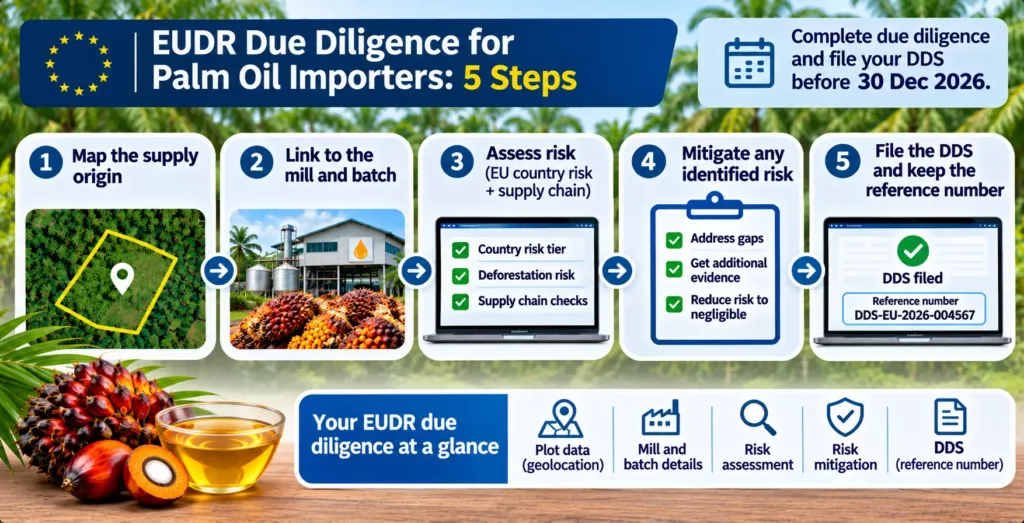
EUDR due diligence for palm oil importers is the three-step process of information collection, risk assessment and risk mitigation that the first company placing palm oil, palm kernel oil or listed palm derivatives on the EU market must complete before filing a Due Diligence Statement (DDS). It applies from 30 December 2026 for large and medium operators and 30 June 2027 for micro and small operators, and it requires plot-level geolocation proving no deforestation after 31 December 2020.
Key takeaways
Only the operator that first places palm products on the EU market files the DDS. Downstream refiners and manufacturers no longer file their own under Regulation (EU) 2025/2650.
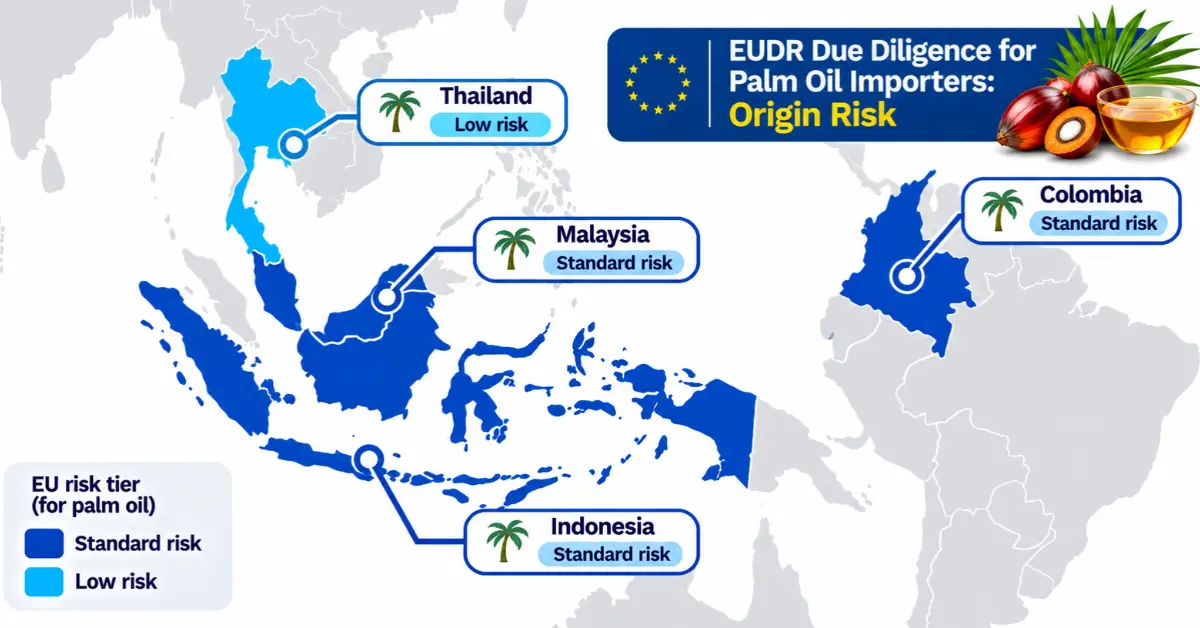
Indonesia and Malaysia are standard risk, so full due diligence applies to most palm volume.
Every plot that supplied the mill must be geolocated. RSPO mass balance and book-and-claim do not meet EUDR.
Further palm derivatives join the scope on 30 December 2027, so oleochemical importers should map product codes now.
EUDR due diligence for palm oil importers is now a fixed deadline, not a planning exercise. The European Commission’s May 2026 simplification package confirmed there will be no further postponement, so palm oil placed on the EU market from 30 December 2026 needs a filed DDS before it clears customs.
In plain language, EUDR due diligence means proving that each consignment is deforestation-free, legally produced and traceable to the plots that grew the fresh fruit bunches.
Palm is also one of the hardest EUDR commodities to trace. Indonesia and Malaysia produce roughly 85% of the world’s palm oil, and a single mill can buy fruit from thousands of independent smallholders through dealers. This guide to EUDR due diligence for palm oil importers covers who files, what each origin requires, and the five-step process importers can run today.
Download our eBook
Assess your EUDR readiness, uncover data gaps, and take proactive steps towards stronger compliance.
EUDR Due Diligence for Palm Oil Importers: What the Regulation Requires
The obligation sits with whoever first places in-scope palm products on the EU market.
Which palm products and HS codes are covered now and from 2027
Who files the DDS after the December 2025 amendment
Palm Oil Products Covered by EUDR
Annex I currently covers palm nuts and kernels (HS 1207 10), palm oil (HS 1511), palm kernel oil (ex 1513), palm oilcake (HS 2306 60), and palm-based glycerol, palmitic and stearic acids, and industrial fatty acids and alcohols. Delegated Regulation (EU) 2026/2102 adds further derivatives from 30 December 2027, including hydrogenated and modified palm oils, crude glycerol, amines and palm-based soap, where made using oil palm. Getting the HS code right is the first gate in EUDR due diligence for palm oil importers.
Palm Oil Importer Obligations After Regulation (EU) 2025/2650
The December 2025 amendment placed due diligence and DDS filing exclusively on the operator that first places the product on the EU market or exports it. Downstream operators and traders no longer submit their own statement; only the first downstream operator or trader keeps and passes on the upstream DDS reference number.
For most EU food, feed, biofuel and oleochemical chains, the palm oil importer is now the single point where compliance is proven. That raises the stakes on EUDR due diligence for palm oil importers: if your file fails, every customer downstream inherits the problem.
Competent authorities must check 3% of operators sourcing from standard-risk countries each year, against 1% for low-risk origins. Because the benchmark is reviewed in 2026, EUDR due diligence for palm oil importers should include a tier check before every contract cycle.
Palm Oil Due Diligence Step 1: Supplier Information Collection
The first step in EUDR due diligence for palm oil importers is gathering the product description, HS code, quantity, country of production, supplier and customer details, and evidence of legal production under the producing country’s land-use, environmental, labour and tax laws.
Palm Oil Due Diligence Step 2: Plot Geolocation
Capture coordinates for every estate and smallholding that supplied the mill. A single point is acceptable for plots up to 4 hectares; larger plots need a polygon. This is where EUDR due diligence for palm oil importers most often fails, because mill records rarely reach smallholders who sell through dealers.
Palm Oil Due Diligence Step 3: Deforestation Risk Assessment
Screen each plot against the 31 December 2020 cut-off with satellite imagery, then weigh country tier, supply chain complexity, mixing risk and any signs of illegality. Peat and expansion areas near forest frontiers deserve closer review.
Palm Oil Due Diligence Steps 4 and 5: Mitigation and DDS Filing
Where risk is not negligible, request extra documents, commission independent audits or exclude plots and mills. Then file the DDS in the EU Information System, pass the reference number to customs and customers, keep records for five years, and review your system at least once a year.
Penalties set by Member States can reach a maximum of at least 4% of EU-wide annual turnover, plus confiscation of goods, which is why EUDR due diligence for palm oil importers belongs in the commercial plan, not only the sustainability report.
EUDR Palm Oil Due Diligence Challenges for Importers
Palm’s mill and refinery structure creates gaps that spreadsheets rarely close.
Mills pooling fruit from thousands of smallholders
Refineries blending oil from many mills
Certification models that EUDR does not accept
A palm oil cargo is only as compliant as the least-documented smallholder who supplied the mill.
A refinery lot can trace back to dozens of mills and thousands of plots. Because untraced oil cannot be blended into a compliant lot, segregated or identity-preserved supply becomes the practical route; RSPO mass balance and book-and-claim do not qualify. RSPO, MSPO and ISPO certificates help with risk mitigation, but they never replace plot-level geolocation, verifiable evidence or the DDS itself.
How TraceX handles palm oil due diligence
TraceX’s EUDR compliance solution, turns EUDR due diligence for palm oil importers into one workflow. Suppliers and field teams capture estate and smallholder plot data through an offline mobile app in 15 languages, and the platform validates GeoJSON polygons and screens plots against global datasets, flags post-2020 clearing through Satellite alerts and prepares DDS data for submission to the EU Information System.
The legal methodology was validated by Maruszkin Law Firm, the platform is ISO 27001, SOC 1 and SOC 2 compliant, and EUDR clients in 8 countries already use it. Typical onboarding takes four weeks.
See how TraceX maps estates and smallholdings, screens deforestation risk and prepares DDS data for Indonesian, Malaysian and Latin American palm oil.
Manual vs Platform EUDR Due Diligence for Palm Oil Importers
Spreadsheets break at palm volumes; here is where the difference shows.
Five requirements compared side by side
Requirement
Spreadsheets and email
Traceability platform
Plot geolocation
Mill lists arrive in mixed formats; checked by hand
Validated GeoJSON with automatic polygon and 4-hectare checks
Deforestation screening
Ad hoc map reviews per mill
Automated screening against the 2020 cut-off
Blending control
Mill-to-refinery links rebuilt after shipment
Plot, mill and refinery lots linked from farm to vessel
DDS filing
Data re-keyed into the EU Information System
Structured DDS data ready for submission
Audit trail
Scattered across inboxes
Five-year records in one place
EUDR Palm Oil Due Diligence Software: Buyer Evaluation Checklist
Score any vendor on these six questions before your next contract cycle.
Can it validate points and polygons against the 4-hectare rule?
Does it screen plots against the 31 December 2020 cut-off with documented datasets?
Can it link refinery and mill lots back to every contributing plot?
Does it run different workflows for standard-risk and low-risk origins?
Can it map your product codes against the 2027 palm derivative additions?
Is the legal methodology independently reviewed, and is data security certified?
Frequently Asked Questions
When does EUDR due diligence apply to palm oil importers?
EUDR due diligence for palm oil importers applies from 30 December 2026 for large and medium operators and from 30 June 2027 for micro and small operators. Further palm derivatives join on 30 December 2027.
Who files the DDS for imported crude palm oil?
The operator that first places it on the EU market, usually the EU importer or refiner. Downstream food and oleochemical manufacturers no longer file; the first downstream company keeps the reference number.
Is RSPO-certified palm oil automatically EUDR compliant?
No. Certification can support risk mitigation, but mass balance and book-and-claim do not meet EUDR, and no certificate replaces plot-level geolocation or the DDS.
Does palm oil from Thailand still need geolocation?
Yes. Low-risk status removes the formal risk assessment and mitigation steps, but information collection, including plot geolocation, still applies.
Are oleochemicals made from palm oil covered?
Some are covered now, including palm-based glycerol and certain fatty acids and alcohols. Delegated Regulation (EU) 2026/2102 adds more derivatives from 30 December 2027.
Start using TraceX
Transparency, Trust, & Success for your Climate Journey.
We use cookies on our website to give you the most relevant experience by remembering your preferences and repeat visits. By clicking “Accept All”, you consent to the use of ALL the cookies. However, you may visit "Cookie Settings" to provide a controlled consent.
This website uses cookies to improve your experience while you navigate through the website. Out of these, the cookies that are categorized as necessary are stored on your browser as they are essential for the working of basic functionalities of the website. We also use third-party cookies that help us analyze and understand how you use this website. These cookies will be stored in your browser only with your consent. You also have the option to opt-out of these cookies. But opting out of some of these cookies may affect your browsing experience.
Necessary cookies are absolutely essential for the website to function properly. These cookies ensure basic functionalities and security features of the website, anonymously.
Cookie
Duration
Description
cookielawinfo-checkbox-analytics
11 months
This cookie is set by GDPR Cookie Consent plugin. The cookie is used to store the user consent for the cookies in the category "Analytics".
cookielawinfo-checkbox-functional
11 months
The cookie is set by GDPR cookie consent to record the user consent for the cookies in the category "Functional".
cookielawinfo-checkbox-necessary
11 months
This cookie is set by GDPR Cookie Consent plugin. The cookies is used to store the user consent for the cookies in the category "Necessary".
cookielawinfo-checkbox-others
11 months
This cookie is set by GDPR Cookie Consent plugin. The cookie is used to store the user consent for the cookies in the category "Other.
cookielawinfo-checkbox-performance
11 months
This cookie is set by GDPR Cookie Consent plugin. The cookie is used to store the user consent for the cookies in the category "Performance".
viewed_cookie_policy
11 months
The cookie is set by the GDPR Cookie Consent plugin and is used to store whether or not user has consented to the use of cookies. It does not store any personal data.
Functional cookies help to perform certain functionalities like sharing the content of the website on social media platforms, collect feedbacks, and other third-party features.
Performance cookies are used to understand and analyze the key performance indexes of the website which helps in delivering a better user experience for the visitors.
Analytical cookies are used to understand how visitors interact with the website. These cookies help provide information on metrics the number of visitors, bounce rate, traffic source, etc.
Advertisement cookies are used to provide visitors with relevant ads and marketing campaigns. These cookies track visitors across websites and collect information to provide customized ads.