RSPO EUDR Compliance: What Your Certification Covers
Published
, 13 minute read
Share this article
Quick summary: Discover how RSPO certification can enhance your compliance with the EU Deforestation Regulation (EUDR) by ensuring sustainable sourcing practices, improving traceability, and demonstrating your commitment to sustainability.
RSPO EUDR compliance is not automatic: RSPO certification supports EUDR risk mitigation but does not replace it. To place palm oil on the EU market, operators must still submit a Due Diligence Statement (DDS) in EU TRACES, provide polygon-level geolocation for every supplying plot, and prove no deforestation after 31 December 2020 obligations that apply regardless of certification status. RSPO’s traceability systems, audits, and (in certified estates) existing polygon data can accelerate this work, but the legal responsibility for each shipment stays with the operator. Large and medium operators must comply by 30 December 2026; micro and small operators by 30 June 2027.
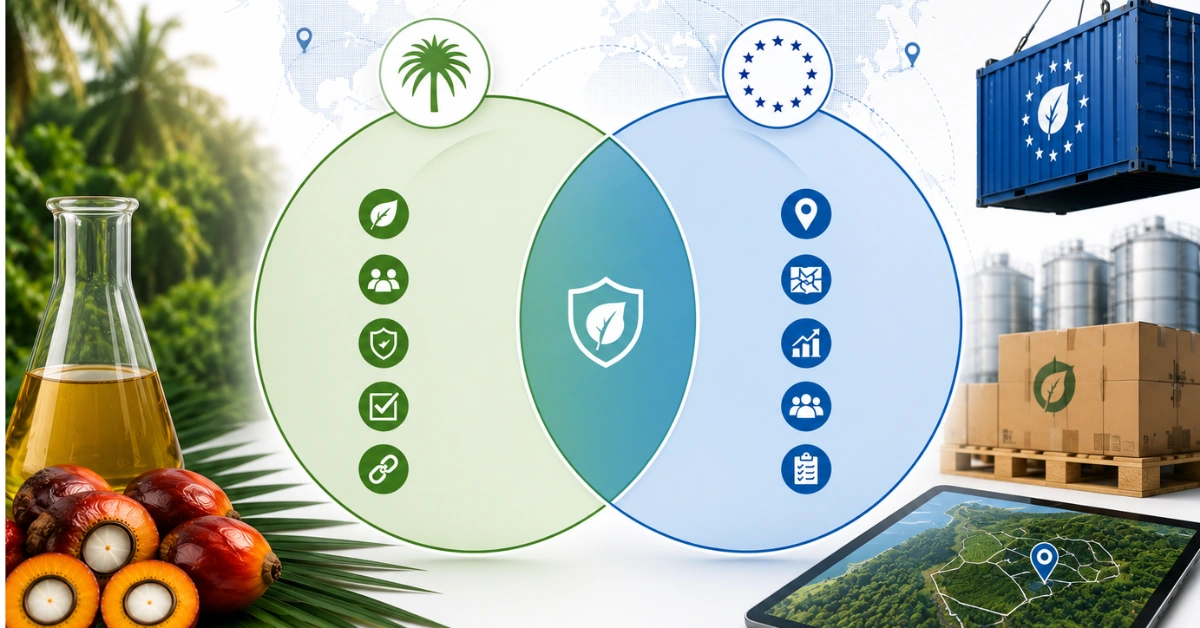
RSPO EUDR is the question every certified palm oil business is asking right now: we hold the certificate does that mean we comply with the EU Deforestation Regulation? The short answer is no, but it helps more than almost anything else you could already have in place.
In plain language: RSPO is a voluntary sustainability certification for palm oil; EUDR is a binding EU regulation that requires per-shipment, plot-level proof that products are deforestation-free and legally produced. One is a scheme you join; the other is a legal obligation you must evidence, shipment after shipment.
The worst assumption a certified business can make before the 30 December 2026 deadline is that the certificate is the compliance. A DDS must be filed regardless of certification status and shipments without a valid DDS reference number do not enter the EU market. This guide maps where RSPO EUDR overlap is real, where the gaps are, and how to close them without building a second compliance operation from scratch.
KEY TAKEAWAYS
RSPO EUDR alignment is strong on principles of traceability, no-deforestation, third-party audits but EUDR is a per-shipment legal obligation, not a label.
EUDR requires polygon geolocation, a deforestation-free proof point of 31 December 2020, and a DDS filed in EU TRACES none of which an RSPO certificate satisfies on its own.
RSPO certification is genuinely valuable as risk-mitigation evidence under EUDR Article 10 and as a source of existing plot data for certified estates.
The biggest RSPO EUDR gaps sit in Mass Balance supply chains, smallholder FFB aggregation, and shipment-level volume attribution.
Deadlines: 30 December 2026 for large/medium operators, 30 June 2027 for micro/small operators [verify].
A compliance platform from TraceX converts RSPO scheme data into EUDR-ready DDS submissions instead of forcing a parallel manual process.
Don’t Leave Your EUDR Readiness to the Last Minute
Book a complimentary EUDR Readiness Consultation with TraceX experts and receive your free EUDR Implementation Handbook.
This section explains the legal distinction that determines everything else why a voluntary scheme cannot discharge a regulatory duty.
EUDR is a regulation, not a certification there is no ‘EUDR certificate’
The DDS obligation sits with the operator placing product on the EU market
Certification is admissible as risk-mitigation evidence, not as a substitute
What EUDR Actually Demands From Palm Oil Businesses
The EU Deforestation Regulation (EU 2023/1115) requires that palm oil along with soy, coffee, cocoa, cattle, rubber, and wood placed on or exported from the EU market is deforestation-free (no deforestation after 31 December 2020), legally produced under origin-country law, and covered by a Due Diligence Statement submitted in EU TRACES with polygon geolocation of every production plot. Responsibility cannot be delegated upstream: even if a supplier provides bad data, the operator filing the DDS carries the legal risk.
Where the ‘RSPO Equals Compliance’ Myth Comes From
The confusion is understandable. RSPO EUDR overlap is real at the level of intent both target deforestation-free palm oil, traceability, and verification. The industry’s 2024-era assumption was that a mature certification would be recognized as equivalent. The final regulation went the other way: certifications may be used within the risk assessment, but a logo, audit report, or supplier self-declaration is insufficient on its own. Single GPS points don’t pass either authorities expect GeoJSON polygons representing actual plot boundaries.
The Deadlines That Make This Urgent
Following the December 2025 amending regulation, large and medium operators must comply by 30 December 2026, and micro/small operators by 30 June 2027. The extension changed the date not the substance. Geolocation, risk assessment, and TRACES submission requirements remain fully intact, and non-compliance exposes operators to fines of up to at least 4% of EU-wide turnover, product seizure, and exclusion from public procurement
RSPO EUDR Alignment: What Your Certification Genuinely Covers
This section gives certified businesses credit where it’s due the three areas where RSPO materially accelerates EUDR readiness.
Traceability infrastructure through SCCS and PalmTrace
No-deforestation standards aligned with EUDR’s environmental core
Independent third-party verification that strengthens risk assessment
Traceability & Transparency Through the RSPO Supply Chain
RSPO-certified companies already map their palm oil supply chains under the Supply Chain Certification Standard (SCCS), and PalmTrace tracks certified volumes from mill onward. For Identity Preserved and Segregated models, a certified business often already knows its mills and certified estates frequently hold existing polygon data, a head start most uncertified competitors lack. Under EUDR Article 10, this documented chain of custody is legitimate, weight-bearing risk-mitigation evidence.
Environmental Standards That Mirror EUDR’s Core
RSPO’s Principles & Criteria prohibit new planting on primary forest and High Conservation Value (HCV) areas, ban fire-based land clearing, and protect peatlands. Producers who have operated under these standards since before the 2020 cut-off are structurally far less likely to fail a deforestation check against satellite imagery. Groups like Golden Agri-Resources built no-deforestation and peatland-protection policies through RSPO adoption years before EUDR existed that history now functions as a de-risking asset in due diligence.
Verification and Audit Trails Regulators Respect
RSPO certification requires independent third-party audits against published criteria. An audit report doesn’t replace a DDS, but it strengthens the credibility of your risk assessment and reduces the verification burden for the plots and mills it covers. Brands like Unilever, Nestlé, and L’Oréal have long used RSPO documentation as the transparency backbone of palm oil sourcing the same documentation now feeds directly into EUDR due diligence files.
Risk assessment is at the core of EUDR compliance.
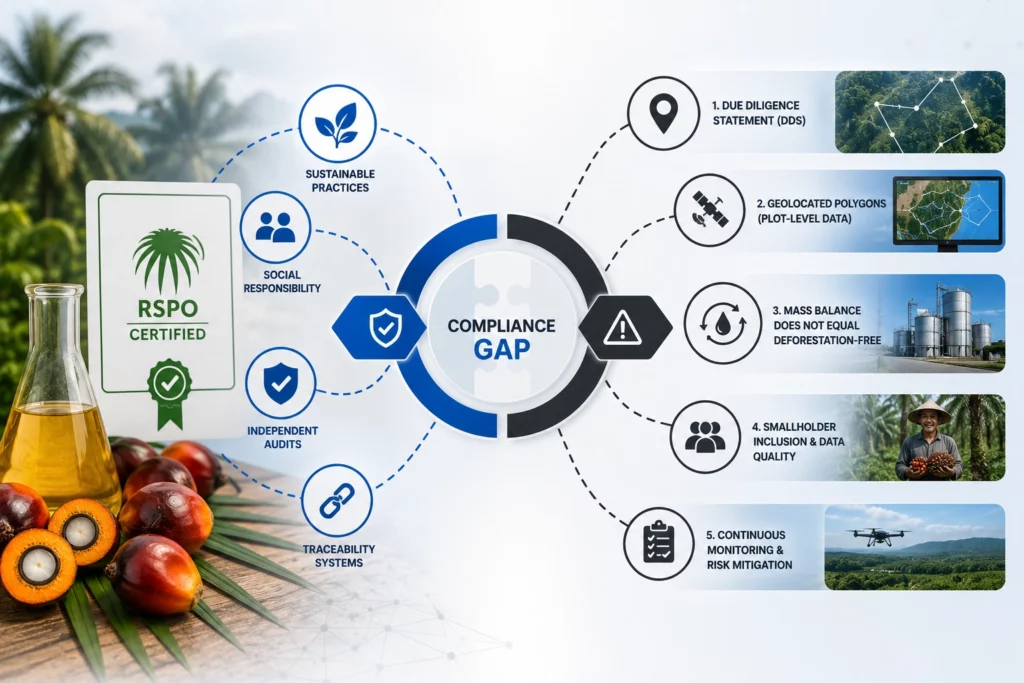
RSPO EUDR Gaps: The 5 Places Certification Falls Short
This is the commercially decisive section the specific, named gaps that certified businesses must close before their first DDS.
No DDS filing, no polygon mandate, no shipment-level attribution
Mass Balance and Book & Claim models break physical traceability
Smallholder FFB aggregation is where most palm chains lose the plot literally
Gap 1 — No Due Diligence Statement
RSPO has no mechanism to file a DDS in EU TRACES. Every shipment of in-scope palm product needs a DDS reference number before it can legally enter the EU. This is an operator obligation that exists entirely outside the certification scheme.
Gap 2 — Polygon Geolocation for Every Plot
EUDR requires GeoJSON polygon boundaries for each production plot (points are only acceptable for plots under 4 hectares). RSPO certification does not mandate polygon submission for every supplying plot particularly across independent smallholder bases so certified supply chains routinely have large geolocation blind spots.
Do you have the geolocation data needed for EUDR compliance?
Most RSPO-certified volume trades under the Mass Balance model, where certified and conventional oil mix physically. EUDR doesn’t recognize an accounting claim: the physical product in the shipment must trace to compliant plots with volume attribution. Mixing sources without attribution breaks traceability in exactly the way authorities have said they will reject.
Gap 4 — Smallholder and FFB Agent Aggregation
Palm supply chains commonly break at the Fresh Fruit Bunch agent level, where fruit from hundreds of smallholders is aggregated before the mill. Smallholders producing a large share of global palm oil often lack the tools to produce polygon maps, land documents, and legality records and certification status at the mill does nothing to generate that upstream data.
Sourcing from multiple farms or suppliers? Traceability becomes more complex.
An RSPO audit is periodic; EUDR compliance is continuous and attaches to every consignment. Land-use change after your last audit, an expired permit, or a new supplier entering the pool must be caught in near-real time a monitoring cadence certification was never designed to deliver.
RSPO EUDR Compliance Workflow: Turning Your Certificate Into a Filed DDS
This section sequences the practical work how a certified operator gets from ‘we hold the certificate’ to ‘every shipment carries a valid DDS reference’.
Start from RSPO data you already hold; don’t rebuild from zero
Close geolocation and legality gaps supplier by supplier
Automate risk assessment and DDS generation before volumes scale
Step 1 — Inventory Your RSPO Data Assets
Pull together SCCS chain-of-custody records, PalmTrace transactions, estate polygon files, HCV assessments, and audit reports. For certified estates this often covers a meaningful share of the geolocation requirement on day one. Map which supplying plots, mills, and volumes are covered and which aren’t.
Step 2 — Close the Polygon and Legality Gaps
For every uncovered plot typically independent smallholders behind FFB agents mobilize field-level GPS polygon capture and collect land and legality documentation. Exporters running this at scale routinely need data from thousands of farmers per season, which is why mobile capture tools that work offline and sync centrally are the difference between a 10-week program and a 10-month one.
Step 3 — Verify Against the 2020 Cut-off
Every polygon must be checked against satellite imagery and deforestation databases for land-use change after 31 December 2020. Certified status lowers the expected failure rate; it does not remove the obligation to run the check and document the result for each plot.
Step 4 — Assess Risk, Mitigate, and File the DDS
Combine plot data, legality documents, RSPO evidence, and country benchmarking into a documented risk assessment; mitigate where risk is non-negligible. Then generate and submit the DDS in EU TRACES for each shipment, retaining all records for five years. A single invalid polygon, wrong HS code, or unsupported geolocation format can trigger a TRACES rejection that blocks the shipment at customs pre-submission validation is the whole game.
Confused about how to file an EUDR Due Diligence Statement?
RSPO EUDR Readiness: Certification Alone vs. Certification + Compliance Platform
EUDR Obligation
RSPO Certification Alone
RSPO + TraceX
Polygon geolocation for all plots
Partial certified estates only; smallholder gaps
Mobile polygon capture, offline sync, auto-validation against satellite data
Deforestation check vs. 2020 cut-off
Indirect audit-based, periodic
Automated per-plot satellite screening with documented evidence
Legality documentation
Covered at audit level, not per plot
AI document parsing extracts and files land titles, permits, KYC at scale
Risk assessment & mitigation
Supports as evidence only
Structured Article 10 workflow with country benchmarking built in
DDS creation & TRACES filing
Not covered
Auto-generated, validated DDS per shipment with reference tracking
Volume attribution (Mass Balance risk)
Not covered accounting claim only
Batch-level traceability from plot to shipment
Continuous monitoring
Annual audit cycle
Ongoing alerts on land-use change, expiring documents, new suppliers
5-year record retention
Manual
Immutable, time-stamped, audit-ready records
RSPO EUDR Automation With TraceX
How the platform converts existing certification assets into filed, defensible due diligence without a parallel manual process.
Ingests RSPO estate polygons and certificates as risk-mitigation evidence
Fills smallholder gaps with field-level polygon capture
Automates the deforestation check, risk assessment, and DDS filing
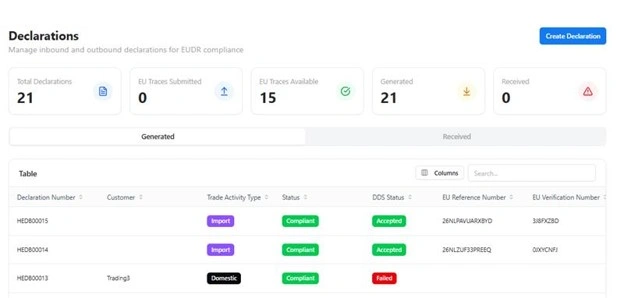
TraceX EUDR Solutions is purpose-built for the position certified palm oil businesses are in: valuable scheme data in one place, a legal filing obligation in another, and a smallholder data gap in between. The platform digitally onboards suppliers with GPS-verified plot mapping and multilingual Smart Assessment Questionnaires, parses land titles, RSPO certificates, and KYC files with agentic AI, cross-checks every polygon against satellite imagery and deforestation databases, and compiles verified data into EUDR-compliant DDS submissions for EU TRACES. In one upstream deployment, AI parsing of supplier documents takes a high compliance coverage of sourced volume within a few weeks. Your RSPO investment becomes the foundation of EUDR compliance instead of a false sense of security.
READY TO TURN YOUR RSPO CERTIFICATE INTO FILED EUDR COMPLIANCE?
Your certification is a head start but only a valid DDS reference number gets your palm oil across the EU border. See how TraceX Cleara AI converts your RSPO data into audit-ready, shipment-level compliance before the 30 December 2026 deadline.
Use this to pressure-test your readiness and any vendor claiming to close the gap:
Have we mapped which of our supplying plots already have polygon data via RSPO estate records?
What share of our volume moves under Mass Balance, and how will we attribute physical volumes to compliant plots?
Do we have a plan (and tooling) for polygon capture across smallholder and FFB-agent supply?
Can we run automated deforestation checks against the 31 December 2020 cut-off for every plot?
Who in our organization owns DDS filing in EU TRACES, and is the workflow validated against common rejection causes?
Are RSPO audit reports and certificates structured as citable risk-mitigation evidence in our due diligence files?
Can we retain and retrieve all compliance records for five years, per shipment?
Does our platform integrate with our ERP so compliance data flows without manual re-entry?
Frequently Asked Questions (FAQ’s)
Does RSPO certification satisfy EUDR requirements?
No. RSPO certification supports EUDR risk mitigation and supplies useful traceability and audit evidence, but operators must still provide polygon geolocation, verify deforestation-free status after 31 December 2020, and file a Due Diligence Statement in EU TRACES for every shipment.
What is the difference between RSPO and EUDR?
RSPO is a voluntary sustainability certification scheme for palm oil governed by a multi-stakeholder roundtable. EUDR is binding EU law that applies to seven commodity groups and attaches legal, per-shipment due diligence obligations to the operator placing product on the EU market.
Can RSPO polygon data be reused for EUDR?
Often, yes. Certified estates frequently hold polygon boundary data from HCV assessments and certification mapping that can be ingested directly into EUDR due diligence one of the biggest practical head starts certification provides.
Does Mass Balance certified palm oil pass EUDR?
Not by itself. EUDR requires the physical product to trace to compliant plots with volume attribution. Because Mass Balance mixes certified and conventional oil, operators need batch-level traceability on top of the certification claim.
When do palm oil businesses need to comply with EUDR?
Large and medium operators must comply by 30 December 2026; micro and small operators by 30 June 2027, following the December 2025 amendment [verify]. Deforestation-free status is assessed against a 31 December 2020 cut-off regardless of company size.
How does TraceX help RSPO-certified companies with EUDR?
TraceX AI Solutions ingests existing RSPO data as risk-mitigation evidence, captures missing smallholder polygons via mobile field tools, runs automated satellite deforestation checks, parses legality documents with AI, and generates validated DDS submissions for EU TRACES turning certification assets into filed compliance.
Start using TraceX
Transparency, Trust, & Success for your Climate Journey.
We use cookies on our website to give you the most relevant experience by remembering your preferences and repeat visits. By clicking “Accept All”, you consent to the use of ALL the cookies. However, you may visit "Cookie Settings" to provide a controlled consent.
This website uses cookies to improve your experience while you navigate through the website. Out of these, the cookies that are categorized as necessary are stored on your browser as they are essential for the working of basic functionalities of the website. We also use third-party cookies that help us analyze and understand how you use this website. These cookies will be stored in your browser only with your consent. You also have the option to opt-out of these cookies. But opting out of some of these cookies may affect your browsing experience.
Necessary cookies are absolutely essential for the website to function properly. These cookies ensure basic functionalities and security features of the website, anonymously.
Cookie
Duration
Description
cookielawinfo-checkbox-analytics
11 months
This cookie is set by GDPR Cookie Consent plugin. The cookie is used to store the user consent for the cookies in the category "Analytics".
cookielawinfo-checkbox-functional
11 months
The cookie is set by GDPR cookie consent to record the user consent for the cookies in the category "Functional".
cookielawinfo-checkbox-necessary
11 months
This cookie is set by GDPR Cookie Consent plugin. The cookies is used to store the user consent for the cookies in the category "Necessary".
cookielawinfo-checkbox-others
11 months
This cookie is set by GDPR Cookie Consent plugin. The cookie is used to store the user consent for the cookies in the category "Other.
cookielawinfo-checkbox-performance
11 months
This cookie is set by GDPR Cookie Consent plugin. The cookie is used to store the user consent for the cookies in the category "Performance".
viewed_cookie_policy
11 months
The cookie is set by the GDPR Cookie Consent plugin and is used to store whether or not user has consented to the use of cookies. It does not store any personal data.
Functional cookies help to perform certain functionalities like sharing the content of the website on social media platforms, collect feedbacks, and other third-party features.
Performance cookies are used to understand and analyze the key performance indexes of the website which helps in delivering a better user experience for the visitors.
Analytical cookies are used to understand how visitors interact with the website. These cookies help provide information on metrics the number of visitors, bounce rate, traffic source, etc.
Advertisement cookies are used to provide visitors with relevant ads and marketing campaigns. These cookies track visitors across websites and collect information to provide customized ads.
Download the 2026 Traceability Scorecard and Benchmark Your Supply Chain Across 10 Critical Capabilities.
Download our eBook
Don’t Wait for an Audit to Find Your EUDR Gaps
The 2026 Simplification Package changes how HS codes, DDS pass-through and geolocation rules apply to you. Get the free guide and 20-point readiness checklist before enforcement catches you unprepared.