Battery Passport Identification & QR Codes: What Must Be Live by 18 February 2027
Published
, 8 minute read
Share this article
Quick summary: Battery Passport Identification & QR Codes explained: ISO/IEC 15459 IDs, Article 13 QR marking and DPP registry upload, all due 18 February 2027.
Battery passport identification & QR codes are the two linked elements that give each in-scope battery a digital identity under EU Regulation 2023/1542. From 18 February 2027, every battery placed on the EU market needs a QR code, and LMT batteries, EV batteries and industrial batteries above 2 kWh need a battery passport reached through that code and tied to an ISO/IEC 15459 unique identifier.
In plain terms, the unique identifier answers “which battery is this?”, and the QR code is how a person or a machine reaches that battery’s record. Get battery passport identification & QR codes right and every later obligation, from due diligence to recycled-content reporting, has a stable place to live. Get them wrong and you are reprinting housings, re-keying databases and explaining gaps to market surveillance authorities.
KEY TAKEAWAYS
18 February 2027: QR code on all batteries (Article 13(6)); passport for LMT, EV and industrial batteries above 2 kWh (Article 77(1)).
Identifier standard: ISO/IEC 15459 series or equivalent, assigned by the operator placing the battery on the market (Article 77(3)).
Registry: the identifier must be uploaded to the EU DPP registry set up under ESPR Article 13 (Article 77(10)).
Marking: printed or engraved visibly, legibly and indelibly; packaging is a fallback only where size or nature rules out the battery itself (Article 13(7)).
Next wave: supply chain due diligence follows on 18 August 2027.
Download our eBook
Explore the key steps, challenges and considerations for building a reliable Battery Passport strategy.
Battery Passport Identification & QR Codes: What Regulation 2023/1542 Requires
Two articles carry most of the load: Article 13 for the QR code and Article 77 for the passport and its identifier.
Article 13(6): QR code on every battery from 18 February 2027
Article 77(1): battery passport for LMT, EV and industrial batteries above 2 kWh
Article 77(3): one unique identifier per passport, ISO/IEC 15459 or equivalent
Article 77(10): identifier uploaded to the EU DPP registry
Many teams treat battery passport identification & QR codes as a labelling job for the packaging line. That framing misses the point. The QR code is only a data carrier. The identifier is a key into a live record that has to stay accurate, complete and up to date through service, repair, repurposing and recycling.
A QR code without a governed identifier behind it is a sticker, not a passport.
Battery passport scope: which batteries need a passport, which need only a QR code
Every battery gets a QR code, including portable and SLI batteries. For LMT batteries, EV batteries and industrial batteries above 2 kWh, that code must open the battery passport. For all other batteries, it opens the label information and related documents required by Article 13, such as the EU declaration of conformity.
Battery passport identification & QR codes on the 2027 timeline
Regulation (EU) 2025/1561 pushed due diligence obligations to 18 August 2027. It did not move the passport or QR code date. Plan for a six-month gap in which your identifiers and data carriers must already work while your due diligence records are still maturing.
SEE HOW IT WORKS
Want to see identifier assignment, QR generation and passport publishing in one flow?
Battery Passport Identification: How the Unique Identifier Works
The unique identifier is the anchor for every data point in the passport, so its design decisions are hard to reverse.
Built on the ISO/IEC 15459 series or an equivalent standard
Assigned by the economic operator placing the battery on the market
Registered in the EU DPP registry through a standardised interface
Battery passport identifier standards: the ISO/IEC 15459 series
ISO/IEC 15459 defines how globally unique identifiers are issued through registered issuing agencies. In practice, many manufacturers build on an existing issuing agency scheme they already use for parts and logistics. The regulation does not mandate a single vendor or a single scheme, but it does require interoperability with other European digital product passports. Harmonised DPP standards covering identifiers and data carriers were published in 2026, so align your scheme with those before you print a single code.
Battery passport identifier ownership: who assigns and maintains it
The operator placing the battery on the market assigns the identifier and is responsible for keeping passport data current. It may authorise another operator in writing to act on its behalf. When a battery is repaired, repurposed or remanufactured and its status changes, responsibility shifts to the operator who changed it, and a new passport is linked to the original. Your identifier scheme must handle that parent and child relationship from day one.
Battery passport identifier registration in the EU DPP registry
The EU DPP registry under ESPR went live on 20 July 2026. Article 77(10) requires the identifier for each battery passport to be uploaded to it. Registration runs through an API, not a web form, so treat battery passport identification & QR codes as an integration project for IT and compliance together.
Battery Passport QR Codes: Marking Rules Under Article 13
The QR code is the physical link between the battery and its data, so it must survive the battery’s full working life.
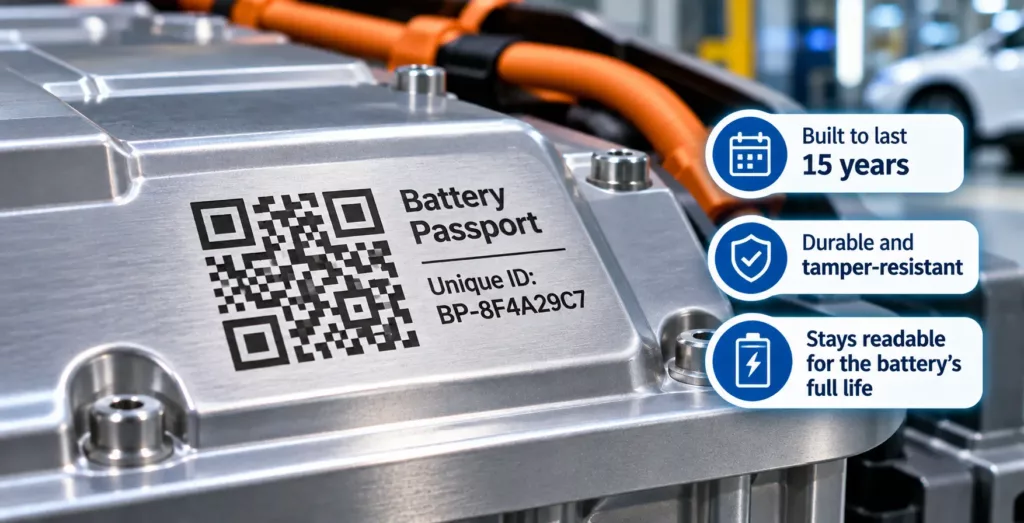
Printed or engraved visibly, legibly and indelibly on the battery
High contrast and readable by common handheld devices (Annex VI Part C)
Packaging and accompanying documents only where the battery itself cannot carry it
Battery passport QR code placement and durability
An EV or industrial battery may spend ten to fifteen years exposed to heat, vibration and cleaning agents before it reaches a recycler. The recycler still needs to scan it, and if the code fails, battery passport identification & QR codes fail together because the record becomes unreachable. That is why many manufacturers are testing direct part marking such as laser engraving on housings. Validate your chosen method against Article 13(7) with your legal team rather than relying on a marking supplier’s reading of “indelible”.
Battery passport QR code access tiers
One scan does not show everyone the same data. Article 77(2) and Annex XIII split passport content into three levels: information open to the public, information for persons with a legitimate interest such as repairers and recyclers, and information reserved for notified bodies, market surveillance authorities and the Commission. Battery passport identification & QR codes therefore need role-based access behind the link, not a static web page.
Battery Passport Identification & QR Codes: Manual vs Platform Approach
Most compliance gaps appear where identifiers, codes and data are managed in separate tools.
Spreadsheets and standalone QR generators break at serial-level scale
A connected platform keeps identifier, code, data and registry in sync
Requirement
Manual / spreadsheet approach
Platform approach
ISO/IEC 15459 identifier per battery
Ranges tracked by hand; duplicates likely
Issued automatically per unit and checked for uniqueness
QR code generation
Static codes from free generators
Codes generated from the identifier and linked to a live record
Access tiers (Article 77(2))
One public page for everyone
Role-based views for public, legitimate interest and authorities
DPP registry upload (Article 77(10))
Manual exports, no audit trail
API submission with logs
Repurposing and repair
New records with no link to the original
Parent and child passports linked
For low volumes a manual set-up can work for a pilot. Once you are passporting thousands of EV or industrial batteries a year, battery passport identification & QR codes become a data-governance system, and spreadsheets cannot provide the audit trail an inspector will ask for.
The TraceX DPP platform treats battery passport identification & QR codes as one system, with the identifier as the source of truth. It assigns ISO/IEC 15459-aligned identifiers at serial level, generates the linked QR code, manages Annex XIII data with tiered access and prepares registry submissions. TraceX is GDPR, ISO 27001 and SOC 1 & 2 compliant, so sensitive supplier and performance data stays protected behind the scan.
See identifiers, QR codes and passport data managed in one place.
Battery Passport Identification & QR Codes Readiness Checklist
Use these questions to judge whether your current set-up, or any vendor you are evaluating, is ready for 2027.
Which ISO/IEC 15459 issuing agency scheme will we use, and does it match the 2026 harmonised DPP standards?
Can the system assign identifiers at individual battery level, not just model level?
Does each QR code resolve to a passport with three access tiers?
Is the marking method tested for indelibility over the battery’s expected life?
Can we upload identifiers to the EU DPP registry by API, with a log?
How are repurposed or remanufactured batteries linked to their original passport?
Who signs off on data accuracy, and how is every change recorded?
Frequently Asked Questions
Do all batteries need a battery passport?
No. Only LMT batteries, EV batteries and industrial batteries above 2 kWh need a passport. All batteries need a QR code from 18 February 2027.
What standard does the battery passport identifier follow?
Battery passport identifier follows the ISO/IEC 15459 series or an equivalent standard, as required by Article 77(3) of Regulation 2023/1542.
Can the QR code go on the packaging instead of the battery?
Only where the nature or size of the battery makes marking it impossible or unwarranted. In that case, the code goes on the packaging and the accompanying documents.
Does the identifier need to be registered anywhere?
Yes. Article 77(10) requires the identifier to be uploaded to the EU DPP registry created under the ESPR, which went live in July 2026.
Did the 2025 postponement change the passport deadline?
No. Regulation (EU) 2025/1561 moved due diligence to 18 August 2027. Battery passport identification & QR codes remain due on 18 February 2027.
Start using TraceX
Transparency, Trust, & Success for your Climate Journey.
We use cookies on our website to give you the most relevant experience by remembering your preferences and repeat visits. By clicking “Accept All”, you consent to the use of ALL the cookies. However, you may visit "Cookie Settings" to provide a controlled consent.
This website uses cookies to improve your experience while you navigate through the website. Out of these, the cookies that are categorized as necessary are stored on your browser as they are essential for the working of basic functionalities of the website. We also use third-party cookies that help us analyze and understand how you use this website. These cookies will be stored in your browser only with your consent. You also have the option to opt-out of these cookies. But opting out of some of these cookies may affect your browsing experience.
Necessary cookies are absolutely essential for the website to function properly. These cookies ensure basic functionalities and security features of the website, anonymously.
Cookie
Duration
Description
cookielawinfo-checkbox-analytics
11 months
This cookie is set by GDPR Cookie Consent plugin. The cookie is used to store the user consent for the cookies in the category "Analytics".
cookielawinfo-checkbox-functional
11 months
The cookie is set by GDPR cookie consent to record the user consent for the cookies in the category "Functional".
cookielawinfo-checkbox-necessary
11 months
This cookie is set by GDPR Cookie Consent plugin. The cookies is used to store the user consent for the cookies in the category "Necessary".
cookielawinfo-checkbox-others
11 months
This cookie is set by GDPR Cookie Consent plugin. The cookie is used to store the user consent for the cookies in the category "Other.
cookielawinfo-checkbox-performance
11 months
This cookie is set by GDPR Cookie Consent plugin. The cookie is used to store the user consent for the cookies in the category "Performance".
viewed_cookie_policy
11 months
The cookie is set by the GDPR Cookie Consent plugin and is used to store whether or not user has consented to the use of cookies. It does not store any personal data.
Functional cookies help to perform certain functionalities like sharing the content of the website on social media platforms, collect feedbacks, and other third-party features.
Performance cookies are used to understand and analyze the key performance indexes of the website which helps in delivering a better user experience for the visitors.
Analytical cookies are used to understand how visitors interact with the website. These cookies help provide information on metrics the number of visitors, bounce rate, traffic source, etc.
Advertisement cookies are used to provide visitors with relevant ads and marketing campaigns. These cookies track visitors across websites and collect information to provide customized ads.