EUDR Circumvention Risk: What It Means, How to Identify It & How Businesses Can Respond
Published
, 9 minute read
Share this article
Quick summary: EUDR circumvention risk: detect origin, volume, mixing and traceability gaps, strengthen due diligence, and reduce compliance exposure before EU market entry.
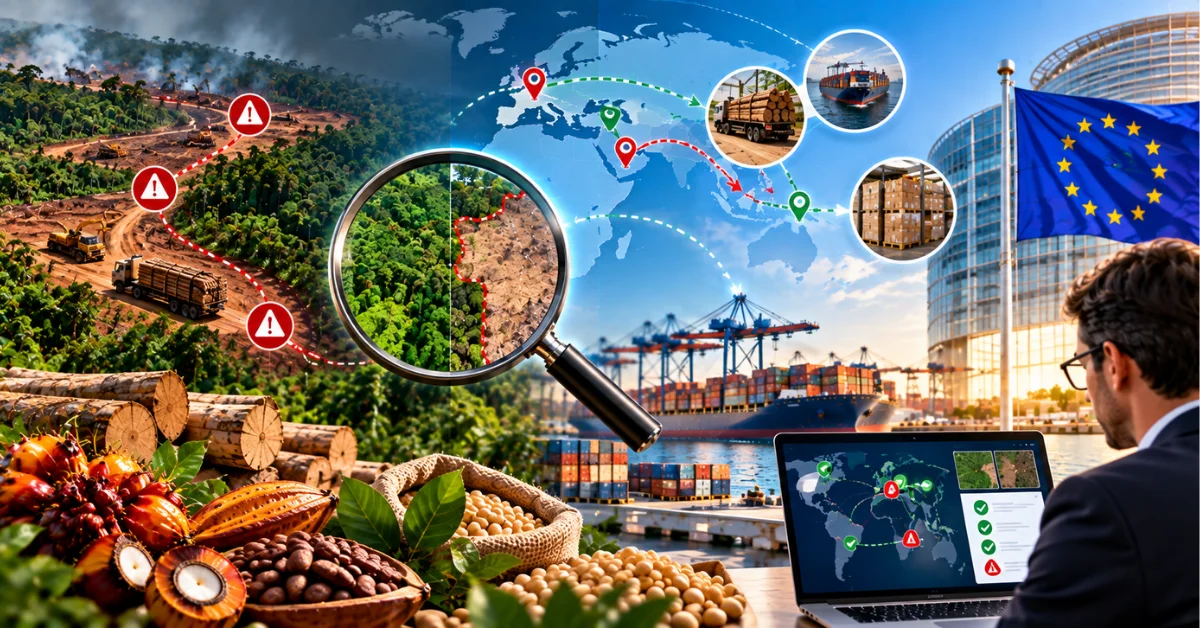
EUDR circumvention risk is the risk that relevant commodities or products enter an EU supply chain through arrangements that obscure their true origin, production conditions, or connection to the plots where commodities were produced. Under Article 10 of the EU Deforestation Regulation (EUDR), operators must consider the risk of circumvention and the risk of mixing with relevant products of unknown origin or products from areas where deforestation or forest degradation has occurred or is occurring.The issue is therefore broader than checking whether a supplier has submitted a valid geolocation. Businesses need to determine whether the declared source, quantities, suppliers, processing steps and supporting evidence form a consistent and traceable picture. Commission guidance explains that unidentified steps, inconsistent information and difficulties tracing products back to production plots can increase the risk of non-compliance.
EUDR Circumvention Risk: Key Takeaways
Circumvention risk is an explicit factor in EUDR Article 10 risk assessment.
A valid geolocation file alone does not prove that the declared supply base accounts for the relevant product.
Plot-to-volume, supplier-to-plot and source-to-shipment relationships should be checked for consistency.
Processing in another country does not automatically replace the original country of production in the traceability record.
Mixing with unknown-origin material can create a specific EUDR risk.
Discrepancies are verification triggers, not automatic proof of non-compliance.
Where risk is more than negligible, Article 11 risk mitigation measures may be required.
December 2026 is approaching. Is your supply chain actually ready?
Move from spreadsheets and fragmented supplier data to a traceable, audit-ready EUDR workflow with TraceX.
EUDR is built around traceability to the place of production. Article 9 requires operators to collect information including the country of production and geolocation of all plots where the relevant commodity was produced. Article 10 then requires operators to verify and analyse that information and assess whether the product presents a risk of non-compliance.Circumvention risk can arise when the available information does not provide a credible connection between the commodity and its declared source. This does not mean every inconsistency proves circumvention. Instead, inconsistencies should be treated as signals that may require additional verification or risk mitigation.
Learn how to build an Article 10-compliant risk assessment process, identify red flags early, and create an audit-ready workflow.
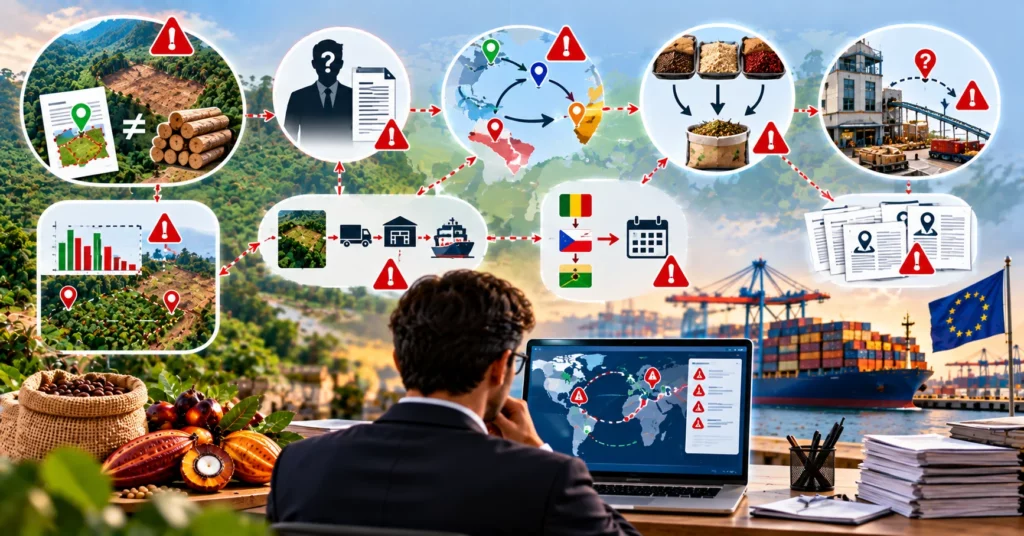
Consider a plywood manufacturer purchasing 10,000 m³ of timber from multiple suppliers. The company declares source information for 100 production plots covering 5,000 hectares. During an internal review, the operator finds that the declared plots and available production records appear to support only around 6,000–7,000 m³.The gap does not automatically establish non-compliance. Different tree species, harvesting conditions, yield assumptions, additional legitimate sourcing arrangements, or conversion factors may explain the difference. However, the discrepancy should trigger questions: Are all source plots declared? Are suppliers sourcing timber from additional areas? Are volumes correctly linked to plots? Is material of unknown origin being mixed into the supply chain?A practical validation chain is: Forest Plot → Harvest Volume → Supplier → Timber Receipt → Production Batch → EU Shipment.
Learn how EUDR plot data verification can help identify potential gaps such as incorrect boundaries, missing plots, repeated source data, and unusual plot-to-volume relationships before they become compliance issues.
Imagine a coffee exporter reports 1,000 tonnes of coffee from 200 declared plots covering 400 hectares. If available production information indicates that the declared plots would reasonably support substantially less volume, the difference becomes a verification trigger.The operator should investigate whether additional plots exist, whether suppliers source from other farms, whether volume has been attributed to the wrong plots, or whether conversion factors between different coffee forms explain the difference. Yield variability may also be legitimate. The important point is that a volume-to-plot discrepancy should prompt investigation rather than being treated automatically as a compliance failure.
3: Processing in a Low-Risk Country
The EUDR itself gives a clear example of potential circumvention: a relevant commodity or product produced in a higher-risk country could subsequently be processed in a low-risk country and then placed on or enter the EU market with documentation suggesting that the product was produced in the low-risk country.This is why country of processing should not replace country of production in the compliance record. The operator needs to preserve the origin and traceability of the relevant commodity through processing. Competent authorities can take further action when information points to a risk that the Regulation is being circumvented.
4: Mixing Unknown-Origin Material
Consider a manufacturer that purchases verified timber from declared plots but also receives additional timber through an intermediary without complete source information. If the materials are mixed and the final shipment cannot be reliably connected to the declared production plots, the operator may face a traceability and circumvention risk.Article 10 specifically requires consideration of the risk of mixing with relevant products of unknown origin or products produced in areas where deforestation or forest degradation has occurred or is occurring. A robust workflow therefore needs to maintain source-to-material links even when commodities are aggregated or processed.
Learn how aggregated traceability in EUDR can help you manage multiple sources, maintain source-level visibility, and build a more structured and audit-ready traceability process.
What Are the Warning Signs of EUDR Circumvention Risk?
Common warning signs include:
Large gaps between declared production areas and reported procurement volumes.
Suppliers that cannot explain the origin of all material supplied.
Unidentified or undocumented steps between the production plot and the EU-bound product.
Sudden changes in sourcing countries, suppliers or declared production areas.
Material from different origins being mixed without reliable segregation or traceability.
Processing through another country while the original production source is unclear.
Inconsistent supplier, procurement, geolocation, quantity or shipment records.
Repeated reliance on incomplete or unverifiable source information.
How to Assess EUDR Circumvention Risk
A practical assessment should connect Article 9 information with the actual movement of material through the supply chain. Start with the source plot and work forward to the supplier, procurement transaction, processing stage, batch and EU shipment. Then work backwards from a finished shipment to determine whether every relevant input can be traced to an identified production source.Businesses can strengthen this process by comparing plot area and production information with procurement quantities, checking supplier declarations against transaction records, validating geolocation, documenting processing and conversion factors, and maintaining evidence for each material flow. Where a discrepancy cannot be explained, it should be escalated for further verification and, where necessary, risk mitigation.
Learn how to structure an effective EUDR risk assessment process, identify potential compliance gaps, and strengthen your due diligence before products reach the EU market.
EUDR Circumvention Risk and Supply-Chain Complexity
Supply-chain complexity is an explicit Article 10 risk criterion. Commission guidance explains that complexity can increase with the number of processors and intermediaries, the number of countries and plots involved, and the number of relevant products used to manufacture a product. For timber, complexity can also increase when multiple tree species are involved, timber is traded across several countries, or processing takes place in third countries.Businesses should therefore evaluate circumvention risk across the entire route from production plot to the relevant product placed on or exported from the EU market not only at the immediate supplier level.
What Should Businesses Do When a Risk Is Identified?
If the risk assessment does not establish no or only negligible risk, Article 11 requires the operator to adopt adequate risk-mitigation procedures and measures before placing the relevant product on the market or exporting it. Possible actions include collecting additional information or documents, conducting independent surveys or audits, strengthening Article 9 information, or supporting supplier capacity building.The mitigation process should be documented so the business can demonstrate what information was reviewed, what risk was identified, what action was taken, and why the resulting risk was considered acceptable.
How Technology Can Help Detect EUDR Circumvention Risk
EUDR circumvention risk is difficult to manage when supplier records, geolocation files, procurement data, production records and shipment information are stored in separate spreadsheets or systems. A connected compliance workflow can compare source-level information with quantities and downstream transactions. TraceX EUDR Solutions connects these data points in a single compliance workflow, allowing businesses to link source plots to suppliers, procurement, batches and shipments, compare declared source information with quantities and downstream transactions, identify unusual or inconsistent relationships, and flag potential gaps for further verification before relying on the data for EUDR due diligence.A digital workflow can connect: Supplier → Production Plot → Geolocation → Production/Harvest → Procurement → Material/Batch → Risk Assessment → Evidence → Shipment → DDS. Rules can flag unusual volume-to-area relationships, missing source plots, unexplained supplier changes, unknown-origin material and gaps in traceability for review.The goal is not to automate a conclusion of non-compliance. It is to surface anomalies early so compliance teams can investigate them, document the explanation and apply appropriate mitigation where required.
EUDR compliance requires more than collecting supplier declarations and plot coordinates. Businesses need to connect source data, quantities, procurement, processing, traceability, risk assessment and shipment records to identify unexplained gaps before they become compliance issues.
Frequently Asked Questions (FAQ’s)
What is EUDR circumvention risk?
It is the risk that relevant commodities or products enter the supply chain through arrangements that obscure their true origin, production conditions or traceability, including through mixing or processing arrangements.
Does a volume mismatch automatically mean EUDR non-compliance?
No. A mismatch should trigger investigation. Yield variation, conversion factors, additional legitimate sourcing and other factors may explain the difference.
Is mixing relevant under EUDR?
Yes. Article 10 specifically requires operators to consider the risk of mixing with relevant products of unknown origin or products associated with deforestation or forest degradation.
What happens if circumvention risk is more than negligible?
The operator must adopt adequate risk-mitigation procedures and measures under Article 11 before placing the relevant product on the market or exporting it.
Can a low-risk country remove circumvention concerns?
Not automatically. Under Article 13, simplified due diligence requires an assessment of supply-chain complexity and circumvention or mixing risks. If relevant information points to circumvention or non-compliance, the full Articles 10 and 11 obligations apply.
Start using TraceX
Transparency, Trust, & Success for your Climate Journey.
We use cookies on our website to give you the most relevant experience by remembering your preferences and repeat visits. By clicking “Accept All”, you consent to the use of ALL the cookies. However, you may visit "Cookie Settings" to provide a controlled consent.
This website uses cookies to improve your experience while you navigate through the website. Out of these, the cookies that are categorized as necessary are stored on your browser as they are essential for the working of basic functionalities of the website. We also use third-party cookies that help us analyze and understand how you use this website. These cookies will be stored in your browser only with your consent. You also have the option to opt-out of these cookies. But opting out of some of these cookies may affect your browsing experience.
Necessary cookies are absolutely essential for the website to function properly. These cookies ensure basic functionalities and security features of the website, anonymously.
Cookie
Duration
Description
cookielawinfo-checkbox-analytics
11 months
This cookie is set by GDPR Cookie Consent plugin. The cookie is used to store the user consent for the cookies in the category "Analytics".
cookielawinfo-checkbox-functional
11 months
The cookie is set by GDPR cookie consent to record the user consent for the cookies in the category "Functional".
cookielawinfo-checkbox-necessary
11 months
This cookie is set by GDPR Cookie Consent plugin. The cookies is used to store the user consent for the cookies in the category "Necessary".
cookielawinfo-checkbox-others
11 months
This cookie is set by GDPR Cookie Consent plugin. The cookie is used to store the user consent for the cookies in the category "Other.
cookielawinfo-checkbox-performance
11 months
This cookie is set by GDPR Cookie Consent plugin. The cookie is used to store the user consent for the cookies in the category "Performance".
viewed_cookie_policy
11 months
The cookie is set by the GDPR Cookie Consent plugin and is used to store whether or not user has consented to the use of cookies. It does not store any personal data.
Functional cookies help to perform certain functionalities like sharing the content of the website on social media platforms, collect feedbacks, and other third-party features.
Performance cookies are used to understand and analyze the key performance indexes of the website which helps in delivering a better user experience for the visitors.
Analytical cookies are used to understand how visitors interact with the website. These cookies help provide information on metrics the number of visitors, bounce rate, traffic source, etc.
Advertisement cookies are used to provide visitors with relevant ads and marketing campaigns. These cookies track visitors across websites and collect information to provide customized ads.
Download the 2026 Traceability Scorecard and Benchmark Your Supply Chain Across 10 Critical Capabilities.
Download our eBook
Don’t Wait for an Audit to Find Your EUDR Gaps
The 2026 Simplification Package changes how HS codes, DDS pass-through and geolocation rules apply to you. Get the free guide and 20-point readiness checklist before enforcement catches you unprepared.