EUDR Article 10: Risk Assessment Requirements, Criteria & Process
Published
, 8 minute read
Share this article
Quick summary: EUDR Article 10 explains risk assessment criteria, evidence checks, source-level verification, and how businesses can prove negligible risk for EUDR compliance.
EUDR Article 10 is the core provision governing risk assessment under the EU Deforestation Regulation. It requires operators to verify and analyse the information collected under Article 9, together with other relevant documentation, and determine whether there is a risk that a relevant product is non-compliant. An operator cannot place the relevant product on the EU market or export it unless the risk assessment shows no or only a negligible risk of non-compliance.
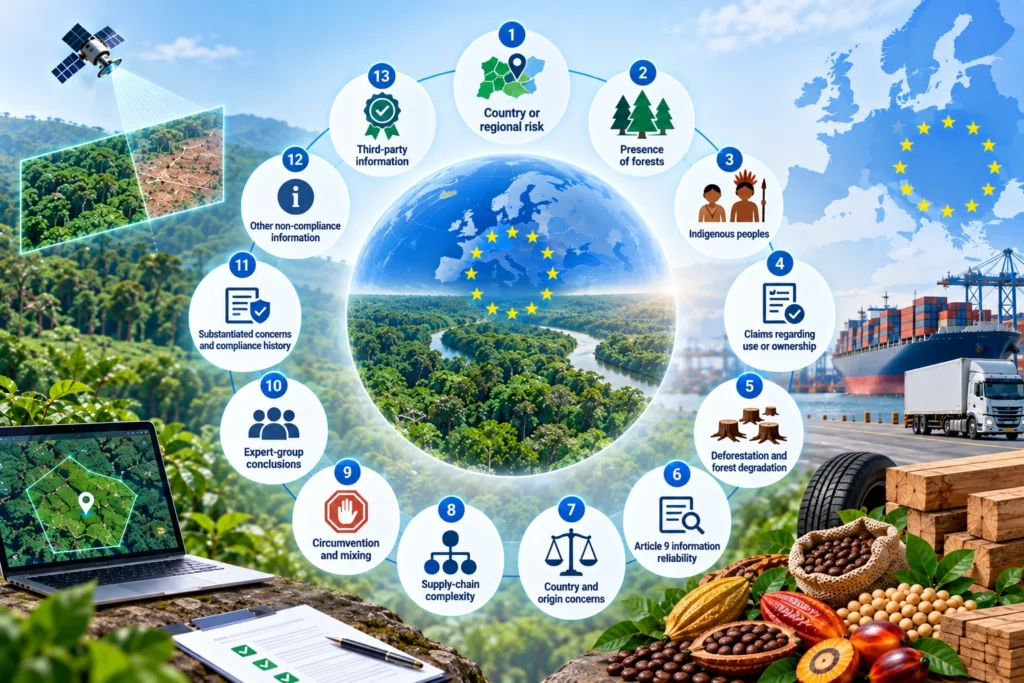
Article 10 turns supply-chain information into a documented compliance decision. Country risk is only one input: the Regulation also identifies forests, indigenous peoples, information reliability, country and origin concerns, supply-chain complexity, circumvention and mixing, substantiated concerns, and other relevant information as assessment criteria.
EUDR Article 10: Key Takeaways
Article 10 requires operators to verify and analyse Article 9 information and other relevant documentation.
The assessment must establish no or only negligible risk of non-compliance before placing/exporting the relevant product.
Country risk is one criterion, not a substitute for the broader assessment.
Supply-chain complexity, source reliability, mixing/circumvention and substantiated concerns can affect the assessment.
Multiple sources or geolocations require appropriate source-level assessment.
Article 10 sits between Article 9 information collection and Article 11 risk mitigation. Article 9 establishes the information, documents and data to be collected. Article 10 requires that information to be verified and analysed through a risk assessment. Article 11 applies when the assessment identifies more than negligible risk. The Commission guidance describes these activities as a connected process that should reflect the operator’s business activities and supply chains.
For complex supply chains, this distinction matters. When products are made with commodities from several sources or geolocations, the Commission guidance states that risk needs to be assessed for each source or geolocation.
Learn how to conduct an effective, documented, and audit-ready EUDR risk assessment.
Consider the risk assignment for the country of production or relevant parts under Article 29. Country risk is an input, not the complete assessment.
Presence of forests
Consider the presence of forests in the country of production or relevant parts.
Indigenous peoples
Consider their presence and the relevant consultation and cooperation requirements.
Claims regarding use or ownership
Consider duly reasoned claims based on objective and verifiable information.
Deforestation and forest degradation
Consider prevalence in the country or relevant parts.
Article 9 information reliability
Assess the source, reliability, validity and links to other documentation.
Country and origin concerns
Consider corruption, document/data falsification, weak law enforcement, relevant human-rights concerns, armed conflict and applicable sanctions.
Supply-chain complexity
Consider the complexity and processing stage, especially difficulty connecting products to the source plot.
Circumvention and mixing
Assess risks involving unknown-origin products or products from areas where deforestation or forest degradation has occurred or is occurring.
Expert-group conclusions
Consider relevant conclusions from Commission expert groups.
Substantiated concerns and compliance history
Consider Article 31 substantiated concerns and relevant history of non-compliance.
Other non-compliance information
Consider any information indicating a risk of non-compliance.
Third-party information
Certification and other verified schemes may provide complementary information where it meets EUDR requirements; they do not replace operator responsibility.
How to Conduct an EUDR Article 10 Risk Assessment
Define the product and sourcing scope Identify the commodity/product, classification, supplier, production country, source areas and supply-chain path.
Collect Article 9 information Collect product description, quantity, country, geolocation, production date/time range, supplier/customer data, deforestation-free evidence and legality evidence.
Learn what EUDR Article 9 requires, which information needs to be collected, and how businesses can build a complete, traceable and audit-ready information workflow.
Verify the information Check completeness, consistency, reliability and supporting evidence. Compare supplier information with procurement, geolocation and documentary records.
Apply the Article 10 criteria Evaluate the applicable country, environmental, social, information-quality, supply-chain, circumvention and compliance factors.
Assess each relevant source Where commodities come from multiple sources or geolocations, assess the applicable risk for each source.
Determine whether risk is negligible Establish whether the evidence supports no or only negligible risk of non-compliance. The Commission guidance describes negligible risk as the conclusion of a full assessment under Article 10 and, where necessary, mitigation under Article 11.
Mitigate where required If more than negligible risk remains, apply appropriate Article 11 measures before placing or exporting the product.
Learn what EUDR Article 11 requires, when risk mitigation is necessary, what measures businesses can consider, and how to document mitigation actions for an audit-ready due diligence process.
Document and review Document the rationale, evidence and decision. Article 10 requires risk assessments to be documented and reviewed at least annually and made available to competent authorities upon request.
EUDR Article 10 vs Country Risk Classification
Country benchmarking and Article 10 risk assessment are related but not interchangeable. A country’s Article 29 classification is one Article 10 criterion. The wider assessment can include source-level information, forest context, information reliability, supply-chain complexity, mixing and circumvention, substantiated concerns and other relevant information.
For sourcing from low-risk countries, Article 13 provides a simplified due diligence route in defined circumstances. Operators still need the applicable Article 9 information and must assess supply-chain complexity and the risk of circumvention or mixing with unknown-origin or standard/high-risk products. If relevant information indicates non-negligible risk, Articles 10 and 11 apply.
Learn how EUDR country risk classification works, what low, standard and high risk mean, and how businesses should incorporate country risk into their overall due diligence workflow.
What Evidence Should Support an Article 10 Assessment?
Evidence should reflect the actual product and supply chain. Depending on the commodity, an Article 10 record may connect supplier declarations, plot-level geolocation, production dates, land-use or legality documents, satellite or remote-sensing findings, procurement records, batch records, transaction documents, certification or other third-party information, and records of identified concerns.
The key is the connection between evidence and decision-making. A business should be able to show not only which documents it collected, but how those documents and other information were evaluated against the Article 10 criteria.
Common EUDR Article 10 Risk Assessment Gaps
Treating country risk classification as the complete assessment.
Using one generic risk score for different suppliers, plots or commodities.
Failing to connect source geolocation with the relevant material, batch or shipment.
Accepting supplier declarations without assessing reliability and supporting evidence.
Ignoring supply-chain complexity or mixing risks.
Failing to document why evidence supports a negligible-risk conclusion.
Not recording substantiated concerns or new information that could change the assessment.
Keeping the assessment as a static document without a review history.
How Digital Systems Can Operationalize EUDR Article 10
For organisations managing hundreds of suppliers, thousands of plots and multiple sourcing countries, Article 10 can be difficult to manage through spreadsheets and disconnected documents. A structured digital workflow can connect supplier onboarding, geolocation validation, source-level traceability, evidence collection, risk criteria, exceptions, mitigation actions and audit records.
TraceX EUDR Solutions support a staged, explainable assessment workflow that evaluates supplier geolocations across multiple satellite and Earth-observation datasets and explicit risk dimensions. The workflow can produce a plot-level risk assessment record rather than relying on a single threshold flag. TraceX also provides automated GeoJSON validation to identify geometry and geospatial integrity issues before source data enters the compliance workflow.
This creates a connected path from Supplier → Source Plot → Geolocation → Procurement → Batch → Evidence → Risk Assessment → Mitigation → Shipment, helping teams operationalize Article 10 as an ongoing compliance workflow.
Turn EUDR Article 10 Into an Operational Workflow
EUDR Article 10 requires more than assigning a risk level. Businesses need a repeatable process connecting supplier information, source geolocation, evidence, risk criteria, mitigation and shipment-level traceability.
Article 10 requires operators to document and review risk assessments at least annually and make them available to competent authorities upon request. Operators must be able to demonstrate how information was checked against the Article 10 criteria and how the degree of risk was determined.
For audit readiness, retain the assessment methodology, source information, evidence, risk rationale, mitigation actions and review history. A final risk label without the underlying reasoning and evidence may not demonstrate how the Article 10 assessment was performed.
Frequently Asked Questions
What is EUDR Article 10?
It establishes the operator’s risk assessment obligation and requires verification and analysis of Article 9 information and other relevant documentation.
Is country risk classification enough for Article 10?
No. Country risk is one criterion. Operators must consider the applicable Article 10 criteria and the actual product and supply-chain circumstances.
Does Article 10 require plot-level assessment?
Where a product contains relevant commodities from several sources or geolocations, Commission guidance states that risk needs to be assessed for each source or geolocation.
What happens when Article 10 identifies more than negligible risk?
The operator must apply adequate Article 11 risk mitigation before placing the product on the market or exporting it.
How often must Article 10 risk assessments be reviewed?
At least annually, with documentation available to competent authorities upon request.
Does low-risk sourcing eliminate all EUDR requirements?
No. Under Article 13, qualifying operators still have applicable information and low-risk supply-chain/circumvention checks; relevant new information indicating non-negligible risk triggers Articles 10 and 11.
Start using TraceX
Transparency, Trust, & Success for your Climate Journey.
We use cookies on our website to give you the most relevant experience by remembering your preferences and repeat visits. By clicking “Accept All”, you consent to the use of ALL the cookies. However, you may visit "Cookie Settings" to provide a controlled consent.
This website uses cookies to improve your experience while you navigate through the website. Out of these, the cookies that are categorized as necessary are stored on your browser as they are essential for the working of basic functionalities of the website. We also use third-party cookies that help us analyze and understand how you use this website. These cookies will be stored in your browser only with your consent. You also have the option to opt-out of these cookies. But opting out of some of these cookies may affect your browsing experience.
Necessary cookies are absolutely essential for the website to function properly. These cookies ensure basic functionalities and security features of the website, anonymously.
Cookie
Duration
Description
cookielawinfo-checkbox-analytics
11 months
This cookie is set by GDPR Cookie Consent plugin. The cookie is used to store the user consent for the cookies in the category "Analytics".
cookielawinfo-checkbox-functional
11 months
The cookie is set by GDPR cookie consent to record the user consent for the cookies in the category "Functional".
cookielawinfo-checkbox-necessary
11 months
This cookie is set by GDPR Cookie Consent plugin. The cookies is used to store the user consent for the cookies in the category "Necessary".
cookielawinfo-checkbox-others
11 months
This cookie is set by GDPR Cookie Consent plugin. The cookie is used to store the user consent for the cookies in the category "Other.
cookielawinfo-checkbox-performance
11 months
This cookie is set by GDPR Cookie Consent plugin. The cookie is used to store the user consent for the cookies in the category "Performance".
viewed_cookie_policy
11 months
The cookie is set by the GDPR Cookie Consent plugin and is used to store whether or not user has consented to the use of cookies. It does not store any personal data.
Functional cookies help to perform certain functionalities like sharing the content of the website on social media platforms, collect feedbacks, and other third-party features.
Performance cookies are used to understand and analyze the key performance indexes of the website which helps in delivering a better user experience for the visitors.
Analytical cookies are used to understand how visitors interact with the website. These cookies help provide information on metrics the number of visitors, bounce rate, traffic source, etc.
Advertisement cookies are used to provide visitors with relevant ads and marketing campaigns. These cookies track visitors across websites and collect information to provide customized ads.
Download the 2026 Traceability Scorecard and Benchmark Your Supply Chain Across 10 Critical Capabilities.
Download our eBook
Don’t Wait for an Audit to Find Your EUDR Gaps
The 2026 Simplification Package changes how HS codes, DDS pass-through and geolocation rules apply to you. Get the free guide and 20-point readiness checklist before enforcement catches you unprepared.