EPR Registration Under PPWR: What Businesses Need to Know
Published
, 12 minute read
Share this article
Quick summary: EPR Registration Under PPWR is one of the most critical compliance obligations that companies placing packaged products on the EU market must understand before 12 August 2026. Under the Packaging and Packaging Waste Regulation (PPWR), Extended Producer Responsibility (EPR) is not a single EU-wide registration but a country-specific legal requirement that must be completed before […]
EPR Registration Under PPWR is one of the most critical compliance obligations that companies placing packaged products on the EU market must understand before 12 August 2026. Under the Packaging and Packaging Waste Regulation (PPWR), Extended Producer Responsibility (EPR) is not a single EU-wide registration but a country-specific legal requirement that must be completed before products are sold in each Member State. Whether you are a manufacturer, importer, brand owner, distributor, or e-commerce seller, failure to obtain the appropriate EPR registrations can result in products being placed on the market illegally.
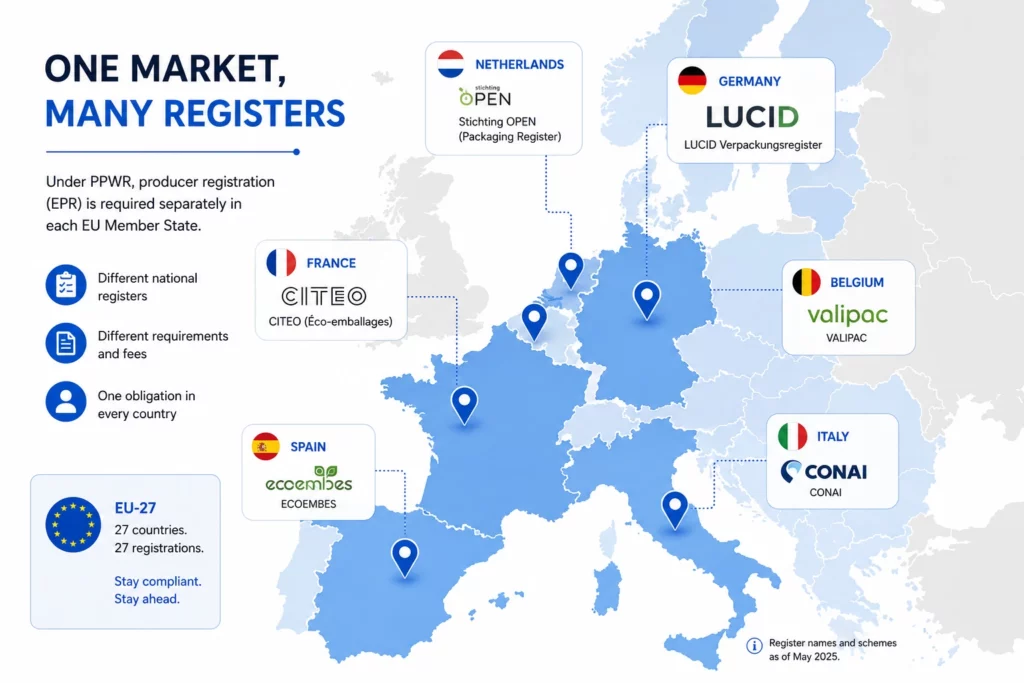
EPR Registration Under PPWR requires businesses to assess where their products are sold and register separately in every destination country. For example, a company based in Spain that sells products into Germany, France, Italy, and the Netherlands may need four separate EPR registrations, along with contracts with the relevant Producer Responsibility Organisations (PROs) in each market. Companies selling through cross-border e-commerce platforms face even broader obligations, as they may need authorised representatives and local registrations in multiple countries.
EPR Registration Under PPWR also extends beyond registration itself. Businesses must establish systems to track packaging quantities by material type, maintain accurate records, calculate EPR fees, and submit annual reports to national authorities. Because registrations, approvals, and PRO contracts can take several weeks to complete, companies that delay preparation risk missing the 12 August 2026 deadline and exposing themselves to fines, retroactive fees, and interruptions to EU sales.
If you place packaging or packaged products on the EU market wherever your company is based this guide walks you through the decision points, the costs, the common traps, and what to put in place now.
Not Sure Where PPWR Compliance Begins?
Get a clear starting point mapped to your specific packaging and markets. Talk to a PPWR expert who’s guided teams like yours through exactly this.
EPR Registration Under PPWR is a mandatory, country-specific requirement for companies placing packaged products on the EU market from 12 August 2026. Manufacturers, importers, brand owners, and e-commerce sellers must register in each EU country where they sell products, join local Producer Responsibility Organisations (PROs), and establish systems for packaging reporting and fee calculations. Failure to comply can result in fines, retroactive fees, and restrictions on selling products within the EU.
EPR registration under PPWR
Extended Producer Responsibility (EPR) is a policy principle that makes the producer of a product financially and sometimes operationally responsible for that product once it becomes waste. For packaging, that means whoever first places packaging on a national market helps fund the collection, sorting and recycling of it at end of life.
Instead of municipalities absorbing the full cost of managing packaging waste, producers pay a fee for every tonne they put on the market. Those fees fund the recycling infrastructure and, increasingly, are adjusted up or down based on how recyclable the packaging is. EPR registration is the act of enrolling with the relevant national scheme (or its producer responsibility organisation) so those obligations can be tracked, reported and paid.
The bigger purpose is circular-economy: shift the true cost of waste back to the people who design and sell the packaging, and the economics start rewarding lighter, simpler, more recyclable designs.
EPR is one of the most misunderstood aspects of packaging compliance, yet failing to register correctly can lead to fines, retroactive fees, and even restrictions on selling products in EU markets.
A common misconception is that PPWR replaces national EPR. It does not. Existing national EPR schemes remain in place Germany’s LUCID register, France’s bonus/malus system, Belgium’s Fost Plus, and the rest all continue to operate. What PPWR does is set a common rulebook on top of them.
Under Articles 44 and 45, PPWR:
Standardises the producer definition — clarifying, per packaging item, exactly who the obligated producer is across borders.
Mandates national producer registers — every Member State must run a register that authorities use to monitor compliance.
Makes eco-modulation mandatory — fees are tied to a packaging recyclability grade (A, B or C), with harmonised modulation phasing in toward the end of the decade.
Tightens online-marketplace duties — platforms must verify that third-party sellers are registered before they can sell into a market.
EPR registration is no longer just a reporting obligation. Under PPWR it becomes the entry point to a broader packaging-compliance framework that links design, sourcing, finance and legal.
Who needs EPR registration? (Find your role)
Whether you’re obligated and in which country depends on your role in placing packaging on the market. Most buyers fit one or more of the profiles below. Use it to pinpoint where you sit before you register anywhere.
If you are a…
You are likely obligated when…
Typical priority
Brand owner
Your branded products are first placed on a Member State’s market in their packaging.
Highest — usually the named producer
Manufacturer
You produce packaging or packaged goods and first make them available in-country.
High
Importer
You bring packaged goods into a Member State from outside it.
High
Online seller
You sell directly to end users in a Member State (distance sales count where the customer is).
High & rising — marketplaces now verify
Distributor
In some cases — e.g. you re-label, repackage, or act as the first in-country placer.
Situational
Non-EU company
You sell into the EU; you generally need a registered presence or an Authorised Representative.
High — see below
Who is responsible under the EU Packaging and Packaging Waste Regulation (PPWR)?
Our latest blog explains the key PPWR roles and responsibilities with practical examples to help businesses understand where they fit within the compliance framework.
EXAMPLE A US skincare brand ships directly to consumers in Germany, France and Spain through its own webshop. Even with no EU office, it is the producer for that packaging in each of the three countries so it needs registration (via an Authorised Representative) in all three, not one.
Is there one EPR registration for the whole EU?
Short answer: No.
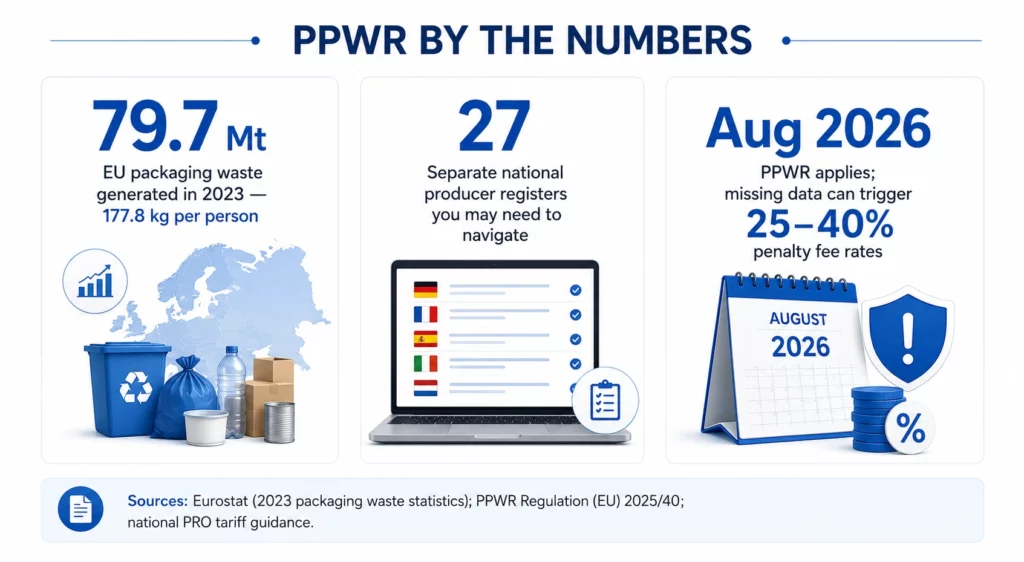
PPWR harmonises the rules, not the registers. Registration stays country-specific. Each Member State maintains its own producer register, its own producer responsibility organisations, its own fee schedules, and its own reporting cadence. In practice that means a company selling across, say, eight EU markets may need eight separate registrations, each with its own format and deadlines. There is no single “EU EPR number” and, notably, no general exemption for micro-enterprises from the registration obligation itself.
When should companies register?
For many companies, the answer is already national EPR obligations have been in force across most Member States for years, and the 2018 directive required schemes for all packaging by the end of 2024. PPWR layers new structure on top from 12 August 2026.
A simplified view of the road ahead:
Date
What happens
What it means for you
Now – Aug 2026
National EPR obligations in force; PPWR transition period.
Register where you already sell; clean up packaging data.
12 Aug 2026
PPWR applies. National registers, marketplace verification and Authorised-Representative rules bite. PFAS limits start.
Be registered & reporting; gaps now risk market access.
From 2027
Eco-modulated fees roll out; new EPR categories prepared.
Recyclability grade starts driving your fee bill.
Aug 2028
Digital Product Passport for packaging begins.
Your packaging data must be structured & shareable.
2029–2030
Harmonised eco-modulation; from 2030 only grades A–C reach the market.
Below-grade-C packaging must be redesigned out.
WHY PREPARE EARLY
The August 2026 date is a milestone, not the finish line but it’s the point at which incomplete registration or data can stop you selling. Teams that wait until 2026 to chase supplier data routinely find the qualification work takes longer than the registration itself.
Requirements vary by country, but most registers ask for a similar core dataset. Have these ready before you start:
Company details — legal entity, local establishment status, contacts.
VAT and tax information for each market.
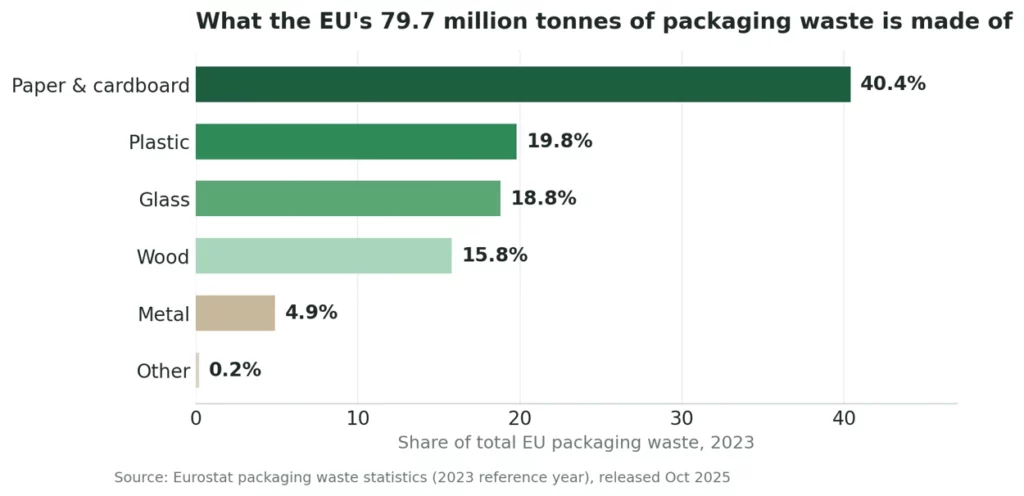
Packaging material categories — plastic, paper/cardboard, glass, metal, wood, composite.
Packaging quantities — weights placed on market, by material, often per period.
Product categories — household vs. commercial/industrial, format types.
Authorised Representative details — where you’re a non-EU producer or otherwise required.
Five of those six fields are administrative and quick. The one that consumes the project is packaging quantities by material accurate weights and composition for every SKU, sourced from suppliers who often don’t have it to hand.
Do non-EU companies need an Authorised Representative?
In many cases, yes. Member States can require non-EU producers selling under distance contracts to appoint an Authorised Representative (AR) for EPR a local legal entity that registers on your behalf, files reports, and carries the obligations in-country.
Requirements still differ by country today, but harmonisation is increasing under PPWR, and for some streams an EU-level representative is being layered on top of national ones. For exporters, the AR is often the practical gateway to staying in the market: without it, marketplaces and authorities can block or de-list your products.
EXAMPLE
Marketplaces have already begun de-listing third-party sellers that can’t show a valid EPR registration number. For a non-EU seller, that registration usually only exists once an Authorised Representative is appointed making the AR a revenue-protection decision, not just a legal box-tick.
The challenges companies actually run into
Registration mechanics rarely sink a project. The friction shows up around it. These are the recurring pain points we hear from packaging and compliance teams:
Challenge
Why it hurts
What good looks like
Multiple country registrations
Different portals, languages, formats and deadlines multiply the admin.
One source of truth feeding each country’s format.
Different reporting templates
Each PRO wants data sliced its own way; manual re-work and errors creep in.
Map once, reuse everywhere.
Poor packaging data
Weights and material composition are missing, stale, or in spreadsheets.
Structured, validated, SKU-level packaging records.
No internal owner
EPR falls between sustainability, legal, supply chain and finance.
Named owner with a cross-functional process.
Supplier information gaps
Suppliers can’t or won’t provide composition and recyclability data.
Standardised supplier data requests & collection.
The jobs your team is really hiring EPR readiness to do
Behind “get registered” sit several distinct jobs. Naming them helps you scope the work and the tools correctly.
Job to be done
Trigger
Success looks like
“Know exactly where I’m obligated.”
Expanding into new EU markets or selling online.
A clear country-by-country obligation map.
“Register and stay registered without scramble.”
PPWR application date approaching.
Active registrations + a renewal/reporting calendar.
“Report accurately, on time, every period.”
Recurring PRO reporting deadlines.
Reports generated from trusted data, not rebuilt by hand.
“Lower my fee exposure.”
Eco-modulation raising costs on poor designs.
Visibility of recyclability grade before design is locked.
“Prove it under audit.”
Enforcement and marketplace checks tightening.
Audit-ready evidence trail per market.
Why packaging data is the real challenge
Many companies assume the registration form is the hard part. In reality, the heavy lifting is assembling the data foundation that every registration and report depends on:
Accurate packaging weights for every component of every SKU.
Material composition data — mono-material vs. multilayer, pigments, additives.
Supplier information collected consistently and kept current.
Repeatable reporting processes so each period isn’t a fresh fire drill.
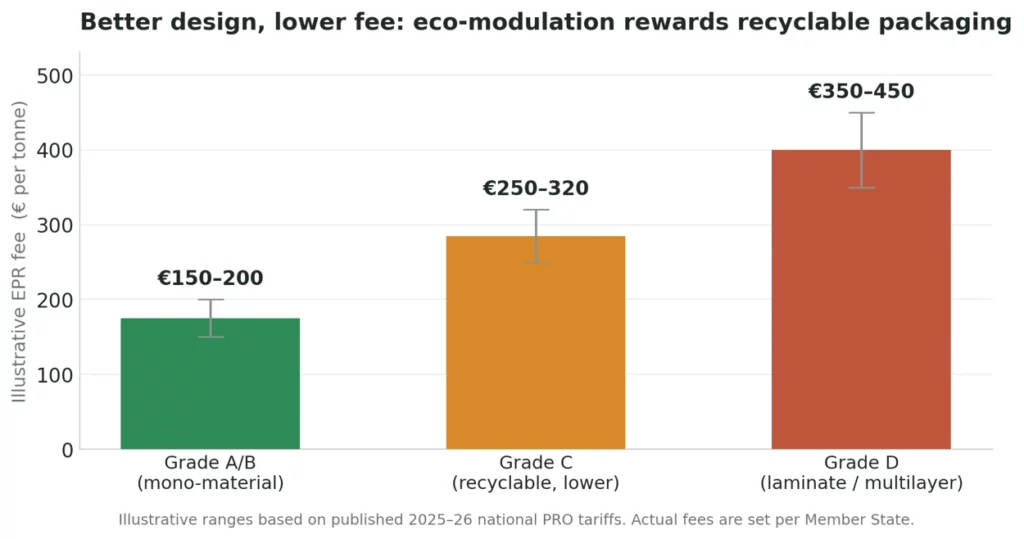
This is also where eco-modulation bites: because fees are weight- and recyclability-based, even small design facts move money. Published tariffs show mono-material designs landing in the lower fee bands while multilayer laminates sit far higher and certified recycled content can shave tens of euros per tonne. You can’t capture any of that saving if you can’t see the data.
EPR registration is relatively straightforward. Building and maintaining the packaging-data foundation that supports ongoing reporting across SKUs, suppliers and countries is where organisations actually struggle.
Germany. Producers register in the LUCID register run by the ZSVR and license through a dual system. From 12 August 2026 the Packaging Act (VerpackG) is replaced by an implementing act, LUCID registration stays mandatory, and marketplaces must run seller-verification so an unregistered seller simply can’t trade.
France. A detailed bonus/malus scheme rewards recyclable design and penalises disruptors even a small-format surcharge on plastic bottles under half a litre. The packaging spec, not just the paperwork, determines the fee.
A multi-market FMCG brand. Selling the same product across six countries, it discovers each PRO wants packaging weights sliced differently. Once SKU-level packaging data lives in one structured place, each national report becomes a mapping exercise rather than a six-times-over rebuild.
How to get ahead of it: a practical approach
The teams that find PPWR manageable tend to follow the same sequence. Treat registration as the output of a data process, not a one-off form.
Step
What to do
Why it matters
1. Map obligations
List every market where you place packaging and your role in each.
You can’t register correctly until you know where you’re the producer.
2. Centralise packaging data
Pull SKU-level weights, materials and supplier data into one structured system.
One trusted source feeds every register and report.
3. Close supplier gaps
Standardise how you request and validate composition data.
Removes the single biggest cause of delay.
4. Appoint ARs where needed
Line up Authorised Representatives for non-EU obligations.
Protects market access and marketplace listings.
5. Operationalise reporting
Define owners, calendars and repeatable report generation.
Turns annual panic into routine.
How TraceX helps
TraceX PPWR Solutionshelps organisations centralise packaging information, supplier data and compliance records in one place so EPR registration and reporting draw from a single, validated source. Instead of rebuilding numbers for each national register, teams maintain SKU-level packaging data once, surface recyclability and weight insights that influence fees, and keep an audit-ready trail across every market. That turns PPWR readiness from a scramble into an ongoing, governed process.
Everything You Need to Understand PPWR — in One Guide
Skip the scattered articles and regulatory PDFs. Our handbook breaks down PPWR obligations, timelines, and requirements into one clear resource.
☑ Identify every market where your products are placed on the market.
☑ Determine your role (and therefore your obligation) under PPWR in each.
☑ Review existing EPR registrations and spot the gaps.
☑ Appoint Authorised Representatives where required.
☑ Centralise and validate packaging data weights, materials, composition.
☑ Close supplier information gaps with a standard data request.
☑ Establish repeatable reporting processes per country.
☑ Define clear internal ownership across functions.
Conclusion
EPR registration is not a one-time exercise. As packaging regulation evolves, companies will need stronger data, clearer ownership and better supplier collaboration not just a completed form.
Because packaging compliance doesn’t begin when you submit your registration. It begins with the systems that support it.
Start using TraceX
Transparency, Trust, & Success for your Climate Journey.
We use cookies on our website to give you the most relevant experience by remembering your preferences and repeat visits. By clicking “Accept All”, you consent to the use of ALL the cookies. However, you may visit "Cookie Settings" to provide a controlled consent.
This website uses cookies to improve your experience while you navigate through the website. Out of these, the cookies that are categorized as necessary are stored on your browser as they are essential for the working of basic functionalities of the website. We also use third-party cookies that help us analyze and understand how you use this website. These cookies will be stored in your browser only with your consent. You also have the option to opt-out of these cookies. But opting out of some of these cookies may affect your browsing experience.
Necessary cookies are absolutely essential for the website to function properly. These cookies ensure basic functionalities and security features of the website, anonymously.
Cookie
Duration
Description
cookielawinfo-checkbox-analytics
11 months
This cookie is set by GDPR Cookie Consent plugin. The cookie is used to store the user consent for the cookies in the category "Analytics".
cookielawinfo-checkbox-functional
11 months
The cookie is set by GDPR cookie consent to record the user consent for the cookies in the category "Functional".
cookielawinfo-checkbox-necessary
11 months
This cookie is set by GDPR Cookie Consent plugin. The cookies is used to store the user consent for the cookies in the category "Necessary".
cookielawinfo-checkbox-others
11 months
This cookie is set by GDPR Cookie Consent plugin. The cookie is used to store the user consent for the cookies in the category "Other.
cookielawinfo-checkbox-performance
11 months
This cookie is set by GDPR Cookie Consent plugin. The cookie is used to store the user consent for the cookies in the category "Performance".
viewed_cookie_policy
11 months
The cookie is set by the GDPR Cookie Consent plugin and is used to store whether or not user has consented to the use of cookies. It does not store any personal data.
Functional cookies help to perform certain functionalities like sharing the content of the website on social media platforms, collect feedbacks, and other third-party features.
Performance cookies are used to understand and analyze the key performance indexes of the website which helps in delivering a better user experience for the visitors.
Analytical cookies are used to understand how visitors interact with the website. These cookies help provide information on metrics the number of visitors, bounce rate, traffic source, etc.
Advertisement cookies are used to provide visitors with relevant ads and marketing campaigns. These cookies track visitors across websites and collect information to provide customized ads.
Download the 2026 Traceability Scorecard and Benchmark Your Supply Chain Across 10 Critical Capabilities.
Download our eBook
Don’t Wait for an Audit to Find Your EUDR Gaps
The 2026 Simplification Package changes how HS codes, DDS pass-through and geolocation rules apply to you. Get the free guide and 20-point readiness checklist before enforcement catches you unprepared.