Food Safety Regulations: What US, EU and Indian Rules Now Expect From Your Records
Published
, 8 minute read
Share this article
Quick summary: Food safety regulations in the US, EU and India now test one thing: can you produce lot-level records fast? Compare FSMA 204, EU and FSSAI rules and act now.
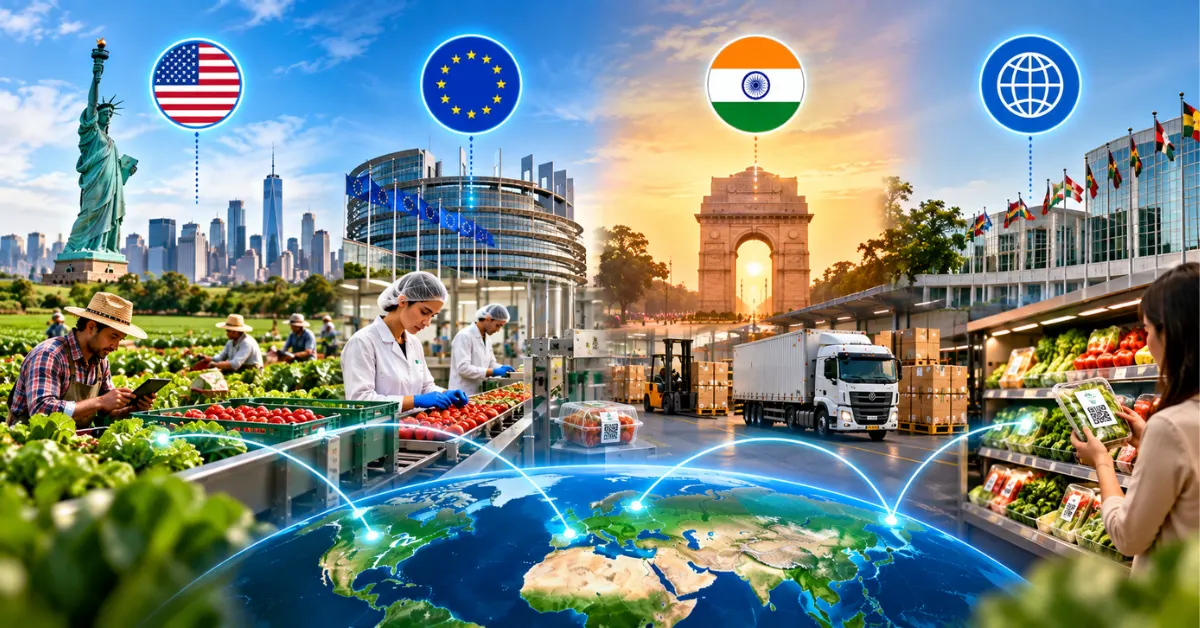
Food safety regulations are the laws and standards that govern how food is produced, processed, stored and distributed so that it is safe to eat. The main frameworks are FSMA in the US, the General Food Law and hygiene regulations in the EU, the Food Safety and Standards Act in India and the Codex Alimentarius internationally. Across all of them, the practical test has shifted from “do you have a food safety plan?” to “can you show which lots went where, and fast?”
KEY TAKEAWAYS
The FSMA 204 Food Traceability Rule now applies from 20 July 2028 and requires records within 24 hours of an FDA request.
EU law has required one-step-back, one-step-forward traceability for all food and feed businesses since 2005.
HACCP is the common base: Codex defines it, the EU requires HACCP-based procedures and FSSAI expects a food safety management system.
Certificates prove a system exists; food safety regulations increasingly ask for lot-level evidence.
Consistent lot codes across every handover are where most traceability records break.
See how TraceX can give you end-to-end supply chain visibility.
TraceX supports end-to-end traceability across complex supply chains, from source to finished product.
Food Safety Regulations Compared: US, EU, India and Codex
Four frameworks cover most export food businesses, and they share more than their names suggest.
Food safety regulations exist because the stakes are high. The CDC estimates that foodborne illness makes 48 million Americans sick each year, hospitalises 128,000 and kills 3,000. Each jurisdiction answers that risk differently, but all of them rely on prevention plus the ability to trace product quickly.
Framework
Core requirement
Traceability expectation
US: FSMA (2011) and the Food Traceability Rule (FSMA 204)
Preventive controls, produce safety, foreign supplier verification
Key Data Elements at Critical Tracking Events for foods on the Food Traceability List; records within 24 hours; compliance from 20 July 2028
EU: General Food Law, Reg. (EC) No 178/2002, and hygiene Reg. (EC) No 852/2004
Food business operators carry primary responsibility; HACCP-based procedures
One step back, one step forward (Article 18) for all food and feed operators
India: Food Safety and Standards Act, 2006 (FSSAI)
Licensing or registration, hygiene schedules, food safety management systems
Records of sourcing and distribution; recall procedures
Codex Alimentarius (FAO/WHO)
General Principles of Food Hygiene, including HACCP
Reference standard used in trade disputes and national law
For an exporter, these rules stack rather than replace one another. A spice processor in India shipping to the US and Germany answers to FSSAI at home, FSMA preventive controls and FSVP at the US border, and EU Article 18 through its importer.
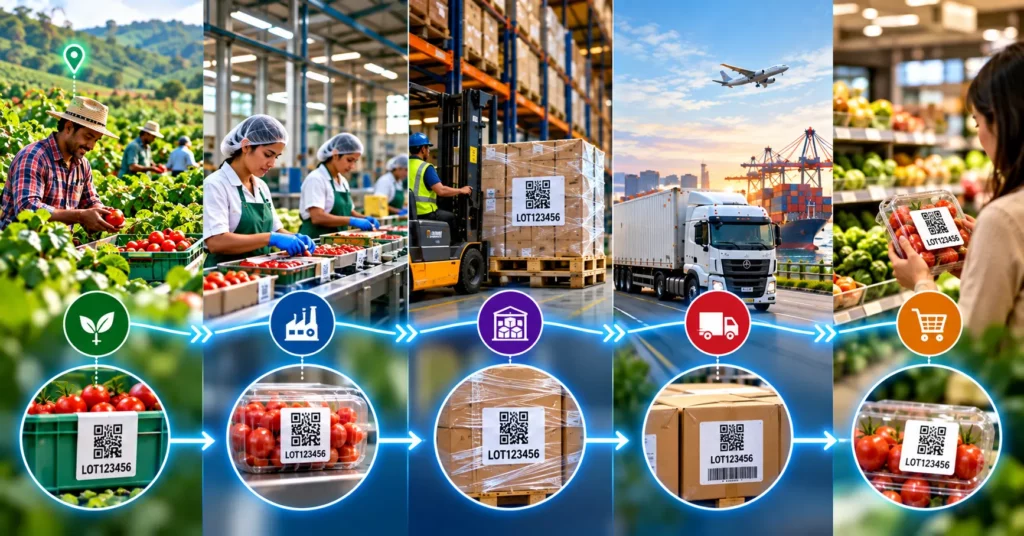
From farm to fork, food safety depends on knowing where products come from, how they move, and where issues occur. Learn how digital traceability can improve visibility, support faster recalls, and strengthen food safety across the supply chain.
Food Safety Regulations Compliance Gaps That Surface in Recalls
Most failures are record failures, discovered at the worst possible moment.
Lot codes that change between handovers
Paper records that cannot be searched
Supplier data that stops at the gate
Food Safety Records With Broken Lot Codes
A lot code assigned at packing is often relabeled at the distributor and again at the retailer. In an FDA traceability exercise discussed at a 2026 public meeting, most participants recorded lot codes, but far fewer kept the same code consistent across every tracking event. Under food safety regulations, a broken chain of codes turns a targeted recall into a broad one.
Food Safety Documentation Stuck on Paper
Binders and spreadsheets satisfy an annual audit, but food safety regulations increasingly expect a sortable file covering every shipment of one ingredient within a day.
Food Safety Visibility That Ends at the Supplier Gate
Many processors know their direct supplier but not the farm or packhouse behind it. When contamination starts upstream, that gap turns a one-supplier issue into a whole-category withdrawal.
Food safety regulations do not fail companies. Missing links between lots do.
From farm to fork, digital food traceability helps connect suppliers, products, batches, and transactions improving visibility, transparency, and accountability across the supply chain.
Food Safety Regulations Readiness: Building Lot-Level Traceability
Three building blocks turn a food safety plan into evidence you can produce on demand.
Critical tracking events captured digitally
Persistent lot and product identifiers
Supplier records linked upstream
Food Traceability Events Captured as They Happen
Record harvesting, cooling, packing, shipping, receiving and transformation as discrete events, each with who, what, where, when and quantity. That structure mirrors the Critical Tracking Events and Key Data Elements in FSMA 204 and covers the EU one-up, one-down duty at the same time, so one data model serves several food safety regulations.
Food Traceability Identifiers That Survive Handovers
Assign a traceability lot code once and carry it through every step, using GS1 identifiers such as GTINs for products and GLNs for locations.
Connect each incoming lot to its supplier, farm or packhouse, with certificates and test results attached. A HACCP plan identifies the hazards; linked source records show where a hazard entered.
Stop treating food safety regulations as a certification exercise. GFSI-benchmarked schemes such as BRCGS, FSSC 22000 and SQF prove that a system exists. Regulators now ask a narrower, harder question: which lots, from which sources, went to which customers, and can you show it within a day?
The companies that pass that test did not buy a better binder. They made the lot code the unit of record everywhere, from farm to dispatch.
How Can Digital Traceability Improve Food Safety?
See how Green Earth Fresh Produce used TraceX to digitize its vegetable supply chain, strengthen farm-to-fork traceability, monitor farming practices, and improve transparency across contract farming operations.
Food Safety Regulations Software vs Manual Records
Manual systems pass audits; they struggle with the 24-hour question.
Six capabilities compared
Capability
Paper and spreadsheets
TraceX platform
Lot tracking
Codes re-keyed at each step
One lot code carried through every event
Record retrieval
Days of manual collation
Sortable export by lot, product or date
Supplier data
Certificates in email and folders
Digital supplier profiles with expiry alerts
Upstream visibility
Direct supplier only
Farm and packhouse linkage
Recall scope
Broad, to be safe
Targeted to affected lots
ERP connection
Duplicate entry
Integration with existing ERP
The tipping point is usually the first mock recall. If gathering one day of shipments for one ingredient takes a team several days, meeting modern food safety regulations with that system is unrealistic. Some large retailers already ask suppliers for FSMA 204-style data ahead of the federal date.
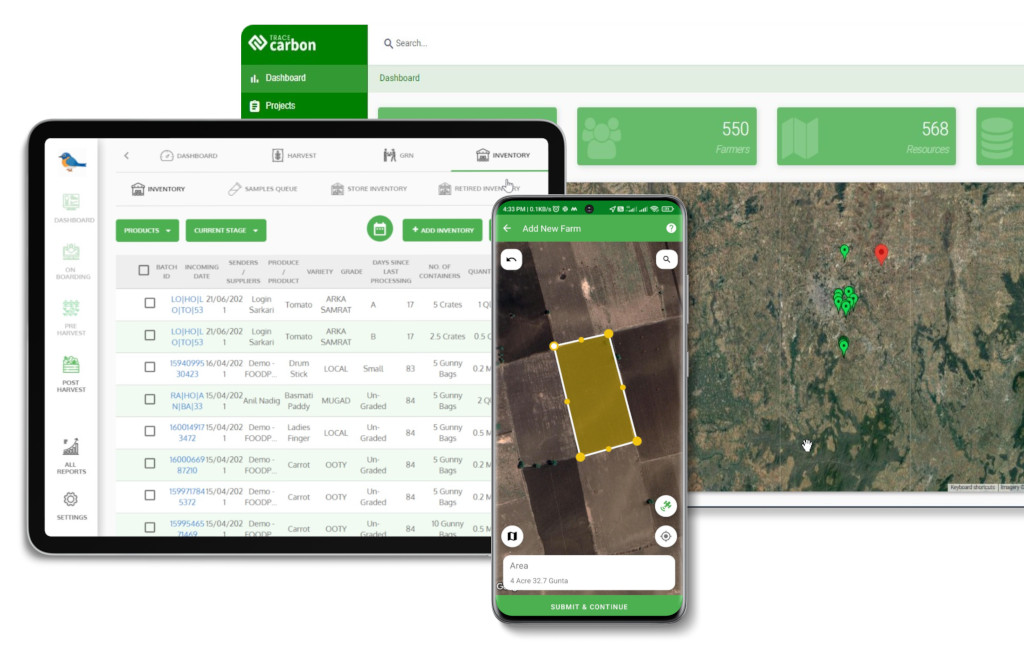
TraceX’s food traceability solution helps businesses strengthen food safety compliance by creating end-to-end visibility from farm to fork. It connects suppliers, farms, raw materials, processing activities, batches, inventory, and shipments in a single digital workflow, making it easier to identify quality or contamination points, maintain production records, support audits, and enable faster, targeted recalls when required. With batch-level traceability, verified supply-chain data, and digital records, businesses can build the transparency and evidence needed to support food safety standards and regulatory requirements.
Ready to Strengthen Your Supply Chain Traceability?
See how TraceX connects suppliers, farms, products, batches, processing, and shipments to create end-to-end visibility across your supply chain.
Food safety regulations are laws and standards that set how food must be produced, handled, stored and distributed so it is safe to eat, and how businesses must record and trace it.
What are the main food safety regulations for exporters?
Most exporters deal with FSMA in the US, the EU General Food Law and hygiene regulations, their home country law such as India’s FSS Act 2006, and Codex Alimentarius standards used in trade.
When does the FSMA 204 Food Traceability Rule apply?
The compliance date is 20 July 2028, moved from 20 January 2026. Covered firms must keep Key Data Elements for listed foods and give the FDA records within 24 hours of a request.
What does EU Article 18 traceability require?
Every food and feed business must identify who supplied each product and to whom it sold products, and give that information to authorities on demand.
Is HACCP mandatory?
In the EU, food business operators must run procedures based on HACCP principles. In the US, FSMA preventive controls build on similar hazard analysis. Codex sets out the reference principles.
Is a GFSI certification enough to comply?
No. Certification shows a management system is in place. Regulators can still ask for lot-level records, and the business remains legally responsible for them.
Where should a food business start?
Run a mock recall on one high-risk ingredient. The gaps it exposes in lot codes, supplier records and retrieval time become your priority list.
Start using TraceX
Transparency, Trust, & Success for your Climate Journey.
We use cookies on our website to give you the most relevant experience by remembering your preferences and repeat visits. By clicking “Accept All”, you consent to the use of ALL the cookies. However, you may visit "Cookie Settings" to provide a controlled consent.
This website uses cookies to improve your experience while you navigate through the website. Out of these, the cookies that are categorized as necessary are stored on your browser as they are essential for the working of basic functionalities of the website. We also use third-party cookies that help us analyze and understand how you use this website. These cookies will be stored in your browser only with your consent. You also have the option to opt-out of these cookies. But opting out of some of these cookies may affect your browsing experience.
Necessary cookies are absolutely essential for the website to function properly. These cookies ensure basic functionalities and security features of the website, anonymously.
Cookie
Duration
Description
cookielawinfo-checkbox-analytics
11 months
This cookie is set by GDPR Cookie Consent plugin. The cookie is used to store the user consent for the cookies in the category "Analytics".
cookielawinfo-checkbox-functional
11 months
The cookie is set by GDPR cookie consent to record the user consent for the cookies in the category "Functional".
cookielawinfo-checkbox-necessary
11 months
This cookie is set by GDPR Cookie Consent plugin. The cookies is used to store the user consent for the cookies in the category "Necessary".
cookielawinfo-checkbox-others
11 months
This cookie is set by GDPR Cookie Consent plugin. The cookie is used to store the user consent for the cookies in the category "Other.
cookielawinfo-checkbox-performance
11 months
This cookie is set by GDPR Cookie Consent plugin. The cookie is used to store the user consent for the cookies in the category "Performance".
viewed_cookie_policy
11 months
The cookie is set by the GDPR Cookie Consent plugin and is used to store whether or not user has consented to the use of cookies. It does not store any personal data.
Functional cookies help to perform certain functionalities like sharing the content of the website on social media platforms, collect feedbacks, and other third-party features.
Performance cookies are used to understand and analyze the key performance indexes of the website which helps in delivering a better user experience for the visitors.
Analytical cookies are used to understand how visitors interact with the website. These cookies help provide information on metrics the number of visitors, bounce rate, traffic source, etc.
Advertisement cookies are used to provide visitors with relevant ads and marketing campaigns. These cookies track visitors across websites and collect information to provide customized ads.
Download the 2026 Traceability Scorecard and Benchmark Your Supply Chain Across 10 Critical Capabilities.
Download our eBook
Don’t Wait for an Audit to Find Your EUDR Gaps
The 2026 Simplification Package changes how HS codes, DDS pass-through and geolocation rules apply to you. Get the free guide and 20-point readiness checklist before enforcement catches you unprepared.