Quick summary: TraceX and GCC are bringing farm-to-cup visibility to Araku Valley’s tribal coffee, helping growers prove origin, strengthen market access, and prepare for rising sustainability and EUDR compliance demands.
Traceable tribal coffee is now a reality in the hills of Andhra Pradesh. TraceX has partnered with the Andhra Pradesh Girijan Cooperative Corporation (GCC) and the Government of Andhra Pradesh to bring digital, farm-to-cup traceability to Araku Valley’s tribal-grown coffee. The move puts verified origin data behind one of India’s most celebrated specialty coffees and connects its tribal growers more directly to premium global markets.
Key takeaways
TraceX, GCC and the Government of Andhra Pradesh are bringing traceable tribal coffee to Araku Valley
Digital traceability adds verified origin, farm-to-cup visibility and sustainability evidence to coffee grown by tribal farming communities.
GCC provides the cooperative and aggregation backbone; TraceX provides the platform.
Coffee is one of the seven EUDR-scoped commodities so origin-level, geolocated traceability is becoming a market-access requirement for EU-bound exports, not a nice-to-have.
For farmers, the aim is fairer recognition, stronger market linkage and a credible path to higher value.
See how TraceX helps you track products from farm to finished product, connect suppliers and batches, capture product movements, and build end-to-end supply chain visibility.
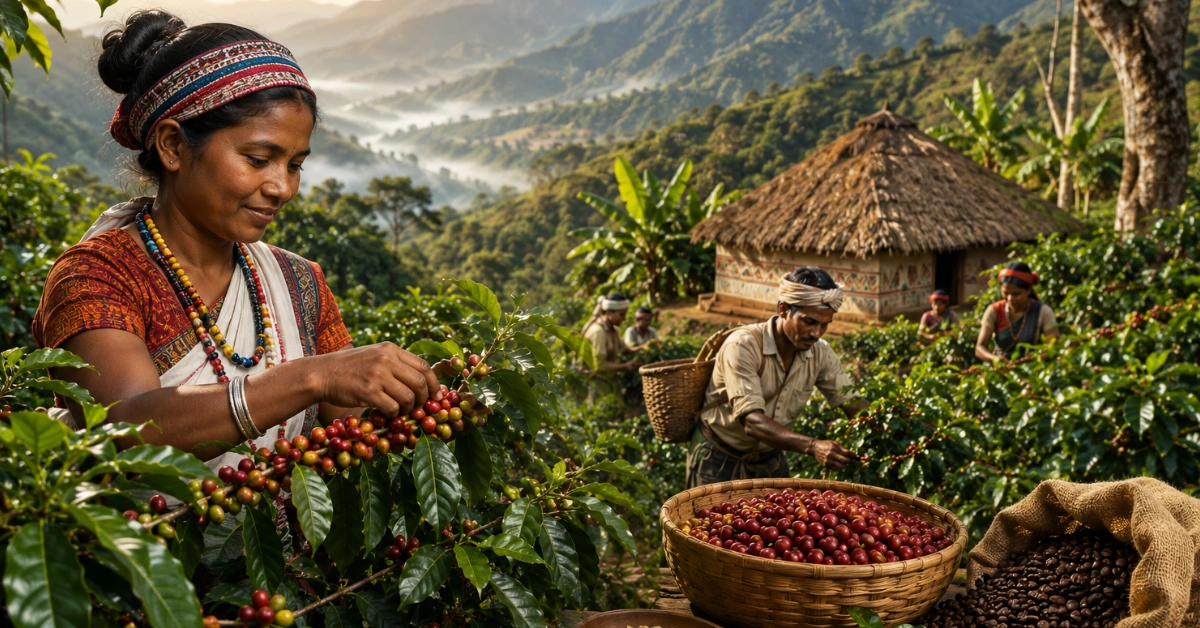
Araku is not a generic origin. Grown by tribal farming communities across the Eastern Ghats largely in the Alluri Sitarama Raju district around the Paderu region Araku coffee is cultivated with organic methods on smallholder plots and has earned a GI tag, organic certification and genuine international acclaim. It is often described as one of the first specialty coffees produced by Indian tribal farmers, with a terroir-mapped identity and flagship stores as far away as Paris.
That reputation has reached the highest levels. Prime Minister Narendra Modi praised Araku coffee and the tribal cooperatives behind it on his ‘Mann ki Baat’ programme, and Chief Minister N. Chandrababu Naidu has publicly set the ambition of turning Araku into a global brand. The commercial stakes are real: provenance is precisely what specialty buyers pay for. Making that provenance verifiable turning Araku into traceable tribal coffee is how the region protects and grows its premium. It also future-proofs the origin: as buyers and regulators demand proof rather than promises, traceable tribal coffee is what keeps Araku on premium shelves instead of slipping back into commodity pricing.
The problem: origin coffee loses its story on the way to market
Here is the gap the partnership addresses. Origin coffee routinely loses its story between the farm and the global cup. Once smallholder lots are aggregated and blended, buyers can no longer see where the coffee was grown, who grew it, or how value moved along the chain. The farmers the very people whose land and labour create the quality become invisible, and the premium that provenance should command leaks out to intermediaries.
For a region like Araku, that is not a small loss. When a buyer cannot verify origin, organic practice or the tribal-farmer story, the coffee is priced closer to a commodity than to the specialty product it is. Without traceable tribal coffee, the region’s biggest differentiators its people, its place and its practices stay unprovable. Closing that visibility gap is exactly what digital traceability is built to do.
From farm-level sourcing to processing and export, coffee traceability is becoming essential for transparency, quality and compliance.
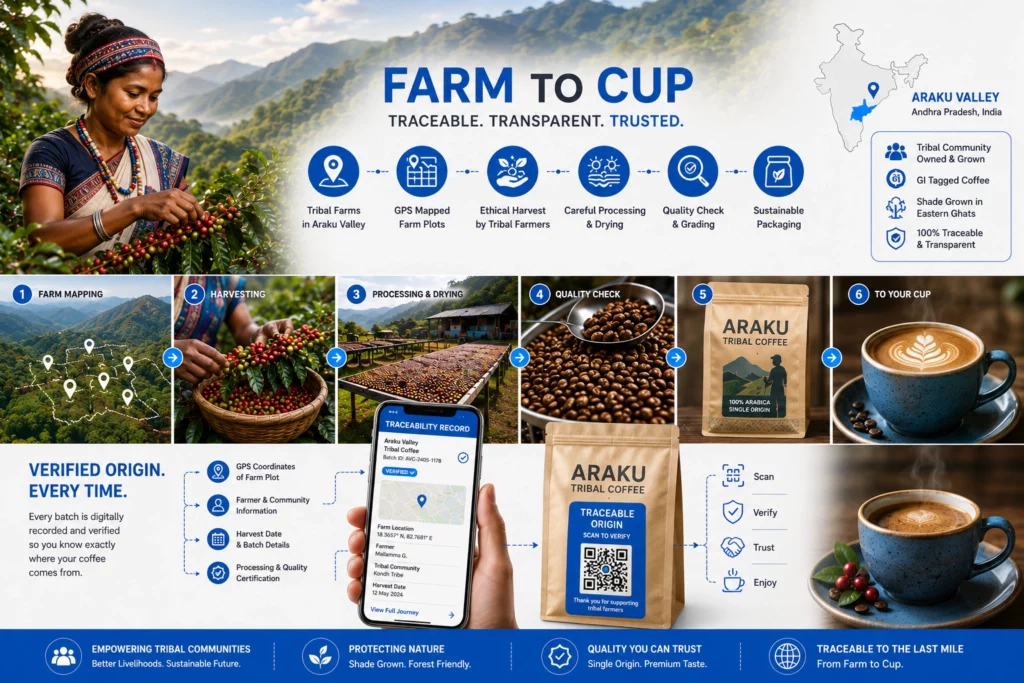
In plain terms, the partnership makes Araku’s coffee provable. The TraceX food traceability platform captures data at each stage farmer and plot registration, GPS farm mapping, harvest and post-harvest records, and every transfer as lots move through aggregation and processing so the finished coffee carries a verified digital identity from farm to cup. The result is traceable tribal coffee whose origin, practices and journey can be checked rather than merely claimed.
Each partner plays a distinct role:
GCC (AP Girijan Cooperative Corporation): the cooperative and aggregation backbone organising tribal growers, procuring their coffee, and giving the programme the institutional structure to scale across communities.
Government of Andhra Pradesh: political backing and the market-building ambition to position Araku as a global brand.
TraceX: the digital platform that captures, secures and shares the origin and sustainability data end to end.
This builds directly on TraceX’s earlier Araku work, where an end-to-end digital traceability solution was deployed across roughly 3,500 smallholder farmers in 355 villages using a multilingual, offline-capable field app proof that traceable tribal coffee can be captured even in remote hill terrain.
Practically, that means a consumer or buyer can follow a lot back to the community and plot that produced it, and a cooperative can demonstrate organic practice and fair handling with records rather than assurances. A scannable QR code on the pack can surface the village of origin, turning the supply chain into a story the buyer can verify. That is the everyday shape of traceable tribal coffee: not a certificate on a wall, but a living record that travels with the beans.
Traceable tribal coffee as a market-access and compliance play
Beyond the feel-good headline, this is a strategic move. Traceable tribal coffee turns Araku’s story into an asset that unlocks three things at once: stronger market access, because premium and specialty buyers increasingly require verifiable origin; credible sustainability claims, because organic and ethical-sourcing assertions can now be backed by data rather than marketing; and readiness for tightening global rules.
That last point is where the timing matters most. Coffee is one of the seven commodities in scope of the EU Deforestation Regulation (EUDR). Under EUDR, operators placing coffee on the EU market must show it is deforestation-free and legally produced, backed by plot-level geolocation and a due diligence statement with the deforestation cut-off set at 31 December 2020 and application from 30 December 2026 for large and medium operators. In other words, origin-level, geolocated traceable tribal coffee is fast becoming a market-access requirement for anyone exporting into the EU, not an optional extra.
Because the same farm-mapping and origin data that tell Araku’s story also satisfy EUDR’s geolocation demands, the groundwork laid here doubles as compliance infrastructure. For EU-bound consignments, TraceX EUDR-specific module can turn that captured plot data into geolocation validation and a filed due diligence statement, making traceable tribal coffee export-ready as well as story-ready.
Why this is bigger than one origin
The Araku programme is a template. Any cooperative sitting on a high-provenance, smallholder-grown crop faces the same problem value leaking out where the story disappears and the same opportunity. Traceability is the mechanism that converts provenance into price and compliance at the same time.
Explore how the TraceX food traceability platform captures farm-to-cup origin data and how TraceX EUDR Solutions turns it into EUDR-ready geolocation and due diligence for coffee cooperatives and exporters.
What traceable tribal coffee means for the farmers
Strip away the technology and the point is people. For Araku’s tribal growers, traceable tribal coffee is about three concrete shifts. First, recognition: when a buyer can see the specific community and plot behind a lot, the farmer stops being an anonymous input and becomes a named origin the basis for genuine farm-to-cup storytelling.
Second, market linkage: verified origin and sustainability data make it easier to connect growers directly with premium and international buyers who will pay for exactly those attributes, shortening the distance between a hillside plot and a specialty shelf. Third, a path to higher value: where provenance is provable, cooperatives are better positioned to negotiate premiums and retain more of them for the community rather than seeing that value dissipate through an opaque chain.
None of this is automatic, and it should not be oversold: traceability is an enabler, not a guarantee of higher prices. But it removes a real barrier that has long kept tribal growers invisible and underpaid. Done well, traceable tribal coffee gives Araku’s communities the evidence to claim the value their coffee has always deserved.
Frequently Asked Questions (FAQ’s)
What is traceable tribal coffee?
It is coffee grown by tribal farming communities here, in Andhra Pradesh’s Araku Valley whose origin, growers and supply chain journey are captured and verifiable through digital traceability, rather than lost during aggregation and blending.
Who are the partners in the Araku traceability programme?
TraceX (the traceability platform), the Andhra Pradesh Girijan Cooperative Corporation (GCC, the tribal cooperative), and the Government of Andhra Pradesh, with the collaboration marked in the presence of Chief Minister Shri N. Chandrababu Naidu.
Why does traceability matter for coffee exports to the EU?
Coffee is an EUDR-scoped commodity. Exporters placing coffee on the EU market must prove it is deforestation-free and legally produced, backed by plot-level geolocation and a due diligence statement, with application from 30 December 2026 for large and medium operators. Origin-level traceability is therefore becoming a market-access requirement.
How does traceability benefit tribal coffee farmers?
It makes their community and plots visible to buyers, strengthens direct market linkage to premium buyers, and gives cooperatives the verified evidence to negotiate and retain higher value though it enables, rather than guarantees, better prices.
Start using TraceX
Transparency, Trust, & Success for your Climate Journey.
We use cookies on our website to give you the most relevant experience by remembering your preferences and repeat visits. By clicking “Accept All”, you consent to the use of ALL the cookies. However, you may visit "Cookie Settings" to provide a controlled consent.
This website uses cookies to improve your experience while you navigate through the website. Out of these, the cookies that are categorized as necessary are stored on your browser as they are essential for the working of basic functionalities of the website. We also use third-party cookies that help us analyze and understand how you use this website. These cookies will be stored in your browser only with your consent. You also have the option to opt-out of these cookies. But opting out of some of these cookies may affect your browsing experience.
Necessary cookies are absolutely essential for the website to function properly. These cookies ensure basic functionalities and security features of the website, anonymously.
Cookie
Duration
Description
cookielawinfo-checkbox-analytics
11 months
This cookie is set by GDPR Cookie Consent plugin. The cookie is used to store the user consent for the cookies in the category "Analytics".
cookielawinfo-checkbox-functional
11 months
The cookie is set by GDPR cookie consent to record the user consent for the cookies in the category "Functional".
cookielawinfo-checkbox-necessary
11 months
This cookie is set by GDPR Cookie Consent plugin. The cookies is used to store the user consent for the cookies in the category "Necessary".
cookielawinfo-checkbox-others
11 months
This cookie is set by GDPR Cookie Consent plugin. The cookie is used to store the user consent for the cookies in the category "Other.
cookielawinfo-checkbox-performance
11 months
This cookie is set by GDPR Cookie Consent plugin. The cookie is used to store the user consent for the cookies in the category "Performance".
viewed_cookie_policy
11 months
The cookie is set by the GDPR Cookie Consent plugin and is used to store whether or not user has consented to the use of cookies. It does not store any personal data.
Functional cookies help to perform certain functionalities like sharing the content of the website on social media platforms, collect feedbacks, and other third-party features.
Performance cookies are used to understand and analyze the key performance indexes of the website which helps in delivering a better user experience for the visitors.
Analytical cookies are used to understand how visitors interact with the website. These cookies help provide information on metrics the number of visitors, bounce rate, traffic source, etc.
Advertisement cookies are used to provide visitors with relevant ads and marketing campaigns. These cookies track visitors across websites and collect information to provide customized ads.
Download the 2026 Traceability Scorecard and Benchmark Your Supply Chain Across 10 Critical Capabilities.
Download our eBook
Don’t Wait for an Audit to Find Your EUDR Gaps
The 2026 Simplification Package changes how HS codes, DDS pass-through and geolocation rules apply to you. Get the free guide and 20-point readiness checklist before enforcement catches you unprepared.