Sustainable Agriculture Practices: The 7 That Matter and the Proof Each One Now Demands
Published
, 6 minute read
Share this article
Quick summary: Discover the top 7 best practices in sustainable agriculture that are revolutionizing the farming industry. From regenerative farming techniques to innovative water management strategies, this blog highlights actionable steps for a greener future. Learn how sustainable agriculture can lead to improved yields, environmental conservation, and a resilient food system. Read on to unlock the secrets of sustainable farming practices and contribute to a more sustainable world.
The seven core sustainable agriculture practices are crop rotation, cover cropping, conservation (reduced) tillage, composting and soil-health management, integrated pest management (IPM), agroforestry, and water management. Together they build soil, cut inputs, conserve water, and sequester carbon. But in 2026 the practice is only half the job: each one creates a sustainability claim, and under EUDR and CSRD an unverifiable claim is a reporting liability. The differentiator is no longer which practices you adopt it is whether you can prove them with plot-level, audit-ready data.
Sustainable agriculture practices are no longer a differentiator on their own they are table stakes. Every serious agribusiness now runs some mix of crop rotation, cover cropping, and reduced tillage, and every competitor lists the same seven. What separates a supplier that wins premium, compliant contracts from one that loses them is not the practice on the ground; it is the evidence behind it. Because in 2026, the moment you claim a practice, you have created something an auditor can ask you to prove.
In plain terms, sustainable agriculture practices are the farming methods soil, water, pest, and land management that reduce environmental impact while keeping farms productive. This guide covers the seven that matter, but its real focus is the part most content skips: the specific data each practice now requires to survive scrutiny under EUDR, CSRD, and buyer audits.
Key takeaways
The seven core sustainable agriculture practices: crop rotation, cover cropping, conservation tillage, composting, IPM, agroforestry, and water management.
Every practice generates a sustainability claim and every claim is now a data obligation under EUDR and CSRD.
Practices don’t fail in the field; they fail in the audit, when the supporting data is missing or manual.
Digital farm management turns each practice into plot-level, audit-ready proof the real competitive moat.
Turn Sustainable Agriculture Practices into Measurable Outcomes
Sustainable agriculture requires more than adopting better farming practices—it requires visibility, verified data, and continuous monitoring. TraceX helps agribusinesses digitize farm operations, strengthen traceability, measure sustainability performance, and build resilient agricultural supply chains.
The 7 Sustainable Agriculture Practices That Matter
Seven practices do most of the work, and they reinforce one another:
Crop rotation: Alternating crops breaks pest and disease cycles, balances soil nutrients, and cuts synthetic fertiliser dependency.
Cover cropping: Cover crops like clover and rye protect bare soil, fix nitrogen, suppress weeds, and improve water infiltration.
Conservation (reduced) tillage: No-till and low-till retain soil organic carbon, cut erosion, and lower machinery emissions.
Composting & soil-health management: Organic matter and structured nutrition build fertility and boost carbon sequestration.
Integrated pest management (IPM): IPM combines biological controls, rotation, and monitoring to reduce reliance on synthetic pesticides.
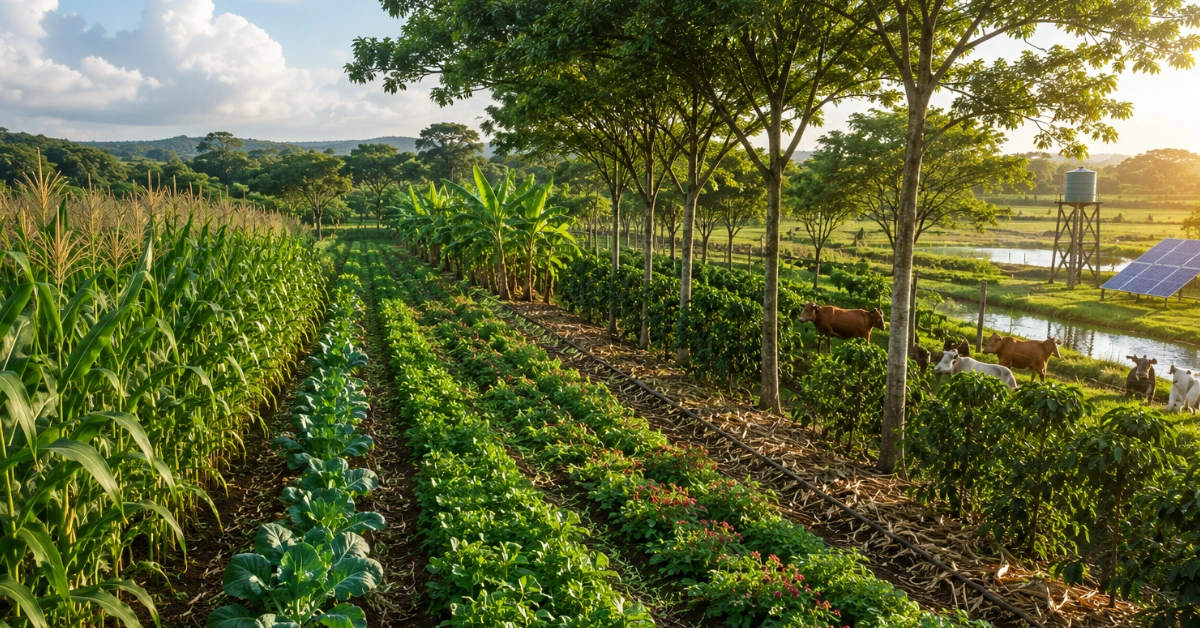
Agroforestry: Integrating trees with crops restores land, diversifies income, and is a recognised nature-based solution for carbon credits.
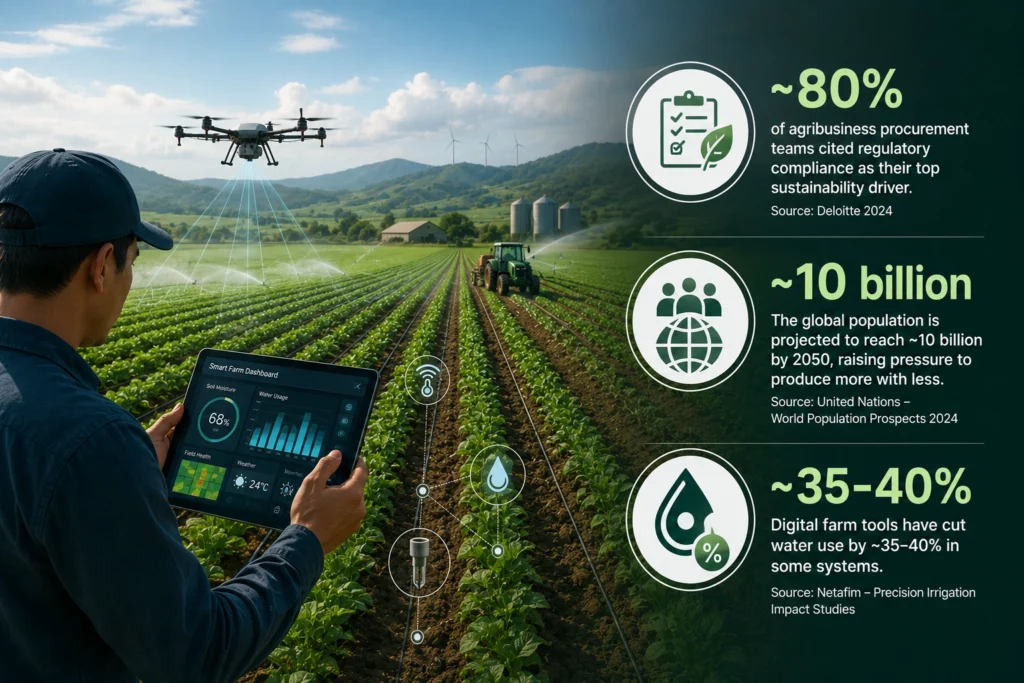
Water management: Efficient irrigation and moisture monitoring conserve a scarce resource and protect yields.
The Unique Problem With Sustainable Agriculture Practices in 2026
Here is the reframe. Each of those seven practices produces a claim “we rotate,” “we cover-crop,” “we sequester carbon through agroforestry.” For decades those claims lived on a brochure. Today they live in regulatory filings. The EU Deforestation Regulation demands plot-level proof of deforestation-free, legal production; CSRD and SBTi FLAG pull farm-level activity into Scope 3 emissions disclosure. A practice you cannot evidence is no longer neutral it is an unbacked claim, and auditors flag the data gap first.
This is why sustainable agriculture practices “fail in the audit, not the field.” The farming is usually fine. What breaks is the once-a-year manual soil test, the paper spray log, the rotation recorded in a notebook records that cannot be verified across thousands of smallholders at audit time. The practice is real; the proof is missing.
The Proof Behind Each Sustainable Agriculture Practice
Pairing each practice with the evidence it now demands is what turns a farm programme into an audit-ready, contract-winning one:
Practice
Claim it creates
Data auditors demand
Where it breaks
Crop rotation
Lower input use
Season-by-season plot log
Notebook records
Cover cropping
Soil & carbon gain
Planting/termination dates
No time-stamps
Conservation tillage
Carbon retained
Tillage type per plot
Unlogged fields
Composting / soil
Improved fertility
Soil tests over time
Once-a-year test
IPM
Reduced pesticides
Input & scouting records
Paper spray logs
Agroforestry
Carbon sequestered
Tree geolocation + growth
No monitoring
Water management
Water saved
Metered use per plot
Estimates only
How TraceX Turns Sustainable Agriculture Practices Into Proof
The pain is now precise: every practice opens a data gap, and manual records cannot close it across thousands of farmers. The capability that answers it is a farm management platform that digitises first-mile data configurable crop calendars and Package-of-Practice (POP) workflows, activity scheduling, real-time soil and input capture, and geolocated agroforestry monitoring and generates structured, audit-ready reports across the whole supplier base. The benefit: practices that hold up under EUDR, CSRD, and buyer scrutiny, plus the traceability for ESG that converts sustainability from intent into measurable, monetisable outcomes.
Make every practice audit-proof
See how TraceX turns your sustainable agriculture practices into plot-level, audit-ready proof across every farmer.
The proof point: C-SAFE partnered with TraceX to support tomato farmers in the Sri Amaranarayana FPO, using the Package-of-Practices feature to standardise cultivation workflows from land preparation to harvest improving consistency, productivity, and alignment with sustainable methods.
Audit-Ready Checklist for Your Sustainable Agriculture Practices
Before your next certification review or buyer audit, confirm you can:
Log every practice at plot level, with dates not once-a-year snapshots
Capture soil, input, and water data in real time across all farmers
Geolocate agroforestry and monitor tree growth for carbon claims
Generate structured, audit-ready reports for EUDR, CSRD, and certifiers
Tie farm activity to Scope 3 and FLAG emissions reporting
Standardise workflows with crop calendars / Package-of-Practices
Frequently Asked Questions (FAQ’s)
What are the main sustainable agriculture practices?
Crop rotation, cover cropping, conservation (reduced) tillage, composting and soil-health management, integrated pest management, agroforestry, and water management all aimed at healthier soil, less waste, and lower chemical use.
Why is proving sustainable agriculture practices so important now?
Because regulations like EUDR and CSRD turn each practice into a reportable claim. An unverifiable practice becomes a compliance and reputational liability, so plot-level, audit-ready data is now essential.
Where do sustainable agriculture practices usually fail?
Rarely in the field usually in the audit. Manual, once-a-year, or paper-based records create data gaps that certifiers and auditors flag first, even when the farming itself is sound.
How does technology support sustainable agriculture practices?
Digital farm management software captures practice data in real time, standardises workflows, and generates audit-ready reports turning practices into verifiable outcomes across thousands of farmers.
We use cookies on our website to give you the most relevant experience by remembering your preferences and repeat visits. By clicking “Accept All”, you consent to the use of ALL the cookies. However, you may visit "Cookie Settings" to provide a controlled consent.
This website uses cookies to improve your experience while you navigate through the website. Out of these, the cookies that are categorized as necessary are stored on your browser as they are essential for the working of basic functionalities of the website. We also use third-party cookies that help us analyze and understand how you use this website. These cookies will be stored in your browser only with your consent. You also have the option to opt-out of these cookies. But opting out of some of these cookies may affect your browsing experience.
Necessary cookies are absolutely essential for the website to function properly. These cookies ensure basic functionalities and security features of the website, anonymously.
Cookie
Duration
Description
cookielawinfo-checkbox-analytics
11 months
This cookie is set by GDPR Cookie Consent plugin. The cookie is used to store the user consent for the cookies in the category "Analytics".
cookielawinfo-checkbox-functional
11 months
The cookie is set by GDPR cookie consent to record the user consent for the cookies in the category "Functional".
cookielawinfo-checkbox-necessary
11 months
This cookie is set by GDPR Cookie Consent plugin. The cookies is used to store the user consent for the cookies in the category "Necessary".
cookielawinfo-checkbox-others
11 months
This cookie is set by GDPR Cookie Consent plugin. The cookie is used to store the user consent for the cookies in the category "Other.
cookielawinfo-checkbox-performance
11 months
This cookie is set by GDPR Cookie Consent plugin. The cookie is used to store the user consent for the cookies in the category "Performance".
viewed_cookie_policy
11 months
The cookie is set by the GDPR Cookie Consent plugin and is used to store whether or not user has consented to the use of cookies. It does not store any personal data.
Functional cookies help to perform certain functionalities like sharing the content of the website on social media platforms, collect feedbacks, and other third-party features.
Performance cookies are used to understand and analyze the key performance indexes of the website which helps in delivering a better user experience for the visitors.
Analytical cookies are used to understand how visitors interact with the website. These cookies help provide information on metrics the number of visitors, bounce rate, traffic source, etc.
Advertisement cookies are used to provide visitors with relevant ads and marketing campaigns. These cookies track visitors across websites and collect information to provide customized ads.
Download the 2026 Traceability Scorecard and Benchmark Your Supply Chain Across 10 Critical Capabilities.
Download our eBook
Don’t Wait for an Audit to Find Your EUDR Gaps
The 2026 Simplification Package changes how HS codes, DDS pass-through and geolocation rules apply to you. Get the free guide and 20-point readiness checklist before enforcement catches you unprepared.