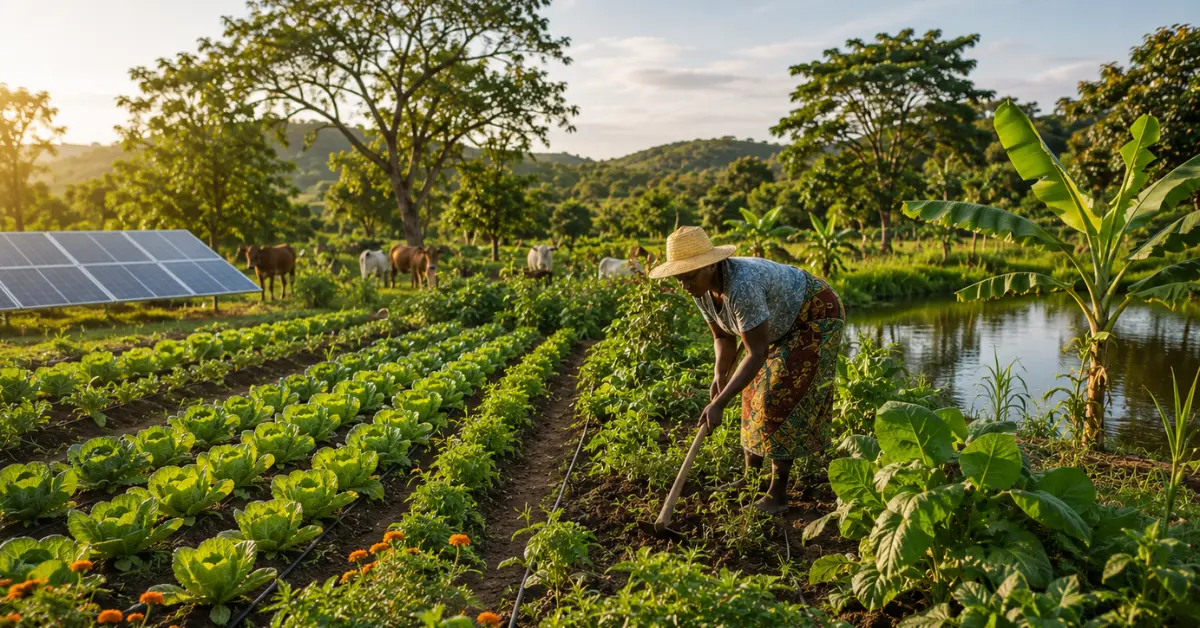
Sustainable Agriculture: The Practices, Pillars, and Proof That Build Future-Ready Brands
Published
, 6 minute read
Share this article
Quick summary: Sustainable agriculture explained: the three pillars, key practices, and how traceability turns sustainable farming into a proven, premium brand advantage.
Sustainable agriculture is a farming approach that meets today’s food needs without compromising the ability of future generations to meet theirs. It balances three pillars environmental health, economic viability, and social well-being using practices such as organic farming, regenerative agriculture, agroforestry, and precision agriculture. Beyond the farm, it has become a brand strategy: consumers, retailers, and regulators increasingly demand proof of responsible sourcing, so the deciding factor is traceability verifiable, farm-level data that turns sustainability claims into evidence buyers trust.
Sustainable agriculture has moved from an environmental ideal to a business imperative. Consumers increasingly seek out eco-friendly options, retailers demand responsible sourcing, and regulators expect proof so a brand built on sustainability now stands apart. The difficulty most businesses hit is not deciding to be sustainable, but proving it credibly. That is the gap this guide addresses.
In plain terms, sustainable agriculture is a farming approach designed to meet current food needs while preserving the environment for future generations. It balances three goals at once, and getting all three right is what separates a genuine sustainability story from a marketing claim.
Key takeaways
Sustainable agriculture balances three pillars: environmental health, economic viability, and social well-being.
Core practices include organic farming, regenerative agriculture, agroforestry, precision agriculture, and sustainable supply chains.
It is now a brand advantage meeting consumer demand, building trust, and future-proofing the business.
Traceability is the proof layer: it turns sustainable practices into verifiable claims that differentiate brands and satisfy regulators.
Build Sustainable Agriculture Programs That Deliver Measurable Impact
From farmer onboarding and farm mapping to traceability, sustainability monitoring, carbon reporting, and compliance, TraceX helps agribusinesses build transparent, resilient, and future-ready agricultural supply chains.
Every credible sustainability programme rests on the same three pillars:
Environmental health: Conserving water, improving soil, and cutting pollution from pesticides and fertilisers — through crop rotation, organic farming, and reduced tillage.
Economic viability: Keeping farming cost-effective and fairly paid, with long-term productivity and resilience rather than short-term extraction.
Social and community well-being: Supporting fair labour and the health of farming communities, so local people benefit from agricultural activity.
Why Sustainable Farming Is Now Necessary
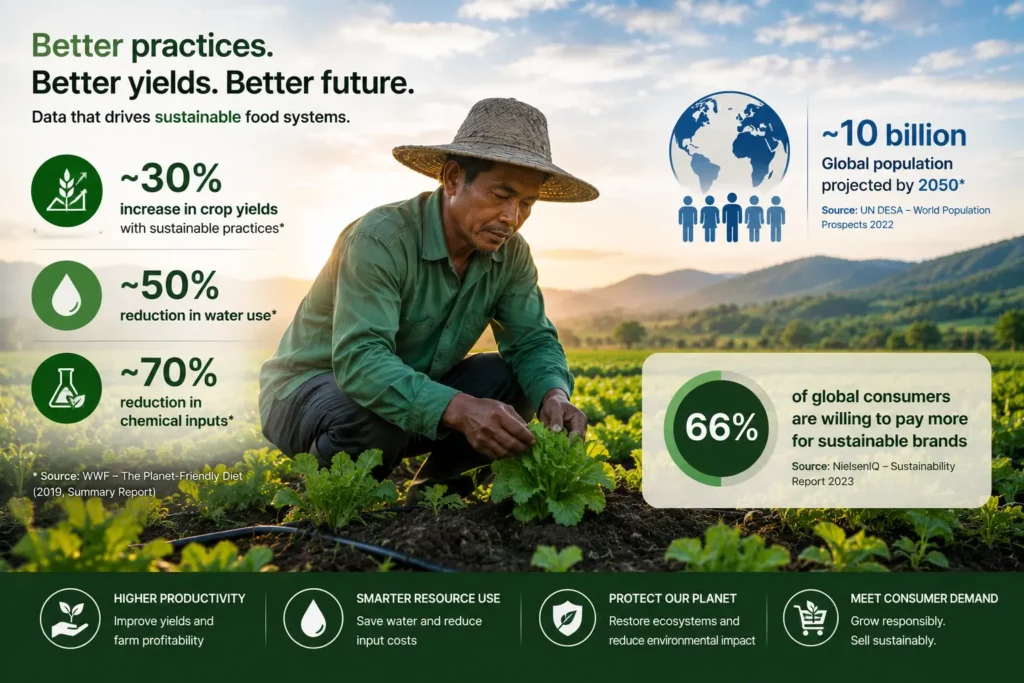
The case is straightforward: it protects the environment, secures the food supply, and mitigates climate change at the same time. Conventional methods drive soil erosion, water pollution, and biodiversity loss; sustainable agriculture preserves natural resources through organic farming, agroforestry, and conservation tillage. With the global population projected to reach [~10 billion by 2050], sustainable farm management that enhances soil fertility and conserves water is essential to food security while carbon sequestration through regenerative practices helps mitigate climate change.
The Key Sustainable Farming Practices
Five practices carry most of the impact, each one a lever brands can build a story around:
Organic farming: Eliminates synthetic pesticides, fertilisers, and GMOs, focusing on soil health and biodiversity.
Regenerative agriculture: Regenerative agriculture goes beyond sustaining to actively restoring ecosystems — soil regeneration, carbon sequestration, and biodiversity.
Agroforestry: Combining trees with crops enhances soil fertility, conserves water, and creates diverse, resilient farming systems.
Precision agriculture: Sensors, GPS, and data analytics optimise inputs, cutting chemical, water, and energy use.
Sustainable supply chains: Sustainable supply chains ensure fair-trade practices, support smallholders, and promote responsible sourcing.
How Sustainable Farming Builds Powerful Brands
Sustainable agriculture is no longer a niche concern it is a strategic advantage. It works on four fronts. It meets surging consumer demand for responsibly produced goods; it enhances brand reputation among environmentally aware buyers; it builds trust through transparency about sourcing and origin; and it future-proofs the business against climate risk, resource scarcity, and shifting preferences. A coffee brand sourcing from farmers who use regenerative practices, or an apparel brand sourcing regeneratively grown cotton, can communicate that story on-pack but only if it can back the claim with ethical, verifiable data.
How Traceability Turns Sustainable Agriculture Into Proof
This is the decisive link. The pain is that sustainability claims are worthless even risky unless they can be verified, and consumers and regulators now expect evidence, not assertions. The capability that answers it is end-to-end traceability: tracking products across the supply chain with real-time data on origin, production methods, and handling. The benefit is a brand differentiator that also validates certifications, supports food safety and recall management, and strengthens every stakeholder’s confidence in the sustainability story.
Turn sustainability into proof
See how TraceX turns sustainable practices into farm-to-table, audit-ready proof that builds trust and premium value.
TraceX’s Sustainable Sourcing Solutions provides comprehensive farm-to-table traceability, real-time data on water, soil, and carbon, compliance monitoring, and simplified reporting for consumers, regulators, and certification bodies acting as a bridge between sustainable practices, informed consumers, and responsible brands.
See How Dharaamrit Digitized Organic Farming at Scale
Discover how Dharaamrit Jaivik FPCL transformed organic farming operations by digitizing farmer onboarding, strengthening traceability, and enabling end-to-end farm monitoring across its growing network of producers.
Conventional vs. Sustainable Agriculture: How They Compare
The contrast is what makes sustainability a brand and business advantage:
Factor
Conventional farming
Sustainable agriculture
Soil & water
Degraded, polluted
Conserved, improved
Input use
High (synthetic)
Lower, biological
Climate impact
Emissions-heavy
Carbon-storing
Consumer appeal
Commodity
Premium, trusted
Brand risk
Higher scrutiny
Future-proofed
Claims
Hard to prove
Traceable, verifiable
Buyer’s Checklist: Choosing a Sustainability Platform
If you are turning sustainable agriculture into a brand advantage, confirm your platform can:
Provide farm-to-table traceability with verifiable origin data
Monitor water, soil health, and carbon in real time
Validate organic, fair-trade, and other certifications
Onboard smallholders on mobile, offline-capable tools
Generate audit-ready reports for consumers, regulators, and certifiers
Turn sustainability data into on-pack, consumer-facing proof
Frequently Asked Questions
What does sustainable agriculture mean for my brand?
It means adopting farming methods that balance environmental health, economic viability, and social responsibility reducing chemical use, conserving resources, and ensuring fair labour so your brand appeals to eco-conscious consumers and stands out as a leader.
How does sustainable agriculture benefit brand reputation?
Consumers increasingly choose brands that prioritise environmental and social responsibility. Demonstrating a real, verifiable commitment builds trust and loyalty, attracts new customers, and can generate positive media coverage and partnerships.
What are the main sustainable farming practices?
Organic farming, regenerative agriculture, agroforestry, precision agriculture, and sustainable supply chains each reducing environmental impact while supporting productivity and farmer livelihoods.
How do I prove my sustainability claims?
With traceability: farm-level data on inputs, practices, and origin captured in an audit-ready, tamper-proof form see how traceability supports ESG and sustainability.
We use cookies on our website to give you the most relevant experience by remembering your preferences and repeat visits. By clicking “Accept All”, you consent to the use of ALL the cookies. However, you may visit "Cookie Settings" to provide a controlled consent.
This website uses cookies to improve your experience while you navigate through the website. Out of these, the cookies that are categorized as necessary are stored on your browser as they are essential for the working of basic functionalities of the website. We also use third-party cookies that help us analyze and understand how you use this website. These cookies will be stored in your browser only with your consent. You also have the option to opt-out of these cookies. But opting out of some of these cookies may affect your browsing experience.
Necessary cookies are absolutely essential for the website to function properly. These cookies ensure basic functionalities and security features of the website, anonymously.
Cookie
Duration
Description
cookielawinfo-checkbox-analytics
11 months
This cookie is set by GDPR Cookie Consent plugin. The cookie is used to store the user consent for the cookies in the category "Analytics".
cookielawinfo-checkbox-functional
11 months
The cookie is set by GDPR cookie consent to record the user consent for the cookies in the category "Functional".
cookielawinfo-checkbox-necessary
11 months
This cookie is set by GDPR Cookie Consent plugin. The cookies is used to store the user consent for the cookies in the category "Necessary".
cookielawinfo-checkbox-others
11 months
This cookie is set by GDPR Cookie Consent plugin. The cookie is used to store the user consent for the cookies in the category "Other.
cookielawinfo-checkbox-performance
11 months
This cookie is set by GDPR Cookie Consent plugin. The cookie is used to store the user consent for the cookies in the category "Performance".
viewed_cookie_policy
11 months
The cookie is set by the GDPR Cookie Consent plugin and is used to store whether or not user has consented to the use of cookies. It does not store any personal data.
Functional cookies help to perform certain functionalities like sharing the content of the website on social media platforms, collect feedbacks, and other third-party features.
Performance cookies are used to understand and analyze the key performance indexes of the website which helps in delivering a better user experience for the visitors.
Analytical cookies are used to understand how visitors interact with the website. These cookies help provide information on metrics the number of visitors, bounce rate, traffic source, etc.
Advertisement cookies are used to provide visitors with relevant ads and marketing campaigns. These cookies track visitors across websites and collect information to provide customized ads.
Download the 2026 Traceability Scorecard and Benchmark Your Supply Chain Across 10 Critical Capabilities.
Download our eBook
Don’t Wait for an Audit to Find Your EUDR Gaps
The 2026 Simplification Package changes how HS codes, DDS pass-through and geolocation rules apply to you. Get the free guide and 20-point readiness checklist before enforcement catches you unprepared.