Supplier Declarations Under PPWR: What Information Should You Request?
Published
, 9 minute read
Share this article
Quick summary: Supplier declarations under PPWR are the evidence behind your Declaration of Conformity. See exactly what to request from every packaging supplier before Aug 2026.
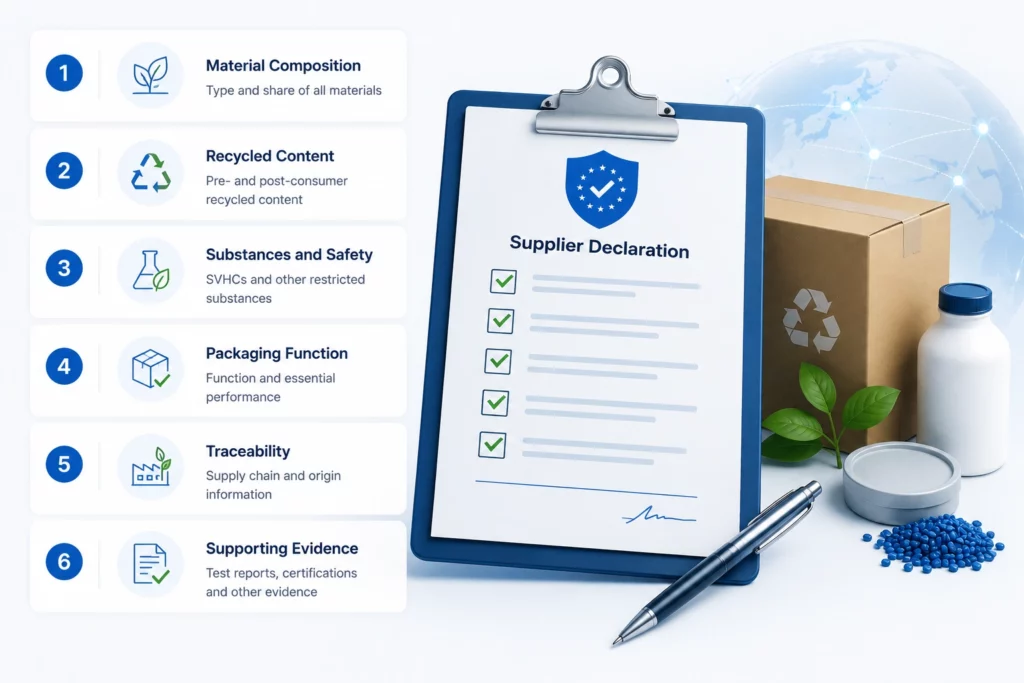
What information should you request insupplier declarations under PPWR?Request everything you need to sign your own Declaration of Conformity against Articles 5–12 of Regulation (EU) 2025/40: (1) full material composition for every component (lids, liners, labels, adhesives); (2) substance-restriction evidence a heavy-metals statement (lead, cadmium, mercury, hexavalent chromium ≤ 100 mg/kg combined) and, for food-contact packaging, a PFAS declaration; (3) recycled-content percentages; (4) recyclability / design-for-recycling data; (5) weight and empty-space data for packaging minimisation; and (6) traceability identifiers linking each declaration to a specific packaging item. Under Article 16, your suppliers are obliged to provide this documentation on request.
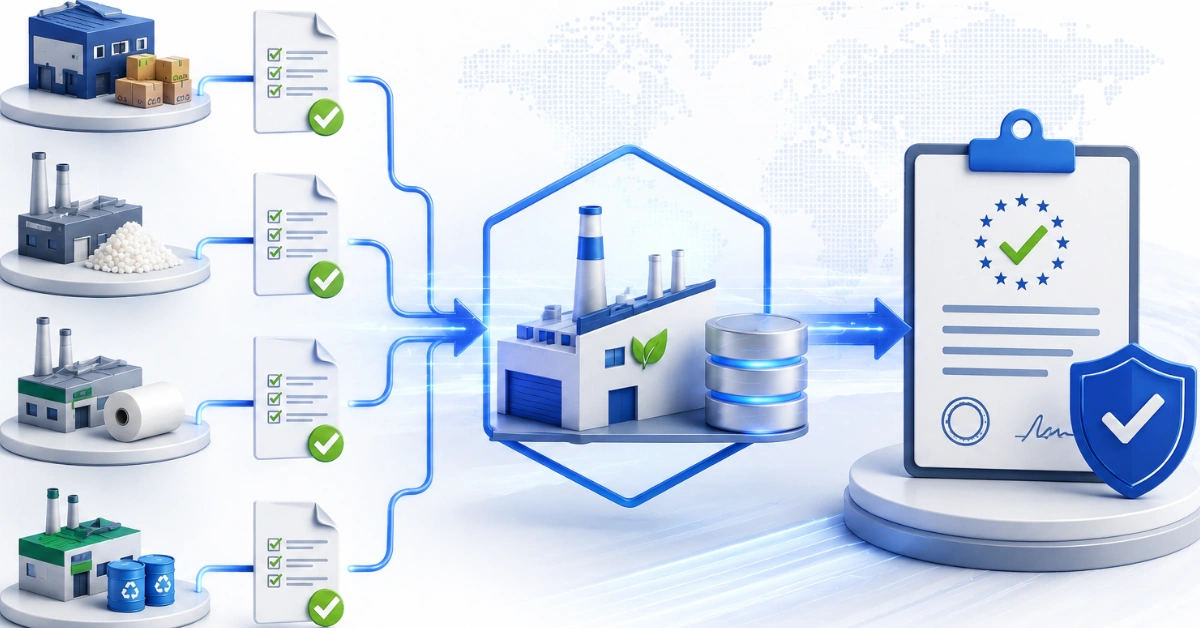
Supplier declarations under PPWR are the packaging conformity documents you collect from your suppliers the material, substance, and recycled-content evidence that lets you sign your own Declaration of Conformity with confidence. If you fill or brand packaging placed on the EU market, the Packaging and Packaging Waste Regulation (Regulation (EU) 2025/40) makes you the party legally responsible for that declaration. But the data behind it rarely lives in your building. It lives with the converter who made the film, the printer who applied the ink, and the mill that supplied the board. This guide breaks down exactly what to request, why each item matters, and how to collect it at scale before the 12 August 2026 application date.
KEY TAKEAWAYS
Supplier declarations under PPWR are the source evidence behind your own Declaration of Conformity (DoC) you cannot self-certify what you cannot prove.
From 12 August 2026, packaging placed on the EU market must be backed by a valid DoC (Article 39) and technical documentation covering Articles 5–12.
Article 16 obliges packaging suppliers to hand over conformity information and ingredient data on request so the gap is usually process, not entitlement.
Request material composition, heavy-metals and PFAS evidence, recycled content, recyclability grade, minimisation data, and unique traceability identifiers.
A structured, centralised collection process turns scattered supplier emails into an audit-ready file that keeps your DoC defensible.
What Are Supplier Declarations Under PPWR?
Supplier declarations under PPWR are written statements and supporting documents from your packaging suppliers confirming what each packaging component is made of and how it performs against the regulation’s requirements. In plain terms: they are the paper trail that proves your packaging meets Articles 5–12 of Regulation (EU) 2025/40.
At a glance, these declarations typically cover:
Material identification for every part of the packaging, not just the primary unit
Confirmation that restricted substances stay within legal limits
Recycled-content and recyclability data that feeds later PPWR targets
Identifiers that let you trace each declaration back to a specific SKU or batch
They are not the same as your Declaration of Conformity. Your DoC is your own self-certified statement of responsibility; these declarations are the underlying evidence that makes that statement defensible under audit.
Your packaging compliance is only as strong as the information your suppliers provide. Learn how to streamline supplier engagement, collect technical documentation, and build an audit-ready PPWR compliance program.
Why Supplier Declarations Under PPWR Sit at the Center of Your Declaration of Conformity
Here is the pain most compliance leads feel first: from 12 August 2026, no packaging may be placed on the EU market without a valid Declaration of Conformity and complete technical documentation. The DoC is a self-declaration under Article 39 by signing it, you assume full legal responsibility for the packaging’s conformity. There is no CE mark to lean on and, for most packaging, no notified body to share the burden.
That shifts the burden of proof onto you permanently. And you can only prove what your suppliers tell you. This is why these declarations are not a procurement side-task they are the foundation of your legal position. Miss one heavy-metals statement or one PFAS declaration for a food-contact film, and your DoC has a hole in it that a market-surveillance authority can drive straight through.
The good news: you are entitled to this data. Under Article 16, suppliers of packaging and packaging materials must provide the information and documents needed to certify conformity, including details of ingredients. The obligation exists. What most teams lack is a repeatable way to request, chase, validate, and store it.
From packaging specifications and material declarations to test reports and Declarations of Conformity, discover what documentation you need to build an audit-ready PPWR compliance program.
What Information to Request in Supplier Declarations Under PPWR
When you build your PPWR supplier-declaration request template, cover six evidence categories. Each maps to a specific obligation you will have to defend in your own technical file.
Minimisation data (weight, dimensions, empty space)
Traceability identifiers
Material Composition and Component-Level Data
Ask for a full material breakdown of every component the box and its lid, liner, label, adhesive, ink, and coating. PPWR conformity is assessed at the component level, so a compliant box with a non-compliant label is still non-compliant packaging. Request the material type, grammage or thickness, and supplier and item reference for each part.
You can’t manage what you can’t measure. Learn how to build a complete packaging inventory, centralize packaging data, and create a strong foundation for PPWR compliance.
Substance-Restriction Evidence: Heavy Metals and PFAS
Two substance requests belong in every PPWR supplier declaration. First, a heavy-metals statement: the combined concentration of lead, cadmium, mercury, and hexavalent chromium must not exceed 100 mg/kg, and this applies to all packaging regardless of material. Second, for food-contact packaging, a PFAS declaration. The Commission’s 2026 guidance describes a graduated approach that starts with a documentary supplier declaration confirming no intentional PFAS addition, before any screening or confirmatory testing which makes the supplier’s written statement your essential first line of evidence.
Recycled Content and Recyclability Data
Request the recycled-content percentage for each plastic component and the supplier’s assessment of recyclability or design-for-recycling grade. Minimum recycled-content thresholds and recyclability grades tighten from 2030, but collecting this data now means you are not restarting supplier outreach from zero when those targets bite. Capture the basis of the claim, not just the number, so the figure is auditable.
Minimisation, Reuse, and Traceability Identifiers
Ask for weight, dimensions, and for e-commerce and grouped formats empty-space ratios, since packaging minimisation limits apply from application. Where reuse or refill systems are relevant, request evidence the system exists. Finally, insist on a unique identifier for each declaration a supplier part number, internal item number, or batch reference so every declaration ties back to a specific packaging item in your inventory. Without that link, your technical file becomes an unsearchable pile.
How to Collect Supplier Declarations Under PPWR at Scale
Knowing what to ask for is half the problem. The other half is collecting supplier declarations under PPWR from dozens of suppliers, in inconsistent formats, and keeping them current as materials and vendors change. Spreadsheets and email threads break down fast a single supplier swap means chasing a new declaration and updating records before that packaging can go to market.
This is where TraceX PPWR Solution fits. The platform gives you a structured supplier-declaration workflow: standardised request templates mapped to Articles 5–12, automated supplier outreach and reminders, validation checks that flag missing or expired evidence, and a centralised, version-controlled document store built for the regulation’s multi-year retention requirement. Because every declaration is linked to the specific SKU it supports, your Declaration of Conformity stays traceable and audit-ready rather than reconstructed under pressure.
The benefit is a defensible compliance position with far less manual chasing: fewer gaps, faster onboarding of new suppliers, and a technical file that surfaces the right evidence in seconds when an authority asks.
See supplier declarations under PPWR handled end-to-end
Watch how standardised requests, automated follow-up, and audit-ready storage turn scattered supplier evidence into one defensible Declaration of Conformity.
Supplier Declarations Under PPWR: Manual Collection vs. TraceX
Capability
Manual (spreadsheets + email)
TraceX
Request templates
Ad hoc; each analyst writes their own
Standardised templates mapped to Articles 5–12
Supplier follow-up
Manual chasing; easy to lose track
Automated reminders and status tracking
Validation
Eyeballed; gaps found late
Automatic flags for missing or expired evidence
Evidence-to-SKU link
Fragile; lives in file names
Each declaration linked to its packaging item
Retention & audit
Scattered folders, version confusion
Centralised, version-controlled, retention-ready
New supplier onboarding
Restart the whole chase
Reusable workflow; fast onboarding
Buyer’s Checklist: Evaluating Supplier Declarations Under PPWR
Use this checklist to judge whether a supplier declaration is complete enough to support your DoC and whether a compliance tool you are evaluating actually closes the gap:
Does the declaration cover every component (lid, liner, label, adhesive, ink), not just the primary unit?
Is there a heavy-metals statement confirming the 100 mg/kg combined limit?
For food-contact packaging, is there a PFAS declaration confirming no intentional addition?
Are recycled-content and recyclability figures stated with their basis, not just a bare number?
Are weight, dimensions, and empty-space data included for minimisation?
Does each declaration carry a unique identifier that links it to a specific SKU or batch?
Is the evidence stored with version control and retained for the required period?
Can you retrieve the full evidence set for any SKU in seconds if an authority asks?
Frequently Asked Questions (FAQ’s)
What are supplier declarations under PPWR?
Supplier declarations under PPWR are the written statements and supporting documents you collect from packaging suppliers confirming material composition and compliance with Articles 5–12 of Regulation (EU) 2025/40. They are the evidence base for your own Declaration of Conformity.
Are suppliers legally required to give me this information?
Yes. Under Article 16 of the PPWR, suppliers of packaging and packaging materials must provide the information and documents needed to certify conformity, including ingredient details, on request.
What is the difference between a supplier declaration and a Declaration of Conformity?
A Declaration of Conformity (DoC) is your own self-certified statement of legal responsibility under Article 39. Supplier declarations under PPWR are the upstream evidence that makes your DoC defensible they are inputs, not substitutes.
What must I request for PFAS in packaging?
For food-contact packaging, request a supplier declaration confirming no intentional PFAS addition. The Commission’s 2026 guidance treats this documentary declaration as the first step, ahead of any screening or confirmatory testing.
What is the heavy-metals limit I should ask suppliers to confirm?
The combined concentration of lead, cadmium, mercury, and hexavalent chromium must not exceed 100 mg/kg. This applies to all packaging, regardless of material or category.
When do supplier declarations under PPWR need to be in place?
Aim to have them complete before the 12 August 2026 general application date, when a valid DoC and technical documentation become mandatory for packaging placed on the EU market. Confirm the current date, as a delay had been discussed.
Do small businesses have to comply?
The PPWR does not provide a general exemption for micro or small enterprises. Core obligations, including documentation, apply regardless of company size.
Start using TraceX
Transparency, Trust, & Success for your Climate Journey.
We use cookies on our website to give you the most relevant experience by remembering your preferences and repeat visits. By clicking “Accept All”, you consent to the use of ALL the cookies. However, you may visit "Cookie Settings" to provide a controlled consent.
This website uses cookies to improve your experience while you navigate through the website. Out of these, the cookies that are categorized as necessary are stored on your browser as they are essential for the working of basic functionalities of the website. We also use third-party cookies that help us analyze and understand how you use this website. These cookies will be stored in your browser only with your consent. You also have the option to opt-out of these cookies. But opting out of some of these cookies may affect your browsing experience.
Necessary cookies are absolutely essential for the website to function properly. These cookies ensure basic functionalities and security features of the website, anonymously.
Cookie
Duration
Description
cookielawinfo-checkbox-analytics
11 months
This cookie is set by GDPR Cookie Consent plugin. The cookie is used to store the user consent for the cookies in the category "Analytics".
cookielawinfo-checkbox-functional
11 months
The cookie is set by GDPR cookie consent to record the user consent for the cookies in the category "Functional".
cookielawinfo-checkbox-necessary
11 months
This cookie is set by GDPR Cookie Consent plugin. The cookies is used to store the user consent for the cookies in the category "Necessary".
cookielawinfo-checkbox-others
11 months
This cookie is set by GDPR Cookie Consent plugin. The cookie is used to store the user consent for the cookies in the category "Other.
cookielawinfo-checkbox-performance
11 months
This cookie is set by GDPR Cookie Consent plugin. The cookie is used to store the user consent for the cookies in the category "Performance".
viewed_cookie_policy
11 months
The cookie is set by the GDPR Cookie Consent plugin and is used to store whether or not user has consented to the use of cookies. It does not store any personal data.
Functional cookies help to perform certain functionalities like sharing the content of the website on social media platforms, collect feedbacks, and other third-party features.
Performance cookies are used to understand and analyze the key performance indexes of the website which helps in delivering a better user experience for the visitors.
Analytical cookies are used to understand how visitors interact with the website. These cookies help provide information on metrics the number of visitors, bounce rate, traffic source, etc.
Advertisement cookies are used to provide visitors with relevant ads and marketing campaigns. These cookies track visitors across websites and collect information to provide customized ads.
Download the 2026 Traceability Scorecard and Benchmark Your Supply Chain Across 10 Critical Capabilities.
Download our eBook
Don’t Wait for an Audit to Find Your EUDR Gaps
The 2026 Simplification Package changes how HS codes, DDS pass-through and geolocation rules apply to you. Get the free guide and 20-point readiness checklist before enforcement catches you unprepared.