PPWR Compliance for Food Importers in the Netherlands
Published
, 14 minute read
Share this article
Quick summary: Learn how food importers in the Netherlands can prepare for PPWR compliance. Understand importer responsibilities, food packaging documentation, supplier verification, technical documentation, packaging conformity, and packaging data management before the August 2026 compliance milestone.
The Netherlands is one of Europe’s largest importers of packaged food products, sourcing goods from across Asia, Africa, Latin America, North America, and the Middle East. From coffee, cocoa, spices, rice, frozen seafood, processed foods, confectionery, beverages, edible oils, and ready-to-eat meals, food importers play a critical role in supplying the Dutch and wider European markets.
With the introduction of the EU Packaging and Packaging Waste Regulation (PPWR), food importers must now ensure that the packaging accompanying imported products complies with applicable EU packaging requirements before those products are placed on the market.
While overseas manufacturers are responsible for producing packaged food products, importers are responsible for ensuring that imported packaging is supported by the necessary technical documentation, supplier information, and compliance evidence required under PPWR.
Unlike the previous Packaging and Packaging Waste Directive, PPWR applies directly across all EU Member States, creating harmonized obligations for manufacturers, importers, distributors, and other economic operators involved in placing packaged products on the EU market.
For food importers managing complex global supplier networks, compliance extends far beyond customs documentation. It requires structured packaging data, supplier collaboration, technical documentation, conformity verification, and scalable compliance processes that can support thousands of imported products.
Organizations that begin preparing now will be better positioned to meet upcoming implementation milestones, reduce supply chain risks, respond to retailer requirements, and demonstrate compliance during regulatory inspections.
Key Takeaways
If your organization imports packaged food products into the Netherlands, PPWR introduces new responsibilities across the packaging lifecycle.
Key priorities include:
Packaging conformity verification
Technical documentation
Declaration of Conformity (DoC)
Supplier compliance documentation
Food packaging material verification
Packaging data management
Design for recyclability verification
Recycled-content documentation
Supplier collaboration
Audit readiness
Rather than treating PPWR as a one-time compliance exercise, food importers should establish scalable packaging governance processes that strengthen supplier collaboration and support long-term regulatory compliance.
Prepare Your Food Packaging Compliance Program Before the August 2026 Deadline
Download our complimentary PPWR Implementation Handbook and begin building your packaging compliance program today.
Unlike the previous Packaging and Packaging Waste Directive, which required implementation through national legislation, PPWR applies directly across all EU Member States. This creates a consistent regulatory framework while assigning clear responsibilities to manufacturers, importers, distributors, brand owners, and other economic operators.
The regulation covers packaging throughout its lifecycle, including:
Packaging design
Packaging minimization
Design for recyclability
Recycled plastic content
Reuse systems
Packaging labelling
Technical documentation
Declaration of Conformity
Market surveillance
Extended Producer Responsibility (EPR)
For food importers, compliance goes beyond sourcing packaged products. Businesses should verify that imported packaging satisfies applicable PPWR requirements through supplier documentation, conformity evidence, and structured packaging data management before products are placed on the EU market.
Why PPWR Matters for Food Importers in the Netherlands
The Netherlands imports millions of tonnes of packaged food products every year to meet consumer demand and support its retail and food service sectors.
Common imported food categories include:
Coffee and tea
Cocoa and chocolate
Rice and grains
Frozen seafood
Frozen fruits and vegetables
Canned foods
Ready meals
Sauces and condiments
Edible oils
Dairy products
Snacks and confectionery
Bakery products
Beverages
Pet food
These products are packaged using a wide variety of materials, including:
Glass jars
PET bottles
HDPE containers
Aluminium cans
Flexible plastic pouches
Vacuum packaging
Composite cartons
Corrugated transport cartons
Shrink wrap
Labels
Wooden pallets
Display-ready packaging
Food packaging presents unique compliance challenges because it must protect product quality, preserve shelf life, ensure food safety, and withstand transportation while also meeting sustainability requirements under PPWR.
Importers cannot assume that overseas manufacturers have already addressed every packaging compliance requirement.
Before placing products on the EU market, food importers should verify that appropriate technical documentation and supporting evidence are available for every packaging component.
This requires close collaboration with:
Food manufacturers
Packaging manufacturers
Packaging converters
Label suppliers
Contract packers
Logistics providers
Testing laboratories
Private-label manufacturers
Without structured compliance processes, organizations may face:
Delays in product launches
Missing supplier documentation
Increased retailer information requests
Regulatory inspections
Product withdrawal risks
Higher administrative costs
At the same time, retailers, consumers, and regulators are demanding greater transparency around packaging sustainability, making PPWR compliance both a regulatory requirement and a strategic business advantage.
Understand Your Responsibilities Under PPWR
Understanding your role in the packaging value chain is the first step toward building an effective compliance strategy.
What Should Food Importers Prioritize Before the August 2026 PPWR Milestone?
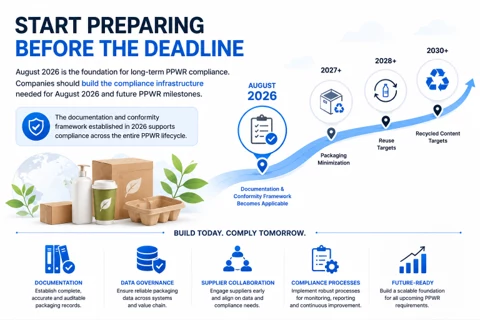
Although several PPWR obligations including packaging minimization, recycled-content targets, and reuse requirements will be introduced progressively over the coming years, 12 August 2026 marks the first major compliance milestone.
By this date, food importers placing packaged products on the EU market should be prepared to demonstrate compliance with the applicable provisions of the regulation.
Rather than waiting until implementation deadlines approach, organizations should begin building the supplier engagement processes, packaging governance framework, technical documentation repository, and packaging data management capabilities needed to support long-term compliance.
Food importers operate within one of the most complex packaging ecosystems. A single imported product may contain primary food-contact packaging, secondary retail packaging, transport packaging, labels, closures, and pallet packaging—often sourced from multiple suppliers across different countries.
Under PPWR, importers should establish processes to verify that packaging complies with applicable regulatory requirements before products are placed on the EU market.
Below are six priority areas every food importer should focus on.
1. Verify Packaging Compliance Before Products Enter the EU Market
Food importers should not assume that overseas manufacturers have already addressed every PPWR requirement.
Instead, they should establish a packaging verification process covering:
Packaging material specifications
Material composition
Packaging weight and dimensions
Food-contact packaging information
Design for recyclability
Recycled plastic content (where applicable)
Packaging minimization
Substance compliance
Supporting laboratory reports
Verifying compliance early helps prevent product delays, supplier disputes, and costly corrective actions.
2. Build a Centralized Technical Documentation Repository
Technical documentation is likely to become one of the most requested compliance assets under PPWR.
For imported food products, documentation may originate from:
Food manufacturers
Packaging manufacturers
Packaging converters
Label suppliers
Carton manufacturers
Plastic packaging suppliers
Glass manufacturers
Contract packers
Independent laboratories
Rather than storing documents across emails and shared drives, food importers should maintain a centralized repository containing:
Packaging specifications
Material declarations
Certificates
Laboratory reports
Packaging drawings
Supplier declarations
Compliance records
Packaging change history
A structured documentation system improves audit readiness and simplifies retailer and regulatory requests.
3. Strengthen Supplier Collaboration Across Global Supply Chains
Food packaging frequently changes because of:
Supplier changes
Packaging redesigns
New sustainability initiatives
Material substitutions
Product reformulations
Private-label updates
Without continuous supplier collaboration, documentation quickly becomes outdated.
Importers should establish standardized workflows for:
Supplier onboarding
Packaging data collection
Technical documentation requests
Compliance declarations
Packaging change notifications
Periodic document reviews
Digital collaboration reduces manual follow-ups while improving data quality and supplier accountability.
4. Manage Food Packaging Data from One Source
Many food importers manage packaging information across multiple systems.
Typical sources include:
ERP systems
Product Lifecycle Management (PLM) software
Procurement systems
Supplier portals
Excel spreadsheets
Email attachments
Quality management systems
This fragmented approach makes it difficult to demonstrate compliance across large product portfolios.
A centralized packaging data management strategy should include:
Packaging hierarchy
Packaging component information
Material composition
Packaging weights
Supplier information
Country of manufacture
Packaging versions
Food-contact material information
Compliance documentation
Having one trusted source of packaging information improves consistency and supports future reporting requirements.
5. Prepare for Regulatory Inspections and Retailer Audits
Large retailers, import authorities, and market surveillance authorities increasingly expect importers to demonstrate packaging compliance through documented evidence.
Food importers should be prepared to provide:
Technical documentation
Packaging specifications
Supplier declarations
Material certificates
Laboratory reports
Packaging identification records
Internal approval records
Supporting compliance evidence
Organizations with structured documentation processes can respond quickly, reducing business disruption during inspections or customer audits.
6. Build a Future-Ready Packaging Compliance Program
PPWR is only one element of Europe’s evolving sustainability regulatory landscape.
Ecodesign for Sustainable Products Regulation (ESPR)
Green Claims requirements
Instead of creating separate compliance processes for each regulation, organizations should establish a shared digital foundation for supplier information, packaging data, technical documentation, and compliance evidence.
This reduces duplication while improving operational efficiency across multiple regulatory initiatives.
Common PPWR Scenarios for Food Importers
Scenario 1: Importing Coffee from Brazil
A Dutch importer sources roasted coffee packaged in multilayer flexible pouches.
Before placing the product on the EU market, the importer should obtain packaging specifications, material composition, supplier declarations, and supporting technical documentation for the packaging.
Scenario 2: Importing Frozen Seafood from Vietnam
Frozen seafood is shipped in primary food-contact packaging, secondary cartons, and transport packaging sourced from different suppliers.
The importer should maintain documentation for every packaging component and ensure packaging changes are reflected in technical records.
Scenario 3: Importing Private-Label Snacks from India
An overseas manufacturer changes the pouch material to improve shelf life without notifying the importer.
Without change management and version control, outdated technical documentation may no longer reflect the packaging placed on the EU market.
Scenario 4: Retailer Requests Packaging Evidence
A Dutch supermarket chain requests evidence that imported food packaging complies with PPWR requirements before listing a new product.
Importers with centralized packaging documentation can respond quickly, while manual processes often result in delays and repeated supplier requests.
Common Challenges Food Importers Face
As PPWR implementation progresses, food importers are likely to encounter challenges such as:
Limited visibility into supplier packaging data
Inconsistent documentation from overseas manufacturers
Multiple packaging suppliers for a single product
Frequent packaging specification changes
Lack of document version control
Manual supplier communication
Fragmented packaging information across systems
Difficulty demonstrating compliance during audits
Increasing retailer sustainability requirements
Addressing these challenges requires more than collecting certificates. It requires structured packaging governance, supplier collaboration, and centralized packaging information.
Meeting PPWR requirements starts with accurate packaging data, robust technical documentation, and effective supplier collaboration.
Learn how to prepare your organization for packaging conformity assessments, documentation requirements, recyclability obligations, and ongoing compliance.
Building a PPWR Compliance Strategy for Food Importers in the Netherlands
For food importers, PPWR compliance extends beyond verifying packaging specifications. It requires an organized approach to supplier collaboration, packaging governance, technical documentation, and data management across global supply chains.
As food packaging becomes more complex and regulatory expectations continue to evolve, businesses that rely on manual documentation and fragmented systems may struggle to maintain compliance. Establishing a structured compliance framework today will help organizations reduce operational risk and improve long-term supply chain resilience.
A Practical PPWR Compliance Framework for Food Importers
A successful PPWR program should involve procurement, quality assurance, packaging, regulatory affairs, sustainability, logistics, and supplier management teams.
The following five pillars provide a practical roadmap for implementation.
1. Establish a Centralized Packaging Information Repository
Food importers often source products from multiple manufacturers, each using different packaging suppliers and documentation formats.
Instead of maintaining packaging information across spreadsheets, shared drives, and emails, organizations should centralize information such as:
Primary food packaging
Secondary packaging
Transport packaging
Material composition
Packaging weights
Packaging dimensions
Food-contact material information
Recycled-content data
Packaging supplier details
Packaging version history
A centralized repository improves consistency while reducing the time required to respond to customer or regulatory requests.
2. Digitize Supplier Collaboration
Food importers depend heavily on suppliers for packaging compliance information.
A structured supplier collaboration process should include:
Supplier onboarding
Packaging specification collection
Technical documentation requests
Material declarations
Laboratory reports
Packaging change notifications
Periodic compliance reviews
Corrective action management
Digitizing these interactions reduces manual communication while improving data accuracy and supplier accountability.
3. Manage Technical Documentation Throughout the Product Lifecycle
Packaging documentation should evolve alongside the product.
Whenever packaging materials, suppliers, dimensions, or designs change, documentation should be reviewed and updated.
Organizations should maintain version-controlled records for:
Technical documentation
Packaging specifications
Material declarations
Laboratory reports
Supplier certificates
Compliance declarations
Packaging drawings
Internal approvals
This ensures that documentation accurately reflects the packaging currently placed on the EU market.
4. Strengthen Packaging Governance
Food packaging changes frequently due to:
Product reformulations
Sustainability initiatives
Packaging redesigns
New suppliers
Retailer requirements
Cost optimization projects
Material substitutions
Without formal governance, outdated documentation can quickly create compliance risks.
Importers should establish internal approval workflows to verify packaging changes before products enter the European market.
5. Maintain Continuous Audit Readiness
PPWR compliance should not be treated as a one-time project completed before a deadline.
Instead, organizations should continuously maintain:
Supplier records
Packaging specifications
Technical documentation
Compliance declarations
Packaging history
Product traceability
Internal approvals
Audit evidence
This enables faster responses to inspections, retailer requests, and regulatory inquiries while reducing business disruption.
PPWR introduces requirements that go far beyond packaging design. From technical documentation and conformity assessments to recyclability, packaging minimization, and economic operator obligations, understanding the regulation is essential for building a compliant packaging strategy.
Managing packaging compliance across multiple countries, suppliers, packaging formats, and product categories can quickly become difficult using spreadsheets and email.
TraceX PPWR Solutions provides a centralized digital platform that helps food importers manage packaging compliance from supplier onboarding through ongoing regulatory readiness.
Centralize Packaging Data
Maintain packaging specifications, material composition, supplier information, recycled-content data, and compliance records in one secure platform.
Streamline Supplier Collaboration
Collect packaging information directly from suppliers using standardized digital workflows, reducing manual follow-ups and improving response times.
Manage Technical Documentation
Store, organize, and maintain version-controlled technical documentation, laboratory reports, certificates, declarations, and supporting compliance evidence.
Improve Packaging Traceability
Create visibility across packaging suppliers, manufacturing sites, packaging components, and imported food products to support stronger compliance and governance.
Support PPWR Compliance
Build the documentation, supplier engagement processes, and packaging governance needed to support packaging conformity, technical documentation requirements, and future regulatory obligations.
Scale Across Global Food Supply Chains
Whether importing food products from India, Brazil, Vietnam, Thailand, Turkey, Indonesia, Africa, or Latin America, TraceX helps standardize packaging compliance across your global supplier network.
Ready to Simplify PPWR Compliance for Imported Food Products?
Schedule a PPWR Readiness Assessment to evaluate your current packaging compliance processes, identify gaps, and build a scalable roadmap for meeting PPWR requirements with confidence.
For food importers in the Netherlands, PPWR is more than a packaging regulation it is a catalyst for improving packaging governance, supplier collaboration, and operational transparency.
Organizations that continue relying on fragmented documentation, manual communication, and disconnected systems may find it increasingly difficult to keep pace with evolving regulatory and retailer expectations.
By investing in centralized packaging data, structured supplier engagement, and digital compliance processes, food importers can reduce compliance risks, improve operational efficiency, and build a future-ready packaging compliance program that supports long-term business growth.
Frequently Asked Questions
Does PPWR apply to food importers?
Yes. Food importers placing packaged food products on the EU market have responsibilities under PPWR and should verify that imported packaging complies with applicable regulatory requirements before products are made available in the EU.
What packaging documentation should food importers collect?
Depending on the packaging and applicable requirements, importers should collect documentation such as:
Technical documentation
Packaging specifications
Material declarations
Supplier declarations
Laboratory reports
Packaging drawings
Certificates
Recycled-content information
Declaration of Conformity (where applicable)
Are overseas manufacturers responsible for PPWR compliance?
Manufacturers have obligations relating to the packaging they produce, but food importers should verify that appropriate compliance documentation is available before placing packaged products on the EU market. Importers should not rely solely on supplier assurances without maintaining supporting records.
Why is packaging data management important?
Food packaging information is often spread across multiple suppliers and internal systems.
Centralized packaging data enables organizations to:
Improve supplier collaboration
Simplify documentation management
Respond faster to retailer requests
Support regulatory inspections
Strengthen packaging governance
Reduce manual administrative effort
How can digital platforms simplify PPWR compliance?
Digital platforms help food importers centralize packaging data, automate supplier collaboration, manage technical documentation, maintain version-controlled records, and improve audit readiness across the packaging lifecycle.
Start using TraceX
Transparency, Trust, & Success for your Climate Journey.
We use cookies on our website to give you the most relevant experience by remembering your preferences and repeat visits. By clicking “Accept All”, you consent to the use of ALL the cookies. However, you may visit "Cookie Settings" to provide a controlled consent.
This website uses cookies to improve your experience while you navigate through the website. Out of these, the cookies that are categorized as necessary are stored on your browser as they are essential for the working of basic functionalities of the website. We also use third-party cookies that help us analyze and understand how you use this website. These cookies will be stored in your browser only with your consent. You also have the option to opt-out of these cookies. But opting out of some of these cookies may affect your browsing experience.
Necessary cookies are absolutely essential for the website to function properly. These cookies ensure basic functionalities and security features of the website, anonymously.
Cookie
Duration
Description
cookielawinfo-checkbox-analytics
11 months
This cookie is set by GDPR Cookie Consent plugin. The cookie is used to store the user consent for the cookies in the category "Analytics".
cookielawinfo-checkbox-functional
11 months
The cookie is set by GDPR cookie consent to record the user consent for the cookies in the category "Functional".
cookielawinfo-checkbox-necessary
11 months
This cookie is set by GDPR Cookie Consent plugin. The cookies is used to store the user consent for the cookies in the category "Necessary".
cookielawinfo-checkbox-others
11 months
This cookie is set by GDPR Cookie Consent plugin. The cookie is used to store the user consent for the cookies in the category "Other.
cookielawinfo-checkbox-performance
11 months
This cookie is set by GDPR Cookie Consent plugin. The cookie is used to store the user consent for the cookies in the category "Performance".
viewed_cookie_policy
11 months
The cookie is set by the GDPR Cookie Consent plugin and is used to store whether or not user has consented to the use of cookies. It does not store any personal data.
Functional cookies help to perform certain functionalities like sharing the content of the website on social media platforms, collect feedbacks, and other third-party features.
Performance cookies are used to understand and analyze the key performance indexes of the website which helps in delivering a better user experience for the visitors.
Analytical cookies are used to understand how visitors interact with the website. These cookies help provide information on metrics the number of visitors, bounce rate, traffic source, etc.
Advertisement cookies are used to provide visitors with relevant ads and marketing campaigns. These cookies track visitors across websites and collect information to provide customized ads.
Download the 2026 Traceability Scorecard and Benchmark Your Supply Chain Across 10 Critical Capabilities.
Download our eBook
Don’t Wait for an Audit to Find Your EUDR Gaps
The 2026 Simplification Package changes how HS codes, DDS pass-through and geolocation rules apply to you. Get the free guide and 20-point readiness checklist before enforcement catches you unprepared.