PPWR Authorised Representative: Who Needs One in 2026?
Published
, 12 minute read
Share this article
Quick summary: Learn who needs a PPWR Authorised Representative under EU packaging EPR rules, what the role involves, key 2026 deadlines, and how businesses can prepare for compliant packaging reporting across Member States.
A PPWR Authorised Representative is a person or company, established in an EU Member State, that a producer appoints to carry out its packaging extended producer responsibility (EPR) obligations in that country. You need a PPWR Authorised Representative if you place packaging or packaged goods on the market in an EU Member State where your business is not established most commonly non-EU manufacturers and brands, cross-border EU sellers, and e-commerce/distance sellers. The representative registers you, reports your packaging volumes, and pays your EPR fees so you stay compliant under Regulation (EU) 2025/40.
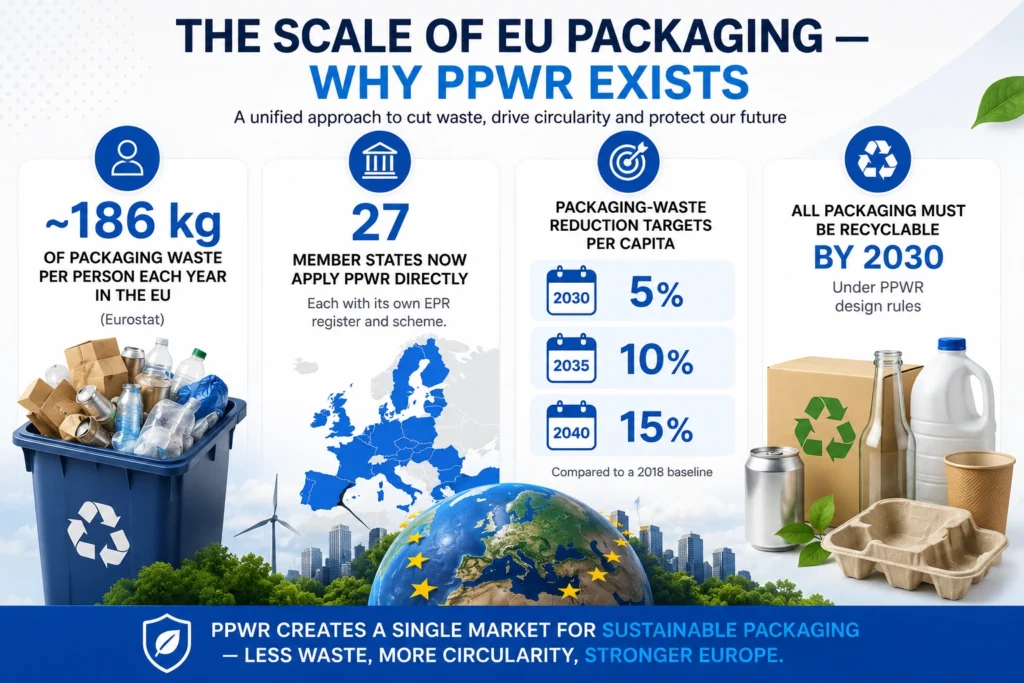
PPWR Authorised Representative requirements are quickly becoming one of the most important compliance topics for any business that sells packaging or products wrapped in packaging into the European Union. The EU’s new Packaging and Packaging Waste Regulation (PPWR), formally Regulation (EU) 2025/40, replaces the old Packaging and Packaging Waste Directive and, because it is a regulation rather than a directive, applies directly across all 27 Member States. One of its most consequential changes for international and cross-border sellers is the formal role of the authorised representative for extended producer responsibility.
If you have ever wondered whether your company is on the hook for EU packaging rules in a country where you have no office, no warehouse, and no legal entity, this guide answers that question directly and shows you exactly what a representative does, who needs one, what happens if you skip it, and how to choose the right partner.
Stop Chasing Packaging Data Across Spreadsheets
Specs, supplier docs, and compliance evidence live in one platform instead of scattered inboxes and files. See exactly how TraceX becomes your single source of truth for PPWR.
A PPWR Authorised Representative fulfils your EU packaging EPR duties in a Member State where you have no legal establishment.
You need one per Member State where you sell but are not established it is not a single EU-wide appointment.
The role applies most directly to non-EU producers, cross-border sellers, and online/distance sellers.
Failing to appoint a PPWR Authorised Representative can mean fines, blocked sales, and marketplace delisting.
PPWR (Regulation (EU) 2025/40) applies from 12 August 2026, so appointments should be in place well before then.
What Is a PPWR Authorised Representative?
A PPWR Authorised Representative is the legal stand-in that meets your EU packaging obligations locally. In plain language, it is a person or organisation, established inside an EU Member State, that a producer formally appoints to carry out that producer’s extended producer responsibility (EPR) duties for packaging in that specific country.
Extended producer responsibility means the company that puts packaging on the market is financially and administratively responsible for what happens to that packaging at end of life its collection, sorting, and recycling. Under PPWR, when the producer responsible for that packaging is not established in the Member State where the packaging is sold, that producer must appoint a PPWR Authorised Representative to take on those duties on its behalf. Specifically, the representative:
Acts as the producer’s official EPR contact within that Member State
Registers the producer in the national packaging or EPR register
Reports the quantities and types of packaging placed on that national market
Ensures the producer’s financial contributions (EPR fees) are paid to the relevant scheme
Important nuance: the PPWR Authorised Representative for EPR is distinct from the general “authorised representative” found in product-safety and CE-marking law. The PPWR role is specifically about packaging waste responsibility, not product conformity.
EPR is becoming a critical part of PPWR compliance. Is your business prepared?
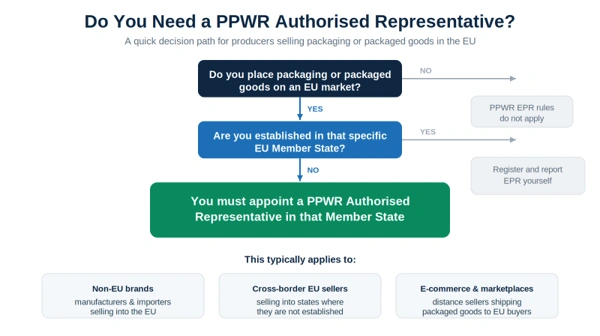
A PPWR Authorised Representative is required whenever you place packaging on an EU market in a country where your business is not legally established. If you sell into a Member State without a registered entity there, the obligation almost always applies. The most common situations are:
Non-EU manufacturers and brands. If you are based outside the EU (for example in the US, UK, or Asia) and your packaged products reach EU consumers, you generally need a representative in each Member State where you sell.
Cross-border EU sellers. Even an EU-based company must appoint a PPWR Authorised Representative in other Member States where it sells packaged goods but has no establishment.
E-commerce and distance sellers. Online sellers shipping directly to EU buyers are squarely in scope distance selling was a major driver behind formalising this role to close “free rider” gaps.
Online marketplaces and fulfilment users. Platforms and the third-party sellers on them increasingly carry verification and compliance duties, making representation essential.
The decision flow below shows the quick logic most teams follow when assessing whether the obligation applies to them.
Rule of thumb: the appointment is per Member State, not per region. Selling into five EU countries without an entity in any of them typically means five separate PPWR Authorised Representative appointments, each registered with that country’s national scheme.
What a PPWR Authorised Representative Is Responsible For
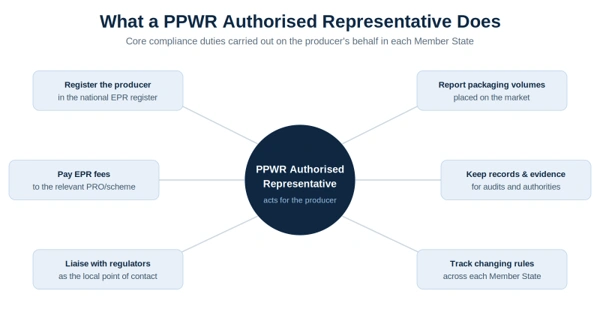
A PPWR Authorised Representative carries the producer’s day-to-day packaging compliance load in-country. Rather than a passive mailbox, it is an active compliance partner whose core responsibilities include:
Critically, appointing a representative does not erase your own accountability. You remain the producer; the representative executes the obligations on your behalf and is the local face of your compliance. That distinction matters when you negotiate contracts and decide how much of the data and liability each side carries.
Registration and reporting
The representative registers the producer in the national EPR/packaging register and submits periodic declarations of how much packaging by material and weight was placed on that market. Accurate data here is the backbone of the entire EPR system.
Financial contributions
EPR is funded by producer fees, usually paid to a Producer Responsibility Organisation (PRO). The PPWR Authorised Representative ensures the correct fees are calculated and paid, increasingly under eco-modulation rules that reward recyclable, lower-impact packaging and penalise hard-to-recycle formats.
Records, audits, and authority liaison
The representative maintains the evidence regulators may request, responds to audits, and acts as the local point of contact a meaningful advantage when correspondence and enforcement happen in the national language.
Preparing for PPWR doesn’t have to be overwhelming.
Learn how to manage packaging data, supplier declarations, technical documentation, EPR obligations, and Declarations of Conformity all in one practical guide.
PPWR Authorised Representative vs. Other Compliance Roles
A PPWR Authorised Representative is often confused with other “representative” roles, but each solves a different problem. The comparison below clarifies where it fits.
Selling packaging in an EU state where you’re not established
Authorised Representative (product/CE law)
Product conformity, technical files, CE marking
Placing regulated products on the EU market from outside it
Producer Responsibility Organisation (PRO)
Collective scheme that organises collection & recycling
Almost always your rep typically registers you with one
Importer / local distributor
May become the responsible producer if no rep is named
A fallback you usually want to avoid leaving to chance
When Do PPWR Authorised Representative Rules Apply?
A PPWR Authorised Representative should be appointed before PPWR’s main obligations bite. PPWR entered into force in early 2025 and applies from 12 August 2026, with various provisions and targets phasing in afterward. Several Member States (such as France and Germany) already required foreign producers to appoint local representatives under national EPR law, so for many sellers this is a tightening and harmonising of an existing duty rather than a brand-new one.
Practical takeaway: don’t wait for the deadline. Registration, scheme onboarding, and first declarations take time, and selling without a valid PPWR Authorised Representative in place can interrupt your access to the market. Because PPWR phases obligations in over several years and individual Member States move at different speeds, the safest approach is to map every country you sell into, confirm where you lack an establishment, and line up representation country by country rather than treating it as a single switch you flip in 2026.
Penalties for Not Appointing a PPWR Authorised Representative
Skipping a PPWR Authorised Representative is a commercial risk, not just a legal one. Enforcement specifics vary by Member State, but the typical consequences of non-compliance include:
Fines and back-payments for unregistered packaging and unpaid EPR fees, sometimes backdated.
Marketplace delisting. Major platforms increasingly require proof of EPR registration; without it, listings can be suspended.
Blocked or withdrawn sales. Authorities can stop non-compliant packaging from being placed on the market.
Reputational and customer-trust damage, particularly for brands marketing themselves on sustainability.
In short, the cost of appointing a representative is almost always far lower than the cost of being caught without one.
What Your PPWR Authorised Representative Will Need From You
A PPWR Authorised Representative can only file accurately if you hand over clean data, so onboarding is a two-way effort. Getting these inputs ready in advance is the single biggest factor in how fast you become compliant. Expect to provide:
Company and legal details for the producer entity being represented, including any EU VAT or trade registrations.
A packaging inventory listing every packaging component you place on each market primary, secondary, and transport packaging broken down by material (plastic, paper/card, glass, metal, composite) and weight per unit.
Volume data per Member State, ideally annual quantities sold into each country so declarations and fees are calculated correctly.
Product and SKU mapping so packaging can be tied to the goods that actually shipped, which matters as eco-modulation gets more granular.
If that data is scattered across spreadsheets, suppliers, and 3PLs today, start consolidating now. A good PPWR Authorised Representative will give you a template, but the underlying accuracy is on you and under-reporting is exactly what audits are designed to catch.
How to Choose the Right PPWR Authorised Representative
Choosing a PPWR Authorised Representative is a buying decision, so evaluate providers the way you would any compliance partner. The right partner removes the administrative burden entirely; the wrong one leaves gaps you only discover during enforcement. Look for:
Coverage across your markets. Can they represent you in every Member State where you sell, ideally through one contract and one dashboard?
Scheme relationships. Established links with the national PROs and registers so onboarding is fast and accurate.
Data and reporting tooling. Clear processes for collecting your packaging data and filing declarations eco-modulation makes this increasingly granular.
Transparent pricing. Understand what is a service fee versus the EPR fees passed through to schemes.
Liability and contractual clarity. Know exactly which obligations the representative assumes and which remain yours.
How TraceX Helps Businesses Work with a PPWR Authorised Representative
Appointing an Authorised Representative helps businesses meet regulatory obligations under PPWR, but the representative can only act on the information they receive. Incomplete packaging data, missing supplier declarations, or outdated technical documentation can delay registrations, reporting, and compliance activities. Under the PPWR, non-EU producers selling into the EU may need to appoint an authorised representative in the relevant Member States, depending on how they place products on the market and who assumes the producer obligations.
TraceX PPWR Solutions provides a centralized platform to manage the packaging data and compliance evidence that Authorised Representatives rely on.
With TraceX, businesses can:
Centralize packaging data for every packaging SKU in one system.
Collect supplier declarations and supporting compliance documents through automated workflows.
Maintain technical documentation and Declarations of Conformity in an audit-ready repository.
Track packaging changes with version control and approval workflows.
Provide Authorised Representatives with up-to-date compliance information for registrations, reporting, and regulatory requests.
Monitor compliance readiness across packaging portfolios through centralized dashboards.
Instead of exchanging spreadsheets, emails, and PDFs, TraceX creates a single source of truth for packaging compliance. This enables businesses and their Authorised Representatives to work from the same verified data, reducing delays, improving collaboration, and helping ensure packaging documentation is always ready for customer or regulatory review.
An Authorised Representative manages your obligations. TraceX manages the data behind those obligations.
Frequently Asked Questions (FAQs)
Do I need a PPWR Authorised Representative in every EU country?
You need a PPWR Authorised Representative in each Member State where you place packaging on the market but are not legally established. If you have an establishment in a given country, you can usually handle EPR there yourself; everywhere else you sell, a representative is generally required.
Is a PPWR Authorised Representative the same as a Producer Responsibility Organisation (PRO)?
No. A PRO is the collective scheme that organises and funds collection and recycling. A PPWR Authorised Representative is who acts for you to register with that scheme, report your volumes, and ensure your fees are paid. Your representative typically enrols you with the relevant PRO.
Can my importer or distributor act as my PPWR Authorised Representative?
Sometimes, but it must be a formal, documented appointment. If no representative is named, the obligation can fall to the importer or even the marketplace by default — which is rarely the outcome you want. Appointing a dedicated PPWR Authorised Representative keeps responsibility clear.
When do I need to have a PPWR Authorised Representative in place?
PPWR applies from 12 August 2026, and several countries already mandate local representation under national EPR law. Because registration and onboarding take time, you should appoint your PPWR Authorised Representative well ahead of selling, not at the deadline.
What happens if I sell into the EU without one?
You risk fines, backdated EPR charges, marketplace delisting, and having non-compliant packaging blocked from the market. The administrative cost of appointing a representative is almost always lower than these penalties.
Start using TraceX
Transparency, Trust, & Success for your Climate Journey.
We use cookies on our website to give you the most relevant experience by remembering your preferences and repeat visits. By clicking “Accept All”, you consent to the use of ALL the cookies. However, you may visit "Cookie Settings" to provide a controlled consent.
This website uses cookies to improve your experience while you navigate through the website. Out of these, the cookies that are categorized as necessary are stored on your browser as they are essential for the working of basic functionalities of the website. We also use third-party cookies that help us analyze and understand how you use this website. These cookies will be stored in your browser only with your consent. You also have the option to opt-out of these cookies. But opting out of some of these cookies may affect your browsing experience.
Necessary cookies are absolutely essential for the website to function properly. These cookies ensure basic functionalities and security features of the website, anonymously.
Cookie
Duration
Description
cookielawinfo-checkbox-analytics
11 months
This cookie is set by GDPR Cookie Consent plugin. The cookie is used to store the user consent for the cookies in the category "Analytics".
cookielawinfo-checkbox-functional
11 months
The cookie is set by GDPR cookie consent to record the user consent for the cookies in the category "Functional".
cookielawinfo-checkbox-necessary
11 months
This cookie is set by GDPR Cookie Consent plugin. The cookies is used to store the user consent for the cookies in the category "Necessary".
cookielawinfo-checkbox-others
11 months
This cookie is set by GDPR Cookie Consent plugin. The cookie is used to store the user consent for the cookies in the category "Other.
cookielawinfo-checkbox-performance
11 months
This cookie is set by GDPR Cookie Consent plugin. The cookie is used to store the user consent for the cookies in the category "Performance".
viewed_cookie_policy
11 months
The cookie is set by the GDPR Cookie Consent plugin and is used to store whether or not user has consented to the use of cookies. It does not store any personal data.
Functional cookies help to perform certain functionalities like sharing the content of the website on social media platforms, collect feedbacks, and other third-party features.
Performance cookies are used to understand and analyze the key performance indexes of the website which helps in delivering a better user experience for the visitors.
Analytical cookies are used to understand how visitors interact with the website. These cookies help provide information on metrics the number of visitors, bounce rate, traffic source, etc.
Advertisement cookies are used to provide visitors with relevant ads and marketing campaigns. These cookies track visitors across websites and collect information to provide customized ads.
Download the 2026 Traceability Scorecard and Benchmark Your Supply Chain Across 10 Critical Capabilities.
Download our eBook
Don’t Wait for an Audit to Find Your EUDR Gaps
The 2026 Simplification Package changes how HS codes, DDS pass-through and geolocation rules apply to you. Get the free guide and 20-point readiness checklist before enforcement catches you unprepared.