Quick summary: EUDR TARIC Codes link product classification to customs checks. Learn key document codes like C716 and Y129 and avoid border delays for EUDR-covered goods.
EUDR TARIC Codes are becoming an important part of the customs compliance process for businesses importing or exporting products covered by the EU Deforestation Regulation (EUDR).
For many companies, EUDR compliance has traditionally meant collecting supplier information, production locations, geolocation, legality evidence, risk assessments and Due Diligence Statements (DDS). But there is another step that matters at the EU border: connecting the product classification and customs declaration with the appropriate EUDR requirement.
This is where TARIC comes in.
TARIC does not replace the EUDR or the DDS. Instead, it is the EU customs tariff database through which customs measures are applied. The European Commission explains that TARIC integrates EU customs tariff, commercial and agricultural measures and is updated daily for use by national customs administrations.
Key Takeaways
EUDR TARIC Codes are part of the customs implementation layer of EUDR.
The most important distinction is that EUDR Annex I determines which relevant commodities and products are covered, while TARIC applies the EU customs measures and document requirements at the border.
Companies should not confuse HS, CN and TARIC, or assume that a broad customs heading automatically means every product under that heading is within EUDR scope.
The September 2026 product-scope amendment makes accurate classification even more important, particularly for “ex” codes.
For businesses, the best approach is to connect product classification, EUDR scope, due diligence, DDS references and customs data in one workflow.
Download our eBook
Assess your EUDR readiness, uncover data gaps, and take proactive steps towards stronger compliance.
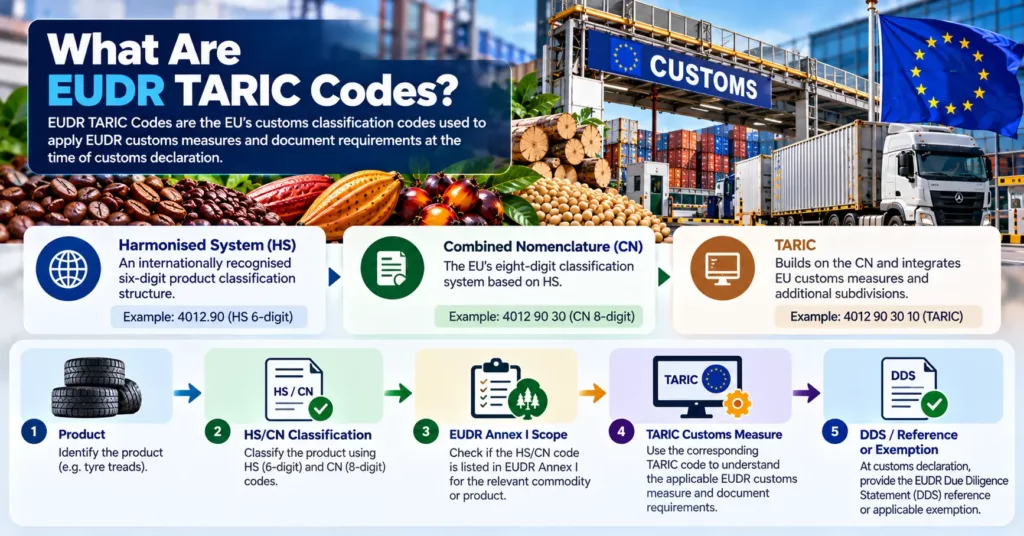
To understand EUDR TARIC Codes, it helps to separate three concepts: HS, CN and TARIC.
The Harmonised System (HS) provides the internationally recognised six-digit product classification structure. The EU then uses the Combined Nomenclature (CN), an eight-digit classification system based on HS. TARIC builds on the CN and integrates EU customs measures and additional subdivisions.
EUDR Annex I uses commodity and product classifications based on the customs nomenclature. TARIC then becomes important at the customs declaration stage because it applies the relevant EUDR customs measures and document requirements.
In simple terms:
Product → HS/CN classification → EUDR Annex I scope → TARIC customs measure → DDS/reference or applicable exemption.
Product classification is the first step in determining whether an EUDR obligation applies. Understand how HS/CN codes, Annex I and “ex” classifications determine EUDR product scope—and what businesses need to check before starting due diligence.
Why Do EUDR TARIC Codes Matter for Customs Clearance?
Customs classification is not only about calculating customs duty. The European Commission explains that classification is also used to determine whether non-tariff measures and import or export restrictions apply.
That makes classification an important EUDR control point.
Suppose a company imports a product whose CN classification falls within an EUDR Annex I heading. Customs systems can apply the corresponding EUDR measure. The declarant may then need to provide the appropriate EUDR document code and, where required, the relevant DDS reference number or declaration identifier.
If the declaration does not contain the required information or an applicable exemption is not correctly declared, the shipment can face a customs compliance issue.
The practical lesson is simple: EUDR due diligence and customs classification cannot be managed as completely separate processes.
EUDR compliance does not end with submitting a DDS. Understand how DDS reference numbers, declaration identifiers, CN/TARIC classification and EUDR information connect with customs declarations for relevant imports and exports.
EUDR TARIC Codes vs CN Codes: What Is the Difference?
A common source of confusion is treating a CN code and a TARIC code as the same thing.
The CN is the EU’s eight-digit customs classification system. TARIC integrates the CN with EU customs measures and can add further subdivisions and measure-related information.
For EUDR, this distinction matters because Annex I determines product scope, while TARIC helps implement the relevant customs control at the border.
For example, an “ex” entry in Annex I does not necessarily mean every product classified under the corresponding heading is covered. The product description and the precise scope wording matter.
The Commission’s September 2026 amendment is a good illustration. It replaced the broad EUDR entry “ex 4012” with “ex 4012 90 30 — Tyre treads.” This means businesses cannot simply look at a broad chapter or heading and assume every product is EUDR-relevant.
The Key EUDR TARIC Document Codes
The current TARIC implementation contains several document codes relevant to EUDR customs declarations.
C716 — DDS reference C716 is used where a Due Diligence Statement has been submitted. The relevant DDS reference number is provided with the document code.
C717 — Simplified Declaration Following the 23 September 2026 TARIC revision, C717 is used for the identification number of a Simplified Declaration submitted by a qualifying micro or small primary operator.
C720 and C725 — Downstream re-import These codes address specific re-import scenarios involving downstream operators, with C720 applying to non-SME downstream operators and C725 to SME downstream operators.
Y129 — “ex” products outside EUDR scope This is particularly important. An Annex I “ex” code may cover a wider group of products than the EUDR actually regulates. Y129 allows the declarant to indicate that the particular product is outside EUDR scope.
Y132 — Products covered by the relevant pre-application provision This addresses specified products produced before the relevant EUDR date.
Y133 — Used, waste, recovered or end-of-life materials This code covers specified products falling within the applicable EUDR exclusions for used, waste, recovered or end-of-life materials.
Other codes address specific situations such as samples/testing, packaging, medicinal products/correspondence and downstream export cases.
Example: A Rubber Product at Customs
Consider a company importing rubber products into the EU.
Its internal product database says “rubber product,” but that description is not enough to determine the EUDR customs treatment.
The company needs to establish:
1. What exactly is the product?
2. What is its EU CN classification?
3. Does the classification appear in EUDR Annex I?
4. If the Annex I entry is an “ex” code, does the product description actually match?
5. Is the product subject to the EUDR?
6. If yes, what DDS or declaration information is required?
7. If not, is an applicable TARIC exemption/document code required?
The 2026 Annex I amendment makes this especially important for rubber. For example, the EUDR entry for heading 4012 was narrowed to “ex 4012 90 30 — Tyre treads,” while other products under the former broader entry were removed from scope.
Example: Importing an EUDR-Relevant Product
Imagine a European importer buying coffee from Brazil.
Before the shipment arrives, the operator has completed its due diligence and submitted the DDS. The DDS receives a reference number.
At the customs stage, the importer or customs representative must ensure that the customs declaration contains the correct product classification and the applicable EUDR document information.
If the DDS exists but the customs declaration does not correctly connect the shipment to the required EUDR information, the compliance process can still break at the border.
What Happens When a Product Is Outside EUDR Scope?
This is where “ex” classifications become especially important.
Suppose an EU customs heading appears in Annex I, but the actual product does not match the specific product description covered by the EUDR. The business should not automatically submit a DDS simply because the broad CN heading appears in Annex I.
Instead, the declarant needs to establish the correct classification and determine whether the product is actually within scope. Where the applicable customs measure requires it, an EUDR-specific TARIC document code such as Y129 can be used to communicate that the product is outside the regulation’s scope.
This creates an important connection between product master data, regulatory scope and customs declarations.
Understand how EUDR Annex I, CN codes, product descriptions and “ex” classifications determine whether a product falls within scope.
EUDR customs controls apply to relevant import and export processes, but the customs classification format can differ.
For imports, EU customs declarations use the applicable TARIC classification. For exports, the relevant CN classification is used, with TARIC measures supporting the customs control.
The September 2026 TARIC implementation also introduced specific codes for certain downstream export and re-import scenarios.
This means companies should not build an EUDR customs workflow that only works for imports. Export processes need to be mapped separately, including the applicable EUDR role, product classification, DDS or simplified declaration status and customs document code.
What Should Companies Capture in Their EUDR Technology?
A technology system supporting EUDR customs compliance should connect, but not confuse, several data layers:
Internal product code
Product description
HS classification
EU CN code
Applicable TARIC information
EUDR Annex I scope
“ex” scope logic
EUDR role
DDS or Simplified Declaration
DDS reference or declaration identifier
Applicable exemption/document code
Shipment and customs declaration
This is important because a product classification can change. The September 2026 Annex I amendment demonstrates that companies relying on static spreadsheets or old product mappings can end up with outdated scope decisions.
A connected system can flag affected products when regulatory classification changes and help teams review the associated compliance workflow.
How TraceX Can Help
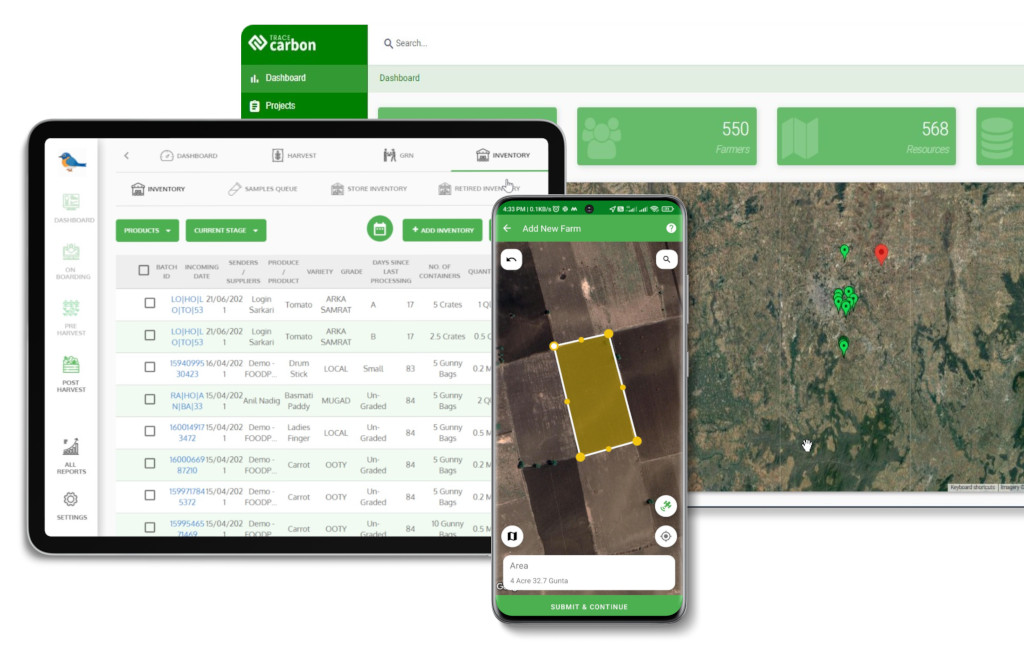
TraceX EUDR Solutions can help businesses connect EUDR product scope, supplier information, due diligence, traceability and customs-related compliance workflows.
Instead of maintaining one spreadsheet for HS/CN codes, another for EUDR scope and another for DDS references, businesses can create a connected product-to-compliance workflow.
A practical workflow can connect:
Product → CN classification → Annex I → EUDR scope → Supplier data → Geolocation → Risk assessment → DDS → Reference number → Shipment → Customs.
This becomes particularly valuable when Annex I changes, when products fall under “ex” classifications, or when companies manage large numbers of products and shipments.
The goal is not simply to know the TARIC code. It is to make sure the correct product, regulatory scope, due-diligence record and customs declaration are connected.
TraceX helps businesses connect product scope, supplier data, geolocation, risk assessment, traceability, DDS workflows and customs-related compliance information in one platform.
See how TraceX can help simplify EUDR compliance from product classification to customs clearance.
Before an EUDR-relevant shipment reaches customs, businesses should ask:
Is the product correctly classified under the EU CN?
Has the current EUDR Annex I been checked?
Does an “ex” description actually cover the product?
Is the correct EUDR role identified?
Has the required DDS or Simplified Declaration been submitted?
Is the correct reference number or declaration identifier available?
Is the appropriate TARIC document code known?
If the product is outside scope, is the applicable exemption/document code supported by evidence?
Are product, shipment and customs records linked?
Has the classification been checked against the current customs and EUDR rules?
Frequently Asked Questions
What are EUDR TARIC Codes?
They are customs-related TARIC document and measure codes used to implement EUDR requirements at the EU customs stage. They work alongside the product’s CN/TARIC classification.
Is TARIC the same as the EUDR HS code?
No. The EUDR product scope is based on the relevant customs nomenclature in Annex I. TARIC is the EU integrated tariff database that applies customs measures.
What is C716 in EUDR?
C716 is the TARIC document code associated with a submitted Due Diligence Statement; the applicable DDS reference number is provided with it.
What is C717 in EUDR?
Under the 23 September 2026 TARIC revision, C717 identifies the Simplified Declaration of a qualifying micro or small primary operator.
What is Y129 in EUDR?
Y129 is used for specified “ex” classifications where the particular product does not fall within EUDR scope.
Why are TARIC codes important for customs clearance?
They help customs systems apply and check the EUDR-related customs measures associated with the declared goods.
Does every EUDR product need C716?
No. The applicable document code depends on the transaction, role and whether a DDS, Simplified Declaration or an exemption applies.
Can an incorrect EUDR TARIC declaration cause customs problems?
Yes. If a required EUDR document code, reference or applicable exemption is missing or incorrect, the customs declaration may fail the relevant control.
Start using TraceX
Transparency, Trust, & Success for your Climate Journey.
We use cookies on our website to give you the most relevant experience by remembering your preferences and repeat visits. By clicking “Accept All”, you consent to the use of ALL the cookies. However, you may visit "Cookie Settings" to provide a controlled consent.
This website uses cookies to improve your experience while you navigate through the website. Out of these, the cookies that are categorized as necessary are stored on your browser as they are essential for the working of basic functionalities of the website. We also use third-party cookies that help us analyze and understand how you use this website. These cookies will be stored in your browser only with your consent. You also have the option to opt-out of these cookies. But opting out of some of these cookies may affect your browsing experience.
Necessary cookies are absolutely essential for the website to function properly. These cookies ensure basic functionalities and security features of the website, anonymously.
Cookie
Duration
Description
cookielawinfo-checkbox-analytics
11 months
This cookie is set by GDPR Cookie Consent plugin. The cookie is used to store the user consent for the cookies in the category "Analytics".
cookielawinfo-checkbox-functional
11 months
The cookie is set by GDPR cookie consent to record the user consent for the cookies in the category "Functional".
cookielawinfo-checkbox-necessary
11 months
This cookie is set by GDPR Cookie Consent plugin. The cookies is used to store the user consent for the cookies in the category "Necessary".
cookielawinfo-checkbox-others
11 months
This cookie is set by GDPR Cookie Consent plugin. The cookie is used to store the user consent for the cookies in the category "Other.
cookielawinfo-checkbox-performance
11 months
This cookie is set by GDPR Cookie Consent plugin. The cookie is used to store the user consent for the cookies in the category "Performance".
viewed_cookie_policy
11 months
The cookie is set by the GDPR Cookie Consent plugin and is used to store whether or not user has consented to the use of cookies. It does not store any personal data.
Functional cookies help to perform certain functionalities like sharing the content of the website on social media platforms, collect feedbacks, and other third-party features.
Performance cookies are used to understand and analyze the key performance indexes of the website which helps in delivering a better user experience for the visitors.
Analytical cookies are used to understand how visitors interact with the website. These cookies help provide information on metrics the number of visitors, bounce rate, traffic source, etc.
Advertisement cookies are used to provide visitors with relevant ads and marketing campaigns. These cookies track visitors across websites and collect information to provide customized ads.
Download the 2026 Traceability Scorecard and Benchmark Your Supply Chain Across 10 Critical Capabilities.
Download our eBook
Don’t Wait for an Audit to Find Your EUDR Gaps
The 2026 Simplification Package changes how HS codes, DDS pass-through and geolocation rules apply to you. Get the free guide and 20-point readiness checklist before enforcement catches you unprepared.